
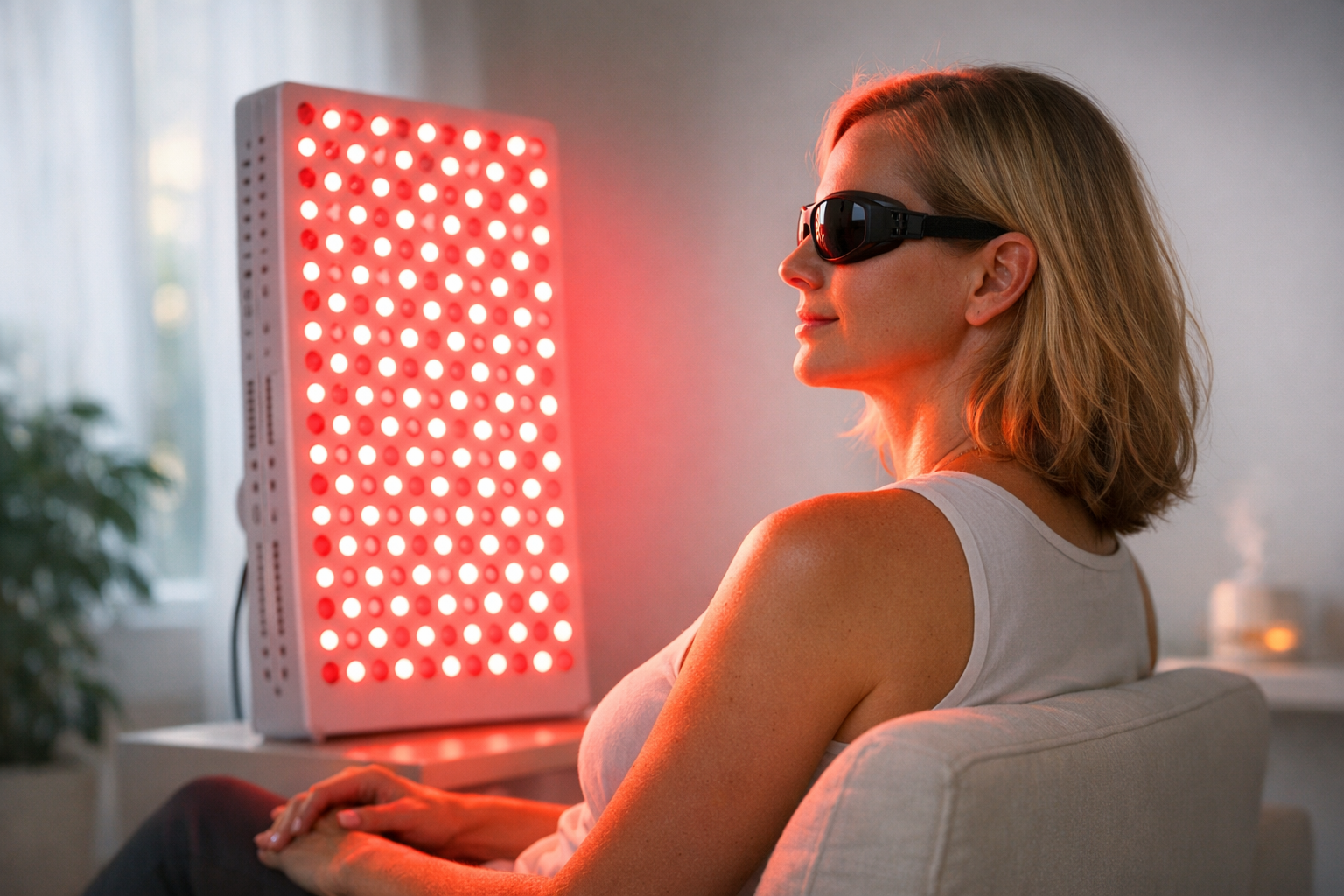
Few wellness categories generate the gap between promise and proof that red light therapy does. Walk through the marketing and you'll be told that shining red and near-infrared light on your body sharpens skin, regrows hair, melts fat, balances hormones, boosts testosterone, and "optimizes your mitochondria." Some of that is defensible. Most of it is not.
The underlying mechanism is real and has a proper name: photobiomodulation, sometimes still called low-level light or laser therapy. Red light in the roughly 630-660nm band and near-infrared around 810-850nm is absorbed by cytochrome c oxidase in the mitochondria, nudging cellular energy production and a cascade of downstream signaling. The problem is that a plausible mechanism is not the same thing as a proven outcome, and the industry has spent a decade collapsing that distinction. Our job here is to pull it back apart.
We've graded each application by how strong the human evidence actually is. This is our editorial judgment, not a marketing sheet, and it is deliberately unflattering where the data earns it.
Skin: wrinkles, collagen, photoaging – moderate evidence
This is the strongest consumer-facing case, and it's still only moderate. Multiple randomized, controlled human trials using combined red (around 633nm) and near-infrared (around 830nm) light over 10 to 30 sessions show measurable improvements: increased collagen density on ultrasound, reduced periocular wrinkle volume, and better skin texture and tone. The wrinkle reductions cluster around a quarter to a third – a small body of trials, but consistent enough that we're comfortable calling this a genuine effect rather than noise.
The honest caveats matter. Trials are typically small, run 4 to 15 weeks, and measure surrogate endpoints on a short horizon. Nobody has shown durable, years-long anti-aging benefit, and improvements almost certainly fade without ongoing use. Treat facial red light as a modest, cumulative cosmetic tool in the same conversation as a decent retinoid or consistent sunscreen – helpful, not transformative. This is the one area where a well-specified at-home device is a reasonable purchase for a realistic buyer.
Androgenetic alopecia – reasonable evidence
Pattern hair loss is the category with the cleanest regulatory and clinical footing. The FDA cleared the first low-level laser device for hair loss back in 2007, and clearance for numerous home-use combs, caps, and helmets has followed. Meta-analyses of randomized trials of these cleared devices find a real, statistically significant increase in hair density for both male and female pattern loss, with some head-to-head data putting the effect in a similar ballpark to topical minoxidil over roughly 24 weeks.
We'd still stop short of calling it definitive. Many trials are short, follow-up is limited, and a chunk of the supporting literature is manufacturer-adjacent. But among all the claims made for red light, "it modestly slows and partially reverses early androgenetic alopecia in consistent users" is one of the better-supported. As a low-risk adjunct to established treatments, it's defensible. As a standalone miracle cure, it isn't.
Musculoskeletal pain and recovery – mixed evidence
Here the picture fragments. For delayed-onset muscle soreness, the pooled evidence is genuinely encouraging: red-to-near-infrared light shows moderate-to-large effects on reducing soreness and restoring muscle strength in the days after hard exercise. For joint pain, particularly knee osteoarthritis, meta-analyses report meaningful pain reduction versus sham – but the certainty of that evidence is repeatedly graded as low to very low, and results swing dramatically with treatment protocol. Some analyses find benefit only at specific session frequencies and none at others.
That volatility is the tell. When an intervention "works" only under narrow, inconsistent conditions across trials, the honest reading is that dose and protocol are doing heavy lifting that the marketing never mentions. There's a signal here for recovery and some chronic joint pain, but it's not the reliable, universal analgesic that recovery-focused wearables imply.
Wound healing – real, but clinical only
In controlled clinical contexts, low-level laser therapy has shown it can accelerate closure, reduce infection, and cut pain for certain surgical and mucosal wounds. But the wider literature is inconsistent, largely because "wounds" is an enormously heterogeneous category and well-controlled trials are scarce. This is a clinician-supervised application, not a use case for a consumer panel. If you have a wound that needs treating, that's a conversation with a clinician, not a purchase decision.
Acne – partial, and mostly a blue-light story
Light therapy for acne has decent supporting data, but it's important to be precise about which light. The bulk of the effect comes from blue wavelengths targeting the bacteria implicated in acne, often paired with red light for its anti-inflammatory contribution. Published reviews report high rates of partial improvement, but most trials are small, under 12 weeks, and carry a high risk of bias. Red light alone is a supporting player here, not the star, and results are milder and slower than prescription options.
The claims with no credible evidence
This is where the category earns its skepticism, and we're not going to soften it.
Fat loss and body contouring. The trials showing "inch loss" around the waist and thighs are overwhelmingly funded by the device manufacturers themselves, measure tape-measure circumference rather than actual fat mass or weight, and describe small, transient changes. There is no credible evidence that red light melts fat or drives meaningful, lasting weight change. Treat any "red light for fat loss" pitch as marketing.
Testosterone and hormones. The testosterone claims lean on animal studies of Leydig cells and on human work that measured sperm motility – a completely separate outcome from hormone levels – using lab-grade equipment, not consumer gadgets. There is no reliable human evidence that shining light on yourself raises testosterone. Broader "hormone balancing" claims have essentially no support.
Thyroid. A small number of trials in autoimmune thyroid disease have reported lower medication needs, and some – though not all – reported reduced antibody levels. That's intriguing and worth watching, but it's early, small-scale, inconsistent, and nowhere near strong enough to act on outside a clinical study. It is not a reason to buy a home device.
General "energy," "wellness," and "mitochondrial optimization." A single small crossover study found a roughly 9% acute rise in resting energy expenditure after a 12-minute red and near-infrared exposure – and only in women with obesity, not normal-weight participants. It's a transient physiological blip, not evidence of any lasting metabolic upgrade. The gap between that finding and the "optimize your mitochondria" marketing is the entire problem with this category in one example. No credible evidence supports red light as a general energy, longevity, or wellness intervention.
If you value knowing exactly what your health tech can and can't substantiate, this is the same lens we apply to blood pressure watches and what to actually trust and to any health-monitoring wearable making bold physiological claims.
The parameters that actually matter
Most consumer confusion dissolves once you understand that dose is everything, and that more is not better. Photobiomodulation follows a biphasic dose response – the Arndt-Schulz curve. Too little light does nothing; an optimal middle dose produces the benefit; too much can flatten or even reverse it. A device that's simply brighter or used longer is not automatically more effective, and can be less.
Four parameters define a treatment. Wavelength: red around 630-660nm for surface tissue like skin, near-infrared around 810-850nm for deeper penetration. Irradiance: the power density actually reaching your skin, which falls off sharply with distance. Dose: irradiance multiplied by time, the number that actually matters and the one marketing almost never publishes honestly. And consistency: every credible protocol relies on repeated sessions over weeks, not one-off use. A device that won't tell you its wavelengths and irradiance at a stated distance has made it impossible for you to know your dose – which tells you plenty.
Safety
Red and near-infrared light therapy is low-risk when used sensibly, but "low-risk" is not "no-risk." Protect your eyes; direct near-infrared exposure to the retina is a real hazard, and reputable panels ship with goggles for a reason. These devices produce heat, and burns are possible with too-close or too-long exposure, especially with high-output panels. Photosensitizing medications, active skin cancers, and pregnancy are reasons to be cautious and check with a clinician first. And because of that biphasic curve, resist the instinct to overdo it – longer and closer is not a shortcut to better results.
How to tell a credible device from hype
The market is flooded, and the tells are consistent.
Credible signs: published, specific wavelengths (not just "red light"), a stated irradiance at a defined distance, third-party or independent testing, FDA clearance for a specific indication where one exists, and realistic, narrow claims. A serious hair device references its clearance; a serious skin panel tells you its numbers.
Hype signs: sweeping, cross-body claims (skin and hair and fat and hormones and energy from one gadget), no published irradiance, "proprietary" wavelengths, before-and-afters in place of parameters, and testimonial volume standing in for trials. As a rough rule: the wider the claims, the thinner the evidence behind them.
A note on form factor, since this is our home turf. Masks and wraps can deliver adequate dose to a fixed, close-contact area like the face, and that's a legitimate design. Wrist-worn or small wearable-format red light devices are a harder sell – the emitter area is tiny, the delivered dose to any meaningful tissue volume is low, and the systemic "wellness" benefits they tend to advertise are exactly the claims with the least support. We're bullish on wearables that measure your physiology; we're skeptical of tiny wearables that claim to therapeutically re-engineer it. That distinction is the same reason we push readers toward understanding what a tracker genuinely measures versus what it infers, and why we favor tools with real, checkable evidence behind them like the OTC glucose biosensors we've examined.
Bottom line
Red light therapy is neither a hoax nor a panacea. Strip away the marketing and you're left with a genuine physiological tool that has moderate evidence for facial skin aging, reasonable evidence for pattern hair loss, mixed but real signal for muscle recovery and some joint pain, and a clinical role in wound healing and acne. That's a respectable, narrow list.
Everything past that list – fat loss, testosterone, hormone balancing, general energy, at-home mitochondrial "optimization" – is where the evidence runs from thin to absent, and where the industry does most of its selling. It's worth trying if you're a realistic buyer targeting one of the supported uses, you pick a device that publishes real wavelength and irradiance specs, and you commit to consistent sessions with modest expectations. If you're buying it to fix your metabolism or your hormones, you're buying the hype, not the science. And for anything you'd consider treating, the right first move is still a conversation with a clinician.