
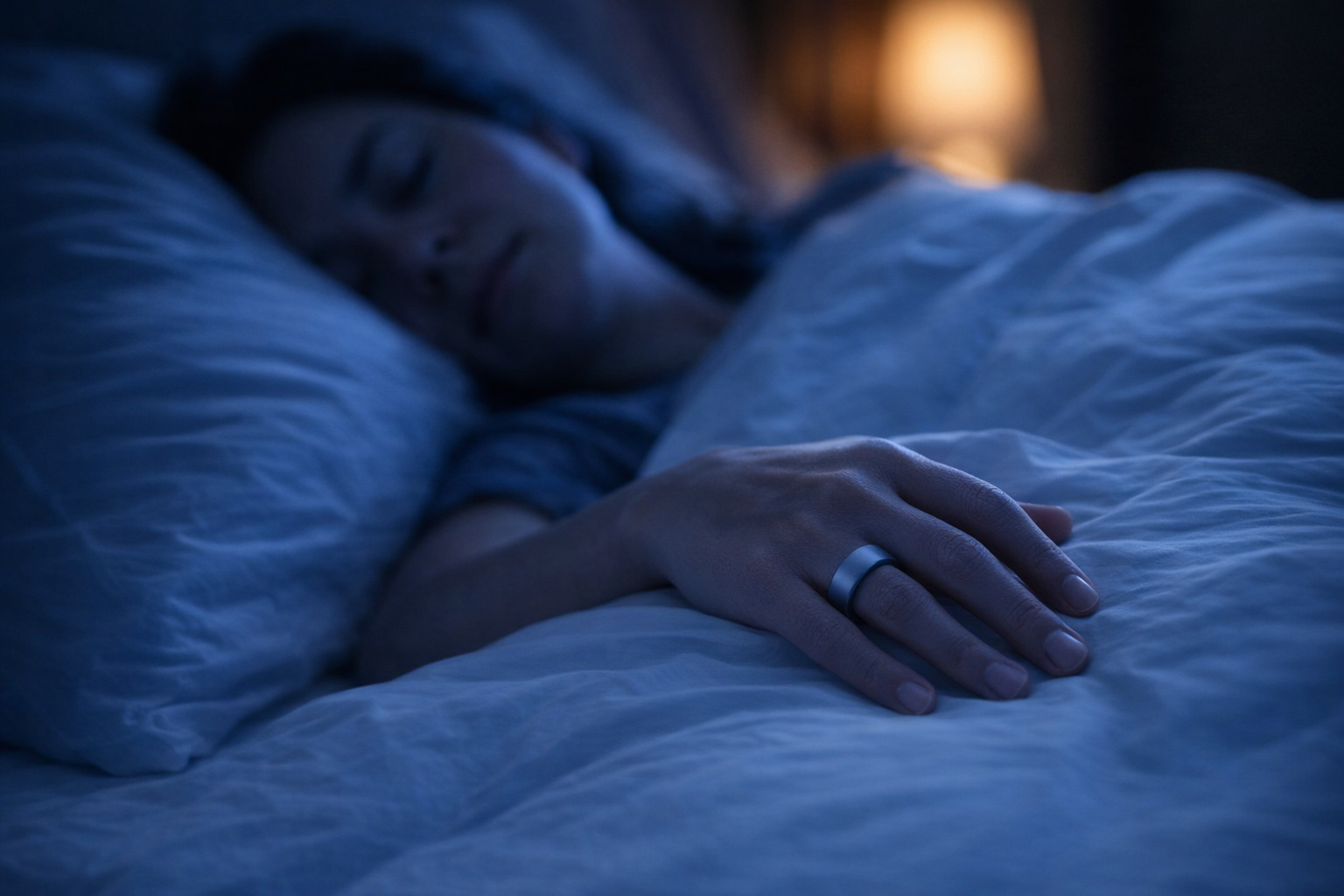
Open your sleep app in the morning and you get a tidy coloured chart: a band of light sleep, a block of deep, a scattering of REM, all timed to the minute. It looks like a readout from a hospital. It isn't. Your watch or ring never saw a single brain wave. It watched how much you moved, how your heart beat, how you breathed, and – on some devices – how warm your skin got, then it guessed the rest.
That doesn't make the number on your wrist useless. But it does mean the honest question isn't "how much deep sleep did I get?" It's "how much should I trust this breakdown, and what is it actually good at?" To answer that, you need to know two things: what the sleep stages really are, and how the gadget on your wrist tries to reconstruct them without the equipment a sleep lab uses.
The Four Stages of Sleep
Sleep isn't a single flat state. Your brain moves through four distinct stages, grouped into non-REM (stages N1, N2 and N3) and REM. Each looks different on an EEG and does a different job.
N1 – the doze. This is the brief handoff from awake to asleep, when your muscles start to relax and your heart rate and breathing slow. It's easy to wake from, and it accounts for only about 5% of a typical night. If someone nudges you here, you might swear you were never asleep at all.
N2 – the workhorse. N2 is the baseline of sleep and where you spend the most time: roughly half the night. Your body temperature drops, your heart rate settles, and your brain fires off bursts of activity called sleep spindles and K-complexes that help consolidate memory and keep you from waking at every small noise. N1 and N2 together are what trackers lump under "light sleep."
N3 – deep sleep. Also called slow-wave sleep, after the large, slow delta waves that dominate the EEG here. This is the physically restorative stage: tissue repair, immune activity, and growth hormone release cluster in N3, and it's the hardest stage to be woken from. In most healthy adults it makes up somewhere in the region of 13–23% of the night, and – this matters for what follows – the great majority of it happens in the first few hours after you fall asleep.
REM – the dreaming stage. Rapid eye movement sleep is when the brain lights up almost as if it were awake, vivid dreaming happens, and your body is temporarily paralysed so you don't act those dreams out. REM is tied to emotional processing and memory, and it makes up around a quarter of adult sleep. Unlike deep sleep, REM is back-loaded: your longest REM stretches come in the final hours before you wake.
How a Night Actually Fits Together
You don't march through those stages once in order. You cycle through them repeatedly. A full cycle runs roughly 90 minutes – anywhere from about 70 to 120 – and you'll complete four to six of them in a normal night, typically climbing from light to deep and back out to REM before starting again.
The crucial detail is that the mix shifts as the night goes on. Deep sleep dominates the early cycles and then all but disappears; REM barely registers in your first cycle but stretches longer with each one, so your last cycle before waking can be REM-heavy. This is why cutting a night short by two hours doesn't cost you two hours evenly – it robs you disproportionately of REM. It's also why the shape of your night, not just the total, is what a tracker is trying to draw when it builds that stacked-bar "hypnogram."
The Gold Standard: What a Sleep Lab Measures
To score sleep stages properly you have to watch the brain directly. That's what polysomnography (PSG) – an overnight sleep study – does. Electrodes record brain activity (EEG), eye movements (EOG) and muscle tone (EMG), alongside heart rate, blood oxygen, airflow and breathing effort. A trained technician then reads the night in 30-second chunks and labels each one as wake, N1, N2, N3 or REM.
Two things about PSG are worth holding onto. First, the stages are defined by brain and eye signals – spindles, delta waves, the REM eye flicks – not by heart rate or movement. Second, even this gold standard isn't perfectly objective: when two expert scorers read the same night, they agree only about 83% of the time. Sleep staging is interpretation, not a physical constant. That 83% ceiling is the yardstick any wearable should be measured against – not an imaginary 100%.
What Your Tracker Actually Measures
Here's the gap. A wrist wearable or smart ring has no EEG, no electrodes on your face, nothing reading your brain. What it does have is:
- An accelerometer that tracks movement and stillness – the modern descendant of decades-old "actigraphy" used to separate sleep from wake.
- An optical heart-rate sensor (PPG), the green LEDs on the back, which measure your pulse and, from the beat-to-beat spacing, your heart-rate variability (HRV).
- Respiratory rate, usually inferred from the same optical or motion data.
- Skin temperature, on devices like the Oura Ring 4 and many recovery bands.
None of those signals is a sleep stage. But they correlate with them: your heart rate and its variability, your breathing and your movement all shift in characteristic ways between deep sleep, REM and wake. So the device feeds those proxies into an algorithm – increasingly a machine-learning model trained against real PSG recordings – and outputs its best statistical guess at which stage you were in. That's the same basic recipe whether you wear an Apple Watch, a Fitbit, a Garmin, or a screenless recovery band like Whoop. The differences between brands come down to sensor quality and, above all, how good the algorithm is.
So How Accurate Is the Breakdown?
It depends entirely on what you're asking the device to tell you, and the honest answer splits in two.
Sleep versus wake: pretty good. At the simple job of deciding whether you were asleep or awake, modern wearables land somewhere around 86–89% agreement with PSG, and their sensitivity to sleep is often 95% or higher. Total sleep time and bedtime/wake time are the numbers you can lean on most.
The four-stage breakdown: shakier. Ask a device to sort the night into light, deep, REM and wake, and agreement with the lab typically falls to somewhere in the 50–65% range. In a 2024 Brigham and Women's Hospital study published in Sensors, the Oura Ring – one of our best smart rings of 2026 – came out best of the three devices tested, reaching about 76% agreement with PSG – remarkably close to that 83% human ceiling – versus a lower score for the Apple Watch and lower still for the Fitbit Sense. Oura's deep-sleep detection was the standout at roughly 80% sensitivity, while the Apple Watch caught only about half of true deep sleep – in the same study it padded light sleep by around 45 minutes yet undercounted deep sleep by roughly 43 minutes.
Two systematic quirks show up across the research. Devices tend to overestimate how much you slept, because lying still and calm in bed looks a lot like sleep to an accelerometer even when you're awake – which is why they're weaker at catching wake than sleep. And stage-level errors are common enough that the exact "1h 12m of deep sleep" figure should be read as a rough estimate, not a measurement. Accuracy is also improving fast: because the algorithms are trained on PSG data, newer models on the same hardware can score noticeably better than the ones they shipped with.
What to Trust, and What to Ignore
The practical takeaway is to read your tracker for trends, not absolutes. The single-night deep-sleep number carries a real margin of error, so obsessing over whether you hit some target is chasing noise. What holds up is the pattern over weeks: are you sleeping longer, more consistently, waking less? Those are the signals worth acting on.
A few rules of thumb:
- Trust duration and consistency more than the stage pie chart. How long and how regularly you slept is the device's strong suit.
- Compare yourself to yourself, not to a "normal" chart. Healthy stage percentages vary a lot between people and shrink with age; your own baseline is the useful reference.
- Treat deep and REM figures as directional. A run of unusually low deep sleep might be worth noting; a single low night probably isn't.
- Remember the device can't diagnose anything. Persistent bad sleep, loud snoring or gasping, or crushing daytime fatigue are reasons to see a doctor, not to buy a better ring. If your tracker won't even log a night, that's a hardware or setup problem – our sleep-tracking troubleshooting guide is a better first stop than the panic button.
When Tracking Backfires: Orthosomnia
There's a failure mode worth naming. Sleep clinicians have coined the term orthosomnia – first described in a 2017 case series – for people whose pursuit of perfect sleep scores actually makes their sleep worse. The anxiety of checking a nightly grade, and of trying to engineer more "deep sleep," feeds the very wakefulness the number is measuring.
It isn't a fringe problem. A 2024 survey of 523 adults put the prevalence somewhere between 3% and 14% depending on how strictly it was defined, and the effect skews young: in one dataset roughly a quarter of 18-to-35-year-olds said sleep apps stressed them out about their sleep, versus a tiny fraction of over-65s. If your tracker is making you dread bedtime, the healthiest thing it can do is spend a few nights in a drawer.
The Bottom Line
Light, deep and REM are real, distinct, and important – deep sleep rebuilds the body, REM tends the mind, and both are front- or back-loaded across a night built from repeating 90-minute cycles. But the colour-coded breakdown your wearable serves up isn't a brain scan; it's a well-educated inference drawn from your pulse, your movement and your breathing. The best devices, led by the smart rings, now get impressively close to what a human scorer would call it – and even the good ones are far more reliable at "you slept seven hours" than at "you got exactly 94 minutes of deep sleep." Use it to spot patterns, nudge your habits, and know when to see a professional. Just don't mistake the estimate for the EEG. If you're shopping for a device where sleep is the priority, our roundup of the best fitness trackers of 2026 breaks down which form factor gets it right.