
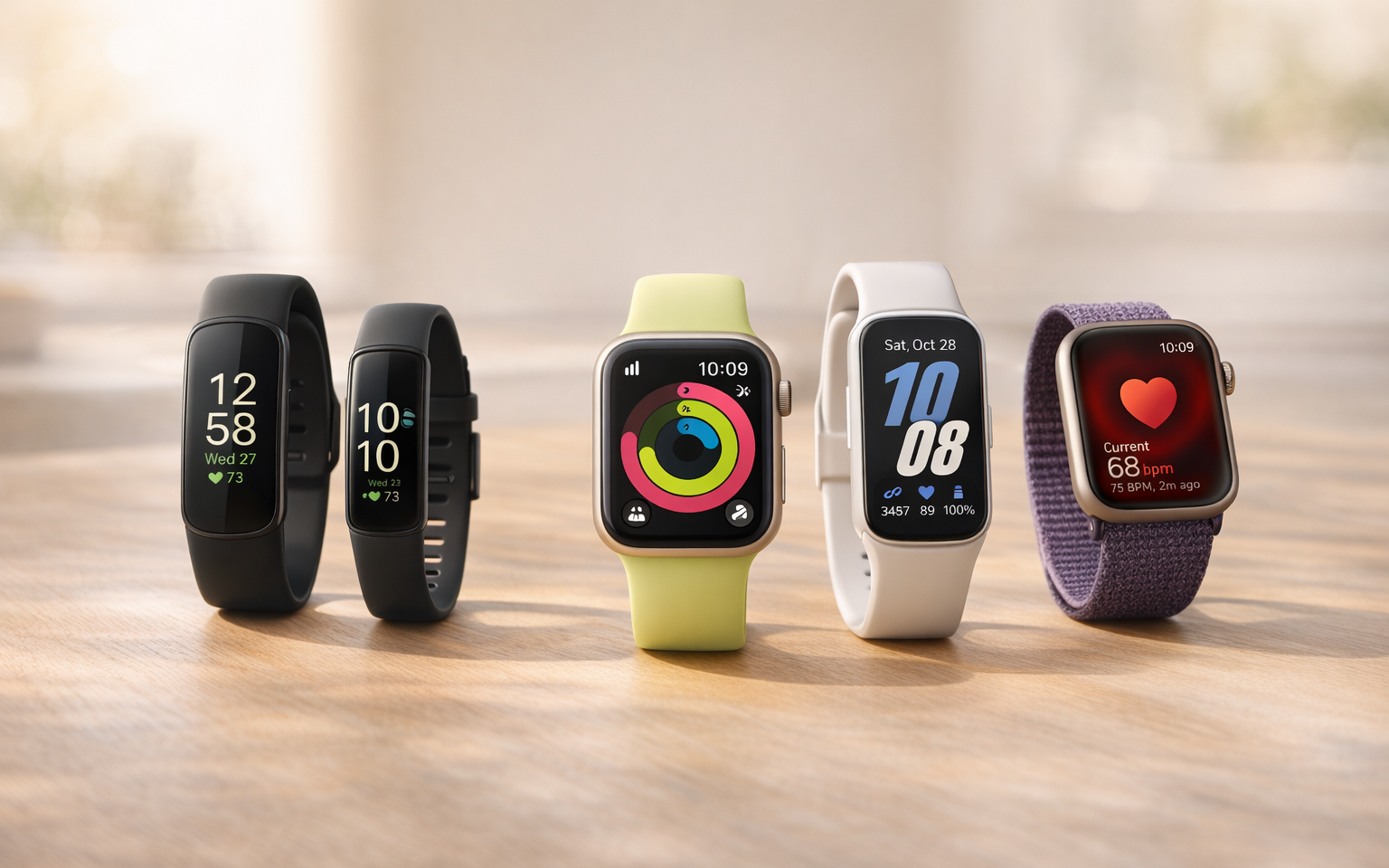
A fitness tracker should make life easier, not add another confusing gadget to charge and decode. This guide is for older adults – and the family members helping them choose – who want the essentials done well: clear step counts, heart rate, sleep, a screen you can actually read without squinting, and ideally a way to call for help after a fall. We skipped the feature-stuffed flagships aimed at marathoners and focused on trackers that are genuinely simple to live with.
Two tradeoffs drive almost every decision here. The first is simplicity versus features: the watches with medical-grade heart tools and fall alerts cost more and ask a little more of you at setup, while the simplest bands do less but never get in the way. The second is screen and safety versus battery and bulk: bright, easy-to-read displays and fall detection tend to need charging every day or two, whereas the lightest, longest-lasting picks drop those features. For most seniors using an iPhone, the best fitness tracker for seniors is the Apple Watch SE 3 – it pairs the clearest safety net with the gentlest learning curve. If that's not your phone or your budget, the other five picks each own a specific job.
Apple Watch SE 3 – Best Overall for iPhone Users
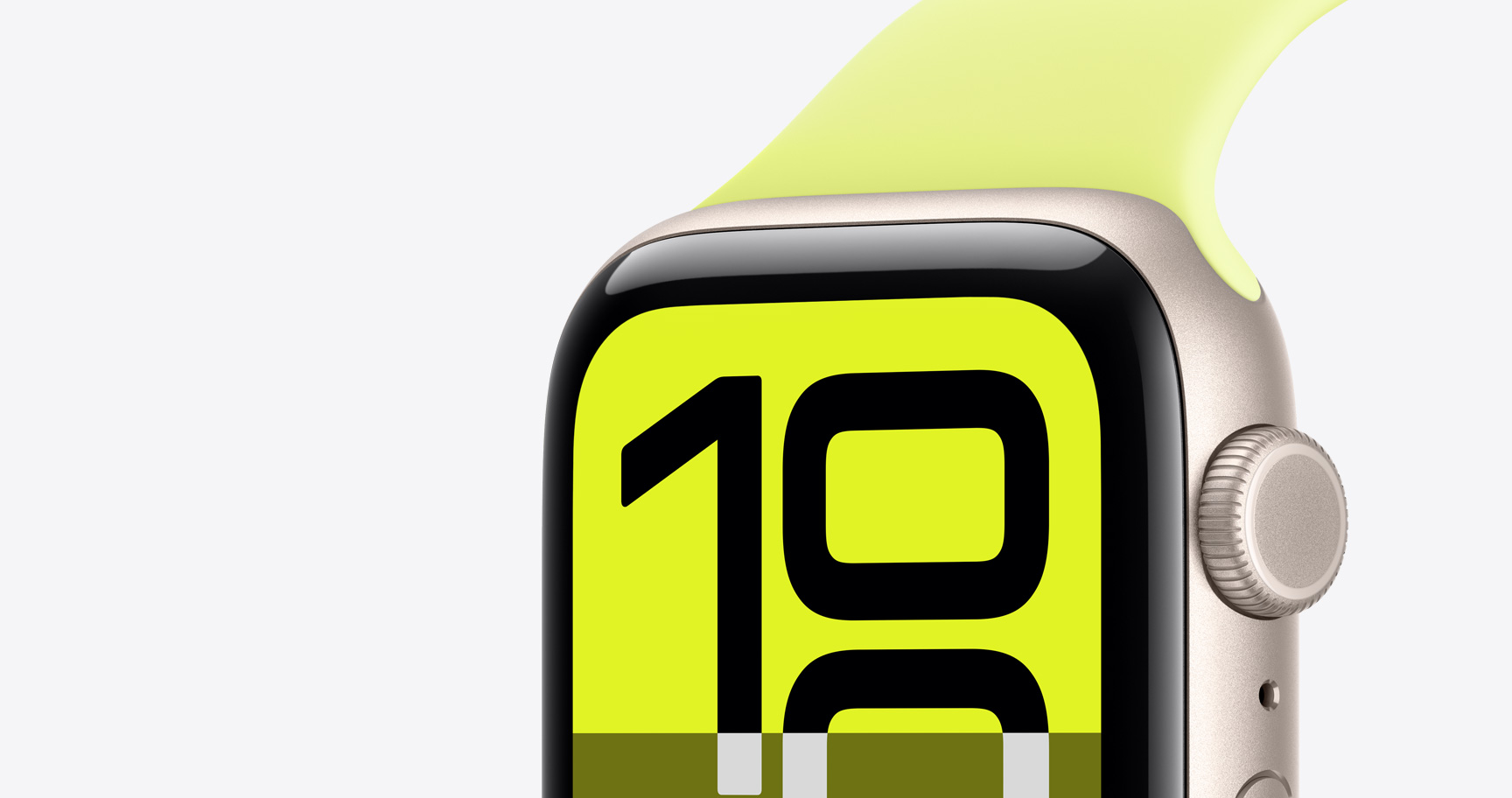
The Apple Watch SE 3 is the one to get if there's an iPhone in the house. It's the only pick here that combines Fall Detection, Crash Detection, and Emergency SOS in one device – if it senses a hard fall and you don't respond, it calls emergency services and notifies your chosen contacts automatically. For a senior living alone, that safety net is the whole argument. Setup is the easiest in the category: it tracks the iPhone's setup flow step by step, and the large, bright Retina display shows big, legible text and tap targets.
Everything else is the reliable Apple baseline – accurate heart rate, sleep tracking, step counts, and a watch face you can customize to show only what matters. It starts at $249 for the 40mm model. If fall detection is your main reason for buying, it's worth walking through our Apple Watch fall detection setup guide before you rely on it, since it has to be switched on and configured for your age group.
The caveat is firm: it only works with an iPhone, and it needs charging roughly every day. For an iPhone owner that's a minor habit; for an Android household it's a non-starter, and you should look further down this list.
Samsung Galaxy Fit 3 – Best Budget and Biggest Screen for the Money
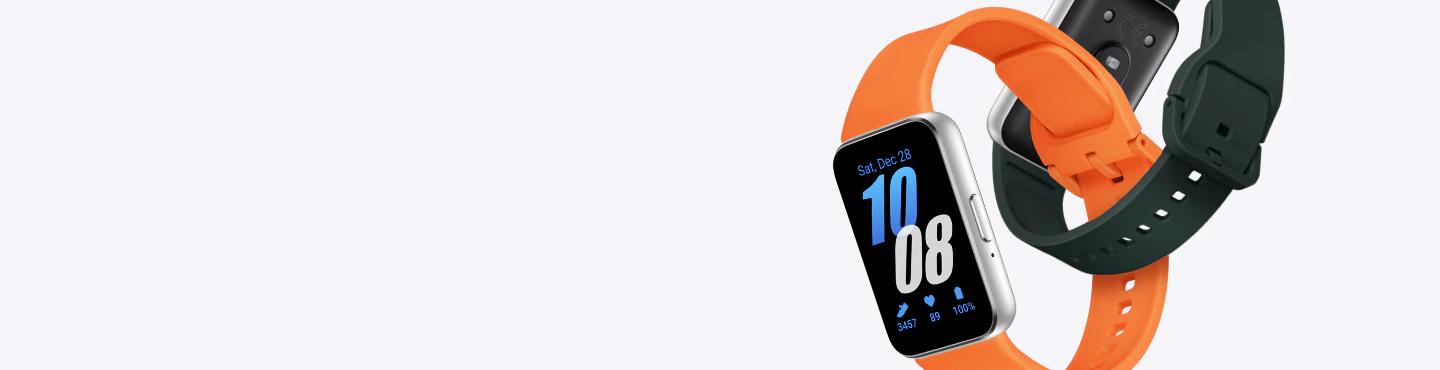
At around $60, the Samsung Galaxy Fit 3 is the value standout, and it earns the title of biggest readable screen per dollar. Its 1.6-inch AMOLED display is larger than what you'll find on bands costing twice as much, with text big enough to read at a glance – a real advantage for anyone who finds tiny tracker screens frustrating. It's light, comfortable for all-day and overnight wear, and runs about 13 days per charge, so charging is a roughly twice-a-month chore rather than a nightly one.
It also includes fall detection, which prompts to call for help when it senses a hard fall – a rare feature at this price. Just know it isn't automatic out of the box, though: like most trackers, it has to be switched on in the Galaxy Wearable app first, so set it up before relying on it. That makes it the obvious budget choice for safety-minded buyers who can't justify a $249 watch.
Two caveats. It has no built-in GPS – it borrows your phone's GPS on a walk, so you'll need your phone with you to map a route. And it leans toward Android; it works best paired with a Samsung or Android phone rather than an iPhone. If you're weighing it against the simplest Fitbit, our Galaxy Fit 3 vs Fitbit Inspire 3 comparison breaks down which budget band suits you.
Fitbit Charge 6 – Best Simple Fitness Band

The Fitbit Charge 6 is the friendliest on-ramp to fitness tracking for someone who's never used one. The Fitbit app remains the most approachable in the category – big numbers, plain-English summaries, gentle encouragement rather than data overload. The bright AMOLED screen is clear, and at around $160 it adds genuinely useful tools: built-in GPS so you can leave your phone at home on a walk, an ECG for spot-checking heart rhythm, and roughly 7 days of battery between charges.
This is the pick for the senior who wants to build a daily-steps habit without a learning curve, and who values an easy app over a long feature list. It's a band, not a watch, so it sits light and unobtrusive on the wrist.
Two things to know. It does not have fall detection – if automatic fall alerts are a priority, choose the Apple Watch SE 3 or Galaxy Fit 3 instead. And some of the deeper insights sit behind a Fitbit Premium subscription, while the account now runs through Google, so expect a Google sign-in during setup.
Garmin Vivoactive 6 – Best for Active Seniors
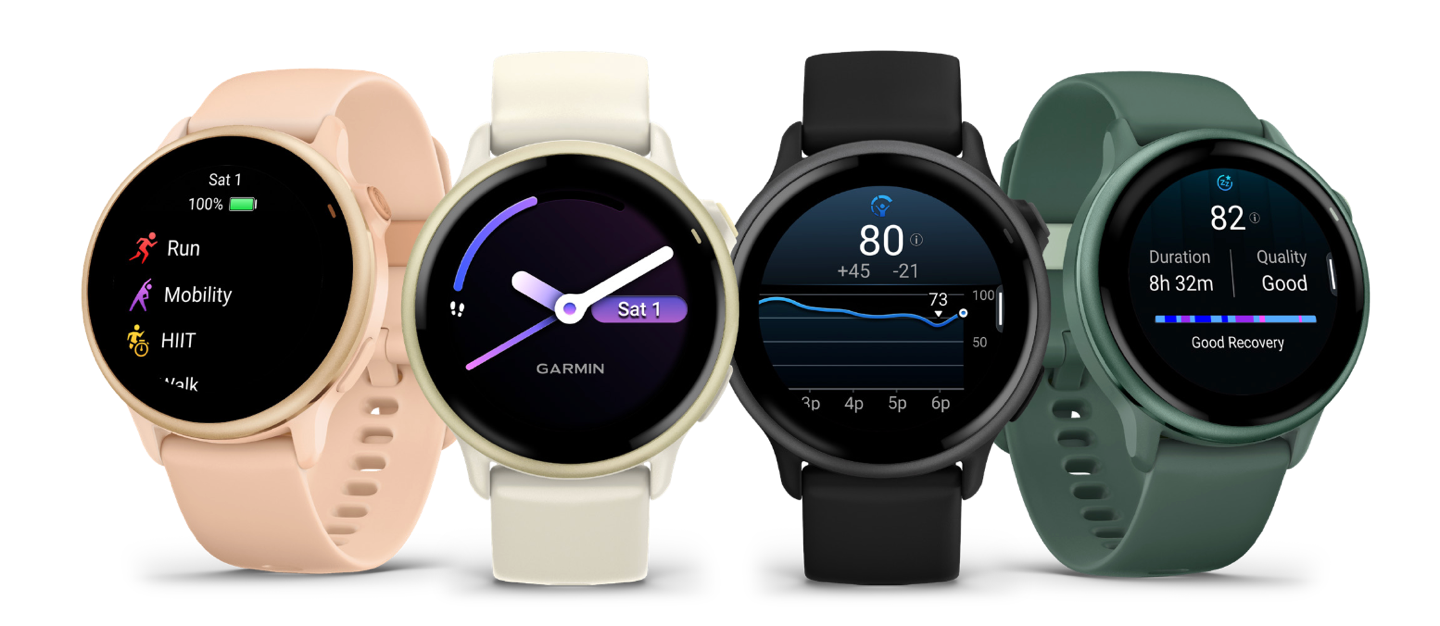
For the senior who's still hiking, cycling, gardening for hours, or walking serious distances, the Garmin Vivoactive 6 is the best fit for an active lifestyle. It has a large, bright AMOLED display, a deep set of built-in sports profiles, and roughly 11 days of battery – long enough that charging never interrupts your week. Crucially, Garmin gives you its full slate of health data without any subscription, which appeals to anyone tired of monthly fees.
It also offers incident detection: during certain outdoor GPS activities, if it senses a hard impact and your phone is connected, it can text your location to chosen contacts. That's a meaningful safety feature for solo walkers and cyclists – but note it's tied to tracked outdoor activities, not the all-day, anywhere fall detection that the Apple Watch provides.
The caveats are price and depth. At about $300 it's the second-most expensive pick, and the Garmin Connect app has a learning curve – it rewards people who enjoy digging into their numbers and can frustrate those who don't. An active, reasonably tech-comfortable senior will love it; a tech-averse one should look elsewhere.
Withings ScanWatch 2 – Best for Heart-Health Monitoring
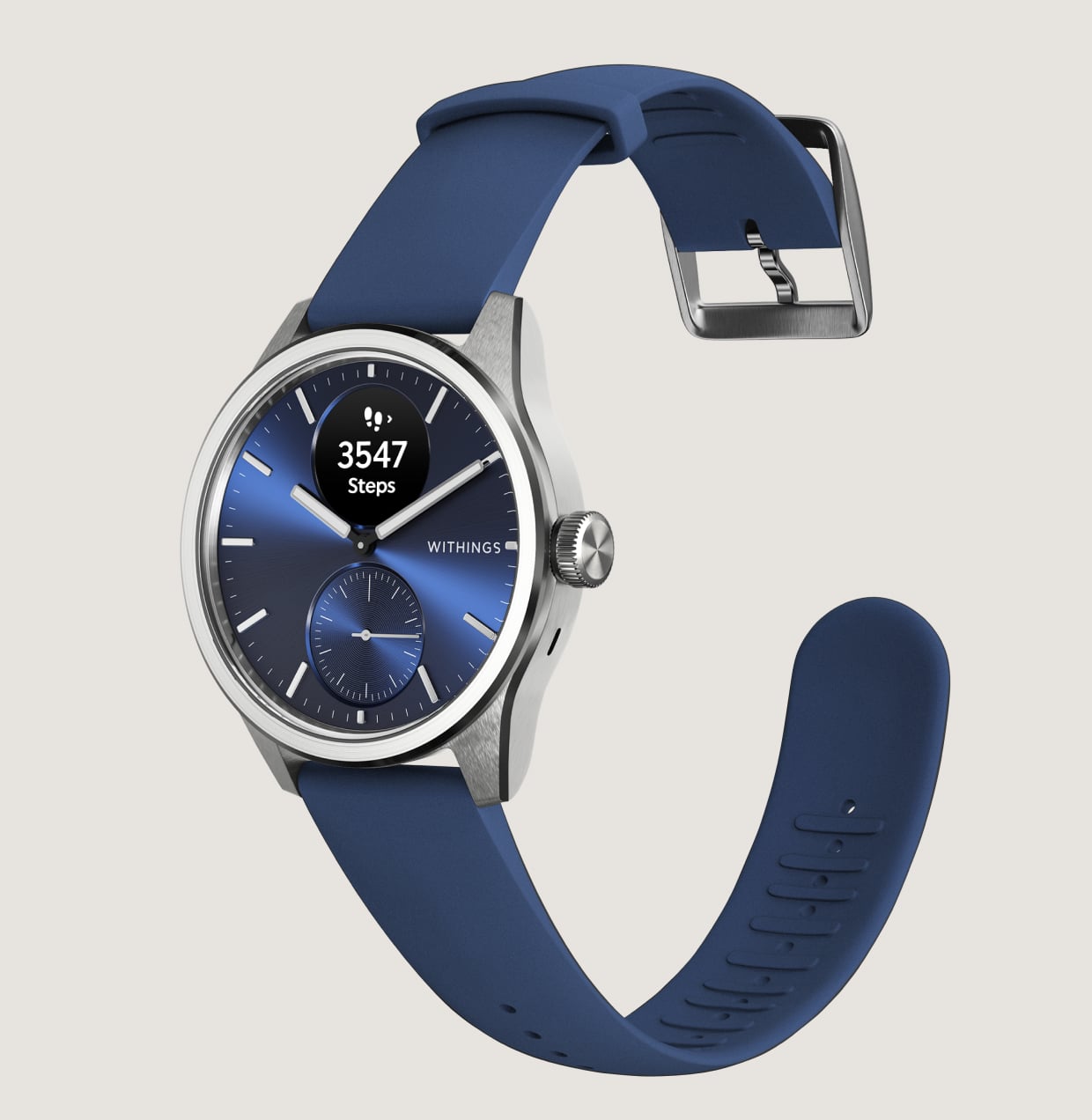
If heart health is the reason you're shopping, the Withings ScanWatch 2 is the standout. It packs a medical-grade ECG with AFib detection, SpO2, and continuous temperature tracking into a watch that looks like an ordinary, elegant analog timepiece – a real hybrid dial with hands, not a screen pretending to be a watch. For a senior who finds smartwatches garish or fiddly, this is the one that simply looks like a nice watch and happens to keep tabs on the heart.
Its other party trick is battery: around a month per charge – up to 35 days – which effectively removes charging from your routine entirely. That alone makes it a strong fit for anyone who'd otherwise forget to plug a device in nightly. It runs about $370.
Two caveats. It's the priciest pick here, and the small digital sub-display shows only brief readouts – this is a watch for people who want serious heart data and a classic look, not a big, scrollable touchscreen. Treat its readings as a useful early-warning tool to discuss with a doctor, not a diagnosis.
Fitbit Inspire 3 – Best Ultra-Simple and Lightweight
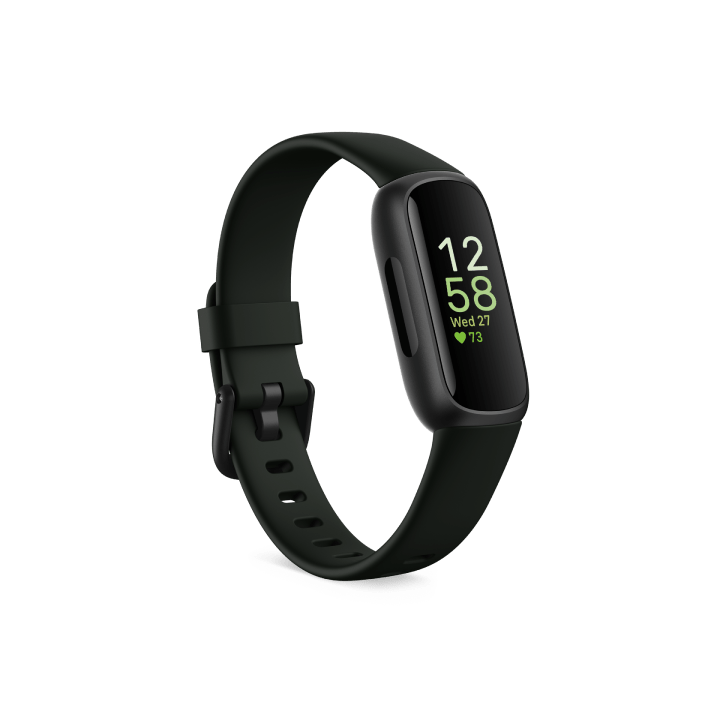
When the goal is "as simple and unintimidating as possible," the Fitbit Inspire 3 wins. It's tiny and featherlight – you forget it's on your wrist – with a small color AMOLED screen, around 10 days of battery, and the same friendly Fitbit app as the Charge 6. There's almost nothing to learn: it counts steps, tracks heart rate and sleep, and stays out of the way. At about $100, it's the gentlest possible introduction to tracking for someone who's resisted wearables until now.
This is the pick for the tech-averse parent or grandparent, or for anyone who wants the basics and nothing more. It's also the most comfortable option for thin wrists and overnight sleep tracking.
The tradeoffs follow from its simplicity: no GPS, no ECG, and no fall detection, and the screen is the smallest in this guide, so text is more compact than on the Galaxy Fit 3 or Charge 6. If you want a bigger display for the same kind of money, the Galaxy Fit 3 is the alternative to weigh.
How We Chose
Our criteria for this guide are senior-specific, and they're not the same priorities we'd use for an athlete's tracker.
- Readability first. Big, bright screens with legible text matter more than resolution specs. A tracker you have to squint at won't get used.
- Simplicity of setup and daily use. The best pick is the one a non-technical person can set up once and never wrestle with again. Friendly apps and clear watch faces outrank long feature lists.
- Fall detection and emergency SOS. For anyone living alone or at risk of falls, automatic help is the single most valuable feature – so we're precise about which devices truly offer it and which don't.
- Battery life and charging hassle. Frequent charging is the most common reason trackers end up in a drawer. Longer battery life is a genuine accessibility feature, not a luxury.
- Comfort and weight. All-day and overnight wear only happens if the device is light and unobtrusive.
- Honest value. We weighed price against what each device actually delivers for an older adult, not against spec-sheet bragging rights.
For a wider view beyond seniors, our best fitness trackers of 2026 roundup covers the full category.
Who Should Buy What
- The iPhone owner who wants a safety net: Apple Watch SE 3. The combination of fall detection, crash detection, and emergency SOS with effortless iPhone setup is unmatched here.
- The budget-minded buyer who still wants safety and a big screen: Samsung Galaxy Fit 3. Fall detection and the largest readable display in the guide for around $60.
- The first-timer building a steps habit: Fitbit Charge 6. The easiest app to learn, with built-in GPS and ECG if you grow into them.
- The still-active hiker, cyclist, or all-day gardener: Garmin Vivoactive 6. Long battery, deep activity tracking, subscription-free data, and incident alerts on outdoor workouts.
- The heart-health-focused buyer who wants a classic look: Withings ScanWatch 2. Medical-grade ECG and AFib detection in an elegant analog watch you charge about once a month.
- The tech-averse minimalist: Fitbit Inspire 3. Featherlight, dead simple, and the least intimidating way into tracking at all.
What To Avoid
A few categories tend to disappoint older buyers, no matter how good the deal looks.
- Flagship smartwatches with cramped interfaces. The most advanced multisport watches pack dozens of menus and tiny text into a small screen. The power is wasted if the basics are hard to reach – and the daily charging only adds friction.
- Cheap no-name bands from online marketplaces. Sub-$30 trackers with unfamiliar brand names often have inaccurate sensors, flimsy apps, and no real support when something breaks. The Galaxy Fit 3 and Inspire 3 prove you don't need to gamble to spend modestly.
- Anything that needs constant charging or fiddly setup. A device that demands a nightly charge or a complicated pairing routine is the one most likely to be abandoned. If charging hassle is your worry, lean toward the long-battery picks – the ScanWatch 2, Galaxy Fit 3, or Vivoactive 6. For more affordable simple options, our best budget wearables under $100 guide is a good next stop.