

Smart glasses spent years as a punchline. The early attempts were clunky, the AI was primitive, and nobody wanted to look like a cyborg at brunch. That era is over. The current generation of AI-equipped smart glasses can identify objects through a built-in camera, translate conversations in real time, and answer complex questions – all without you ever reaching for your phone.
The category breaks down into three camps. Audio-only glasses like the Ray-Ban Meta deliver AI responses through open-ear speakers – natural and discreet, but you need to listen carefully in noisy environments. Display-equipped glasses like the Even Realities G2 project AI responses onto a micro-LED heads-up display, so you can read translations or prompts at a glance. And then there is the Ray-Ban Meta Display, which combines a camera, Meta AI, and an in-lens screen into what amounts to the most capable – and most expensive – option available.
The tradeoffs are real. Camera-equipped glasses enable visual AI (point at a plant, ask what it is) but raise privacy questions. Display glasses give you readable AI output but add weight and cost. And every extra feature chips away at battery life. The picks below are ordered by how broadly useful each pair is, so start at the top unless you already know your priority.
For a broader look at the smart glasses market including AR display glasses for entertainment and monitor replacement, see our best smart glasses 2026 guide.

Ray-Ban Meta Gen 2 (Wayfarer) – Best Overall
Price: From $379 | AI: Meta AI | Camera: 12MP, 3K/30fps | Display: None
The Ray-Ban Meta Gen 2 is our top pick because it nails the hardest part of smart glasses: making you forget you are wearing them. They look like regular Wayfarers. They sound excellent. And the Meta AI integration has matured from a novelty into something genuinely practical.
The AI works in two modes. Voice-only queries handle the basics – weather, reminders, quick facts, music control – with fast, natural responses through the open-ear speakers. But the real differentiator is visual AI. The 12MP camera shoots 3K video at 30fps (or 1080p at 60fps for smoother action clips) and lets you point at a restaurant menu in a foreign language, a trailhead sign, or a piece of furniture you want to identify, and Meta AI will process what it sees and respond. Real-time conversation translation supports dozens of languages and handles casual exchanges reliably.
Audio quality is a step above anything else in this category. The speakers deliver clear mids with minimal sound leakage, and the five-microphone array picks up voice commands reliably even outdoors. Battery life runs about eight hours on a single charge, with the charging case providing roughly 48 hours of additional juice. IPX4 water resistance handles sweat and light rain.
The core tradeoff is straightforward: no display. Every AI response comes through audio, which means you cannot scan a translation at your own pace or glance at directions mid-conversation. For most people, that tradeoff is worth it – these are the only AI smart glasses you can wear all day without anyone noticing they are "smart" at all.

Oakley Meta HSTN – Best for Sports and Outdoor Use
Price: From $399 | AI: Meta AI | Camera: 12MP, 3K/30fps | Display: None
The Oakley Meta HSTN runs the same Meta AI platform as the Ray-Ban Meta in a frame built for movement. PRIZM polarized lenses cut glare on water and snow. The wraparound design stays put during runs, rides, and hikes. And the slightly larger charging case squeezes out extra battery capacity.
AI functionality is identical to the Ray-Ban Meta – visual identification, voice queries, real-time translation, hands-free photo and video – so the choice between them comes down to use case. If you want everyday glasses that blend in at a dinner party, get the Ray-Bans. If you want smart glasses that perform on a trail run or a ski slope, this is the pick.
The sportier aesthetic is polarizing. The HSTN frame looks great with athletic wear but conspicuous with a blazer. The HSTN carries an IPX4 water resistance rating – splash and sweat resistant, but not rated for submersion. Pricing starts at $399 for standard lenses, with limited-edition colorways at $499.
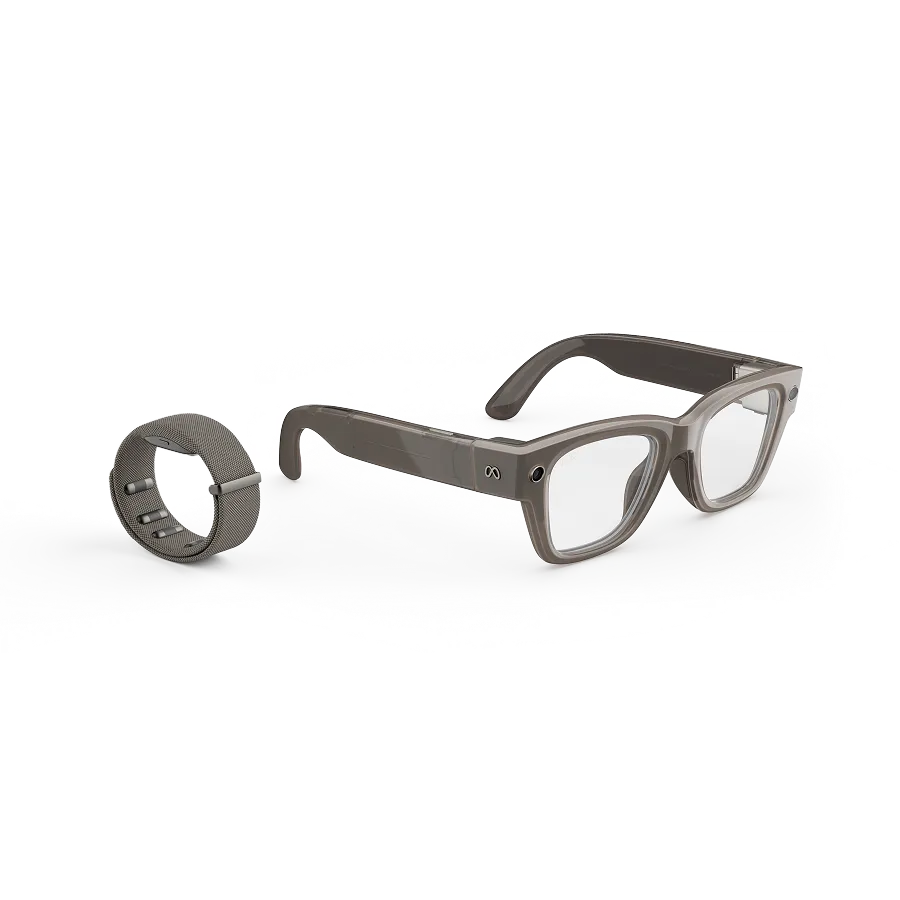
Ray-Ban Meta Display – Best for AR + AI
Price: $799 | AI: Meta AI with visual display | Camera: 12MP/3K | Display: 600x600 monocular, 5,000 nits | Requires Neural Band (included)
The Ray-Ban Meta Display is the most ambitious AI smart glasses on the market. It takes everything the standard Ray-Ban Meta does and adds a monocular in-lens display that shows AI responses, real-time translation captions, navigation directions, calendar widgets, weather, and live sports scores directly in your line of sight.
That display changes the AI interaction model fundamentally. Instead of listening to a translated sentence and hoping you caught every word, you read it. Instead of asking for directions and trying to remember them, you see an arrow. The 600x600 pixel screen pumps out 5,000 nits of brightness, making it readable in direct sunlight. Gesture controls – subtle head tilts and touches – navigate through widgets and dismiss notifications.
The price of ambition is complexity. The glasses require a Neural Band, a wrist-worn processing unit that ships in the box. Eye strain from prolonged single-lens use is real. Some features, including handwriting recognition and certain navigation coverage, remain in beta. The learning curve for gesture controls takes several days to feel natural.
At $799, this is firmly early-adopter territory. But for frequent travelers, productivity obsessives, or anyone who has ever wanted a heads-up display in their daily glasses, the Ray-Ban Meta Display delivers something no other product matches.

Even Realities G2 – Most Discreet AI Display
Price: $599 | AI: Even AI | Camera: None | Display: Micro-LED HUD
The Even Realities G2 solves the biggest problem with smart glasses: looking like smart glasses. At 1.26 ounces, the G2 weighs about the same as a regular pair of prescription frames. The micro-LED display is invisible to onlookers. And with no camera, no visible sensors, and no bulky temples, nobody will know these are anything other than ordinary glasses.
The AI capabilities focus on text-based interaction through the heads-up display. Even AI handles queries and delivers answers as readable text. The teleprompter mode feeds you talking points during presentations. Real-time translation and transcription display foreign-language captions or meeting notes in your peripheral vision. An IP67 rating means full dust protection and temporary submersion – the best durability rating in this category.
Battery life is the standout spec: two full days of mixed use, which is roughly four times what camera-equipped competitors manage. The optional Even R1 smart ring adds gesture control for scrolling through notifications and triggering AI queries without touching the frames.
The absence of a camera means no visual AI – you cannot point at something and ask the G2 what it is. For professionals who want AI assistance in meetings, presentations, or conversations without the social awkwardness of wearing obvious tech, that tradeoff is worth making. The Even Realities G1, the predecessor at $499, remains available for buyers who want the same platform at a lower price with a smaller display.
Solos AirGo 3 – Best Budget Option
Price: From $199 (+$9.99/mo for full AI) | AI: ChatGPT | Camera: None | Display: None
The Solos AirGo 3 strips AI smart glasses down to the essentials: open-ear speakers, beamforming microphones, and a direct ChatGPT integration that lets you query OpenAI'''s assistant with your voice. No camera. No display. Just AI you can talk to while keeping your hands and eyes free.
The ChatGPT integration handles voice-based queries, real-time translation, and basic task assistance. The modular SmartHinge system lets you swap the AI-enabled temples between different frame styles, which means you can switch from prescription glasses to sunglasses without buying two pairs of smart electronics. Touch controls on the temples handle playback, calls, and AI activation.
The compromises at $199 are predictable. Audio quality is adequate but noticeably behind the Meta platform. The AI experience depends on an active Solos Premium subscription ($9.99/month) for full ChatGPT access with conversation history. And without a camera, the AI cannot see anything – you are limited to voice-only queries.
For anyone who wants to try AI smart glasses without spending $400+, the AirGo 3 is the sensible entry point. Just factor in the ongoing subscription cost.
How We Chose
We evaluated every smart glasses product with a built-in AI assistant currently available to consumers. Our selection criteria:
- Genuine AI capability. The glasses must offer a real AI assistant – not just basic voice commands or Siri/Google passthrough. Products where the AI can hold a conversation, translate languages, or (with a camera) identify objects qualified. Basic Bluetooth audio glasses did not.
- Consumer availability. Announced products, prototypes, and crowdfunding campaigns that have not shipped to backers do not qualify. Every pick is something you can buy and receive today.
- Verified real-world performance. We only recommend products with a published WearableBeat review or sufficient independent coverage to assess performance beyond manufacturer claims. Announced-but-unshipped products do not qualify.
- Distinct use case. Every pick fills a specific role. We would rather recommend five glasses that each excel at something than seven that blur together.
We compared AI assistant quality, display capability, camera resolution, audio performance, battery life, comfort, design discretion, and price. Where we have published a full review, we link to it for deeper analysis.
Who Should Buy What
You wear glasses every day and want AI that disappears into your routine. Get the Ray-Ban Meta Gen 2. The Wayfarer design, strong audio, and capable Meta AI make these the only AI glasses most people need.
You are active and want AI during workouts. The Oakley Meta HSTN gives you the same Meta AI in a frame that stays put when you move. PRIZM lenses are a real advantage for outdoor visibility.
You want to see AI responses, not just hear them. The Ray-Ban Meta Display is the only option with both a camera and a display. Budget $799 and accept that some features are still maturing. If you want a display but without the camera and at a lower price, the Even Realities G2 is the discreet alternative at $599.
You give presentations or attend lots of meetings. The Even Realities G2'''s teleprompter mode and transcription features are built for exactly this. The invisible display means your audience will never know.
You want to try AI glasses without a big investment. The Solos AirGo 3 at $199 is the lowest-risk way in. Just remember the subscription cost.
For a comparison between two of the most popular options, see our Ray-Ban Meta Gen 2 vs Even Realities G1 breakdown.
What To Avoid
Crowdfunded AI glasses with unproven track records. The Halliday Glasses generated buzz at CES 2025 with an invisible display and AI ring controller at $489, but the product launched through Kickstarter and Indiegogo rather than traditional retail, and long-term software support remains uncertain for a company this young. Until a crowdfunded smart glasses maker proves it can deliver consistent updates and support, treat these campaigns with caution.
Waiting for Google or Samsung. Samsung'''s Galaxy Glasses and Google'''s Android XR smart glasses are both expected in late 2026 or 2027, with Gemini AI integration. They will almost certainly be worth considering when they arrive. But "coming soon" is not a product, and the current options – particularly the Meta ecosystem – are already very capable. Buy what exists today and upgrade when better options actually ship.
Confusing AR display glasses with AI glasses. Products like the Xreal One Pro and Viture One are excellent for entertainment and virtual displays, but they are screen-replacement devices, not AI assistants. If you want a virtual monitor, check our best smart glasses for monitor replacement guide. If you want an AI you can talk to, stick with the picks in this guide.