
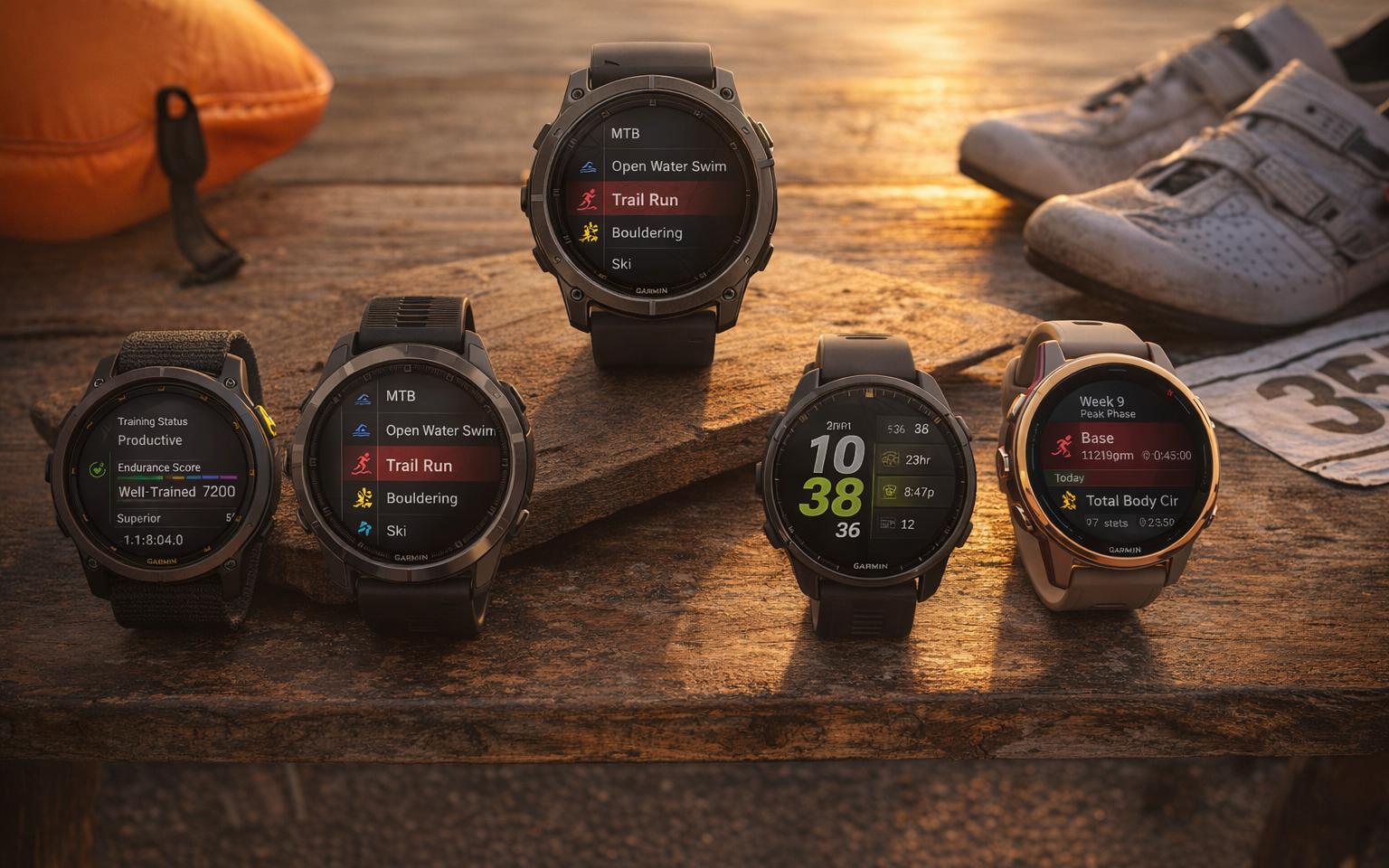
Every triathlon watch needs to do three things well: track an open-water swim with GPS, pair with a cycling power meter, and deliver reliable running metrics – then transition between all three without you fumbling with buttons in T1. That sounds simple, but it eliminates most of the watches on the market, including several in Garmin's own lineup.
The tradeoffs between Garmin's triathlon-capable models come down to three decisions. Battery life versus display quality: AMOLED screens are easier to read mid-ride, but MIP and solar displays will last an entire Ironman without needing a charge. Weight versus durability: titanium and sapphire crystal add protection but also grams on your wrist, which matters across 140.6 miles. Features versus price: the Fenix 8 and Forerunner 970 pack every triathlon tool Garmin has ever built, but you can race a sprint or Olympic tri on a watch that costs half as much.
The best triathlon watch Garmin makes is the Garmin Fenix 8. It has the deepest multisport feature set, the toughest build, and battery life that handles any race distance without anxiety. But the right pick depends on what you race, how you train, and how much you want to spend – so here are six models that cover every triathlete from first-timer to Kona qualifier.
Garmin Fenix 8 – Best Overall for Triathlon
$999.99
The Garmin Fenix 8 is the most complete triathlon watch ever made. The dedicated triathlon activity profile handles swim-bike-run with auto-transitions that detect when you exit the water, mount the bike, and start running – recording each segment and transition time separately without any button presses required. The Auto Sport Change feature is genuinely race-day reliable, and the ability to create custom multisport profiles means you can set up brick workouts, duathlons, or swimruns with the same seamless transition logging.
Open-water swimming performance is where the Fenix 8 earns its price tag. Multi-band GPS with SatIQ technology delivers accurate OWS tracking even in choppy conditions where older watches would lose the plot on every sighting breath. Stroke count, stroke rate, SWOLF efficiency scores, and distance per stroke are all tracked automatically. The AMOLED display – new to the Fenix line with the 8 – is significantly easier to read underwater than the MIP screens on previous models, which matters when you are checking pace between buoys.
On the bike, the Fenix 8 pairs with ANT+ and Bluetooth power meters, speed sensors, cadence sensors, and Varia radar units. Cycling dynamics data is available with compatible power meters, and ClimbPro breaks down every climb on your course in real time. For the run, you get PacePro pacing strategies, wrist-based Running Power, grade-adjusted pace, race predictor, and full running dynamics if you add a compatible pod or chest strap.
Battery life hits 47 hours in standard GPS mode on the 47mm AMOLED model – enough for an Ironman with room to spare. The 51mm version stretches even further. The titanium sapphire edition adds scratch resistance that matters when you are racking an expensive watch in transition, though the standard model's Corning Gorilla Glass is plenty tough for most athletes.
The caveat is price. At $999.99 for the base AMOLED model and $1,099.99 for the 47mm sapphire titanium, the Fenix 8 costs more than many triathletes spend on their wetsuit and helmet combined. The 47mm case is also noticeably heavier than the Forerunner line – the trade-off for that titanium-and-sapphire build. If you race long-course and want a single watch that handles every training session and race day without compromise, the Fenix 8 is it.
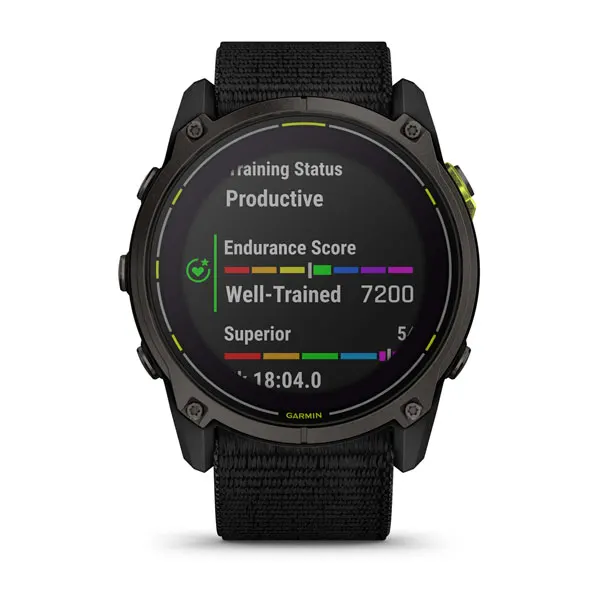
Garmin Enduro 3 – Best for Ironman and Ultra-Distance
$899.99
The Garmin Enduro 3 exists for one reason: battery life that makes every other triathlon watch look like it needs a charger strapped to the aerobars. Up to 320 hours of GPS tracking with solar charging, or 120 hours without solar, means you will never worry about battery during a 17-hour Ironman finish, never stress about forgetting to charge before a long training weekend, and never have to toggle to a lower-accuracy GPS mode just to make it to the finish line.
The Enduro 3 packs more than double the solar energy harvesting capacity of its predecessor, and the improvement is dramatic. In multi-band GPS mode with solar, you get 90 hours of tracking – nearly double what the Fenix 8 delivers in standard GPS mode. The 51mm titanium case is built to MIL-STD-810 standards with a sapphire crystal lens, and at 63 grams, it is remarkably light for its size. The multisport and triathlon profiles are identical to the Fenix 8: auto-transitions, open-water swim tracking, cycling power meter support, running dynamics, PacePro, and ClimbPro all included.
Where the Enduro 3 diverges from the Fenix 8 is the display. The Enduro 3 uses a high-resolution MIP (memory-in-pixel) screen rather than AMOLED. It is perfectly readable in direct sunlight – arguably better than AMOLED outdoors – but lacks the vibrant colors and sharp contrast of the Fenix 8's screen. In the water or in low light, the MIP display is noticeably less legible. For athletes who train and race primarily outdoors during daylight, this is a non-issue. For pool sessions or early-morning brick workouts, it is a real tradeoff.
The Enduro 3 is $100 less than the Fenix 8, which makes it a compelling alternative for anyone whose races exceed four hours. If you are training for a 70.3 or full Ironman, the battery headroom alone justifies the pick. Sprint and Olympic-distance triathletes are paying for capacity they will never use – the Fenix 8 or Forerunner 970 make more sense at those distances.
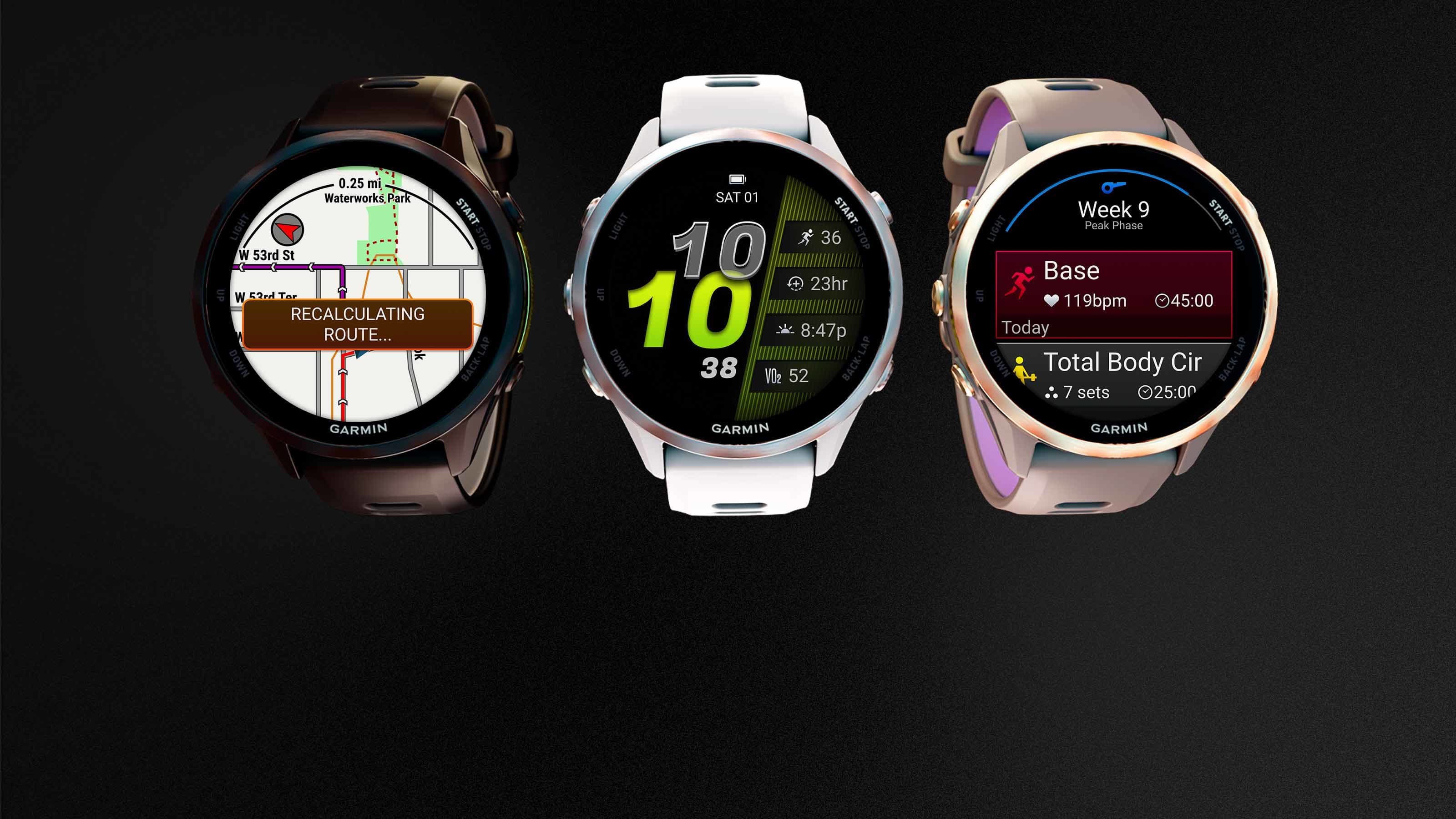
Garmin Forerunner 970 – Best for Data-Obsessed Triathletes
$749.99
The Forerunner 970 is the watch Garmin built for athletes who want every training metric quantified, analyzed, and turned into actionable insight. It shares nearly every triathlon feature with the Fenix 8 – dedicated tri profile, auto-transitions, open-water swim GPS, power meter support – but wraps them in a lighter, more run-focused package with exclusive training intelligence features that the Fenix does not offer.
The headline addition is Garmin Triathlon Coach, a structured training plan system built directly into the watch. You set your goal race – sprint, Olympic, half, or full Ironman – and the 970 generates a periodized training plan across swim, bike, and run that dynamically adjusts based on your recovery status, training load, and life interruptions. This is a meaningful step beyond simply following a static plan on TrainingPeaks. The watch also introduces Running Tolerance, Running Economy, and Step Speed Loss metrics that give competitive triathletes granular insight into run performance degradation – exactly the data you need to pace the marathon leg of an Ironman intelligently.
The 970 features a 1.4-inch AMOLED display with sapphire crystal protection, the Elevate Gen 5 heart rate sensor, ECG capability, and a built-in speaker and microphone for Bluetooth calls. Pool triathlon and obstacle racing profiles are new additions not found on the Forerunner 965. Battery life runs 21 hours in all-systems GPS mode and 23 hours in SatIQ mode – shorter than the Fenix 8, sufficient for most Ironman finishers, though back-of-pack athletes approaching the 17-hour cutoff should start with a full charge and disable always-on display.
The Forerunner 970 sits between the Fenix 8 and the Forerunner 965 in both price and positioning. You sacrifice the Fenix 8's tank-like build quality, dive rating, and longer battery life, but gain the Triathlon Coach platform and more advanced running analytics at $250 less. For triathletes whose training is as important as their racing – and who want the watch to actively guide that training – the 970 is the smarter buy.
Garmin Forerunner 965 – Best Value for Serious Triathletes
$599.99
The Forerunner 965 is the sweet spot of Garmin's triathlon lineup: genuinely race-ready multisport features at a price that does not require justifying the purchase to your spouse. The dedicated triathlon profile with auto-transitions, open-water swim GPS with multi-band accuracy, ANT+ and Bluetooth power meter support, PacePro, and complete running dynamics are all here – the same core triathlon tools found on the Fenix 8 and Forerunner 970.
The 1.4-inch AMOLED display is bright, responsive, and easy to read across all three disciplines. Training Status, Training Load, HRV Status, Morning Report, Endurance Score, Hill Score, and Daily Suggested Workouts give you a comprehensive training ecosystem. Battery life reaches 31 hours in GPS-only mode and 22 hours in SatIQ mode – enough for even a slow Ironman finish, and more than sufficient for Olympic and sprint distances with battery to spare.
What separates the 965 from the newer 970 is mainly the training intelligence tier. The 965 lacks Triathlon Coach, Running Tolerance, Running Economy, and the ECG sensor. It uses the older Elevate Gen 4 heart rate sensor and Gorilla Glass rather than sapphire crystal. The step up from the Forerunner 265 to the 965 is substantial – maps, full navigation, longer battery, and a larger display – but compared to the 970, the 965 gives up less than the $150 price difference suggests.
At $600, the Forerunner 965 is the watch to buy if you race triathlons seriously but do not need the absolute latest training metrics or the premium materials. It does everything 90% of triathletes need, and it does it well. The titanium and sapphire build of the Fenix 8 and Enduro 3 are nice, but the 965's fiber-reinforced polymer case has proven more than durable enough for years of swim-bike-run abuse.
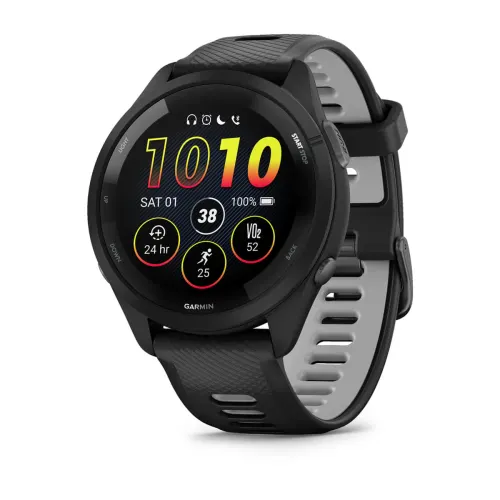
Garmin Forerunner 265 – Best Mid-Range Multisport Watch
$449.99
The Forerunner 265 punches significantly above its weight class for triathlon. It includes a dedicated triathlon activity profile with auto-transitions, open-water swim tracking with multi-band GPS, power meter pairing, and the complete suite of running dynamics – every essential triathlon feature, at $150 less than the Forerunner 965.
The 1.3-inch AMOLED display at 416x416 resolution is stunning for its price. Multi-band GPS with SatIQ delivers the same satellite accuracy as the more expensive Forerunner models, which directly impacts open-water swim tracking quality. Training Status, Training Load, HRV Status, Morning Report, and Daily Suggested Workouts are all included. The 265 also comes in a 42mm 265S variant at 39 grams, which is the lightest triathlon-capable Garmin you can buy – a genuine advantage for weight-conscious racers.
Battery life is the most significant limitation. At 20 hours in GPS mode (14 hours in multi-band), the 265 will handle a sprint tri, Olympic tri, and even most 70.3 finishes without issue, but a full Ironman is cutting it dangerously close. If your target time is under 13 hours and you use SatIQ mode, you should be fine; if you are a back-of-the-pack Ironman athlete, look at the Forerunner 965 or above.
The other notable absence is onboard maps. The 265 cannot display course maps, follow breadcrumb navigation, or show turn-by-turn directions – features that matter on unfamiliar bike courses or trail runs but are irrelevant on a marked triathlon course. For sprint and Olympic-distance triathletes who want race-grade multisport features without spending $600 or more, the Forerunner 265 is the best deal in Garmin's lineup. It belongs on the wrist of every age-group triathlete who would rather spend their remaining budget on a good power meter than a more expensive watch.
Garmin Instinct 3 Solar – Best Budget Triathlon Watch
$399.99 (Solar)
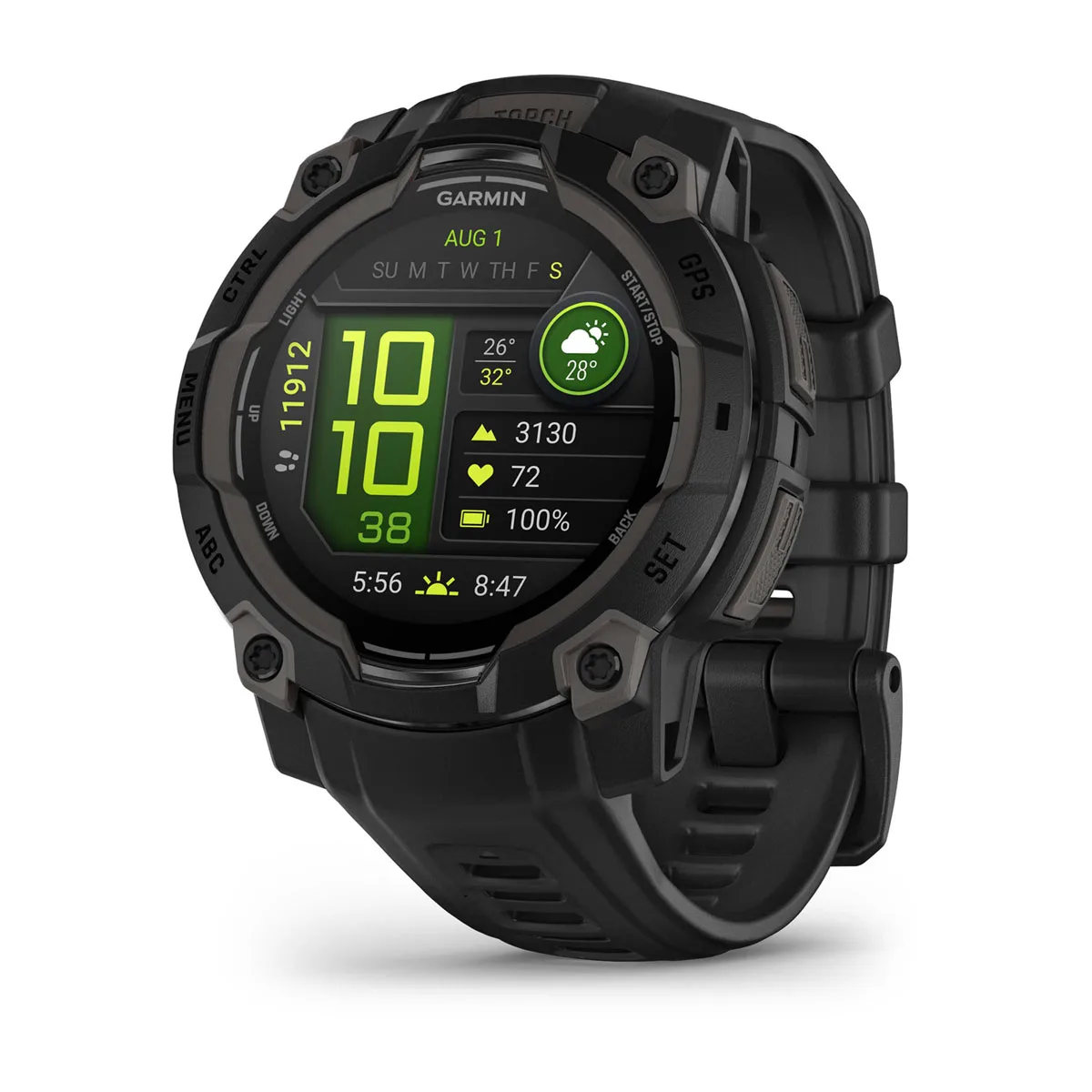
The Instinct 3 is the least obvious triathlon pick on this list, but it delivers every core multisport feature a triathlete needs at the lowest price of any watch here. The dedicated triathlon profile with auto-transitions is present – you can race a full swim-bike-run with the same seamless sport switching as the Fenix 8. Open-water swim tracking, cycling power meter support via ANT+, and running dynamics with a compatible accessory are all included.
The Solar model is the version triathletes should consider. With solar charging and the MIP display, the 45mm Solar reaches 130 hours in standard GPS mode (the 50mm stretches to 260 hours) – more than the Fenix 8 and within striking distance of the Enduro 3. The AMOLED variant trades that endurance for a sharper screen at around 24 hours of GPS life, which is still adequate for any race distance short of a full Ironman. Multi-band GPS with SatIQ is standard across both versions, so tracking accuracy does not suffer compared to more expensive models.
The tradeoffs are real. The Instinct 3's interface is built around a dual-window MIP display (on the Solar model) that lacks the visual polish and data density of the Forerunner or Fenix AMOLED screens. There are no onboard maps, no touchscreen on the Solar version, and the rugged outdoor aesthetic is not for everyone – this is a watch designed for trail runners and hikers that happens to have triathlon features, not a purpose-built tri watch. Training metrics are a tier below the Forerunner 965 and above: no Endurance Score, no race predictor, and fewer structured workout options across disciplines.
But for a first triathlon watch, or for experienced triathletes who want a beater they can abuse without worrying about scratching a $1,000 investment, the Instinct 3 Solar at $400 is hard to beat. It tracks the race accurately, lasts forever on a charge, and meets MIL-STD-810 durability standards. Spend the $600 you saved on race entry fees.
How We Chose
Every watch on this list meets four non-negotiable criteria for triathlon use:
- Dedicated triathlon or multisport activity profile with support for combining swim, bike, and run segments into a single recorded activity
- Open-water swim GPS tracking with stroke detection, SWOLF scoring, and distance measurement
- Auto-transition support that records transition times and switches between sports without manual intervention
- Cycling power meter compatibility via ANT+ or Bluetooth for structured bike training and race-day pacing
Beyond those requirements, we evaluated each watch on GPS accuracy (particularly during open-water swims, where satellite tracking is hardest), battery life relative to target race distances, training ecosystem depth, build quality, and value. Garmin's 2025-2026 lineup offers triathlon profiles across a wider price range than ever before – the challenge is no longer finding a Garmin that can do a triathlon, but identifying which level of features justifies the price for your specific racing.
Who Should Buy What
First triathlon or sprint distance: The Forerunner 265 has the most intuitive interface of any triathlon-capable Garmin – AMOLED touchscreen, clean data screens, and a triathlon profile that works identically to the one on the Fenix 8. The money you save is better spent on coaching, bike fit, or race entry.
Olympic distance, training seriously: The Forerunner 965 hits the sweet spot. The longer battery life handles race day comfortably, and the full training ecosystem of the best running watches applies equally well to multisport training. Maps and navigation are useful for long rides on unfamiliar routes.
70.3 and Ironman: Choose the Fenix 8 if you want the best AMOLED display and the most complete training ecosystem in a single package; choose the Enduro 3 if battery headroom and never worrying about charging is your priority. Both have the durability and GPS longevity that long-course racing demands. The Enduro 3 is particularly strong for athletes who race multiple long-course events per season and want a watch that handles a training block without daily charging.
Data-driven training focus: The Forerunner 970 is the pick. Triathlon Coach, Running Tolerance, and the adaptive training plan features are built specifically for athletes who structure their training around data. If you use TrainingPeaks, follow a periodized plan, or obsess over your TSS, the 970 speaks your language.
Training watch you will not baby: The Instinct 3 Solar at $400 is the beater triathlon watch – MIL-STD-810 tough, 130 hours of GPS life, and a price that means you will not flinch racking it in transition. Ideal as a dedicated race-day watch or a first Garmin for budget-conscious triathletes.
What to Avoid
Garmin Forerunner 165 ($249.99): It looks like a bargain entry into Garmin's running ecosystem, and for pure running, it is. But the Forerunner 165 does not have a triathlon or multisport activity profile. You cannot combine swim, bike, and run into a single activity or record transitions. To use it for a triathlon, you would need to stop and restart a new activity profile for each discipline, losing transition data and making post-race analysis a mess. For $150 more, the Forerunner 265 gives you a proper triathlon profile that works on race day.
Garmin Vivoactive 6 ($299.99): The Vivoactive 6 has no dedicated triathlon profile. You can chain individual sport segments into a generic multisport activity, but it lacks the auto-transition logic of a proper tri mode – and it lacks multi-band GPS, which directly impacts open-water swim tracking accuracy. It also omits key training features like Training Status and structured workout support across multiple disciplines. The Vivoactive 6 is a solid lifestyle and fitness watch, but it was not designed for triathlon and the experience reflects that. The Instinct 3 costs $100 more and delivers a dramatically better multisport experience.