
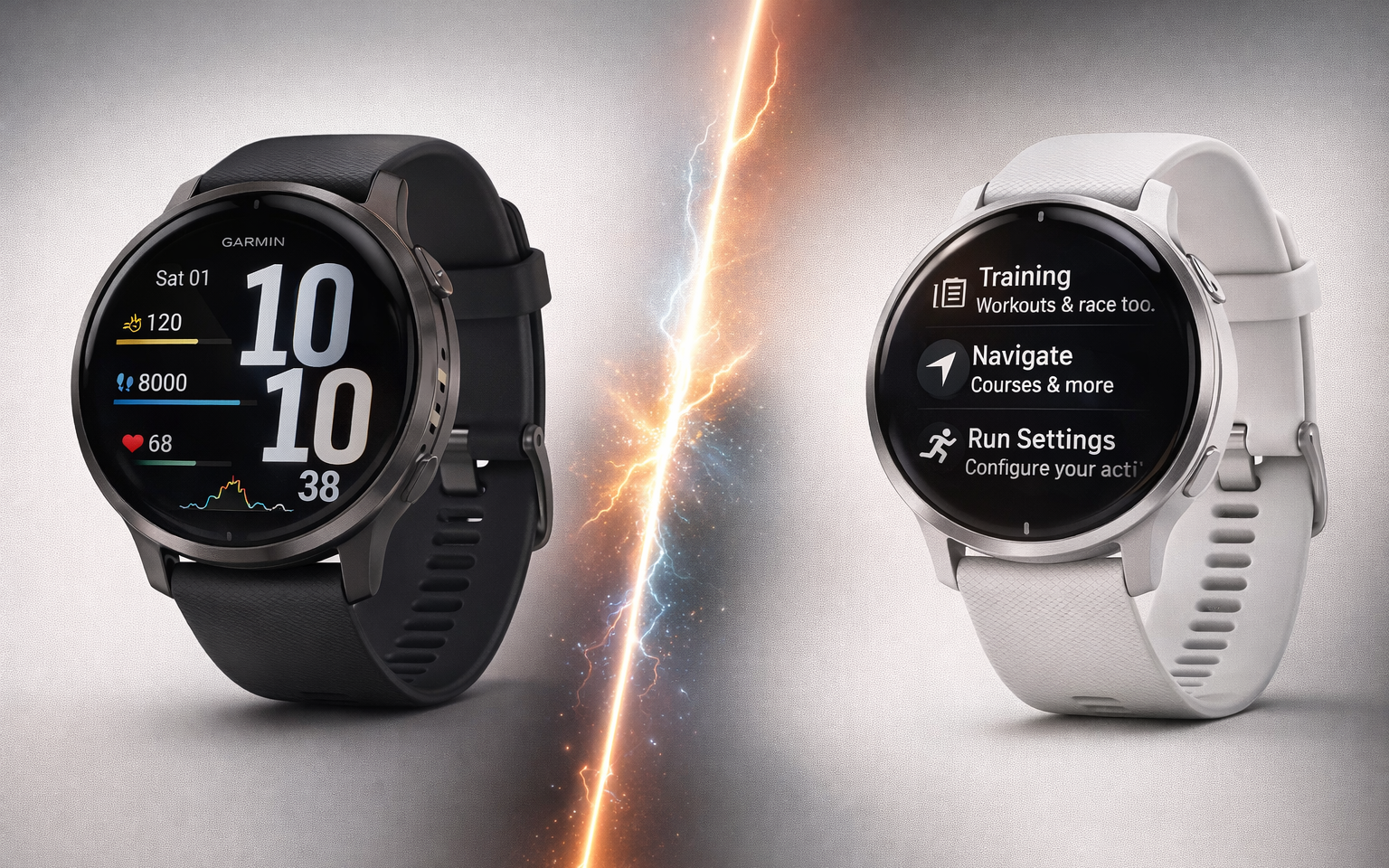
Two Garmin smartwatches. Both with AMOLED displays. Both with 80-plus sport profiles and over a week of battery life. Both running the same Garmin Connect ecosystem. And yet $250 separates them — the Venu 4 at $549.99, the Vivoactive 6 at $299.99. That gap is not padding. It buys a genuinely different set of hardware and capabilities, and the question is whether those extras actually matter for the way you train and live.
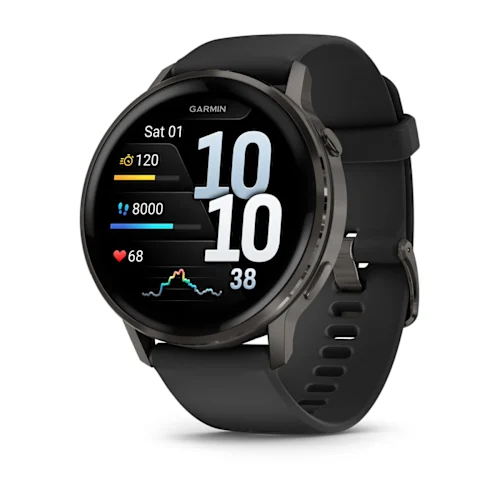
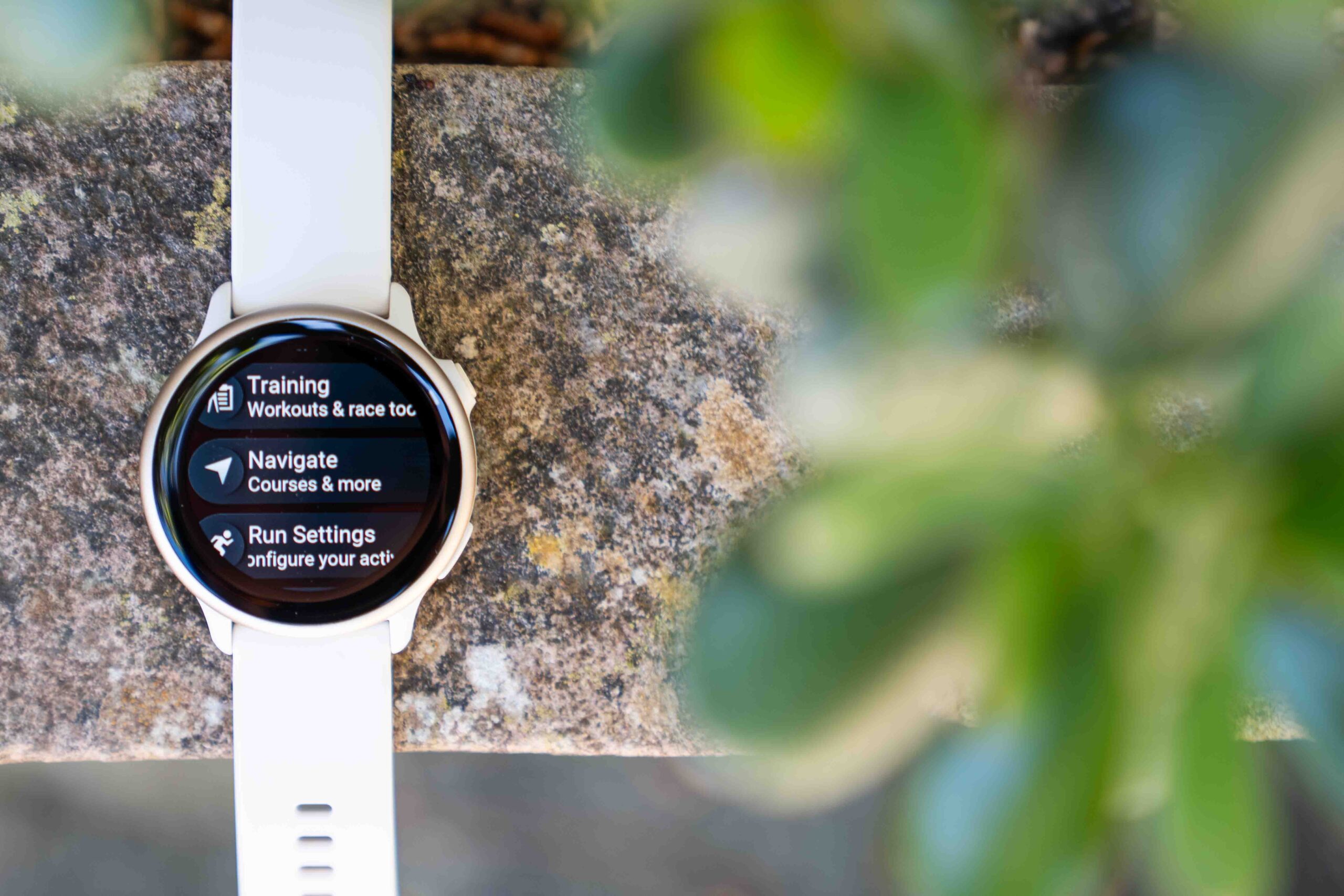
This is not a case where the expensive option is obviously better. The Garmin Vivoactive 6 packs a surprising amount of training depth into a $300 package, while the Garmin Venu 4 layers on premium health sensors, a bigger display, and lifestyle features that justify its price — but only for the right buyer. Here is exactly where each watch wins and where it falls short.
Design and Build
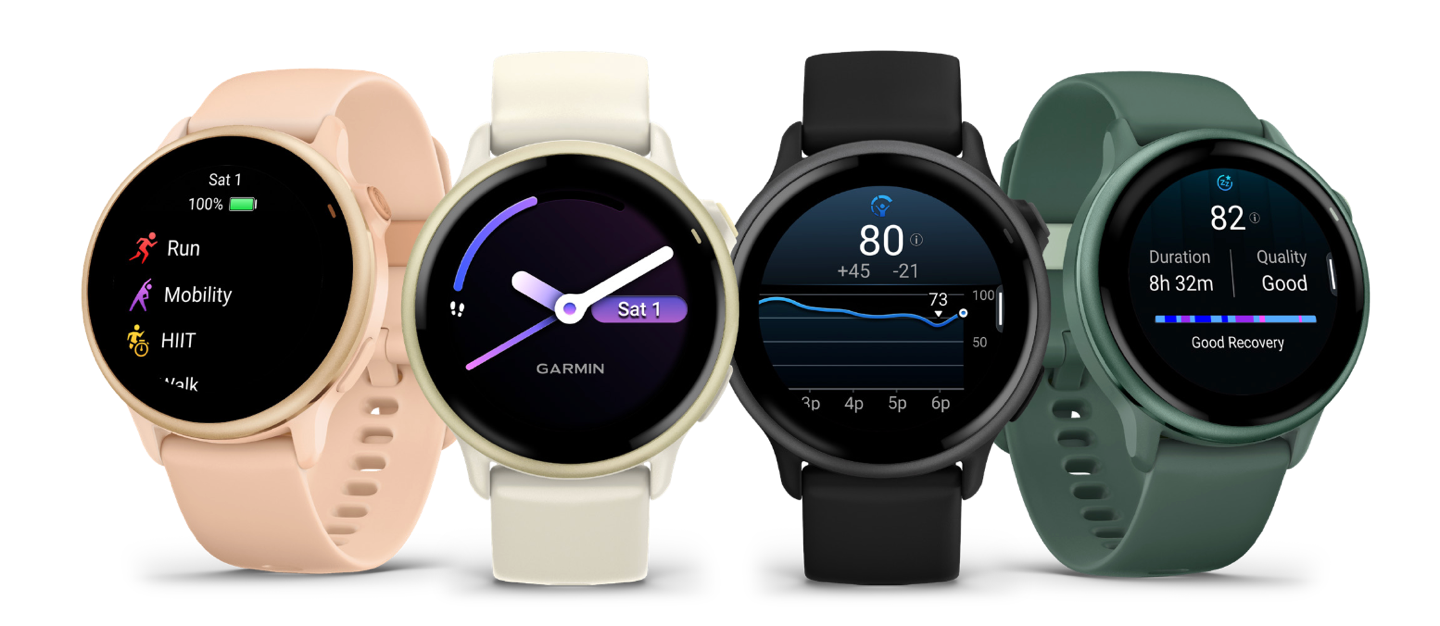
The Venu 4 looks and feels like a premium watch. The stainless steel bezel and refined construction give it a weight and solidity that reads as jewelry as much as sports gear. It comes in two sizes — 41mm (46g) and 45mm (56g) — making it one of the few Garmin watches that genuinely accommodates smaller wrists without compromise. Two physical buttons on the right side provide tactile control alongside the touchscreen. The LED flashlight at the 12 o'clock position, borrowed from Garmin's adventure-grade Fenix line, is a surprisingly useful addition for early-morning runs and navigating dark campsites.
The Vivoactive 6 takes a different approach. The fiber-reinforced polymer case with an aluminum bezel is lighter (36g with band) and more utilitarian. At 42mm, it is a one-size offering — comfortable on most wrists but not tailored to smaller ones the way the Venu 4's 41mm option is. The slimmer 10.9mm profile slides under shirt cuffs easily, and the weight barely registers during sleep tracking. Build quality is solid for the price, but pick it up next to the Venu 4 and the difference in materials is immediately apparent.
For pure aesthetics and versatility across wrist sizes, the Venu 4 wins. For lightweight comfort and low-profile daily wear, the Vivoactive 6 holds its own — especially considering it costs $250 less.
Edge: Venu 4
Display
Both watches use AMOLED panels, but the Venu 4's 45mm model offers a noticeably larger and sharper screen. Its 1.4-inch display at 454x454 resolution delivers crisper text, richer map detail, and more room for data fields during workouts. (The 41mm Venu 4 matches the Vivoactive 6 at 1.2 inches and 390x390 — the display advantage only applies to the larger size.) Brightness is excellent in direct sunlight, and the always-on display mode remains legible outdoors.
The Vivoactive 6's 1.2-inch, 390x390 panel is vibrant and punchy — still a very good screen by any standard. Colors pop, contrast is strong, and readability during outdoor workouts is not an issue. But side by side, the Venu 4's extra screen real estate and higher pixel density make a visible difference, particularly when reviewing charts, maps, or multi-field workout screens.
Both screens support always-on display modes that cut battery life roughly in half. For most daily use, the difference between these two panels matters less than the spec sheet suggests. But if screen quality is a priority, the Venu 4 is the better panel.
Edge: Venu 4
GPS and Navigation
This is where the $250 gap starts earning its keep.
The Venu 4 features dual-band (multi-frequency) GPS with Garmin's SatIQ technology, which automatically selects the best satellite frequencies to balance accuracy and battery life. Multi-band GPS delivers measurably better positioning in challenging environments — dense tree cover, urban canyons, steep valleys — by receiving signals on two frequencies simultaneously. For trail runners, hikers, and anyone who trains in areas where single-band GPS struggles, this is a meaningful upgrade. The barometric altimeter adds accurate elevation tracking for hill workouts, stair climbing, and hiking — data the Vivoactive 6 simply cannot provide.
The Vivoactive 6 uses multi-GNSS positioning (GPS, GLONASS, Galileo, BeiDou, QZSS) on a single band. GPS lock is fast, and accuracy is consistent for the vast majority of outdoor activities — road running, cycling, open-trail hiking. Total distances typically fall within an acceptable margin of error. But in dense urban environments or heavy canopy, the single-band system is more susceptible to drift and signal bounce than the Venu 4's dual-band setup.
For road runners and cyclists who train in open areas, the Vivoactive 6's GPS is perfectly adequate. For trail runners, hikers, or anyone who regularly trains in GPS-challenging terrain, the Venu 4's dual-band system and altimeter provide genuinely better data.
Edge: Venu 4
Health Sensors
The Venu 4 carries Garmin's latest Elevate Gen 5 optical heart rate sensor, a generational upgrade over the Vivoactive 6's Elevate Gen 4. The Gen 5 sensor delivers improved accuracy during high-intensity intervals and rapid heart rate changes — the exact scenarios where wrist-based sensors historically struggle. Independent comparisons against chest straps show the Venu 4 tracking within a few beats per minute even during intense sessions, with less lag than its predecessor.
Beyond heart rate, the Venu 4 adds an ECG app capable of detecting atrial fibrillation or confirming normal sinus rhythm — a feature increasingly standard on premium smartwatches but absent from the Vivoactive 6. A skin temperature sensor rounds out the health suite, enabling more granular recovery and menstrual cycle tracking data.
The Vivoactive 6's Elevate Gen 4 sensor is reliable for steady-state exercise and continuous monitoring, performing well against chest strap references during runs and rides. However, it shows more lag during high-intensity intervals and steep heart rate spikes. Blood oxygen monitoring is present on both watches, but the Vivoactive 6 lacks ECG, skin temperature, and the barometric altimeter that contributes to stress and recovery calculations on the Venu 4.
For athletes who want the most accurate wrist-based heart rate data and proactive health monitoring features like ECG, the Venu 4 is the clear choice. For general fitness tracking where occasional chest strap pairing covers high-intensity gaps, the Vivoactive 6's sensor is more than adequate.
Edge: Venu 4
Training and Fitness Features
Here is where the comparison tightens considerably.
Both watches offer 80-plus built-in sport profiles, Body Battery energy monitoring, Training Readiness scores, HRV status, sleep tracking with smart wake alarms, and Morning Report summaries. Both support Garmin Coach adaptive training plans and structured workouts pushed from Garmin Connect. Both deliver PacePro pacing strategies for runners. The core Garmin training ecosystem is identical across these two watches.
Both watches now include Garmin Fitness Coach — initially a Venu 4 exclusive, it was expanded to the Vivoactive 6 and other models in a February 2026 software update. Fitness Coach generates personalized, heart-rate-based workouts for 20-plus activities that adapt daily based on training history and recovery status. Running dynamics — cadence, stride length, ground contact time, vertical oscillation — are available on both watches via wrist-based estimation, though the Venu 4's newer sensor may provide marginally more consistent data. The altitude data from the barometric altimeter also feeds into more accurate calorie calculations and training load metrics for elevation-heavy activities on the Venu 4.
The Vivoactive 6 matches the Venu 4 feature-for-feature on the fundamentals. For the majority of gym-goers, runners, cyclists, swimmers, and general fitness enthusiasts, the Vivoactive 6 delivers every training feature that matters at nearly half the price. The Venu 4's remaining edge — altimeter-enhanced metrics for elevation-heavy training — adds incremental value rather than transformative capability.
Edge: Draw
Battery Life
The Venu 4 (45mm) delivers up to 12 days in smartwatch mode, while the 41mm version manages 10 days. GPS mode tops out at 20 hours in single-band mode on the 45mm, dropping to 17 hours with multi-band active. SatIQ helps by automatically toggling between frequencies to balance accuracy and endurance.
The Vivoactive 6 offers up to 11 days in smartwatch mode and approximately 21 hours of GPS tracking. A battery saver mode extends standby to 21 days with reduced functionality.
In practice, both watches comfortably last over a week with regular daily use including GPS workouts, notifications, and continuous heart rate monitoring. The Venu 4's slight edge evaporates quickly once the always-on display or frequent GPS sessions enter the equation. Neither watch will leave you scrambling for a charger mid-week, and both outperform the Apple Watch and Samsung Galaxy Watch by a wide margin.
For a device that powers a larger, brighter display, dual-band GPS, ECG, a flashlight, and a speaker, the Venu 4's battery performance is impressive. But the Vivoactive 6 matches it in real-world use while powering less demanding hardware — making this category effectively a wash.
Edge: Draw
Smart Features
The Venu 4 pulls ahead here with hardware the Vivoactive 6 simply does not have.
A built-in speaker and microphone allow the Venu 4 to take phone calls directly from the wrist when paired with a smartphone — a genuine convenience when your phone is in a bag or across the room. Voice assistant integration lets you dictate text replies, set timers, and start activities hands-free. The LED flashlight, while not strictly a "smart" feature, adds practical utility that owners quickly grow to rely on.
Both watches support Garmin Pay for contactless payments and offline music storage from Spotify, Amazon Music, Deezer, and YouTube Music. The Vivoactive 6 matches the Venu 4 on music platform support, with 8GB of onboard storage for playlists. Both deliver smartphone notifications and Connect IQ app support.
If phone calls on the wrist, voice control, and a flashlight matter to your daily routine, the Venu 4 justifies its premium. If you just want music, payments, and notifications — the basics — the Vivoactive 6 covers everything at a fraction of the cost.
Edge: Venu 4
Value
This is the category that defines the entire comparison.
The Vivoactive 6 costs $299.99. For that price, you get an AMOLED display, multi-GNSS GPS, 80-plus sport profiles, Body Battery, Training Readiness, sleep tracking, offline music from four platforms, Garmin Pay, and 11 days of battery life. No subscription. No paywalls. Every feature included on day one. This is one of the best smartwatch values available in 2026.
The Venu 4 costs $549.99 — 83% more. The premium buys you a stainless steel build, a larger and sharper display (45mm only), dual-band GPS, a newer heart rate sensor with ECG, a barometric altimeter, a speaker and microphone, a flashlight, and a second size option. Every one of those upgrades is real and measurable. None of them is essential for mainstream fitness tracking.
The math is stark. At $299.99, the Vivoactive 6 costs roughly half the price of the Venu 4, and the $250 difference buys incremental upgrades rather than fundamental ones. For budget-conscious buyers, fitness beginners, or anyone who prioritizes training features over lifestyle hardware, the Vivoactive 6 delivers 90% of the experience at 55% of the cost.
Edge: Vivoactive 6
Who Should Buy the Garmin Venu 4
- You want the best wrist-based heart rate accuracy Garmin offers, without pairing a chest strap
- You train in GPS-challenging environments — dense forests, urban canyons, mountainous terrain — where dual-band GPS provides measurably better tracks
- You value ECG for proactive heart health monitoring or have a medical reason to track heart rhythm
- You want phone call capability, voice assistant, and a flashlight on your wrist
- You prefer a premium stainless steel build and need a 41mm size option for a smaller wrist
- You see the smartwatch as both a fitness tool and a lifestyle accessory worth investing in
Who Should Buy the Garmin Vivoactive 6
- You want comprehensive Garmin training features — Body Battery, Training Readiness, 80-plus sports, GPS — without spending $550
- You run, cycle, swim, or train in open environments where single-band GPS delivers accurate results
- You prioritize lightweight comfort and a low-profile design for all-day and overnight wear
- You want offline music from Spotify, Amazon Music, Deezer, and YouTube Music without a premium price tag
- You are new to Garmin's ecosystem and want a capable, complete entry point that does not compromise on training depth
- You would rather spend the $250 savings on running shoes, a gym membership, or a quality budget smartwatch for a family member
Our Verdict
The Garmin Vivoactive 6 is the better buy for most people.
That is not a hedged recommendation. At $299.99, the Vivoactive 6 delivers the full Garmin training ecosystem — 80-plus sport profiles, Body Battery, Training Readiness, HRV status, multi-GNSS GPS, AMOLED display, offline music, and 11 days of battery life — with no meaningful compromises for mainstream fitness use. It is the reason the Vivoactive line has become Garmin's best-selling smartwatch series: it gives you what matters and skips what does not, at a price that makes the decision easy.
The Venu 4 is the better watch — better build, better display, better GPS, better heart rate sensor, more health features, more lifestyle conveniences. Every dollar of the $250 premium maps to a tangible upgrade. But those upgrades serve specific needs: ECG for heart health monitoring, dual-band GPS for trail accuracy, phone calls for daily convenience, a premium case for wrist presence. If those needs describe you, the Venu 4 is worth every penny. If they do not, the Vivoactive 6 delivers a remarkably complete fitness smartwatch experience and leaves $250 in your pocket.
For serious athletes who train in varied terrain, want the latest sensor technology, and treat their watch as both a training tool and a daily accessory, the Venu 4 earns its premium. For everyone else — and that includes the majority of fitness enthusiasts — the Vivoactive 6 is one of the smartest purchases in the wearable market today.
Specs at a Glance
| Feature | Garmin Venu 4 (45mm) | Garmin Vivoactive 6 |
|---|---|---|
| Price | $549.99 | $299.99 |
| Case Material | Stainless steel bezel, polymer body | Fiber-reinforced polymer + aluminum bezel |
| Weight | 56g (45mm) / 46g (41mm) | 36g |
| Display | 1.4" AMOLED, 454x454 (45mm) / 1.2", 390x390 (41mm) | 1.2" AMOLED, 390x390 |
| GPS | Dual-band (multi-frequency) + SatIQ | Multi-GNSS (single-band) |
| HR Sensor | Elevate Gen 5 | Elevate Gen 4 |
| ECG | Yes | No |
| Barometric Altimeter | Yes | No |
| Battery Life | Up to 12 days (45mm) / 10 days (41mm); 20 hrs GPS | Up to 11 days; 21 hrs GPS |
| Speaker/Mic | Yes (phone calls, voice assistant) | No |
| LED Flashlight | Yes (white + red) | No |
| Size Options | 41mm, 45mm | 42mm |
| Sports Modes | 80+ | 80+ |
| Water Resistance | 5 ATM | 5 ATM |
| Music | Spotify, Amazon Music, Deezer, YouTube Music | Spotify, Amazon Music, Deezer, YouTube Music |
| Garmin Pay | Yes | Yes |
| Skin Temperature | Yes | No |