
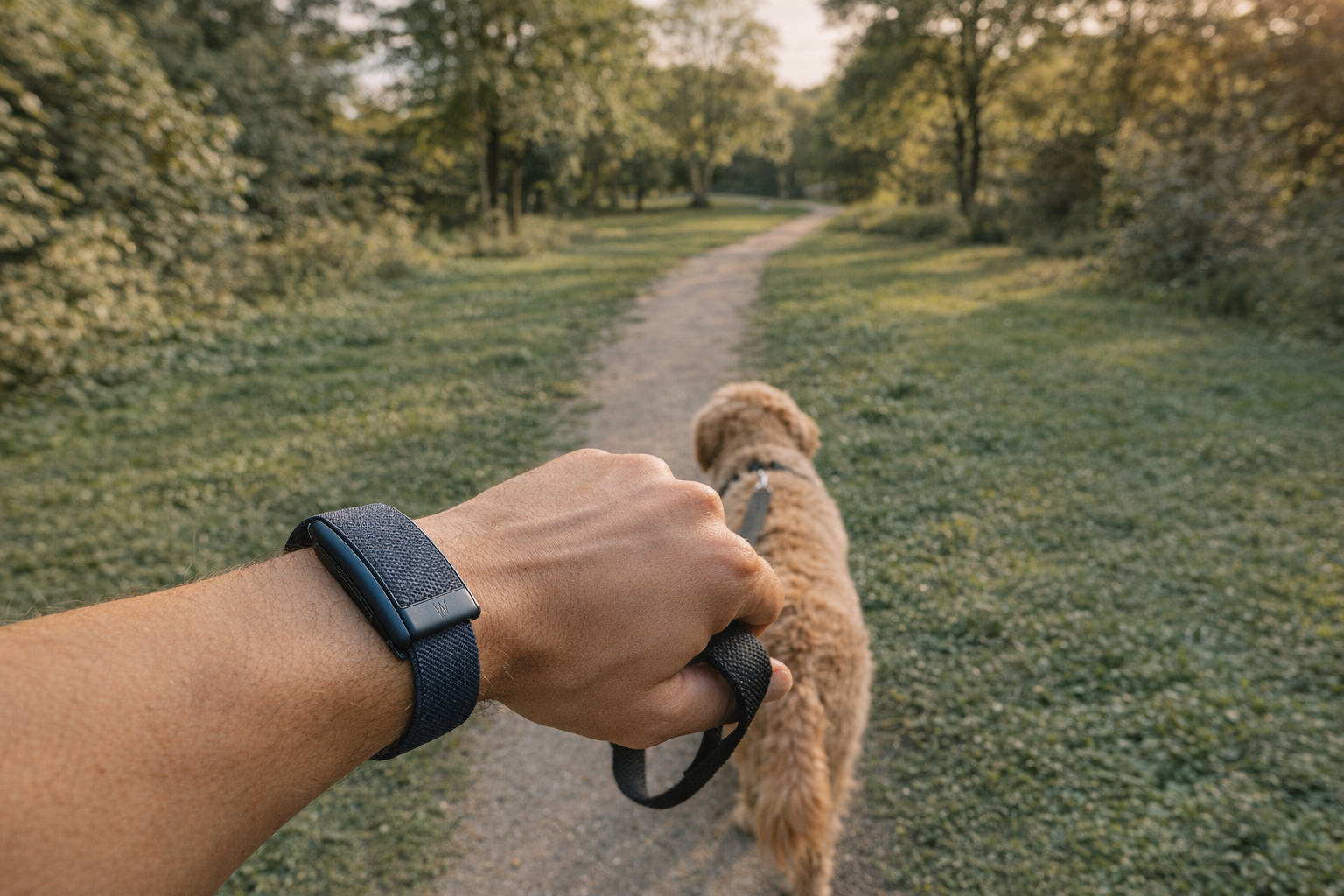
WHOOP works by pressing a sensor array against your skin 24 hours a day, sampling your heart rate, heart rate variability, skin temperature, blood oxygen, and movement, then distilling all of that data into three scores in the companion app: Recovery, Strain, and Sleep. There is no screen. Unlike smartwatches that display notifications and apps on your wrist, WHOOP is purely a collection mechanism – it gathers raw physiological signals through photoplethysmography (PPG) LEDs, an accelerometer, a thermistor, and a gyroscope, and the app does all the interpreting.
The entire system runs on a subscription model. You pay an annual membership fee that includes the hardware, app access, and ongoing software updates. The device itself is just the collection mechanism – the real product is the data analysis happening in the WHOOP app, which tells you how recovered you are each morning, how hard you pushed during the day, and whether you slept enough to support it all. If you are weighing whether the subscription makes sense for your training, our breakdown on whether WHOOP is worth it covers the cost-to-value math in detail.
The Sensor Array: What WHOOP Actually Measures
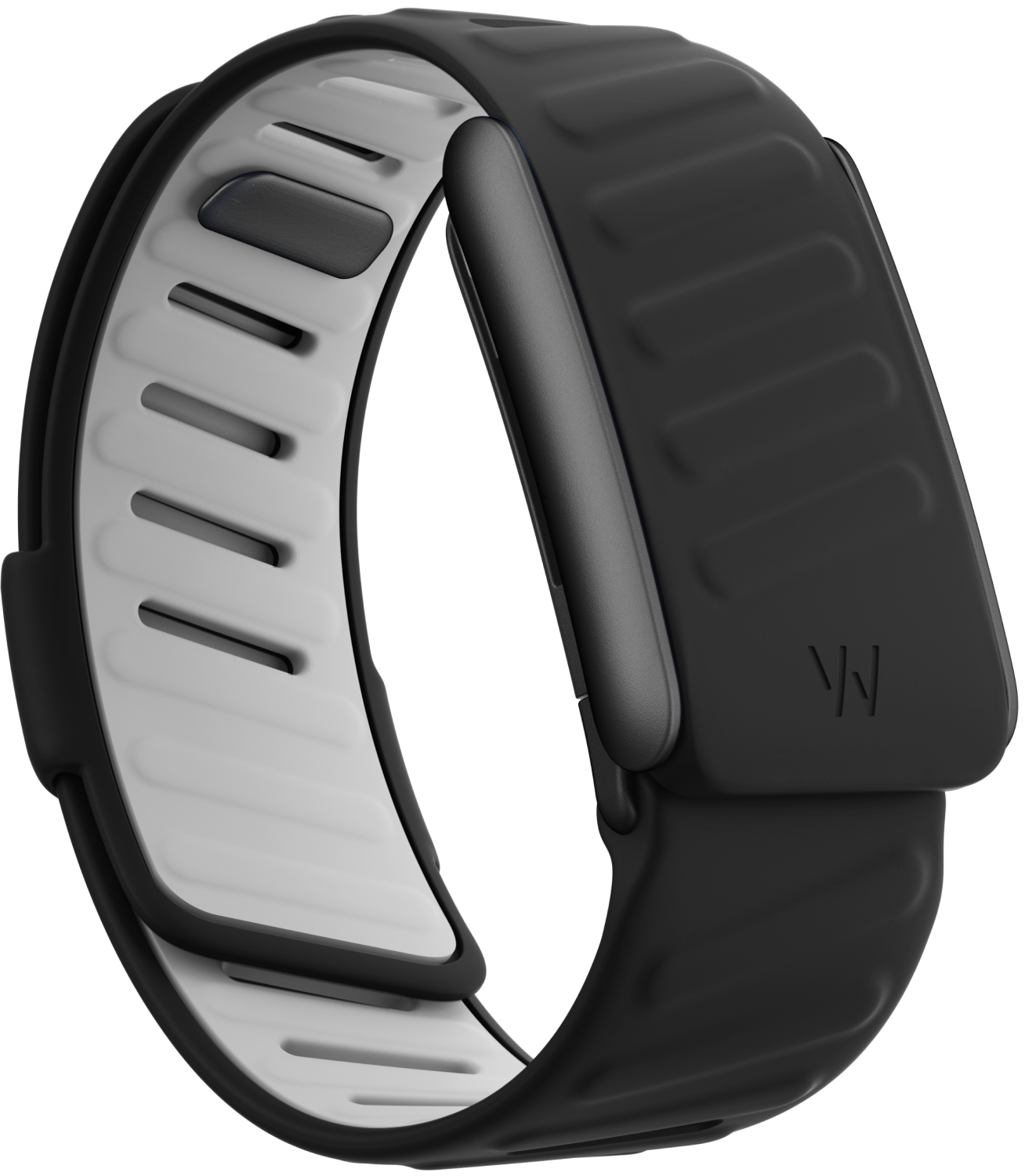
WHOOP 5.0 packs five sensor types into a band that is 7 percent smaller than its predecessor:
Photoplethysmography (PPG) LEDs. This is the primary sensor. Green and infrared LEDs shine light into your skin, and photodiodes measure how much light is absorbed by blood flowing through your capillaries. Each pulse of blood changes the light absorption, and WHOOP samples this signal 26 times per second to derive your heart rate and heart rate variability. The 5.0's PPG array has improved motion artifact rejection compared to the 4.0, meaning fewer erratic readings during high-movement activities.
3-axis accelerometer. Detects motion, body position, and orientation. This is how WHOOP knows when you fall asleep, when you are exercising, and how much you are moving throughout the day. WHOOP 5.0 upgraded the accelerometer for better step-counting accuracy – though step tracking on WHOOP remains secondary to heart-rate-based metrics.
Skin temperature sensor. A thermistor on the underside of the band tracks your skin temperature continuously. WHOOP uses this to detect deviations from your personal baseline, which can signal illness, overtraining, or hormonal cycle changes. The 5.0 features an improved temperature sensor that provides clearer hormonal insights.
SpO2 (blood oxygen) sensor. Red and infrared LEDs measure blood oxygen saturation by comparing how oxygenated and deoxygenated hemoglobin absorb different wavelengths of light. This feeds into respiratory rate estimation and overall recovery assessment.
Gyroscope. Works alongside the accelerometer to improve positional accuracy and movement classification.
The 5.0's processor is 60 percent faster than the 4.0's with 10x greater power efficiency, which pushes battery life to roughly 14 days per charge.
Recovery Score: Your Daily Readiness Number
Every morning, WHOOP gives you a Recovery score from 0 to 100 percent. This is the headline metric – it answers the question: "How ready is my body to take on strain today?"
Recovery is calculated from four physiological inputs measured during your sleep:
Heart rate variability (HRV). This is the most heavily weighted factor. HRV measures the variation in time between successive heartbeats, expressed in milliseconds. Higher HRV generally indicates a well-recovered autonomic nervous system. WHOOP calculates HRV during sleep, when your body is in its most physiologically stable state, giving a cleaner reading than daytime measurement.
Resting heart rate (RHR). Measured during sleep when your body is fully at rest. A lower RHR relative to your personal baseline signals better cardiovascular recovery. An elevated RHR can indicate stress, illness, dehydration, or accumulated fatigue.
Sleep performance. The percentage of your sleep need that you actually achieved. If WHOOP calculated that you needed 7.5 hours and you got 6, your sleep performance drops, and that pulls your Recovery down.
Respiratory rate. Your breaths per minute during sleep. This metric tends to be remarkably stable from night to night for each individual, so deviations stand out. A spike in respiratory rate often signals illness or overreaching.
Skin temperature and blood oxygen data also feed into the broader health monitoring system, though WHOOP emphasizes the four inputs above as the primary Recovery drivers.
The score lands in one of three zones:
- Green (67–100%). You are well recovered. Your body can handle high strain.
- Yellow (34–66%). You are maintaining. Moderate training is appropriate.
- Red (1–33%). Your body needs rest. Pushing hard in the red zone increases injury and illness risk.
The average WHOOP member sits around 58 percent Recovery, which falls in the yellow zone. WHOOP does not publish the exact weighting of each input in its algorithm, but HRV and sleep performance are clearly the dominant factors based on how the score responds to changes in those metrics.

Strain Score: Measuring Cardiovascular Load
While Recovery tells you how ready you are, Strain tells you how much you spent. WHOOP tracks Strain on a 0 to 21 scale based on cardiovascular load throughout the day.
The core of the Strain calculation is heart rate zone duration. The higher your heart rate climbs, and the longer it stays elevated, the more Strain you accumulate. WHOOP establishes personalized heart rate zones based on your individual max heart rate, and time spent in each zone carries a different weight. Higher zones accumulate Strain dramatically faster than lower ones.
The scale is logarithmic, which is the key concept to understand. Going from 0 to 10 Strain is relatively easy – a moderate workout will get you there. Going from 10 to 17 takes serious effort. Going from 17 to 21 is nearly impossible in a single session. Running a marathon might push Day Strain to 20.4, but running a second marathon that same day would only nudge it to about 20.6. This reflects how physiological stress accumulates – the return on additional exertion diminishes as total load increases.
Strain breaks into four zones:
- Light (0–9). Minimal cardiovascular stress. Active recovery territory.
- Moderate (10–13). Comparable to steady Zone 2 aerobic training.
- High (14–17). Significant cardiovascular stress that drives fitness adaptation when paired with adequate recovery.
- All Out (18–21). Extreme exertion requiring one or more recovery days.
Day Strain vs. Activity Strain. Activity Strain measures individual workouts – WHOOP supports over 145 activities. Day Strain captures your total cardiovascular load across the entire day, including non-exercise stress. A demanding day at work or chasing kids around can register meaningful Day Strain even without a formal workout.
This is fundamentally different from step counting or calorie estimation. Strain reflects how hard your cardiovascular system actually worked, personalized to your fitness level. Two people doing the same workout will accumulate different Strain based on their cardiovascular conditioning.
Sleep Tracking: More Than Just Hours
WHOOP tracks four sleep stages – light, deep (slow-wave), REM, and awake – using a combination of heart rate patterns, HRV, movement, and respiratory rate to classify each stage throughout the night.
The real differentiator is not stage tracking but the Sleep Need calculation. WHOOP does not assume everyone needs eight hours. Instead, it calculates your individual sleep need each night based on four factors: your baseline sleep requirement, the Strain you accumulated that day, any sleep debt carried over from previous nights, and naps taken during the day. A high-strain day increases your sleep need. Accumulated sleep debt increases it further.
Sleep Performance is expressed as a percentage – the hours you actually slept divided by your calculated sleep need. Hit 100 percent and you fully met your body's requirement. Fall short and the deficit rolls into sleep debt, which compounds across nights and inflates your sleep need going forward until you catch up.
Sleep Consistency measures how regular your bed and wake times are. The more regular your schedule, the higher the percentage of time in bed you actually spend asleep.
The Sleep Coach recommends specific bedtimes based on when you need to wake up and how much recovery you want to prioritize. It factors in your accumulated sleep debt and recent Strain to suggest optimal sleep timing.
The Subscription Model: Why There Is No Screen
WHOOP inverts the typical wearable business model. Instead of selling expensive hardware with a free app, WHOOP bundles the device into a subscription. As of 2026, three tiers exist:
- WHOOP One – $199/year. Includes the WHOOP 5.0 band, a wired charger, and full access to Recovery, Strain, and Sleep tracking.
- WHOOP Peak – $239/year. Adds a Wireless PowerPack (charges on the wrist), healthspan tracking, real-time stress monitoring, and health alerts.
- WHOOP Life – $359/year. Includes the WHOOP MG device with blood pressure monitoring (beta), ECG heart screening, and irregular rhythm notifications.
Cancel the subscription and the device stops working entirely. There is no one-time purchase option.
The no-screen design is deliberate. WHOOP founder Will Ahmed has said the screenless form factor makes the band "disappear" – it removes the temptation to check notifications, scroll through apps, or interact with your wrist throughout the day. The philosophy is that you should check your data deliberately in the app rather than reactively on your wrist. For a deeper look at the latest hardware including the MG tier, see our WHOOP MG review.
Is WHOOP Accurate?
WHOOP performs strongest in resting and sleep-based metrics. HRV, resting heart rate, and respiratory rate measurements during sleep are consistently reliable because the body is still and the sensor has clean contact with the skin. The Recovery algorithm tracks meaningfully with subjective readiness for most users over time.
Heart rate accuracy during exercise is more mixed. Optical wrist sensors can read 10 to 20 bpm below chest strap measurements during high-intensity workouts – a limitation common to all PPG-based devices, including the WHOOP 5.0. The improved PPG sensor handles steady-state cardio well, but rapid heart rate changes during intervals remain a challenge.
Strain accuracy directly depends on heart rate accuracy. If the optical sensor misreads your heart rate during a workout, your Strain score will be off. For strength-focused athletes, this is the biggest limitation.
Where WHOOP genuinely excels is trend analysis over weeks and months. Even if any single day's readings have minor inaccuracies, the longitudinal patterns – your HRV trending up over a training block, your sleep debt accumulating before you get sick, your Recovery dipping after alcohol – are where the real value emerges. If you are considering alternatives that might better suit your training style, our guide to the best WHOOP alternatives compares the top competitors head-to-head.
Who WHOOP Works Best For (and Who Should Skip It)
WHOOP is built for people who train consistently and want to optimize recovery around that training. Endurance athletes, CrossFit competitors, and anyone training five or more days per week will get the most from the Recovery and Strain feedback loop. The sleep tracking adds genuine value for anyone willing to adjust their habits based on the data.
WHOOP is a poor fit if you want a smartwatch with notifications, GPS, or a screen to glance at. It does not track steps as a primary metric, it has no built-in GPS, and it cannot display the time. It is also a harder sell for casual exercisers – if you work out two or three times per week, the subscription cost is harder to justify relative to what a quality fitness tracker can deliver for a one-time purchase price.
The subscription model is the other dividing line. Some users are comfortable paying for ongoing data analysis. Others bristle at renting access to their own health data with no option to own the hardware outright. That tension is real, and it is worth considering before you commit. For a direct comparison against the most popular alternative in the recovery-tracking space, our WHOOP 5.0 vs. Oura Ring 4 comparison breaks down the differences.