
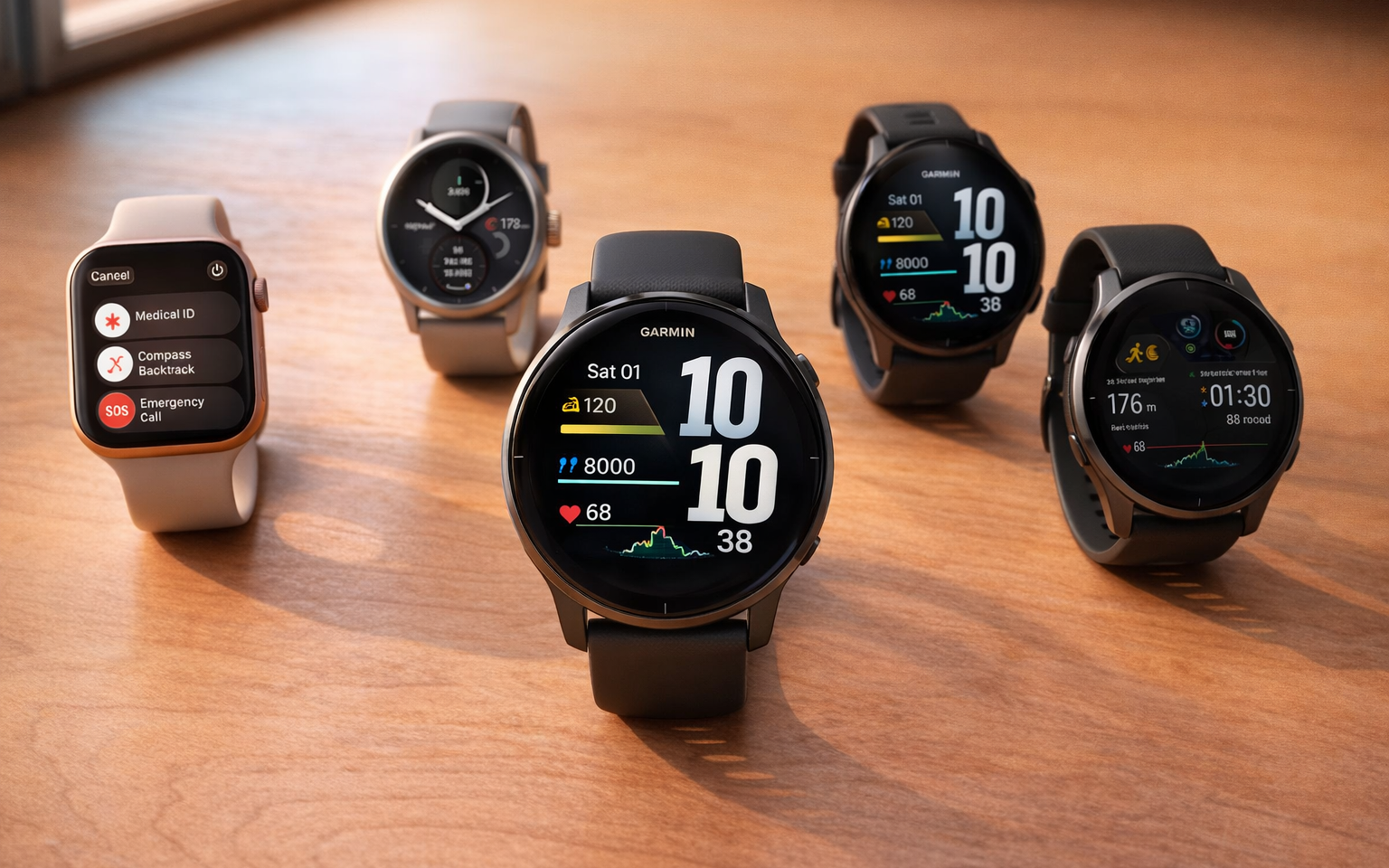
Apple Watch is the default smartwatch for iPhone owners, and for good reason – nothing else matches its depth of integration with iOS. But "default" does not mean "only option worth buying." Garmin, Withings, and Amazfit all make smartwatches that pair with iPhones through well-maintained iOS apps, and each offers something the Apple Watch cannot: multi-day battery life, deeper fitness analytics, hybrid analog designs, or significantly lower prices.
The tradeoffs are real. No third-party watch can reply to iMessages from your wrist, access the Apple Watch App Store, or mirror your iPhone notifications with the same seamless reliability. Every alternative requires accepting some friction – a separate app ecosystem, slightly delayed notification delivery, or reduced smart features. The question is whether what you gain is worth what you give up. For many iPhone users, the answer is a clear yes. Every watch in this guide has been verified for iPhone compatibility and uses an iOS app that is actively maintained in 2026.
Garmin Venu 4 – Best Overall Alternative
$549.99
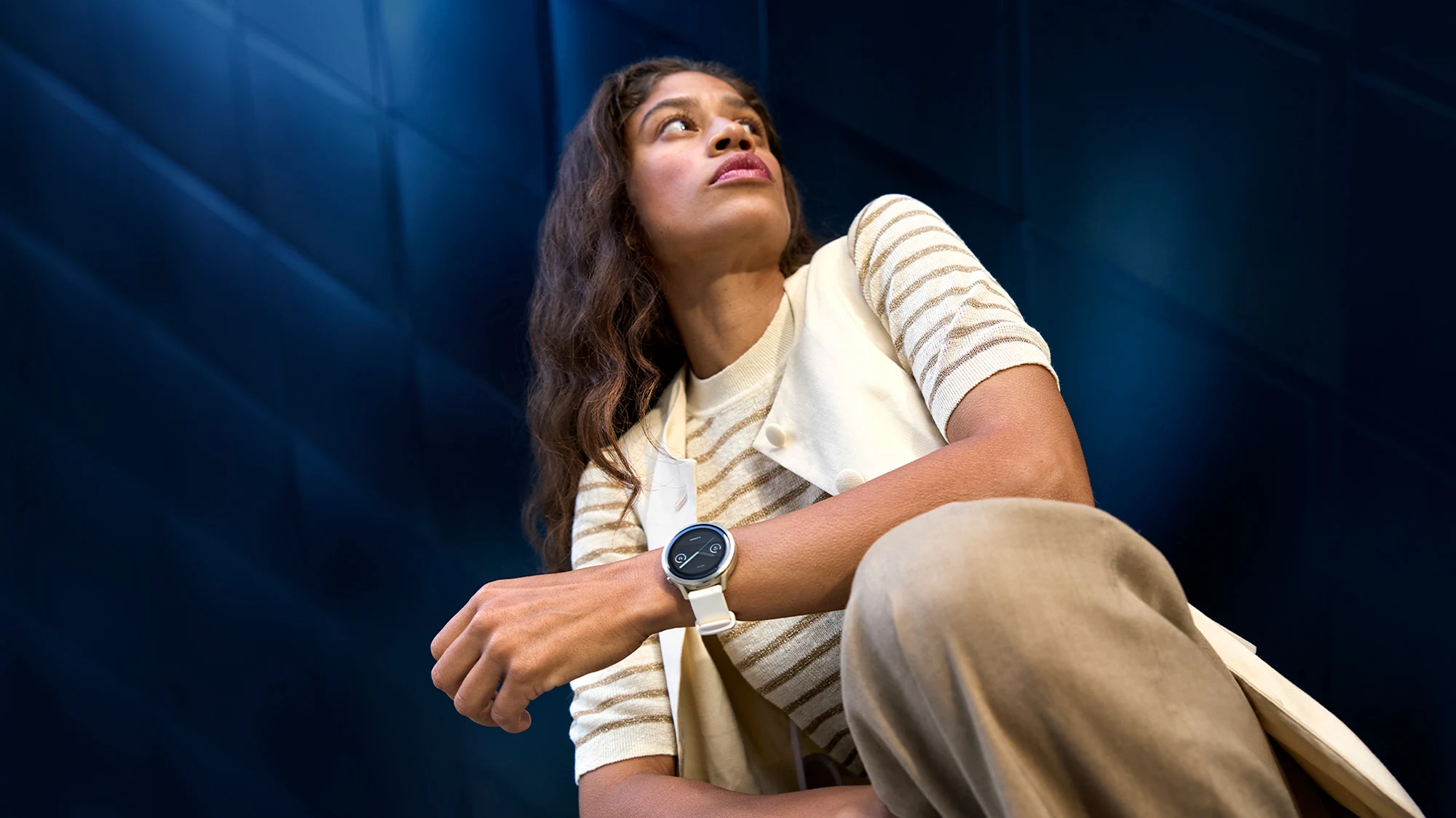
The Garmin Venu 4 is the strongest case for leaving the Apple Watch ecosystem. It pairs with iPhones through the Garmin Connect app, which offers near-complete feature parity with its Android counterpart for health data, workout analysis, and watch customization. Notifications from your iPhone appear on the watch reliably, and the built-in speaker and microphone handle phone calls directly from the wrist – a feature that works identically on iOS and Android.
The fitness depth is where the Venu 4 pulls ahead of any Apple Watch. Training Readiness scores, HRV Status, Body Battery energy monitoring, and wrist-based running dynamics provide a level of training insight that Apple's Workout app simply does not match. The health tracking suite is equally comprehensive: ECG, blood oxygen monitoring, skin temperature, sleep coaching, stress tracking, and full women's health features including cycle tracking and pregnancy monitoring. The 1.4-inch AMOLED display is bright and sharp, and the 45mm case (with a 41mm option available) looks polished enough for daily wear.
Battery life is the headline advantage. The 45mm Venu 4 lasts up to 12 days in smartwatch mode (10 days for the 41mm) – a real difference if you are accustomed to charging an Apple Watch every night. Even with heavy GPS use, you are looking at multiple days between charges.
The limitations on iPhone are specific but worth knowing. You cannot reply to text messages from the watch when paired with an iPhone (an iOS restriction, not a Garmin one). Google Maps turn-by-turn directions are Android-only. And there is no third-party app store – you get Garmin's built-in apps and Connect IQ watch faces, but nothing approaching the breadth of watchOS apps. For iPhone users who prioritize fitness tracking and battery life over app ecosystem depth, the Venu 4 is the best smartwatch money can buy.
Apple Watch Series 11 – Best for Full iPhone Integration
$399 (frequently discounted to $299)
The Apple Watch Series 11 belongs on this list because it is the benchmark every alternative is measured against. If you want the deepest possible integration with your iPhone – iMessage replies, Apple Pay, Siri, a full App Store, and seamless handoff between devices – nothing else comes close. The Series 11 adds hypertension notifications and an improved sleep score to an already mature platform.
The 42mm and 46mm sizes with the always-on OLED display look great, and the health tracking covers ECG, blood oxygen, skin temperature, sleep apnea detection, and crash detection. For general-purpose smartwatch use on an iPhone, the Series 11 does everything well.
The reason to look beyond it is straightforward: battery life tops out at roughly 24 hours, meaning nightly charging is not optional. The fitness tracking, while competent, lacks the granularity of Garmin's training metrics. And once you buy in, you are locked into Apple's ecosystem – the watch becomes a paperweight if you ever switch to Android. At a street price of around $299, it is a strong value. But the alternatives on this list exist because Apple Watch's strengths come with real compromises.
Garmin Vivoactive 6 – Best Value
$299.99
The Garmin Vivoactive 6 delivers a remarkable amount of watch for the price. The 42mm case with a 1.2-inch AMOLED display at 390x390 resolution looks and feels premium, and at 36 grams (with band), it is light enough for continuous wear. At $300, it costs less than an Apple Watch Series 11 at full retail and offers 11 days of battery life – a tradeoff that makes the math very simple for a lot of iPhone users.
The feature set punches well above its price. Over 80 built-in sport profiles, Body Battery energy monitoring, stress tracking, sleep coaching, blood oxygen monitoring, Garmin Pay, and 8GB of onboard music storage from Spotify and Amazon Music. GPS accuracy is solid for the price, though it lacks the multi-band GPS found on the Venu 4 and Forerunner 265. The Garmin Connect iOS app provides the same clean interface for reviewing health data, syncing workouts, and managing watch settings.
iPhone-specific limitations mirror those of the Venu 4: no message replies, notification-only mode for texts. But at this price point, the Garmin Vivoactive 6 is the most compelling entry into the Garmin ecosystem for iPhone users who want multi-day battery life and serious fitness tracking without spending $550.
Withings ScanWatch 2 – Best Hybrid Smartwatch
$369.95
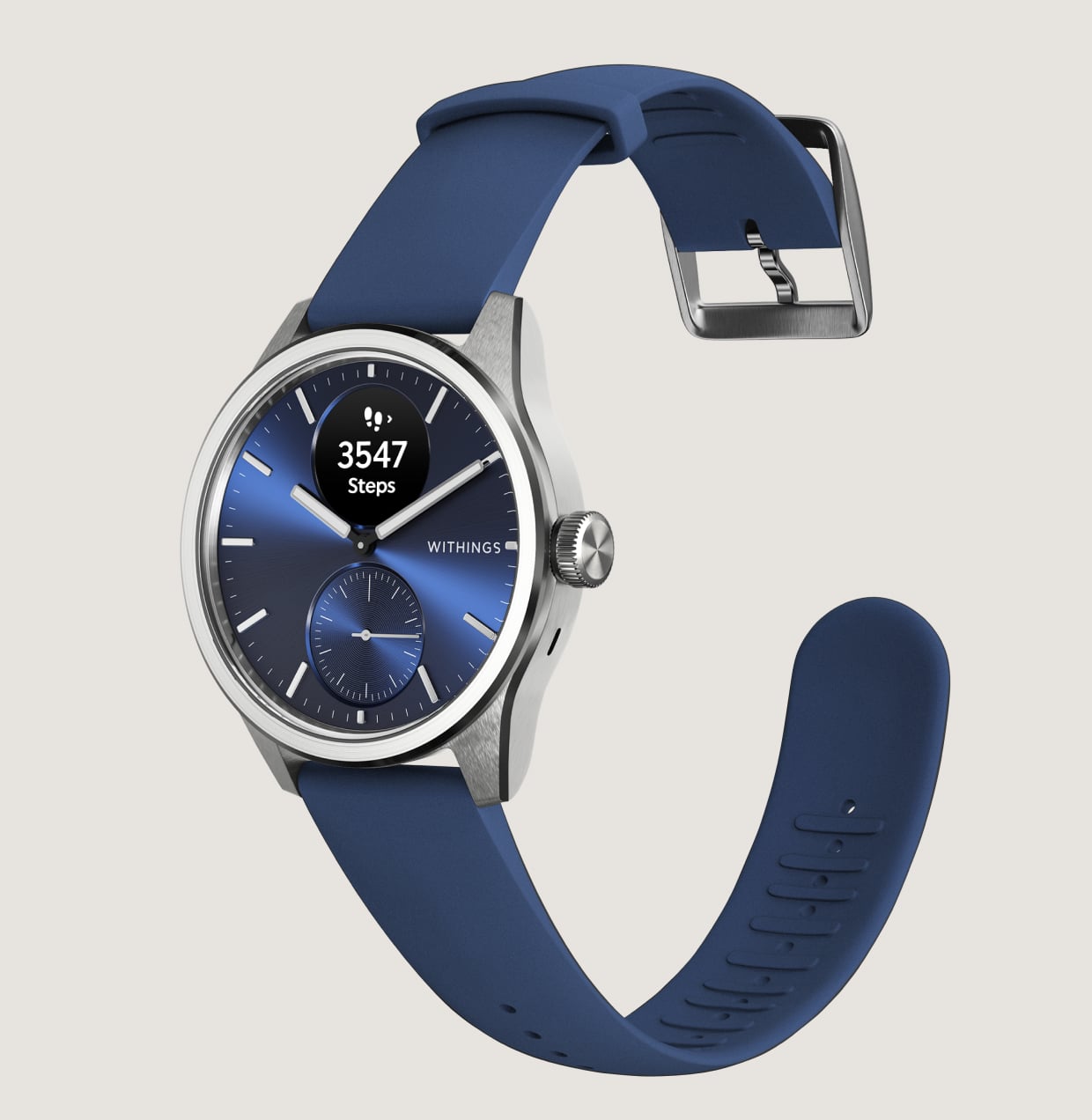
The Withings ScanWatch 2 takes a fundamentally different approach. It looks like a traditional analog watch – stainless steel case, physical hands, sapphire crystal – with a small OLED sub-display that surfaces health data and notifications on demand. For iPhone users who want health monitoring without wearing something that screams "tech gadget," the ScanWatch 2 is the only serious option.
The health tracking is legitimately impressive for a hybrid. Medical-grade ECG with atrial fibrillation detection, continuous SpO2 monitoring, 24/7 skin temperature tracking, heart rate and HRV monitoring, and respiratory rate tracking during sleep. The Withings Health Mate app on iOS is clean, well-designed, and syncs data to Apple Health seamlessly – making it one of the best-integrated third-party health apps on iPhone.
Battery life is the ScanWatch 2's defining advantage: up to 35 days on a single charge. You charge it roughly once a month. For iPhone users exhausted by daily Apple Watch charging, this alone may be reason enough to switch.
The tradeoffs are significant for active users. There is no built-in GPS – outdoor workouts use connected GPS from your iPhone. Fitness tracking is basic compared to Garmin: step counting, workout detection, and heart rate zones, but no advanced training metrics. Core health features – ECG, SpO2, skin temperature – work without a subscription. The Withings+ subscription ($9.95/month) unlocks the Vitality Indicator and on-demand cardiology consultations (up to four per year). The ScanWatch 2 is purpose-built for health monitoring and style, not fitness performance.
Amazfit Balance 2 – Best for Casual Users
$269.99
The Amazfit Balance 2 is the most affordable full-featured smartwatch that works with an iPhone. The Zepp app on iOS handles pairing, syncing, and data analysis, and while it is not as polished as Garmin Connect or Apple's Health app, it is functional and actively updated – version 10.0 brought a refreshed interface and new features in early 2026.
For the price, the feature list is aggressive. A vibrant AMOLED display, built-in GPS with solid accuracy, heart rate monitoring, blood oxygen, stress tracking, sleep analysis, and over 160 sport modes. Battery life stretches to a claimed 21 days in typical use – competitive with Garmin watches costing nearly twice as much. The slim profile reads more as a lifestyle watch than a fitness band.
The iOS experience is where Amazfit shows its budget positioning. Some features launch on Android first before reaching iOS. Notification support works but lacks the polish of Garmin's implementation – occasional delays or missed notifications are more common. There is no NFC payment in the US market, and third-party app support is minimal. The health data is comprehensive but less validated than what Garmin or Apple deliver, particularly for heart rate variability and sleep staging accuracy.
For iPhone users who want a capable smartwatch at the lowest possible price, the Balance 2 is the clear pick. Just go in understanding that the iOS experience, while functional, sits a tier below what Garmin and Apple offer.

Garmin Forerunner 265 – Best for Runners
$449.99 (frequently on sale for $300)
The Garmin Forerunner 265 is now a few years old, which works in its favor – the street price frequently drops to $300, making it one of the best values in GPS running watches. For iPhone-using runners, the Forerunner 265 pairs flawlessly via Garmin Connect and delivers training analytics that no Apple Watch or competing platform can touch.
Multi-band GPS with SatIQ technology provides best-in-class positioning accuracy. Training Status, Training Load, Morning Report, HRV Status, Race Predictor, and Daily Suggested Workouts create a complete training ecosystem that adapts to your fitness level and recovery. The 1.3-inch AMOLED display is bright enough to read mid-run, and battery life hits 13 days in smartwatch mode or 20 hours with continuous GPS – enough for marathon and beyond.
This is not a lifestyle smartwatch. It does not have a speaker or microphone for phone calls, the watch face options lean sporty rather than stylish, and the feature set is laser-focused on running and multisport training. But that focus is exactly why it is here. For pure running performance on an iPhone, the Forerunner 265 is unmatched.
How We Chose
Every watch on this list meets four non-negotiable requirements for iPhone users.
iOS app quality. The companion app must be available on iOS, actively maintained, and capable of delivering the full (or near-full) feature set without requiring an Android phone. Garmin Connect, Withings Health Mate, and the Zepp app all meet this bar. Samsung's Galaxy Wearable app and Google's Pixel Watch app do not – those watches require Android and were excluded entirely.
Notification reliability. iPhone notifications must appear on the watch consistently and promptly. All six picks deliver reliable notification mirroring, though none match the Apple Watch's native depth (inline replies, actionable notifications, iMessage integration).
Health and fitness features. Heart rate monitoring, sleep tracking, and workout tracking are table stakes. The picks that rank highest offer additional depth: ECG, blood oxygen, skin temperature, training analytics, or medical-grade health monitoring.
Battery life relative to category. Battery life is weighed against what the watch is trying to be. A 24-hour Apple Watch is acceptable for an all-in-one smartwatch; a 12-day Garmin is expected for a fitness watch. The goal is identifying watches that deliver strong battery performance for their category.
Price, build quality, display, and design were secondary factors. We prioritized recommending watches across multiple price tiers so that every iPhone user – from budget-conscious to premium – has a strong option.
Who Should Buy What
You want the smoothest possible iPhone experience. Get the Apple Watch Series 11. Nothing else integrates as deeply with iOS.
You want the best fitness watch that works with iPhone. Get the Garmin Venu 4. It is the most complete alternative to Apple Watch, with vastly better battery life and deeper fitness tracking.
You want Garmin fitness depth at the lowest Garmin price. Get the Garmin Vivoactive 6. At $300, it is the best value on this list for fitness-focused iPhone users.
You want a watch that looks like a watch. Get the Withings ScanWatch 2. Five-week battery life, analog design, and strong health tracking through an excellent iOS app.
You want a full-featured smartwatch without the Garmin learning curve. Get the Amazfit Balance 2. At $270, it undercuts the Vivoactive 6 and offers a simpler, more casual experience with impressive battery life, even if the iOS polish is a step behind.
You are a runner first. Get the Garmin Forerunner 265. The training analytics are unmatched, and the street price makes it a strong value.
What To Avoid
Samsung Galaxy Watch 7 and Galaxy Watch Ultra. These are excellent smartwatches – on Android. They run Wear OS and require a Samsung or Android phone for setup and daily use. There is no official iPhone compatibility. Third-party workarounds like the Merge app exist but deliver a severely compromised experience with missing features and unreliable syncing. Do not buy a Samsung Galaxy Watch for your iPhone.
Google Pixel Watch 3. Same story. Wear OS, Android-only. The Pixel Watch requires a Google Pixel or Android phone and has zero iPhone support.
No-name budget watches on Amazon. Watches priced under $50 from unfamiliar brands typically have poorly maintained iOS apps (if they have iOS apps at all), unreliable Bluetooth connections, and health sensors that produce inaccurate data. The Amazfit Balance 2 is the budget floor for a reason – below that price point, the iPhone experience degrades rapidly.
Any watch marketed as "iPhone compatible" without specifying the iOS app. If the listing does not name a specific, well-reviewed iOS companion app, assume the iPhone experience is an afterthought. The watches on this list all have established, actively maintained iOS apps with meaningful user bases.
The bottom line: the Apple Watch is still the most deeply integrated smartwatch for iPhone, but it is no longer the only good one. The Garmin Venu 4 leads this guide because it offers the best combination of fitness depth, battery life, and iOS compatibility. Whether you prioritize fitness tracking, battery longevity, analog style, or value, there is a strong iPhone-compatible option here that does not require nightly charging or Apple ecosystem lock-in.