
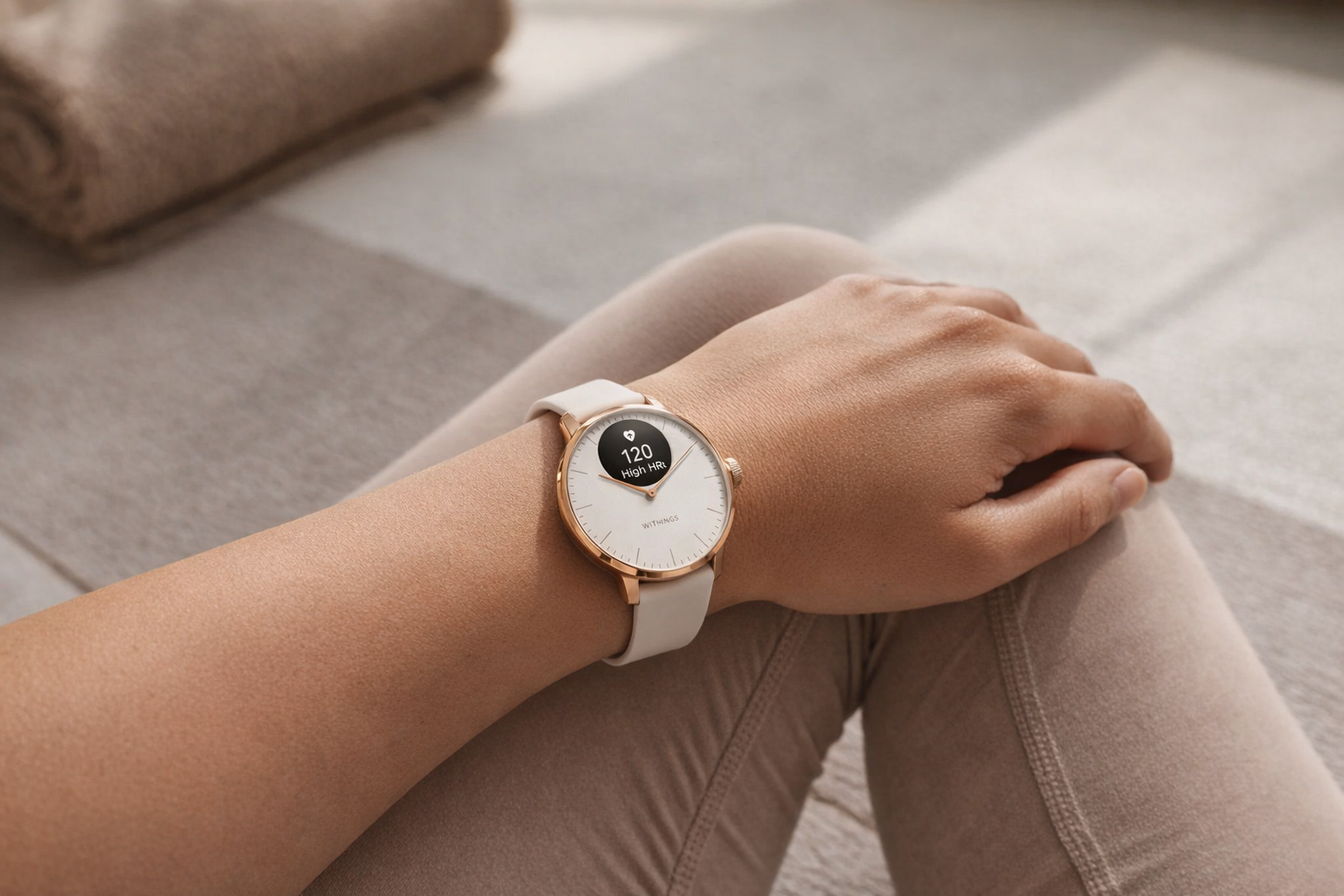
There is a particular kind of frustration that comes with modern smartwatches. You strap on a rectangle of glass that dies every night, buzzes constantly, and announces to everyone within eyeshot that you are the kind of person who checks notifications on their wrist during dinner. The Withings ScanWatch Light exists for the people who find that entire proposition exhausting.
This is a hybrid smartwatch that prioritizes being a watch first and a health tracker second – and a smartwatch barely at all. At $249.95, it wraps continuous heart rate monitoring, sleep tracking, and activity logging inside a 37mm stainless steel case that could pass for a minimalist dress watch. The trade-offs are real: no GPS, no ECG, no blood oxygen sensor, and a display so small it barely qualifies as a screen. Whether that equation works depends entirely on what you want from your wrist.
Design & Build
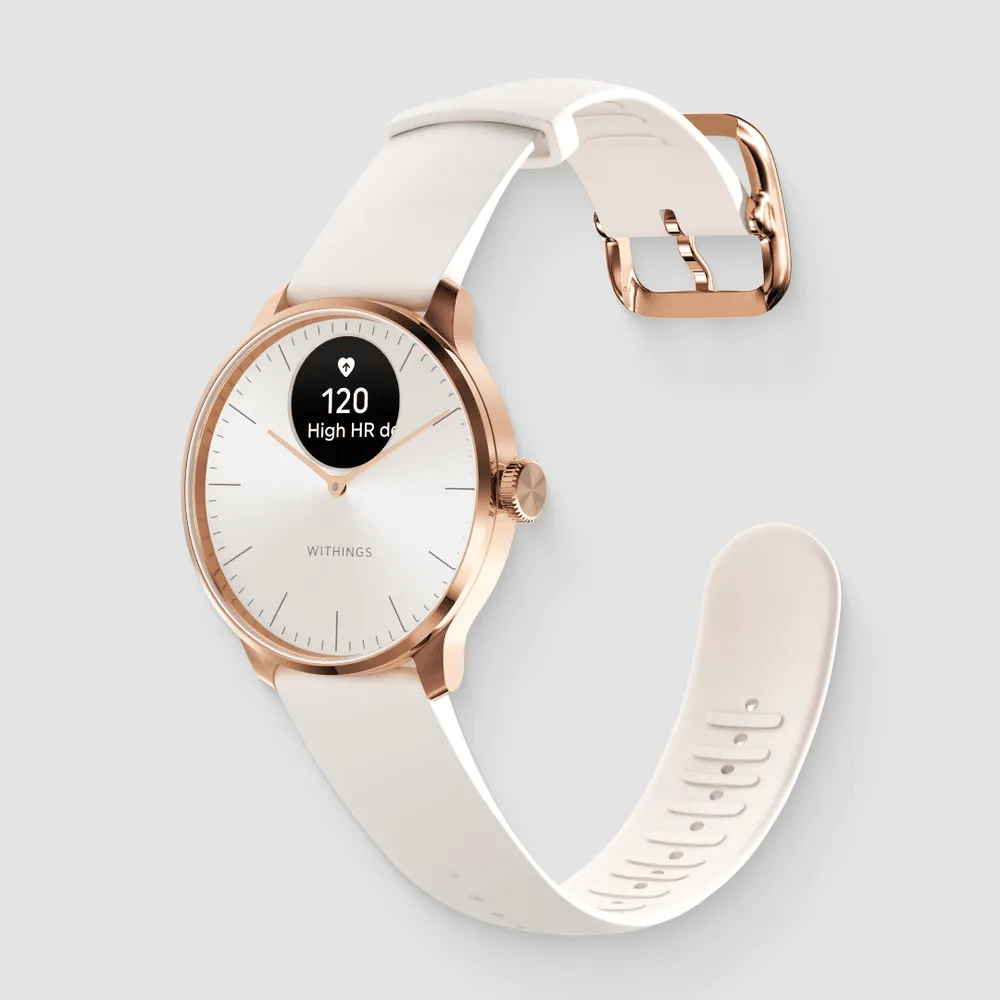
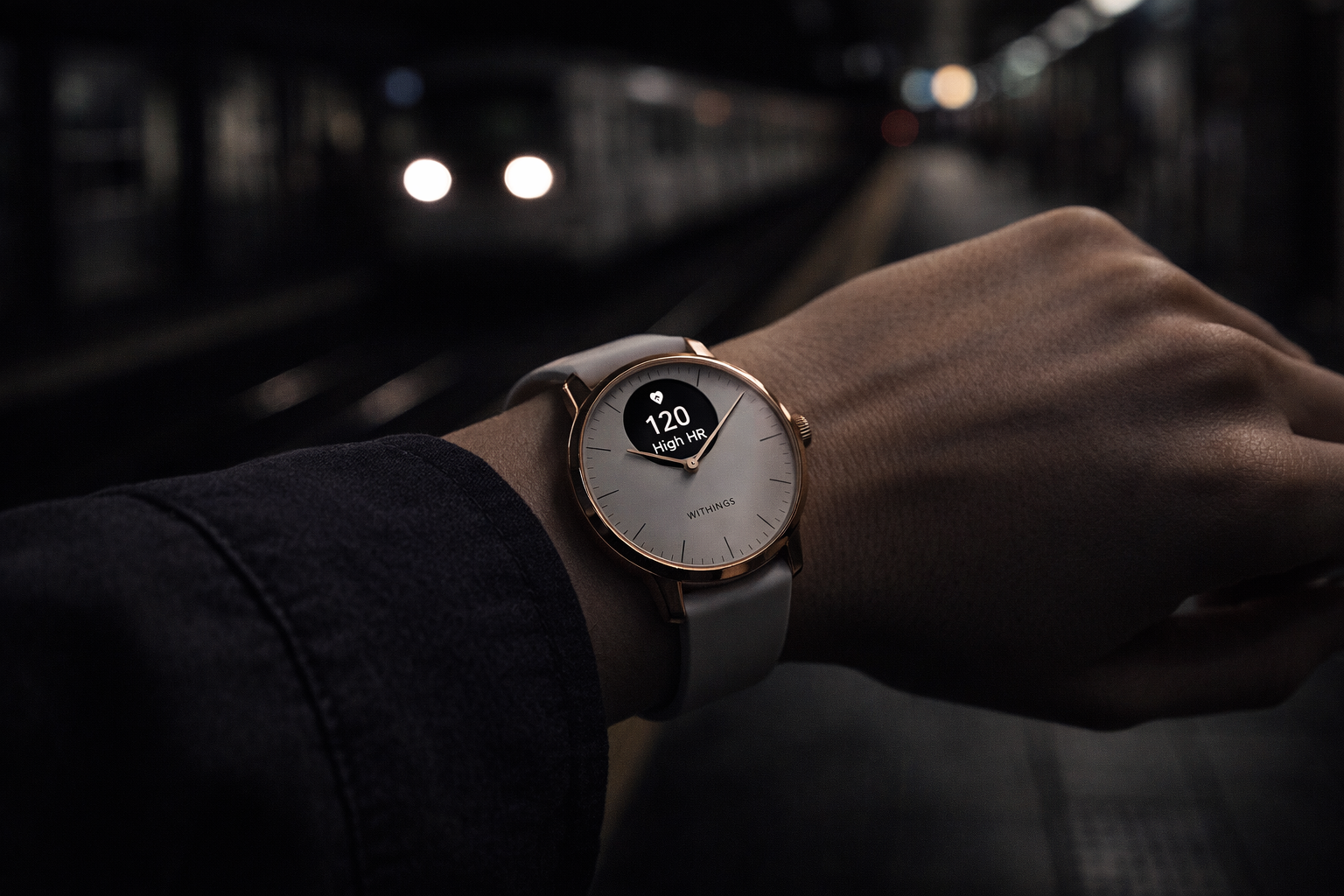
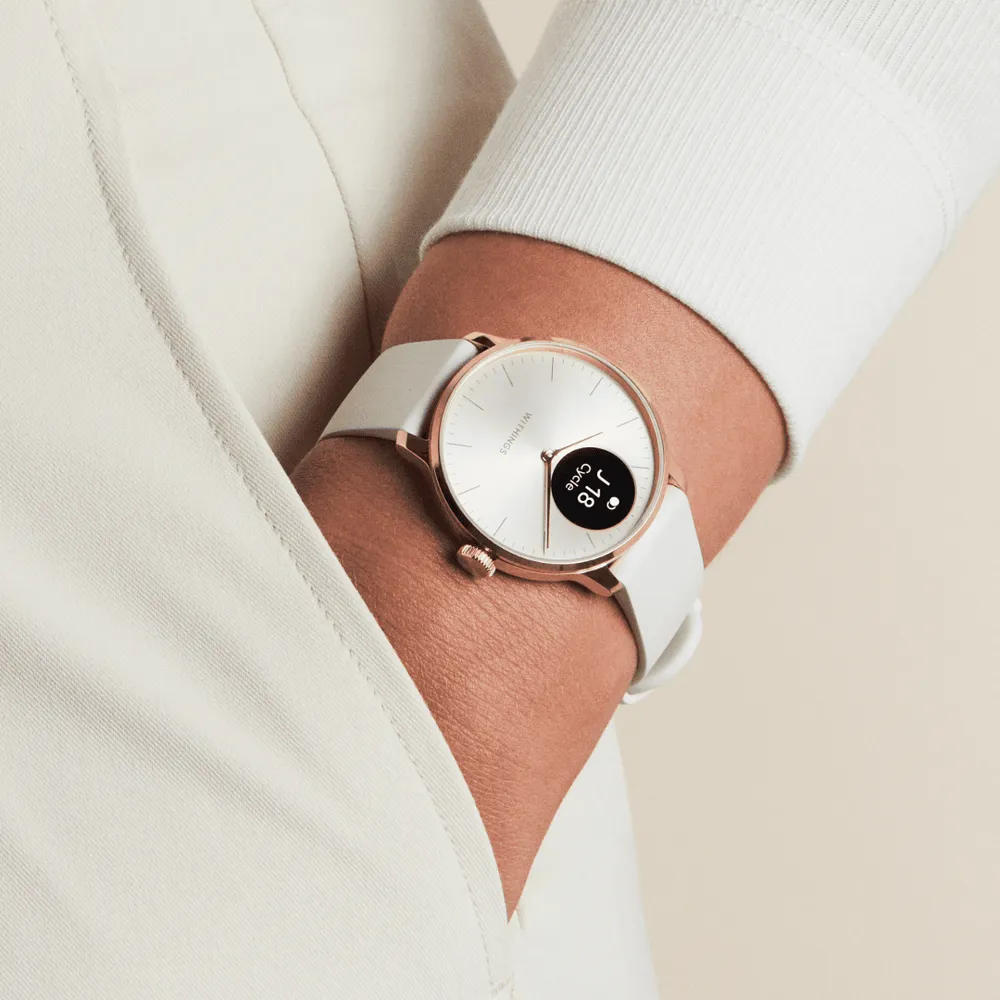
The ScanWatch Light is, without qualification, one of the most attractive wearable devices on the market. The 37mm stainless steel case sits at just 9.85mm thick and weighs 27.1 grams without the band – lighter than most traditional watches in this class. The real achievement is that nothing about its appearance signals "tech product." The analog hour and minute hands sweep across a clean dial, and only the small circular OLED cutout at the six o'clock position hints at anything digital happening underneath.
Withings offers the Light in several colorways, including Pearl White, Black, Sand & Rose Gold, and Withings-exclusive Green and Blue & Rose Gold options. Each manages to look cohesive rather than gimmicky. The 18mm FKM fluoroelastomer band is comfortable and swappable, though the included band feels slightly below the quality of the case itself. Third-party 18mm bands fit without issue.
The Gorilla Glass crystal is a step down from the sapphire glass on the pricier ScanWatch 2, but it handles daily wear respectably. Water resistance is rated at 5 ATM, making it safe for swimming, showering, and the general indignities of daily life. The stainless steel crown provides a satisfying tactile element and serves as the primary physical control.
Where the build story gets complicated is the charger. The proprietary magnetic docking cradle feels cheap relative to the watch itself – a plastic puck that contacts the dial rather than the caseback. The dock itself uses a USB-C connector, but the cable terminates in USB-A on the power adapter end – an odd pairing that limits charging flexibility. The cradle also has known compatibility issues with certain power adapters. It is a minor annoyance in daily use but a noticeable gap in the overall fit and finish.
Display
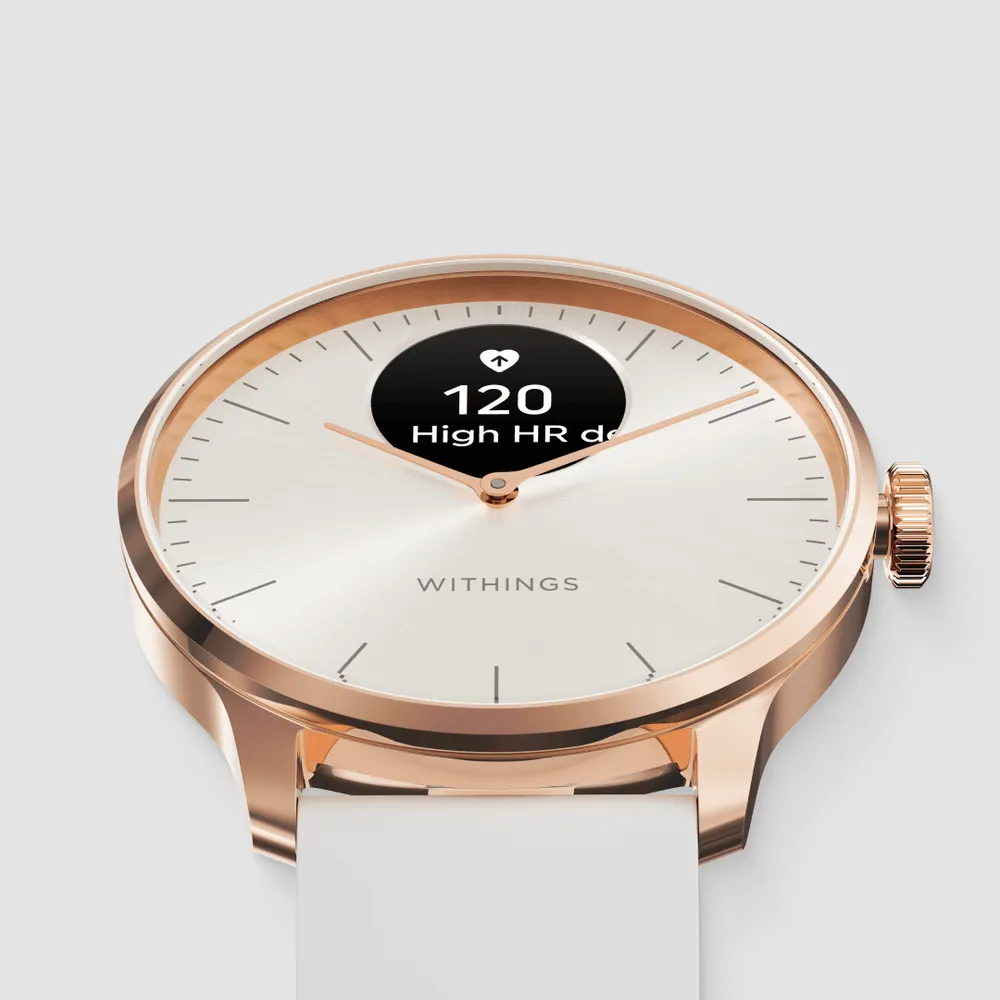
The OLED display is a 0.63-inch grayscale circle nestled into the lower half of the watch face. At 282 PPI and 14,504 pixels, it is sharp enough for its size. The panel represents an improvement over earlier Withings displays, with better contrast and readability in most lighting conditions.
That qualifier matters. In direct sunlight, the display struggles. The modest brightness is adequate indoors but washes out outdoors, making mid-run heart rate checks a squinting exercise. This is a fundamental constraint of keeping the screen small and the battery enormous – there is no always-on option, and activation requires a wrist raise or crown press.
The display handles workout metrics, notifications, and health readings through a scrolling interface navigated by the crown. Notifications are functional but limited: text scrolls slowly across the tiny screen, and there is no way to respond or interact beyond reading. For a quick glance at who texted, it works. For actually reading the message, you will reach for your phone.
This is not a flaw so much as a philosophical commitment. The ScanWatch Light treats its display as an information ticker, not an interface. If that sounds limiting, this is not the right watch.
Health & Fitness Tracking
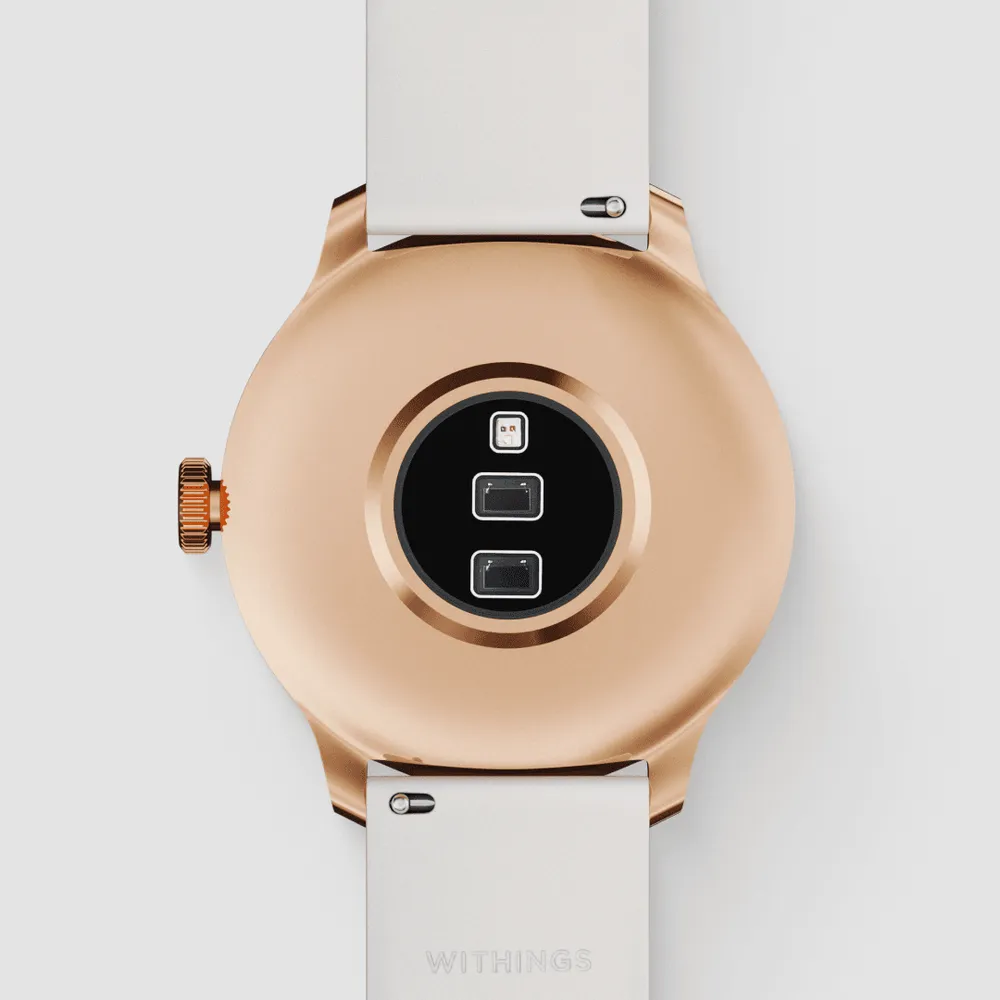
The ScanWatch Light carries a multi-wavelength PPG sensor for continuous heart rate monitoring and a high dynamic range accelerometer for motion tracking. Absent from the spec sheet – and this matters – are the electrocardiogram, standalone blood oxygen (SpO2) readings, and skin temperature monitoring found in the ScanWatch 2. (The Light does use SpO2 hardware internally for its Breathing Quality and Respiratory Scan sleep features, but there is no on-demand SpO2 measurement.)
What remains is a capable but deliberately basic health tracking suite. Heart rate monitoring runs continuously, day and night, with configurable alerts for high and low readings. Resting heart rate accuracy is strong, producing readings that align closely with dedicated fitness devices. During vigorous exercise, however, the optical sensor can drift – a common limitation of wrist-based PPG sensors, and one that is slightly more pronounced here than on competing devices with newer sensor arrays.
Sleep tracking is where the ScanWatch Light genuinely earns its keep. The watch automatically detects sleep onset and waking, tracks light and deep sleep stages, monitors breathing disturbances (a meaningful screen for sleep apnea risk), and produces an overall Sleep Quality Score. One notable gap: REM sleep is not tracked, which limits the granularity of sleep analysis compared to devices like the Oura Ring or Fitbit Charge 6. Still, the data is detailed, the trends are useful, and the overnight heart rate graphs provide genuine health insight. For many buyers, this alone justifies the purchase.
Activity tracking covers the basics: steps, calories, distance, and active minutes. Workout tracking supports 30 exercise types, but the data is sparse without built-in GPS. Connected GPS – routing through the paired phone – provides distance, pace, and route mapping for outdoor activities, but this requires carrying the phone. There is no elevation tracking and no VO2 max estimation. Cycle tracking is integrated and well-implemented, covering phases, period logging, flow tracking, and symptom logging directly through the watch and app.
The honest assessment: the ScanWatch Light is a wellness monitor, not a fitness instrument. It excels at passive, long-term health observation and falls short of what dedicated runners, cyclists, or gym enthusiasts need for training optimization.
Performance & Features
The Withings Health Mate app serves as the command center for all ScanWatch Light data. Available on iOS 16+ and Android 9.0+, it aggregates health metrics into a dashboard that is, on balance, well-designed. Sleep data visualization is particularly strong, with clear graphs and actionable weekly trends. Heart rate history, activity summaries, and cycle tracking all present cleanly.
The app integrates with Apple Health and Google Health Connect, which helps consolidate data from multiple sources. Seven days of data are stored on the watch itself, with unlimited cloud storage through the Withings account.
There are, however, persistent rough edges. On Android, notification reliability requires careful configuration of background app permissions – a setup burden that should not exist on a $250 device. The initial Bluetooth pairing process can be finicky. And Withings+ – a $9.95/month subscription service – gates some advanced health insights, workout programs, and nutritional content behind a paywall. The core health data remains free, but the subscription prompt is a recurring friction point in an already-premium-priced product.
Smart features are minimal by design. There are no apps, no music controls, no voice assistant, and no contactless payments. The watch displays phone notifications and offers cardiac coherence breathing exercises. That is essentially the full extent of its "smart" capabilities. For the target buyer, this restraint is a feature, not a bug.
Battery Life
Battery life is the ScanWatch Light's party trick, and it delivers. Withings officially claims up to 35 days, and real-world results land comfortably in the three-to-four-week range with heart rate monitoring active and a moderate volume of phone notifications enabled. Heavy feature users – particularly those with raise-to-wake enabled and frequent connected GPS sessions – should expect closer to two weeks.
Reducing notification volume or disabling raise-to-wake pushes battery life past three weeks with ease. Using the watch purely as an analog timepiece with passive health tracking can stretch well beyond a month. Charging from empty takes approximately two hours via the magnetic dock.
To contextualize that figure: an Apple Watch Series 9 lasts roughly 18 hours. A Google Pixel Watch 2 manages about 24 hours. A Samsung Galaxy Watch 6 stretches to around 40 hours. The ScanWatch Light operates in a fundamentally different category – charging it becomes a weekly or biweekly ritual rather than a nightly obligation. The psychological difference is significant. A watch you charge twice a month feels like a watch. A watch you charge every night feels like another device demanding your attention.
The one caveat is long-term battery health. The battery is non-replaceable, and capacity degradation becomes noticeable after 18–24 months of ownership. This is not unique to Withings, but it is worth noting for a device that lists battery life as a primary selling point.
Who It's For
The ScanWatch Light is built for a specific person: someone who wears a traditional watch, wants passive health monitoring, and refuses to strap a miniature phone to their wrist. Office professionals who want sleep and heart rate data without a conspicuous gadget. People recovering from health scares who want continuous monitoring without the learning curve of a Garmin. Anyone who has tried an Apple Watch, found it overwhelming, and gone back to a regular timepiece. For more options tailored to this audience, see our best smartwatches for women guide.
It is also a strong option for smaller wrists. At 37mm with a slim profile, it fits comfortably where larger smartwatches look cartoonish. The Garmin Lily 2 Active is another slim-profile option worth comparing if fitness tracking matters more to you.
Who Should Skip
Runners and cyclists who want GPS-tracked routes without carrying a phone. Fitness enthusiasts who need VO2 max, advanced workout metrics, or accurate exercise heart rate. Anyone who values rich notifications, app ecosystems, or smartwatch functionality. People who want ECG or blood oxygen monitoring – spend the extra $100 on the ScanWatch 2. Anyone bothered by subscription upsells in a $250 product.
The Verdict
The Withings ScanWatch Light commits fully to a single idea – that a health-tracking wearable should look and feel like an actual watch – and executes it with more conviction than anything else at this price. The design is genuinely beautiful, the battery life is transformative, and the sleep tracking provides real health value. But the stripped-down sensor suite, tiny display, and absent GPS mean it cannot compete on features with similarly priced alternatives from Garmin or Samsung.
If you want more health sensors without giving up the hybrid design, the ScanWatch Nova adds ECG, SpO2, and temperature tracking. For a broader look at the category, our best health monitoring watches roundup covers the full spectrum. And if you are considering a budget fitness band instead, the Amazfit Active 2 offers GPS and a color display for less money.
This is a watch for people who know exactly what they want and, more importantly, what they do not.
| Category | Weight | Score |
|---|---|---|
| Core Function | 30% | 68/100 |
| Build Quality | 15% | 78/100 |
| User Experience | 20% | 72/100 |
| Value | 20% | 70/100 |
| Battery | 15% | 88/100 |
| Weighted Total | 74/100 |
Score: 74/100 – A good hybrid smartwatch with clear strengths in design and battery life, recommended with the caveat that its appeal is narrow by design. If the premise speaks to you, nothing else does it better.