
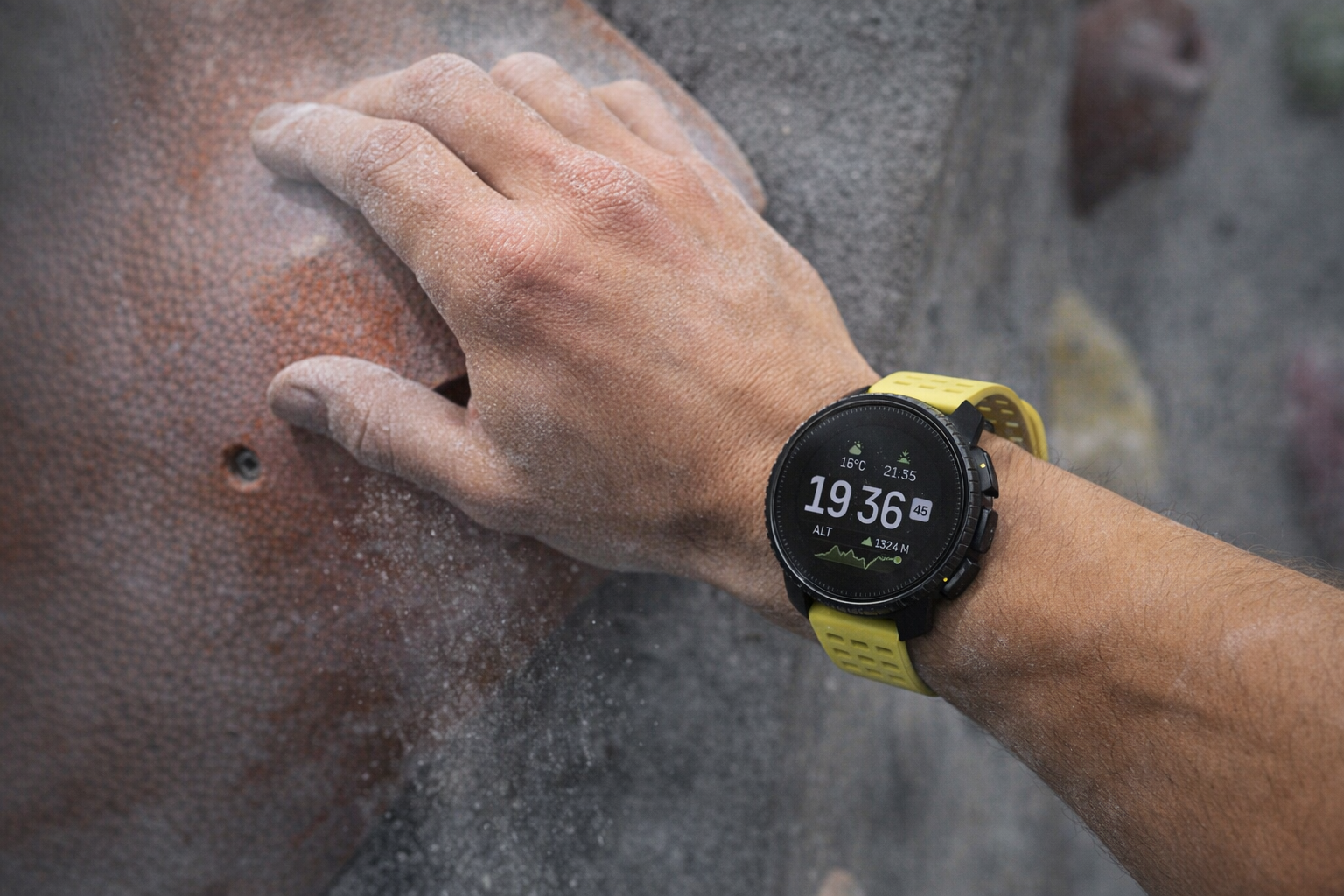
For the better part of a decade, Suunto watched its outdoor watch empire erode. Garmin ate the high end with the Fenix line. COROS undercut the mid-range with aggressive pricing and rapid innovation. Apple grabbed the casual adventure crowd with the Ultra. Suunto's responses – the 9 Peak, the 9 Peak Pro – were competent but conservative, the kind of watches that kept existing loyalists comfortable without giving defectors a reason to come home.
The Vertical is a different proposition entirely. It is the first Suunto watch that feels like it was designed to win customers rather than retain them. Free offline maps on a 32GB storage chip. Dual-band GPS that rivals anything Garmin ships. A solar-equipped titanium variant that can run for 85 hours on a single charge in the most accurate GPS mode. And a price that now starts at $499 for the stainless steel model – significantly less than a fully loaded Garmin Fenix 7. This is the watch that stopped the bleeding, and it did it by doing what Suunto has always done best: building a rugged instrument for people who spend serious time in serious terrain.
Design and Build
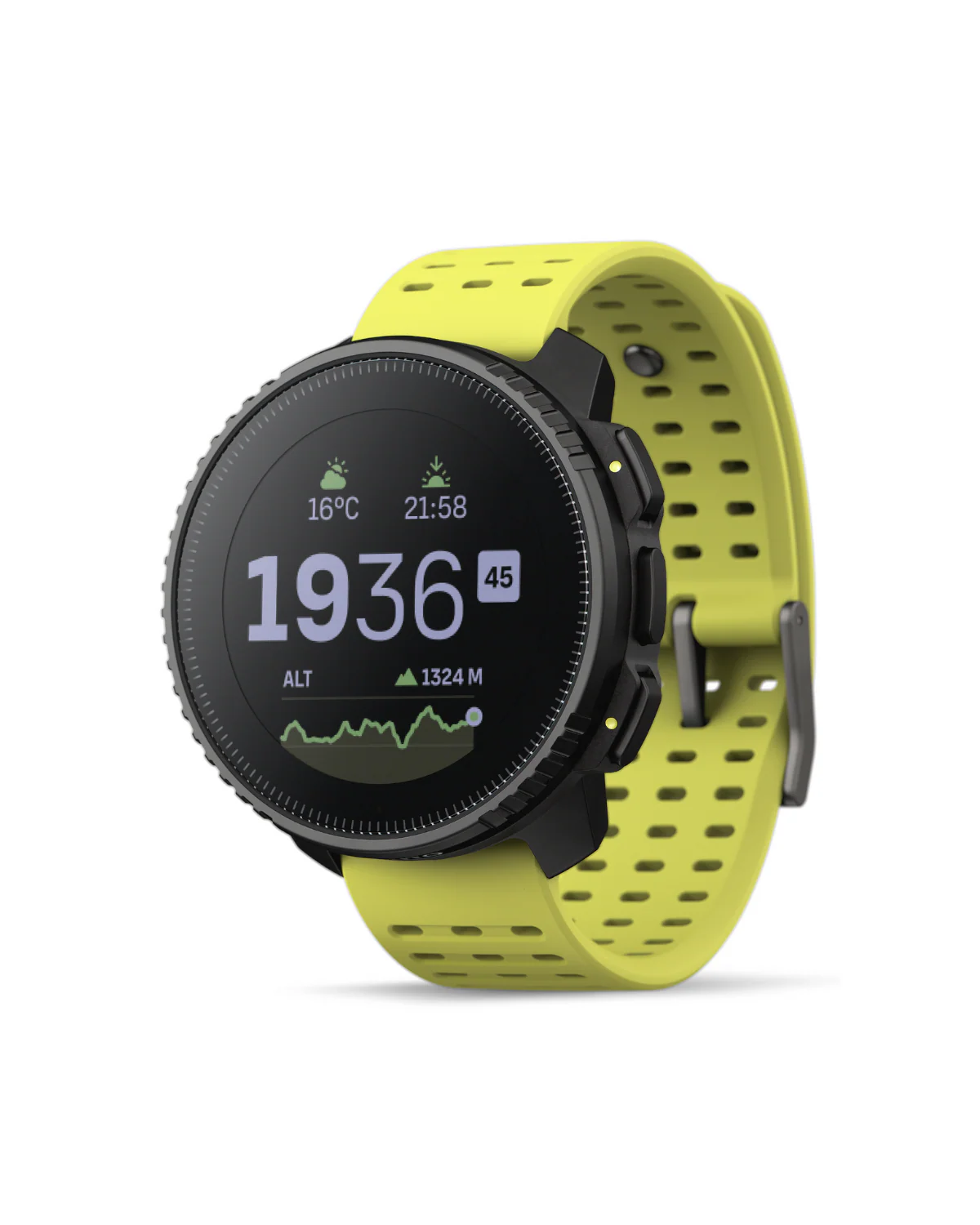
The Suunto Vertical is available in two case materials: stainless steel and titanium. Both share the same 49mm diameter and 13.6mm thickness, but the weight difference is meaningful. The titanium model comes in at 74 grams, while the stainless steel version weighs 86 grams. Neither is featherweight – this is a large outdoor watch – but the titanium variant sits noticeably lighter on the wrist during all-day wear and overnight sleep tracking.
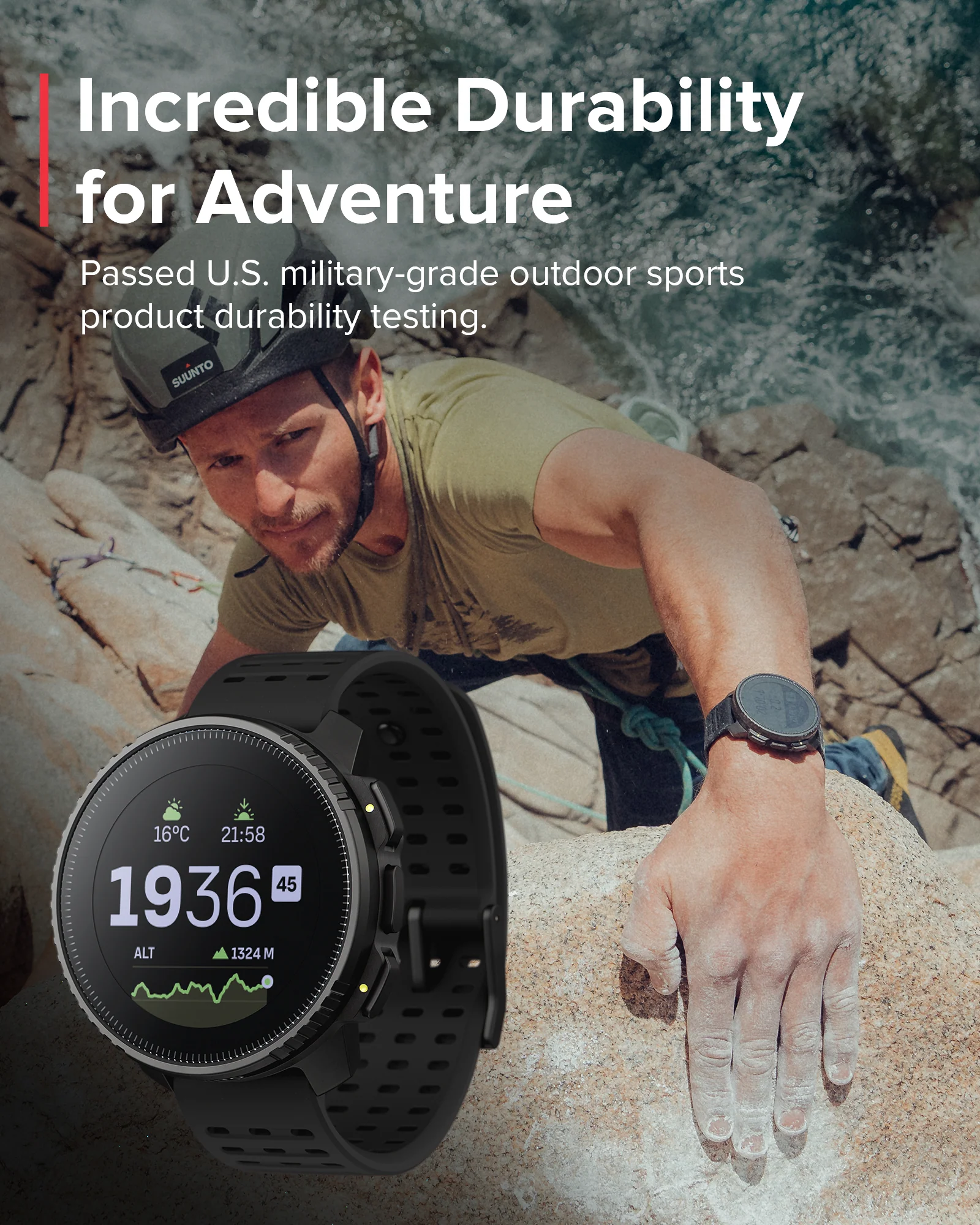
Both variants feature a sapphire crystal display cover, which is a welcome inclusion at this price. Sapphire provides genuine peace of mind against rock strikes, branch scrapes, and the general abuse that an outdoor watch accumulates over months of trail running and mountaineering. Water resistance is rated to 100 meters (10 ATM), suitable for swimming, snorkeling, and rain-soaked mountain crossings.
The industrial design is distinctly Scandinavian – clean, understated, and purposeful. The bezel is flat and functional rather than decorative. Three physical buttons on the right side handle navigation, and the touchscreen supplements button input for map panning and menu scrolling. The silicone strap is comfortable and durable, with a standard quick-release mechanism for easy swaps.
Where the Vertical diverges from Garmin's Fenix line is in its restraint. There is no flashlight. There is no built-in speaker. There is no tap-to-pay. Suunto stripped the feature list down to what matters in the backcountry and executed those features well. Whether that restraint feels refreshing or limiting depends entirely on what you expect from a watch at this price.
Display
The Suunto Vertical uses a 1.4-inch memory-in-pixel (MIP) display at a resolution of 280 x 280 pixels. This is the most polarizing aspect of the watch, and it is worth being direct about both its strengths and its weaknesses.
The strengths are considerable. MIP technology is always-on without meaningful battery penalty. In direct sunlight – precisely the conditions where you most need to read a watch while running, hiking, or cycling – the display actually gets more readable as ambient light increases. There is no fighting reflections or cupping your hand around the screen. For outdoor athletes, this is a genuine functional advantage over AMOLED displays, which require brute-force brightness to compete with the sun.
The weaknesses are equally real. At 280 x 280 pixels on a 1.4-inch panel, the resolution is noticeably lower than competitors. Map detail suffers – fine trail markings and contour labels can be difficult to parse at a glance. Text rendering lacks the crispness of the AMOLED panels found on the Garmin Fenix 7 Pro or Suunto's own Race. In low-light conditions, the backlight is adequate but unremarkable. If you have been using an AMOLED sports watch, the Vertical's screen will feel like a step backward in visual fidelity, even as it delivers superior sunlight performance and battery efficiency.
The ambient light sensor adjusts backlight intensity automatically, and the display remains readable across a wide range of lighting conditions. For its intended audience – people who spend more time above treeline than under fluorescent office lights – the trade-off is defensible.
Maps and Navigation
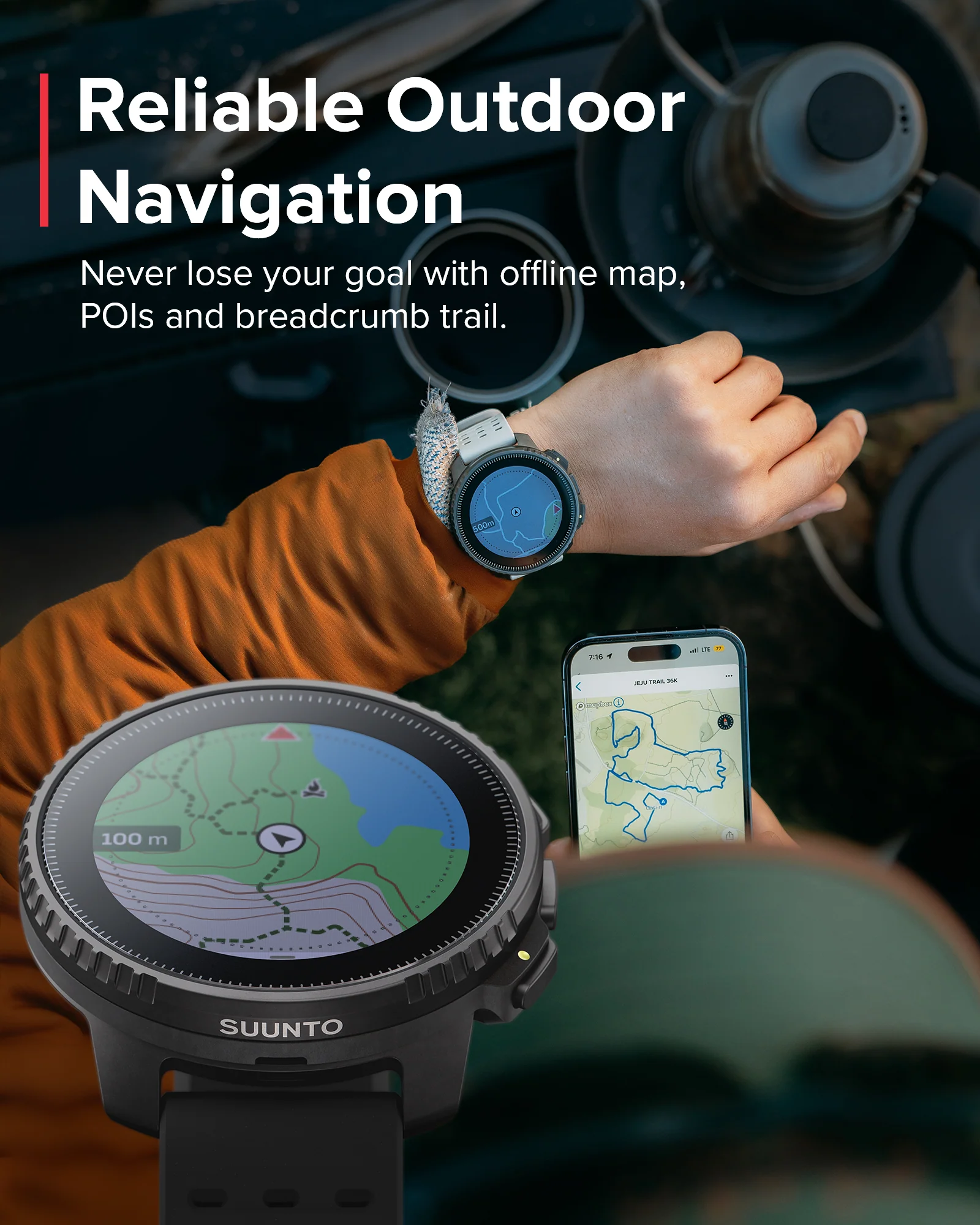
This is the headline feature, and it delivers. The Suunto Vertical was the first Suunto watch to ship with free offline topographic maps, stored on 32 GB of onboard flash memory. That is enough space to hold all of Europe's maps, or roughly half of the continental United States.
Maps are downloaded via Wi-Fi – the watch connects directly to a wireless network, no phone tethering required. The process requires the watch to be charging during download, which is a minor inconvenience but ensures the battery is not drained during large transfers. Once downloaded, the maps are available permanently and do not require a subscription. This is a meaningful differentiator: Garmin's comparable maps on the Fenix line require no separate download process but come at a significantly higher device price, while COROS offers maps but with less storage and less map detail.
The topographic maps display terrain contours, trail paths, water features, road surface types, and landmarks. They are color-rendered and reasonably detailed on the MIP screen, though the 280 x 280 resolution means you will occasionally need to zoom in to distinguish closely spaced trail junctions. The maps are not routable – they will not calculate turn-by-turn directions on the fly like a Garmin Fenix 8 with its built-in routing engine. If you miss a turn, the Vertical will not offer an alternative route. It will show you where you are on the map and where your planned route goes, but the creative problem-solving is left to you.
Route planning is handled through the Suunto app, which generates routes based on waypoints and can import GPX and KML files from third-party platforms. Once synced to the watch, routes can include turn-by-turn instructions with audible and vibration alerts. The breadcrumb trail feature tracks your path in real time, making it straightforward to retrace your steps if conditions deteriorate.
For hikers, trail runners, and mountain bikers who plan routes before heading out, the navigation system is excellent. For explorers who prefer to navigate spontaneously and rely on on-the-fly routing, Garmin's more sophisticated map engine remains the better tool.
GPS, Training, and Software
GPS Accuracy
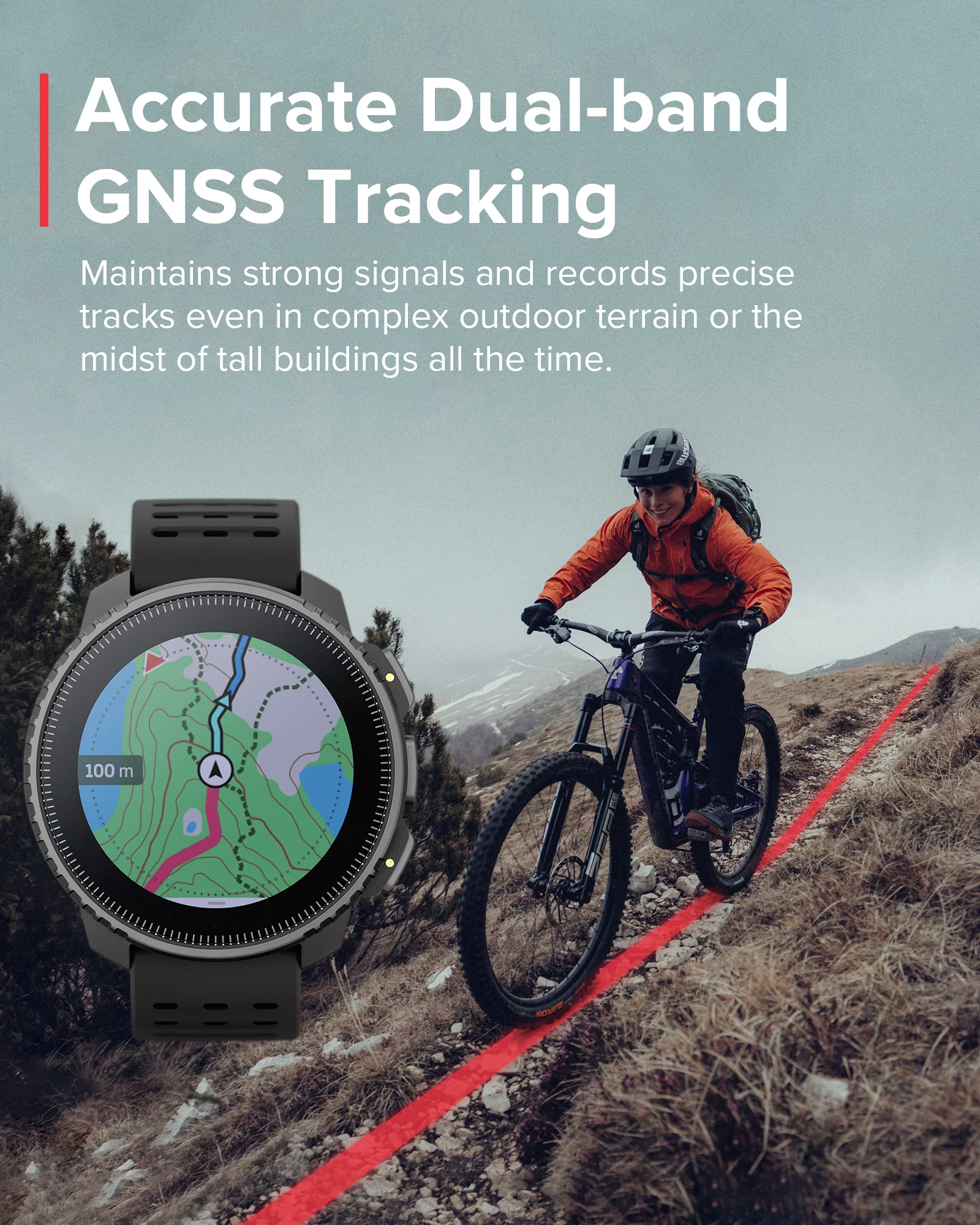
The Suunto Vertical ships with a dual-frequency GNSS chipset that connects to all five major satellite constellations: GPS, GLONASS, Galileo, QZSS, and BeiDou. The dual-band (L1 + L5) reception reduces atmospheric interference and dramatically improves accuracy in challenging environments – dense forest, narrow canyons, urban corridors with tall buildings.
The results are outstanding. GPS tracks from the Vertical are virtually indistinguishable from those produced by the Garmin Fenix 7 Pro and COROS VERTIX 2 on land-based activities. Course-measured benchmarks show distance accuracy within +/- 0.08 miles over a known 2.8-mile course – an error rate of roughly 3% – putting it among the most accurate GPS watches available at any price. Satellite acquisition speed is also excellent – the Vertical locks onto a satellite fix faster than almost any competing watch, typically within seconds of stepping outside.
Open-water swim GPS is the one area where accuracy still trails the best Garmin devices, with tracks showing occasional drift. For land-based activities – running, hiking, cycling, trail running, ski touring – the GPS performance is best-in-class.
Sport Modes and Training
The Vertical supports over 115 sport modes across running, cycling, swimming, skiing, climbing, and dozens of niche activities. Custom sport modes can be created and configured through the Suunto app, with full control over data screens, alerts, and auto-lap settings.
The SuuntoPlus ecosystem extends the watch's capabilities with modular sport apps. These range from climb analysis and ghost tracking to integration with third-party sensors like Train.Red muscle oxygen monitors and CORE body temperature sensors. Two SuuntoPlus apps can run simultaneously during an activity – a useful feature for athletes who want, say, climb guidance and power-based running zones on the same run.
App and Ecosystem
The Suunto app handles syncing, route planning, and data analysis. It connects to Strava, TrainingPeaks, and other third-party platforms for seamless data sharing. The app is well-designed and functional, with clean data visualization and intuitive route creation tools.
However, the ecosystem still lags behind Garmin Connect in depth and community features. Training plan integration is limited. Social features are minimal. The watch itself lacks contactless payments, offline music storage, and a third-party app store. For athletes who treat their watch as a pure training instrument and do their social sharing on Strava, none of this matters. For those who want a Garmin-level connected experience, the gap is real.
Wi-Fi connectivity enables direct map downloads and firmware updates without phone involvement, which is a practical convenience that reduces friction for keeping the watch current.
Health and Fitness Tracking
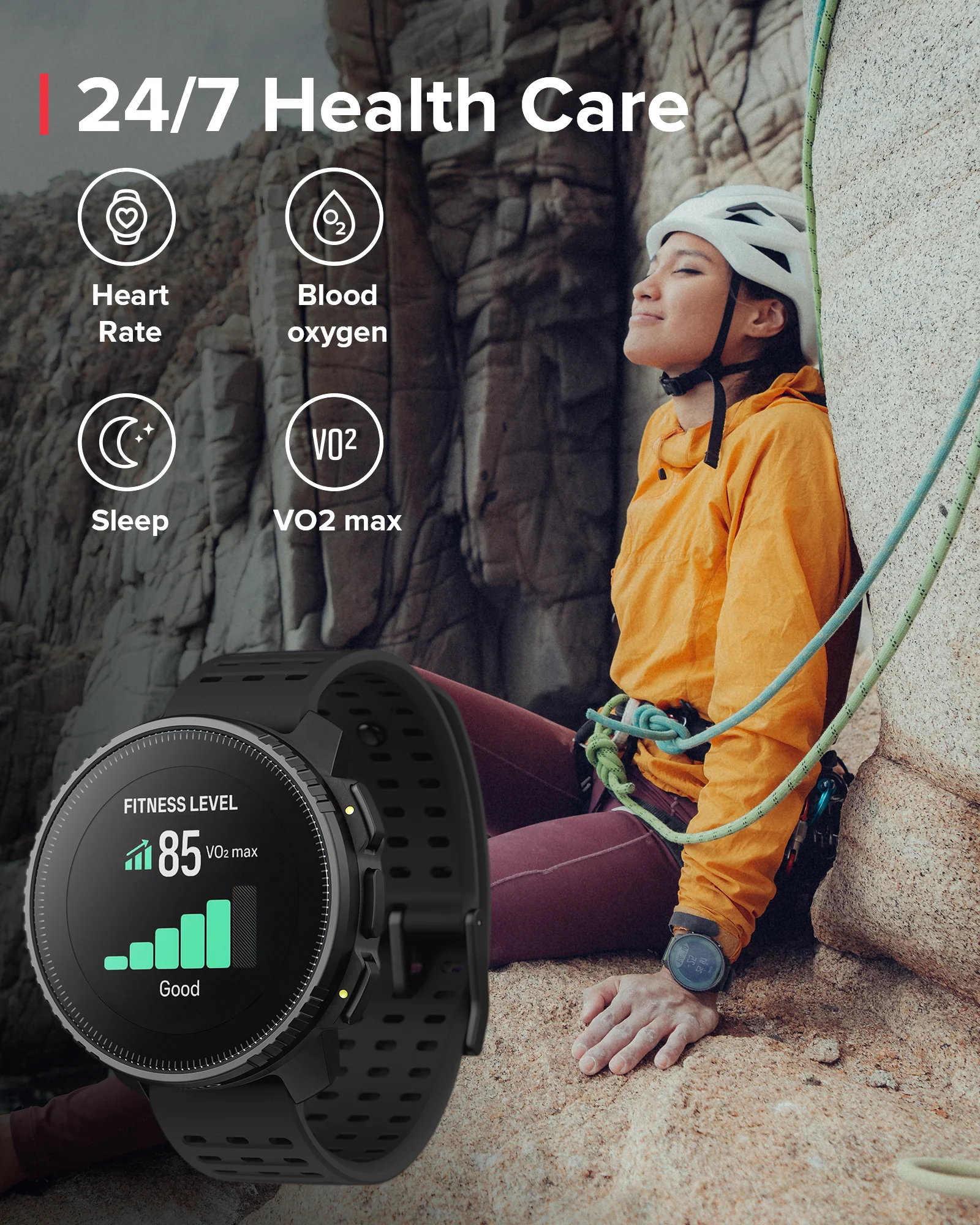
Heart Rate
The Suunto Vertical uses an optical heart rate sensor developed by LifeQ, a biometrics algorithm company, carried over from the 9 Peak Pro. It is behind the hardware curve – Garmin's Elevate V5 sensor uses more LED wavelengths and advanced signal processing, and even Suunto's own newer Race S has upgraded the optical array.
The practical impact is mixed. During steady-state running at moderate intensity, the heart rate data is serviceable and generally tracks within a few BPM of a chest strap reference. During high-intensity intervals, rapid pace changes, and cold conditions, the sensor struggles with lag and occasional dropouts. Cycling heart rate is unreliable for most users due to wrist pressure against handlebars.
The clear recommendation for anyone who cares about heart rate accuracy during training is to pair the Vertical with an external chest strap or arm-band sensor. The onboard sensor is adequate for resting heart rate, daily tracking, and general fitness monitoring, but it is not a precision instrument for structured training.
SpO2 and Daily Health
Blood oxygen (SpO2) monitoring is available for spot checks and altitude acclimatization. The readings are useful directionally – identifying trends at altitude – but should not be treated as clinical data. The SpO2 sensor can be inconsistent, particularly during sleep measurements, which is a known limitation of optical sensors at this generation.
Sleep tracking covers sleep stages, duration, and quality scoring. The data is reasonable but less granular than what Garmin, Polar, or Whoop provide. Sleep tracking can overestimate total sleep time and may struggle with detecting brief awakenings. HRV-based recovery metrics are present but basic compared to the competition.
Step counting and daily activity tracking round out the health features. These are functional but not a reason to buy this watch – the Vertical is a training and adventure tool first, a health tracker second.
Battery Life
This is where the Suunto Vertical makes its most dramatic statement. The battery life is not just good – it is category-defining for a watch with dual-band GPS and offline maps.
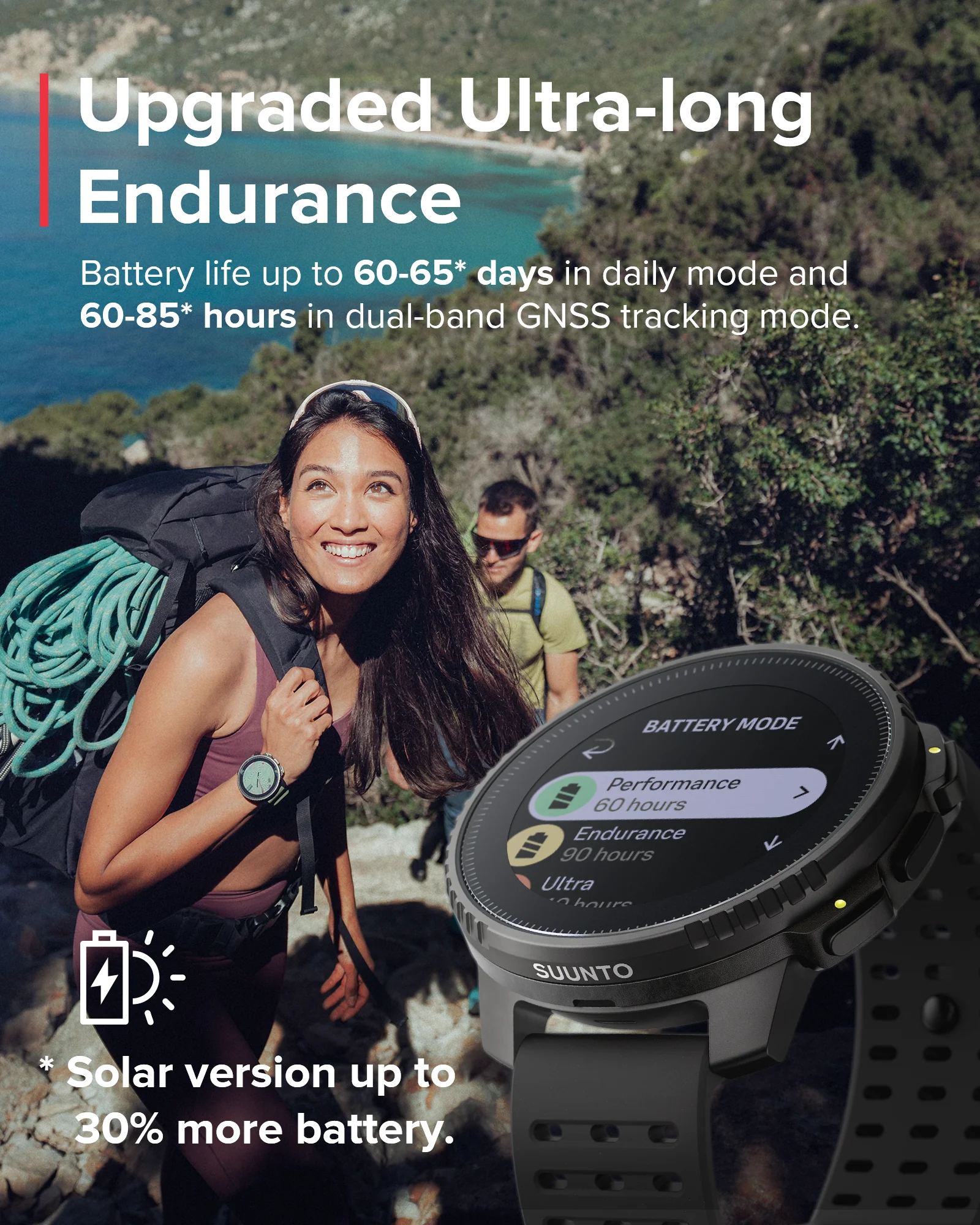
The titanium solar variant claims up to 85 hours of continuous GPS tracking in the most accurate dual-frequency mode. The stainless steel variant delivers up to 60 hours in the same mode. In daily smartwatch use with 24/7 heart rate monitoring, the Vertical is rated for up to 60 days before needing a charge.
These are not fantasy numbers. The rated figures translate to real-world results: regular GPS workouts across multiple weeks before needing a charge, and 60+ cumulative hours of activity tracking in a single charge cycle is well within reach. For ultra-distance events, multi-day hikes, and expedition-style adventures, the Vertical can run continuously for days without requiring a power bank.
The solar charging on the titanium variant provides a meaningful but not transformative boost. Suunto claims up to 30% additional battery life during outdoor training in direct sunlight (calculated at 50,000 lux, roughly equivalent to direct midday sun). Real-world results vary significantly by geography and weather. In consistently sunny conditions, battery drain during outdoor activities approaches zero – a sub-hour run in full sun can consume negligible charge. In overcast or variable conditions, the solar contribution is marginal. Think of it as a useful bonus that extends already exceptional battery life rather than a charging solution that replaces the cable.
Tour mode – which reduces GPS recording frequency to every two minutes and limits heart rate tracking – stretches the battery to a claimed 500 hours. That is over 20 days of continuous GPS logging, making the Vertical a viable option for extended wilderness expeditions where charging is impossible.
Who Should Buy It
The Suunto Vertical is built for a specific kind of athlete and adventurer. It is the right watch if you:
- Spend multi-day stretches in the backcountry and need a battery that will not die on day three
- Want free offline topographic maps without a subscription or paying Garmin prices
- Prioritize GPS accuracy above all other metrics
- Value rugged build quality with titanium and sapphire construction
- Plan routes in advance and follow established trails rather than navigating spontaneously
- Treat your watch as a training and navigation instrument, not a smartwatch
Who Should Skip It
- Display quality matters to you: If you have been using an AMOLED watch, the MIP screen will feel like a compromise. Consider the Garmin Fenix 7 Pro or Suunto's own Race for a sharper panel.
- Heart rate precision is non-negotiable: The optical sensor is the Vertical's weakest component. If you refuse to carry a chest strap but demand accurate HR data, Garmin's Elevate V5 sensor is measurably better.
- You want smart features: No payments, no music storage, no app ecosystem. The Apple Watch Ultra 3 or Garmin Fenix 8 are better choices for connected lifestyles.
- You need routable maps: If getting lost is a real possibility and you want your watch to reroute you, Garmin's routable mapping engine is the superior tool.
- You are price-sensitive and do not need maps: The COROS VERTIX 2S delivers comparable battery life and GPS accuracy if offline maps are not essential to your use case.
The Verdict
The Suunto Vertical is the watch that proved Suunto could still compete at the sharp end of the outdoor market. It does not try to out-Garmin Garmin on features or out-Apple Apple on smartwatch polish. Instead, it identifies the three things that matter most to serious outdoor athletes – GPS accuracy, battery endurance, and navigation – and executes all three at an elite level.
The MIP display is a generation behind. The heart rate sensor needs a hardware upgrade. The app ecosystem is functional but thin. These are real limitations, and they prevent the Vertical from claiming the overall crown in the premium outdoor watch category. Suunto has since addressed many of these shortcomings with the Suunto Vertical 2, which swaps MIP for AMOLED and upgrades the heart rate sensor.
But for the hiker planning a week on the Haute Route, the ultra-runner eyeing a 100-miler, or the ski tourer who needs reliable navigation in whiteout conditions, the Vertical delivers where it counts. The maps are free. The battery is absurd. The GPS is as accurate as anything on the market. And at $499 for the stainless steel model, it significantly undercuts the Garmin Fenix 7 Pro while matching or exceeding it in the metrics that matter most in the mountains. For more options in this category, see our roundup of the best outdoor watches.
Score: 83/100
| Category | Weight | Score |
|---|---|---|
| Core Function | 30% | 84/100 |
| Build Quality | 15% | 88/100 |
| User Experience | 20% | 70/100 |
| Value | 20% | 82/100 |
| Battery | 15% | 94/100 |
| Weighted Total | 100% | 83/100 |