
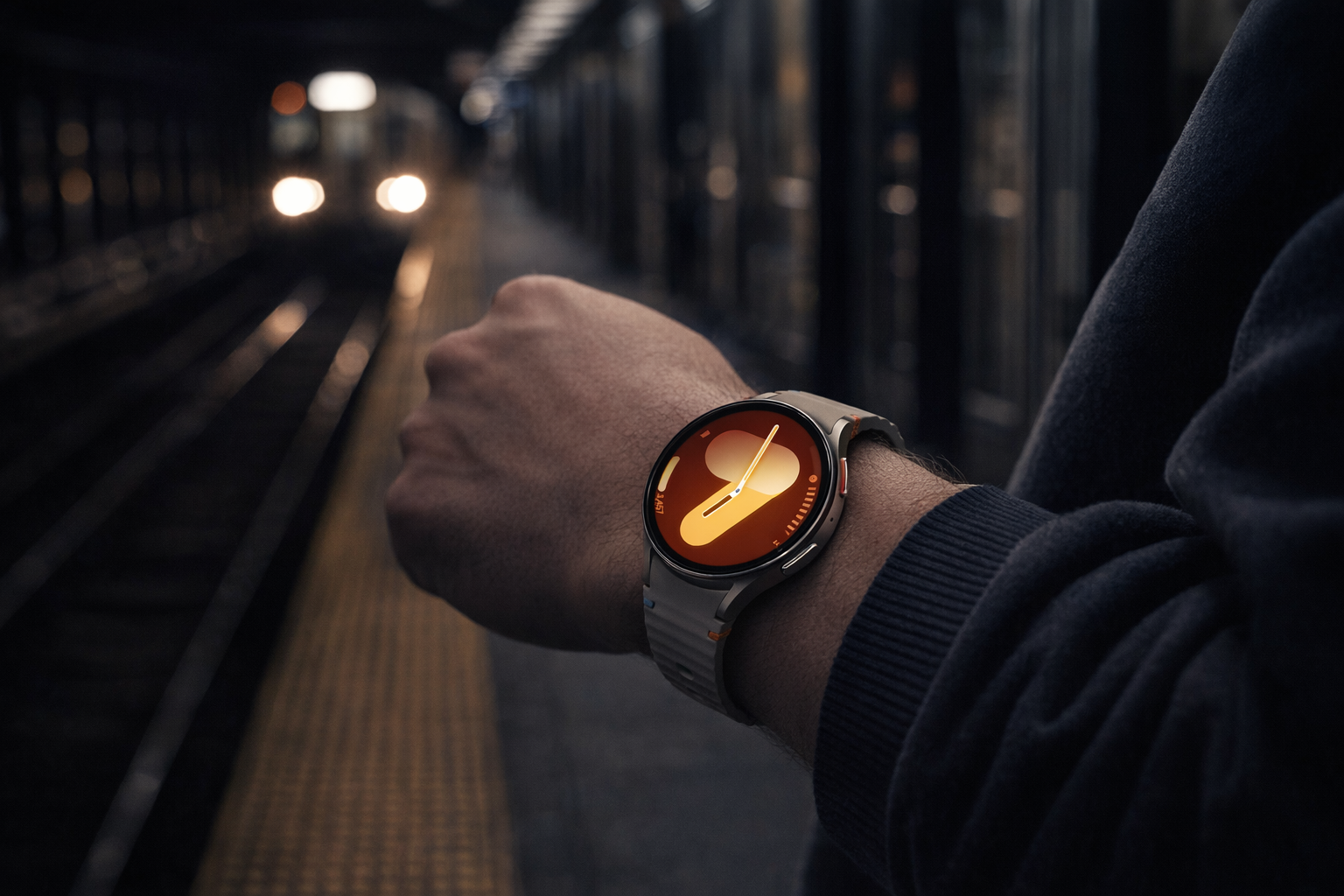
The Samsung Galaxy Watch 7 occupies a peculiar position in the smartwatch market: it is simultaneously the most sensible Android smartwatch purchase and one of the least exciting product launches of 2024. That tension defines the entire experience. Samsung has taken everything that worked about the Galaxy Watch 6, added a genuinely faster processor, expanded the health sensor array, doubled the storage, and shipped it in the same shell at the same price. The result is a watch that does nearly everything well and nothing spectacularly – the kind of product that earns a recommendation through competence rather than charisma. The notable exceptions – GPS accuracy that disappoints serious athletes and battery life that demands nightly charging – are real, but for the broad middle of Android smartwatch buyers, they are tolerable trade-offs.
And yet, competence counts for a great deal when you strap something to your wrist every morning. At $299, the Galaxy Watch 7 undercuts both the Pixel Watch 3 and the Apple Watch Series 10 while delivering a feature set that rivals or exceeds both. For the majority of Android users – particularly those already carrying a Samsung Galaxy phone – this is the smartwatch to buy. The question is whether "the smartwatch to buy" and "an exciting smartwatch" have to be the same thing.
Design & Build
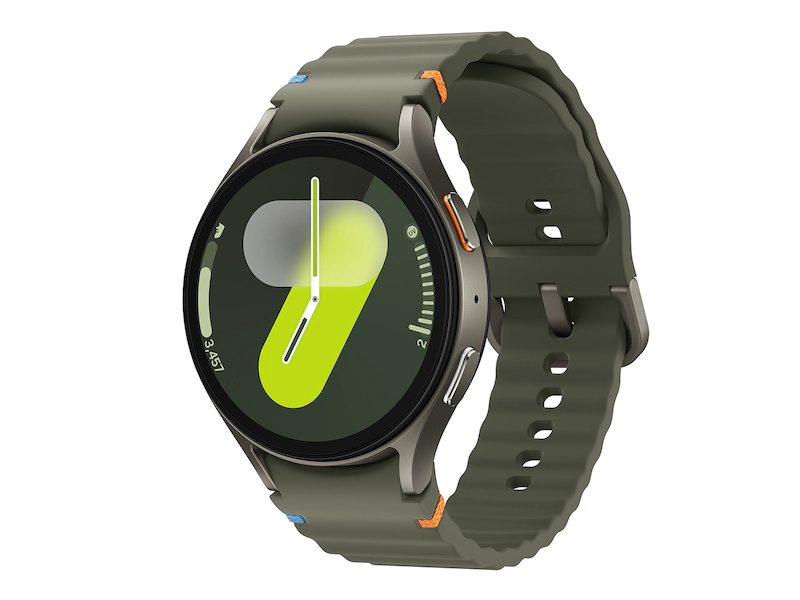
Pick up a Galaxy Watch 7 and a Galaxy Watch 6 side by side, and you will struggle to tell them apart without flipping them over. Samsung has retained the same circular aluminum case, the same two-button layout on the right edge, the same overall proportions. The 40mm model measures 40.4 x 40.4 x 9.7mm and weighs 28.8 grams; the 44mm comes in at 44.4 x 44.4 x 9.7mm and 33.8 grams. Both feel light on the wrist, substantially lighter than the Galaxy Watch Ultra or any Garmin in this price range.
The case is aluminum with a sapphire crystal display cover, and it carries both IP68 and 5ATM water resistance ratings alongside MIL-STD-810H durability certification. This is a watch built to handle pool laps, rain-soaked runs, and the occasional accidental collision with a door frame. The one-click band mechanism returns, and it remains compatible with third-party bands designed for the Galaxy Watch series – a small but welcome flexibility.
Where the Watch 7 does differ from its predecessor is underneath. The BioActive sensor array now protrudes further from the case back, housing 13 heart rate LEDs compared to just four on the Watch 6. That deeper dome improves skin contact and sensor accuracy, but it introduces two trade-offs: the watch sits slightly higher on the wrist, and Samsung has killed Wireless PowerShare compatibility entirely. Older charging cradles may also fit differently due to the deeper sensor recess. The sensor bump can feel uncomfortable during the first few days of wear, particularly during sleep, but it settles in within a week.
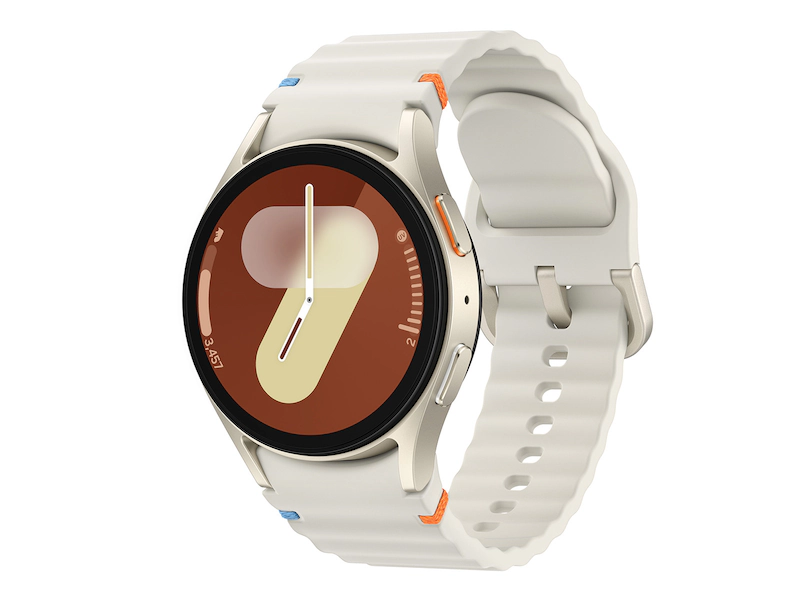
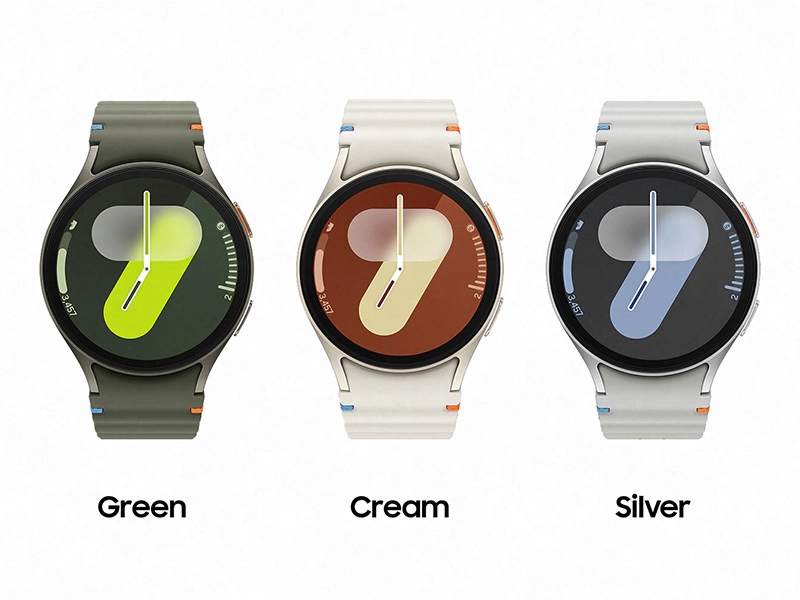
Both sizes are available in Bluetooth-only and LTE variants, with the LTE models carrying a $50 premium. Three colors are available: Green and Silver for the 44mm; Green and Cream for the 40mm. The sport band features a new scalloped texture that grips well and dries quickly, though the sculpted lugs can create visible gaps on narrower wrists.
Display
The Galaxy Watch 7's Super AMOLED display is genuinely excellent. The 44mm model runs at 480 x 480 resolution while the 40mm settles for 432 x 432 – both sharp enough that text remains crisp and legible even at small font sizes. Peak brightness hits 2,000 nits, which makes the screen readable in direct midday sun – a meaningful improvement that puts it on par with the Apple Watch Series 10 and ahead of the Pixel Watch 3 in outdoor visibility.
Colors are vivid without tipping into oversaturation, and contrast is deep enough that dark watch faces blend seamlessly into the black bezels, creating the illusion of an edge-to-edge display. The always-on display mode is well-implemented, dimming to a simplified version of whatever face is active, though activating it comes with a significant battery penalty that will be covered in detail below.
The sapphire crystal protection resists scratches far better than the Gorilla Glass found on cheaper alternatives. Extended daily wear leaves the display surface clean and unblemished in a way that tempered glass simply cannot match.
Performance & Features
The Exynos W1000 is the star of the Galaxy Watch 7's spec sheet, and its impact is immediately noticeable. Samsung's first 3nm wearable processor pairs a single performance core with four efficiency cores and a Mali-G68 GPU, delivering a measurable leap in responsiveness over the 5nm chip in the Watch 6. Apps launch faster, scrolling is smoother, and the interface never stutters or hangs during multitasking. Spotify loads and begins streaming within seconds. Google Maps navigation renders route data without delay. Samsung Health opens workout tracking instantly rather than after the two-to-three-second pause that plagued older models.
Storage has doubled to 32GB (roughly 21GB usable), which means room for a substantial offline music library alongside a full complement of apps. RAM remains at 2GB, which proves sufficient for Wear OS 5 and One UI Watch 6.
Wear OS 5 is a mature platform at this point, and Samsung's One UI Watch layer adds meaningful customization without introducing bloat. The tile system for quick-glance information is well-organized, and the notification handling is reliable – though not flawless, as notifications occasionally fail to surface on the watch, requiring a glance at the phone instead.
Samsung has introduced two gesture controls: a double-pinch to interact with notifications and a knock-knock motion to activate the flashlight or dismiss alarms. The double-pinch works well about 80 percent of the time, but its sensitivity can lead to accidental call answers when raising the wrist. The knock gesture is a neat party trick that loses its appeal after the first week, partly because it requires the screen to be awake to function – defeating the purpose of a hands-free shortcut.
Galaxy AI surfaces through the Samsung Health app with wellness insights, summaries, and contextual tips. These are mildly useful – a morning notification suggesting a lighter workout after a poor night of sleep, for instance – but they rarely deliver information that a moderately self-aware person could not deduce on their own. The AI layer is better understood as a convenience feature than a transformative one.
Health & Fitness
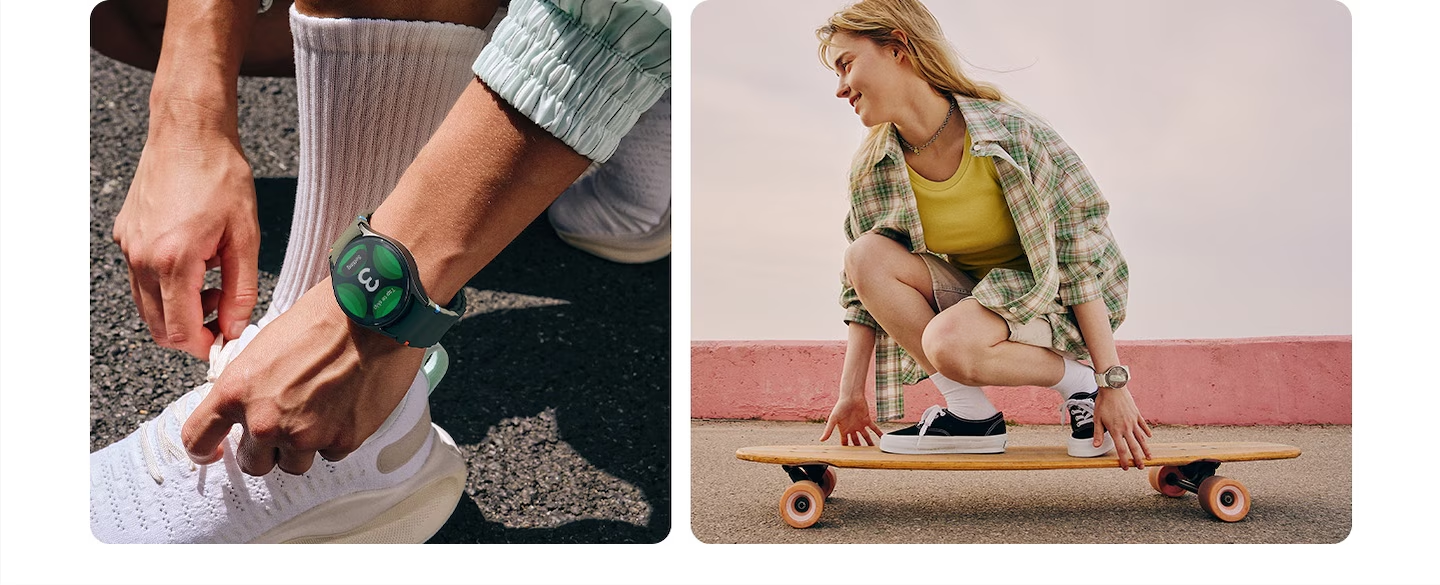
The Galaxy Watch 7's health tracking is its strongest argument for purchase. The upgraded BioActive sensor with 13 LEDs delivers noticeably better heart rate accuracy than the Watch 6, particularly during steady-state cardio activities like running and walking. Resting heart rate readings are consistent and align closely with chest strap references. During interval training, the optical sensor tracks heart rate rises and recovery with reasonable fidelity, though it still lags a beat or two behind dedicated chest monitors during rapid HR transitions.
Cycling heart rate accuracy is less reliable. The combination of wrist vibration, variable grip pressure, and road surface irregularity causes readings to spike and drop erratically. This is an inherent limitation of optical wrist-based HR monitoring, but it is worth noting for cyclists who depend on accurate zone data.
Sleep tracking is a genuine highlight. The watch detects sleep and wake times accurately, distinguishes between light, deep, and REM stages with reasonable precision, and delivers morning reports that include sleep consistency scoring. FDA-authorized sleep apnea detection – a first for any smartwatch at launch – analyzes blood oxygen fluctuations over two nights and flags potential risk. This feature requires a Samsung Galaxy phone, which is a significant asterisk for non-Samsung Android users.
The Energy Score is Samsung's take on daily readiness, combining sleep quality, activity history, resting heart rate trends, and heart rate variability into a single 1-100 number. It proves directionally useful – a score of 45 after a poor night of sleep correlates with genuinely feeling sluggish – but its responsiveness to major stressors like jet lag or intense training blocks can be inconsistent.
Body composition analysis via bioelectrical impedance remains a party trick more than a clinical tool, offering ballpark estimates of body fat percentage and skeletal muscle mass. The AGEs (Advanced Glycation End-products) index is new and measures a metabolic health marker linked to long-term disease risk, though its practical value remains unclear without longitudinal data or medical context.
GPS performance presents a mixed picture. For casual outdoor runs along established routes, the dual-frequency (L1+L5) GPS with GLONASS, Galileo, and BDS support delivers acceptable tracking. Distance measurements are close enough for recreational purposes. But under rigorous evaluation conditions, the Watch 7's GPS accuracy falls short of its competitors, producing wandering track lines and distance errors of 20 to 30 meters per kilometer even in open terrain with clear sky views. Dedicated runners and cyclists who rely on precise route mapping and distance data will find this frustrating – and it is an area where the Pixel Watch 3 and most Garmin devices perform demonstrably better.
Over 100 workout types are supported, and automatic workout detection picks up walking reliably. Custom routines for strength training are a welcome addition, though the system cannot log weight or track progressive overload – a meaningful omission for anyone serious about resistance training.
Battery Life
Battery life is the Galaxy Watch 7's most significant weakness. The 40mm model packs a 300 mAh cell; the 44mm houses 425 mAh. Samsung claims up to 40 hours with the always-on display disabled and 30 hours with it active. Real-world performance falls closer to 24 to 36 hours depending on usage patterns, with the 44mm model consistently outlasting the 40mm by a meaningful margin.
With continuous heart rate monitoring, sleep tracking, and moderate notification volume – but no always-on display and no GPS workouts – the 44mm model lasts roughly a day and a half. Add a 30-minute GPS-tracked outdoor run, and that drops to a full day. The 40mm model, with its smaller battery, often struggles to make it from morning to the next morning under the same conditions.
The always-on display is the battery's worst enemy. Enabling it can cut runtime dramatically – the battery can plummet from 40 percent to near-empty in just three hours of moderate use. For a feature that many smartwatch owners consider table stakes, this penalty is steep enough to make AOD effectively unusable for anyone who values getting through a full day without reaching for a charger.
Charging speed is unremarkable. The 15W wireless charger takes approximately 70 to 90 minutes to go from empty to full, with a partial charge to around 60 percent achievable in about 30 minutes. This is adequate but not competitive with newer fast-charging standards appearing in the market.
In practical terms, the Galaxy Watch 7 is a nightly charger. This is not unusual for smartwatches in this class – the Apple Watch Series 10 lives in the same territory – but it pales against the multi-day endurance offered by Garmin devices or even the 44mm Pixel Watch 3.
Who It's For / Who Should Skip
Buy the Galaxy Watch 7 if:
- You own a Samsung Galaxy phone and want the deepest integration between phone and watch, including sleep apnea detection and Galaxy AI health features.
- You are upgrading from a Galaxy Watch 5 or older and want a meaningfully faster, more capable experience.
- You want comprehensive health tracking – heart rate, sleep, blood oxygen, ECG, body composition – in a single device under $300.
- You prioritize build quality and display excellence in a lightweight package.
Skip the Galaxy Watch 7 if:
- You already own a Galaxy Watch 6. The improvements are real but incremental, and most software features have been backported.
- You are a serious runner or cyclist who depends on precise GPS tracking. The Watch 7's GPS accuracy does not meet the standard set by Garmin or even the Pixel Watch 3.
- You want multi-day battery life. This is a daily charger, full stop.
- You do not own a Samsung Galaxy phone. Key health features are locked behind Samsung's ecosystem, and a Pixel Watch 3 offers a better experience with non-Samsung Android devices.
- You rely heavily on the always-on display. The battery penalty is severe enough to compromise the watch's daily usability.
The Galaxy Watch FE remains an option for budget-conscious buyers who can tolerate older internals, while the Galaxy Watch Ultra serves users who need rugged construction, a larger display, and extended battery life – at twice the price and substantially more wrist weight. If you want the latest Samsung flagship, the Galaxy Watch 8 builds on the Watch 7's foundation with a thinner design and Gemini AI integration.
The Verdict
The Samsung Galaxy Watch 7 is not a reinvention. It is a refinement – a careful, measured improvement over its predecessor that delivers where it matters most: speed, health tracking breadth, and daily wearability. The 3nm Exynos W1000 processor makes the entire experience feel faster and more fluid. The enhanced BioActive sensor brings genuinely improved heart rate accuracy and introduces sleep apnea detection as a meaningful health feature. The display is bright, sharp, and protected by sapphire crystal. At $299, it undercuts its closest competitors while matching or exceeding their feature sets.
But it is held back by battery life that demands nightly charging, an always-on display that is practically unusable without crippling endurance, GPS accuracy that falls short for dedicated athletes, and a design that Samsung has recycled for the third consecutive generation. These are not fatal flaws – they are the kinds of compromises that separate a very good smartwatch from a great one.
For Samsung Galaxy phone owners who want the most capable, well-rounded Wear OS smartwatch available at a mainstream price, the Galaxy Watch 7 remains the default recommendation. For a broader look at the competition, see our guide to the best smartwatches for Android. It earns that position through relentless competence rather than innovation, and for most people, that is more than enough.
Score: 80/100
| Category | Weight | Score |
|---|---|---|
| Core Function | 30% | 82/100 |
| Build Quality | 15% | 84/100 |
| User Experience | 20% | 80/100 |
| Value | 20% | 83/100 |
| Battery | 15% | 68/100 |