
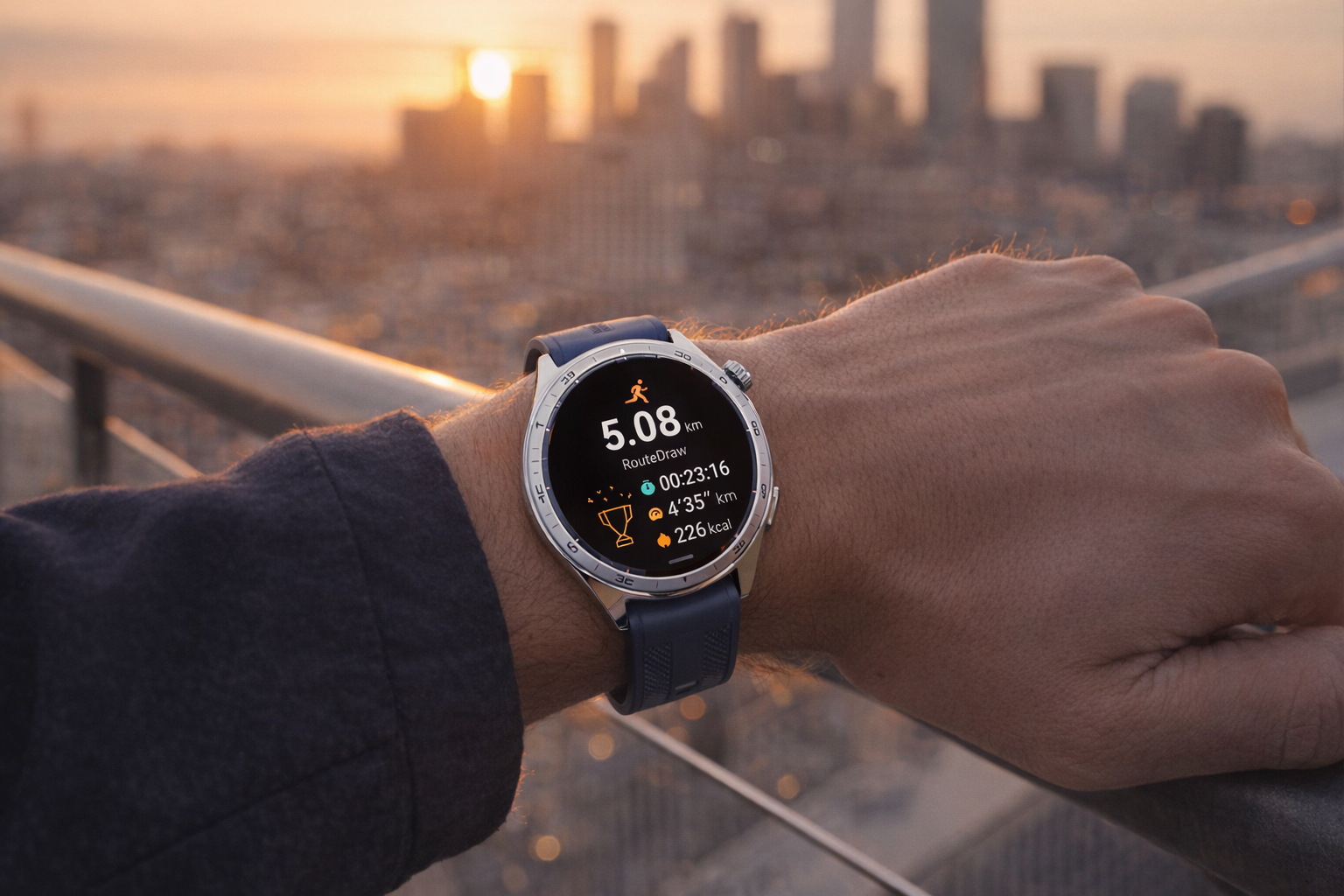
Few watches at any price look as good on the wrist as the Huawei Watch GT 5. Its octagonal stainless steel bezel catches the light like a piece of jewelry, its AMOLED display pops with color, and at just 48 grams for the larger model, it practically disappears during a run. This is the kind of hardware that makes you double-check the price tag – surely something this refined costs more than its EUR 249 launch price.
And then you try to install Spotify. Or Google Maps. Or any of the thousands of apps that make an Apple Watch or Galaxy Watch feel like a tiny smartphone on your wrist. The GT 5's app store is a ghost town, and that single limitation defines the entire ownership experience. This is a watch for people who want gorgeous fitness tracking hardware and can live without the "smart" in smartwatch.
Design and Build
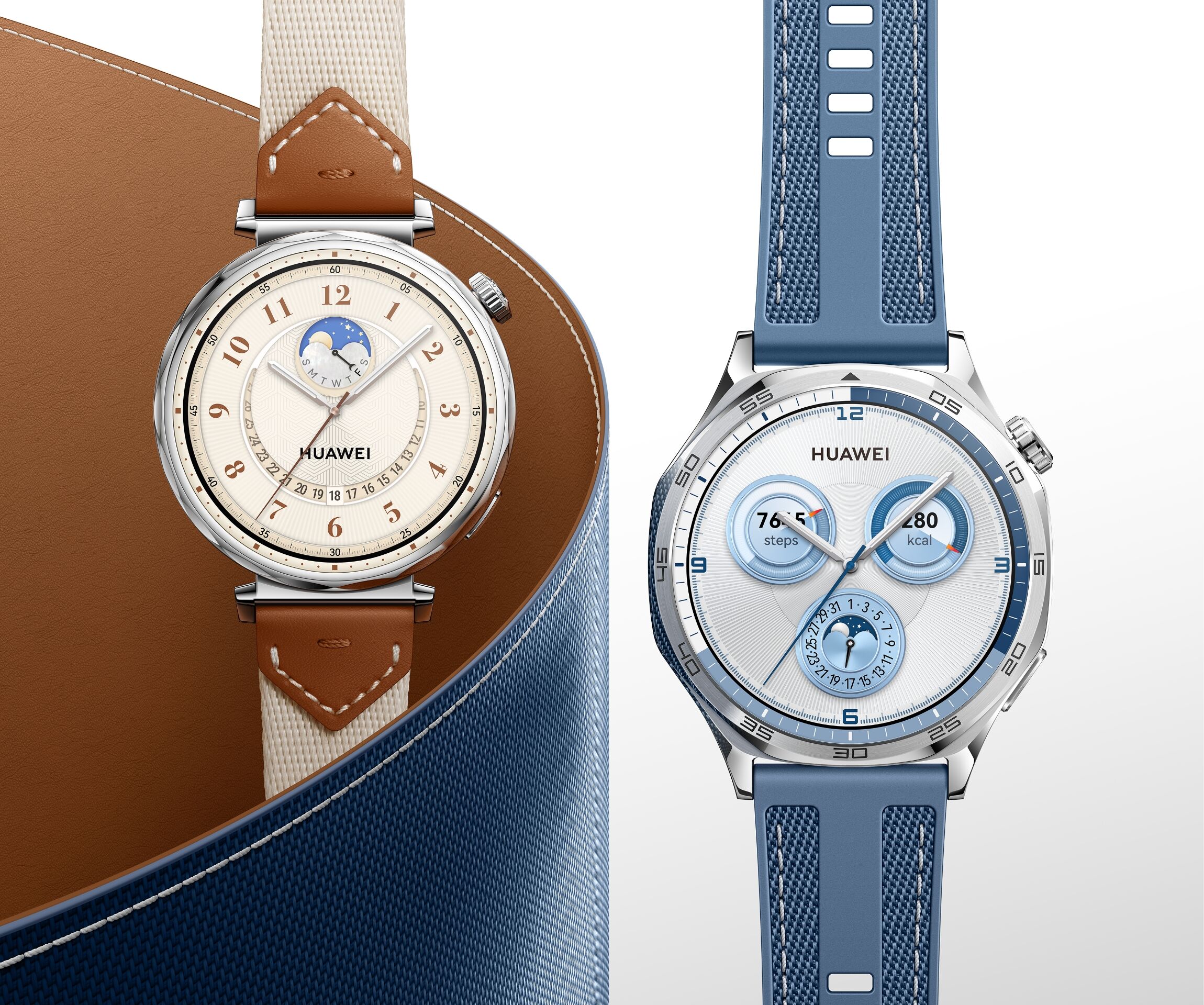
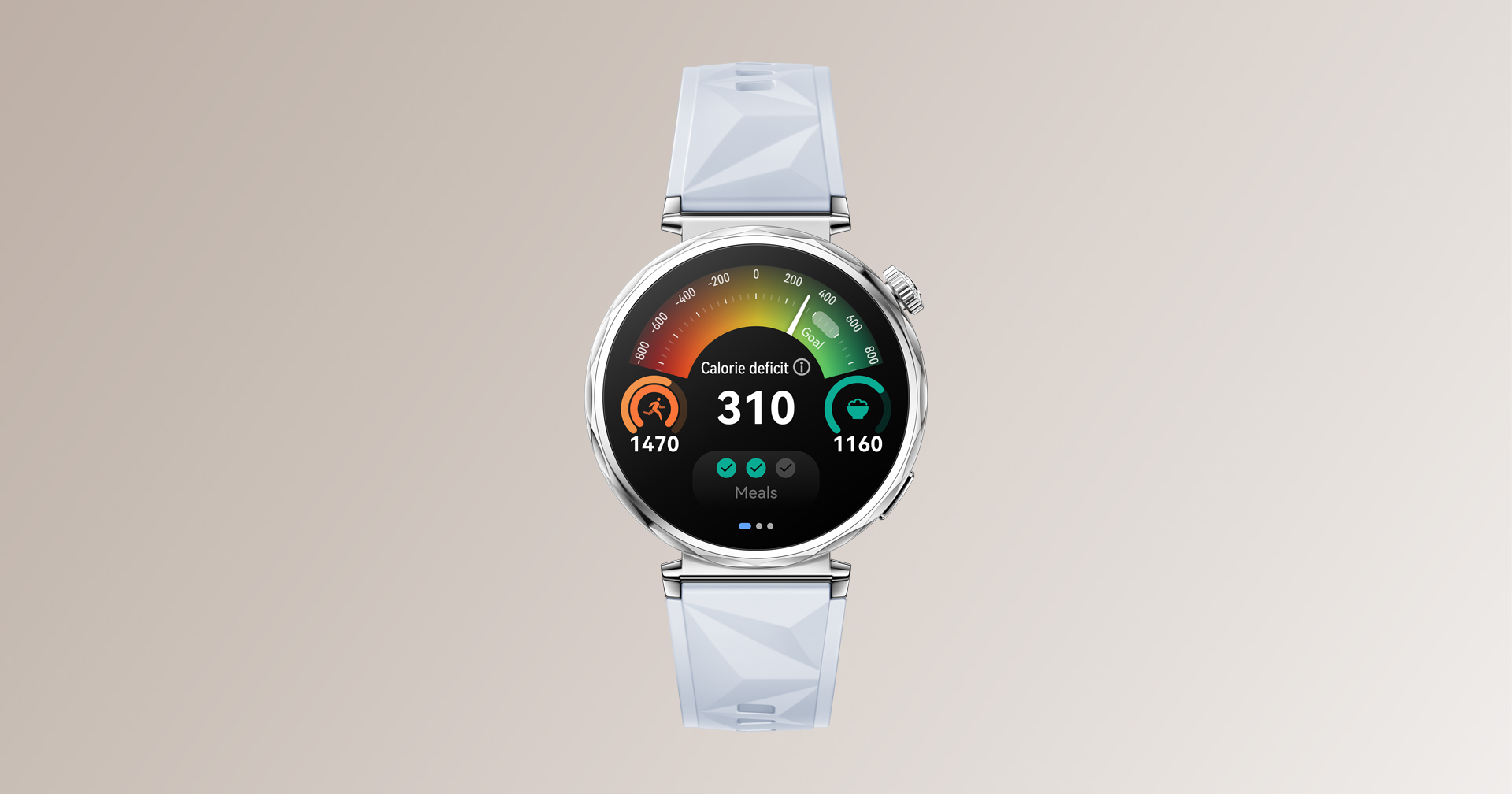
The GT 5 arrives in two distinct sizes: a 46mm model aimed at larger wrists and a 41mm model with a more delicate, jewelry-inspired aesthetic featuring ornamental leaf patterns on the bezel. Both share a stainless steel case with that signature octagonal shape, refined from the GT 4 with sharper, more defined edges that give it a more assertive presence.
At 48 grams for the 46mm and just 35 grams for the 41mm (without strap), these are remarkably light watches. The 46mm case measures 10.7mm thick while the 41mm comes in at a svelte 9.5mm. For context, an Apple Watch Ultra 2 weighs 61.4 grams and a Samsung Galaxy Watch 7 (44mm) weighs 33.8 grams – the GT 5 splits that difference perfectly.
The one letdown is the included fluoroelastomer strap. It is functional and fine for workouts, but it feels noticeably cheaper than the watch head it is attached to. Standard quick-release lugs (22mm on the 46mm, 18mm on the 41mm) make swapping in a nicer leather or metal band straightforward – and doing so is the right move.
Water resistance covers 5 ATM plus an IP69K dust and water ingress rating. Swimming, showering, and rain are all fine. Diving and hot tubs are not. The crystal is standard hardened glass rather than the sapphire found on the GT 5 Pro, so a screen protector is a sensible addition for active use.
Display
The 46mm model carries a 1.43-inch AMOLED panel at 466 x 466 pixels (326 PPI), while the 41mm uses a slightly smaller 1.32-inch screen at the same resolution, yielding a sharper 352 PPI. Both deliver the punchy colors and deep blacks expected from AMOLED, with outdoor visibility that holds up well in direct sunlight.
Watch face selection is generous, and several options look genuinely impressive in always-on display mode – a feat that many competitors still struggle with. The AOD implementation maintains legibility without destroying battery life, though it does reduce endurance significantly – the 46mm drops from 9 days to 5, and the 41mm from 5 days to 3.
One minor quirk: the minimum brightness setting runs a bit high. In a pitch-dark bedroom, the display can be distractingly bright during overnight sleep tracking. The 60Hz refresh rate is standard for this category and perfectly adequate for the interface, though some users may notice slight flicker in certain conditions.
Performance and Features
This is where the GT 5's dual identity becomes impossible to ignore. The hardware runs HarmonyOS 5.0 – not the full HarmonyOS found on Huawei phones, but a lightweight real-time operating system optimized for wearables. The interface itself is snappy, animations are fluid, and navigating through menus via the rotating crown feels natural and responsive.
The problem is what sits behind those menus. Huawei's AppGallery for the watch is barren. There is no Spotify, no Google Maps, no Uber, no native Strava watch app (though workouts do sync to Strava via the Huawei Health app), and no mainstream banking apps for contactless payments. Huawei Wallet exists for NFC payments, and while availability has expanded into several European markets including Germany since late 2024, coverage remains patchy and mainstream alternatives like Google Pay or Apple Pay are nowhere to be found. For buyers coming from Wear OS or watchOS, this is a stark downgrade in daily utility.
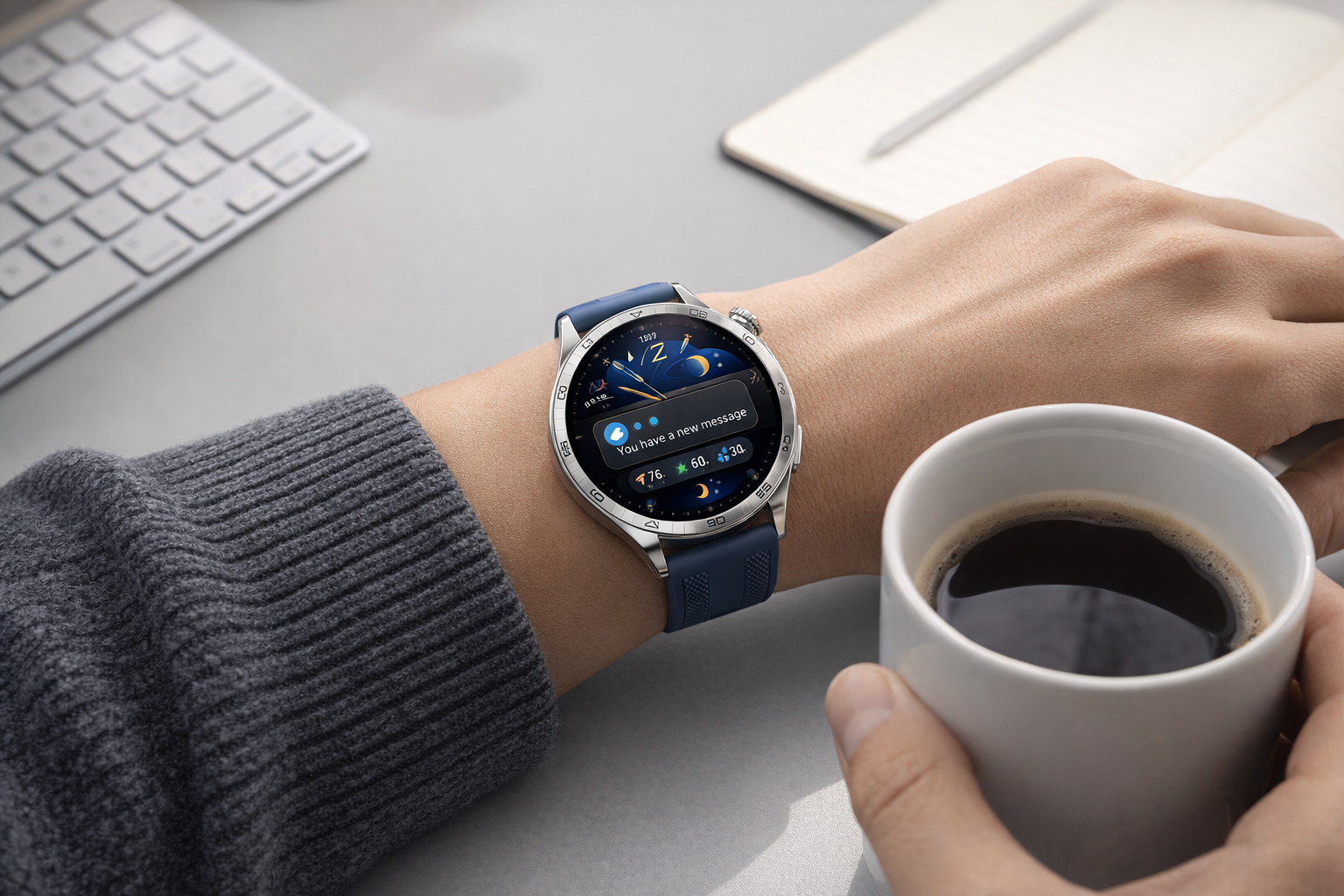
Notification handling splits sharply along platform lines. Android users get full QWERTY keyboard input for text replies, quick reply templates, and can respond to WhatsApp, Telegram, and Messenger messages directly from the wrist. iOS users get none of this – notifications are view-only with no reply capability whatsoever. Given that the GT 5 explicitly supports iPhone pairing, this is a significant gap that Huawei's marketing materials tend to understate.
There is no Wi-Fi on board, so the watch must maintain a Bluetooth 5.2 connection to the phone for any connected features. Music storage allows offline playback through the watch's speaker or paired Bluetooth earbuds, but only for tracks transferred manually – again, no streaming apps.
Health and Fitness
Strip away the smartwatch expectations and the GT 5 transforms into a genuinely impressive fitness tracker. The new TruSense sensor system represents Huawei's most significant health hardware upgrade in years. It redesigns the optical sensor layout with additional LEDs, improved glass coatings, and updated algorithms to address common accuracy pitfalls like varying skin tones, blood vessel patterns, and wrist movement.
The results are measurable. Heart rate readings during exercise track within 1-2 beats per minute of a Polar chest strap reference, and the 46mm model carries an SGS Switzerland certification for dynamic heart rate accuracy – a credential Huawei claims is a category first. Running and strength training accuracy is generally solid, though brief latency spikes and occasional 5-7 BPM underreporting at peak heart rate still occur – a gap that separates it from the best Garmin optical sensors, but one that has narrowed considerably.
Blood oxygen monitoring is reliable for a wrist-based sensor, consistently producing readings in line with dedicated pulse oximeters. Stress tracking, skin temperature measurement, and female cycle tracking round out the health suite. The notable absence is ECG monitoring, which Huawei reserves for the GT 5 Pro.
GPS performance benefits from an upgraded dual-frequency Sunflower Positioning System supporting GPS, GLONASS, Galileo, BDS, and QZSS on L1, with GPS, Galileo, BDS, and QZSS also on L5.
Route accuracy has improved dramatically over the GT 4, with tracking that now rivals Garmin in most open-sky conditions. Tight urban corners and dense tree cover still introduce minor deviations, but signal acquisition is fast and dropout is rare.
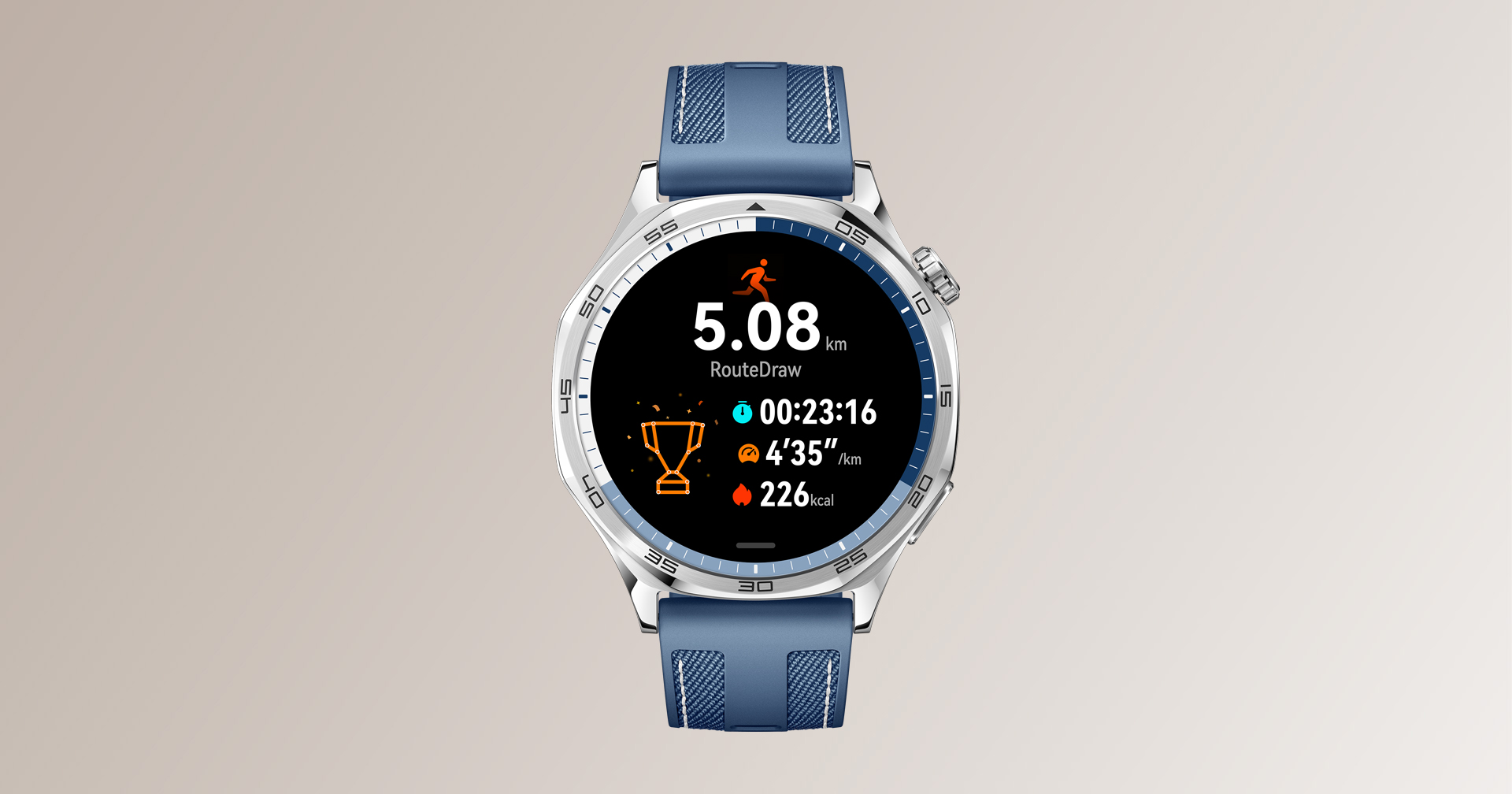
The workout mode library spans over 100 activities. Running receives the deepest treatment, with advanced metrics including ground contact time, vertical oscillation, stride length, and cadence analysis. Cycling gains real-time power zone data (with a compatible power meter), and swimming supports both pool and open water tracking. Huawei's Activity Rings 2.0 system provides daily movement goals in a format immediately familiar to anyone who has used an Apple Watch.
Sleep tracking captures light, deep, and REM stages with reasonable accuracy, generally landing within 5-10 minutes of dedicated sleep trackers like the Oura Ring for sleep and wake time detection. The new Sleep Breathing Awareness feature monitors respiratory patterns overnight and flags potential irregularities – a genuinely useful addition that moves beyond basic sleep scoring.
Battery Life
Battery life is the GT 5's most emphatic argument for its own existence. The 46mm model is rated for up to 14 days of maximum battery life and 9 days of typical use. The 41mm delivers up to 7 days maximum and 5 days typical. With always-on display enabled, expect 5 days from the 46mm and 3 days from the 41mm.
Real-world use confirms these figures. Heavy fitness tracking with daily GPS workouts, continuous heart rate monitoring, and regular notification checking yields roughly 7 days from the 46mm model. Lighter use easily pushes past 10 days. The 41mm, with its smaller 323 mAh battery, is more modest but still delivers a working week between charges with typical use.
For comparison, the Apple Watch Series 10 lasts 18 hours. A Samsung Galaxy Watch 7 manages roughly 30 hours in normal use. The GT 5 operates in a completely different league – the kind where forgetting your charger for a long weekend is not a crisis.
Charging uses a proprietary magnetic puck and takes roughly 90-100 minutes from empty to full. There is no wireless charging pad compatibility.
Who It Is For
The GT 5 is ideal for fitness-focused buyers who want accurate health tracking, outstanding battery life, and a watch that looks far more expensive than it is. Runners and cyclists benefit most from the advanced metrics, and the improved GPS makes it a credible training companion. Anyone tired of nightly charging rituals will find the multi-day battery life liberating. For a step up in sensor capabilities, the Huawei Watch GT 6 Pro adds ECG monitoring and even longer endurance.
It also works well as a straightforward notification viewer paired with an Android phone, where the QWERTY keyboard and messaging app replies add genuine convenience. If you are weighing Android-compatible options more broadly, our best smartwatches for Android guide covers the full landscape.
Who Should Skip
Anyone who relies on third-party watch apps – Spotify, Google Maps, Strava on-wrist, banking apps for contactless payments – should look elsewhere. The app ecosystem is not underdeveloped; it is functionally nonexistent for Western markets.
iPhone users face a particularly compromised experience with no notification replies and limited feature access. A Galaxy Watch or Apple Watch SE 3 delivers far more daily utility for iOS households.
Buyers in the United States cannot purchase this watch through official channels due to ongoing trade restrictions on Huawei. While grey market imports exist, warranty and software update support become uncertain.
Anyone upgrading from a GT 4 should also pause. The improvements are meaningful but incremental – not the generational leap that justifies the spend if the GT 4 is still functioning well.
The Verdict
Score: 79/100 – A premium fitness watch with exceptional hardware and battery life, undercut by a barren app ecosystem that prevents it from functioning as a true smartwatch.
The Huawei Watch GT 5 is a beautiful contradiction. The hardware is genuinely excellent – premium materials, accurate sensors, a vibrant display, and battery life that makes competitors look like they are running on fumes. At its EUR 249 launch price, no other watch in this range matches its combination of build quality and fitness tracking capability.
But a smartwatch with no apps is a hard sell. The barren AppGallery, the absence of contactless payments in most markets, and the severely limited iOS experience mean the GT 5 functions more as a premium fitness band with smartwatch aspirations than a true smartwatch. For the right buyer – one who prioritizes health tracking and battery over apps and ecosystem – it is a genuinely strong purchase. For everyone else, that gorgeous hardware remains frustratingly out of reach behind Huawei's walled garden. If you are still weighing your options, our best smartwatches roundup compares the GT 5 against its closest rivals.
| Category | Weight | Score |
|---|---|---|
| Core Function (fitness/health tracking, GPS, workout modes) | 30% | 80/100 |
| Build Quality (materials, water resistance, comfort) | 15% | 88/100 |
| User Experience (app ecosystem, notifications, smart features) | 20% | 58/100 |
| Value (price vs. alternatives) | 20% | 82/100 |
| Battery Life | 15% | 92/100 |
| Overall | 100% | 79/100 |