

Smart glasses that listen to your conversations, fact-check what people say, and beam relevant information directly into your eye – that is a staggering pitch. The Halliday Glasses, born out of a $3.3 million Kickstarter campaign with more than 8,000 backers, arrived in 2025 promising to be the first proactive AI glasses with an invisible display. The concept alone generated enormous CES buzz and positioned Halliday as an audacious upstart willing to swing where even Meta and Google have been cautious.
The problem is that the ambition far outstrips the execution. Nearly every core feature – the AI, the display, the audio, the novel control ring – falls short of what Halliday promised and what $499 should deliver. What arrived in backers' mailboxes is less a finished product than a proof of concept still searching for the polish that separates a CES demo from something you would actually wear every day.
Design & Build
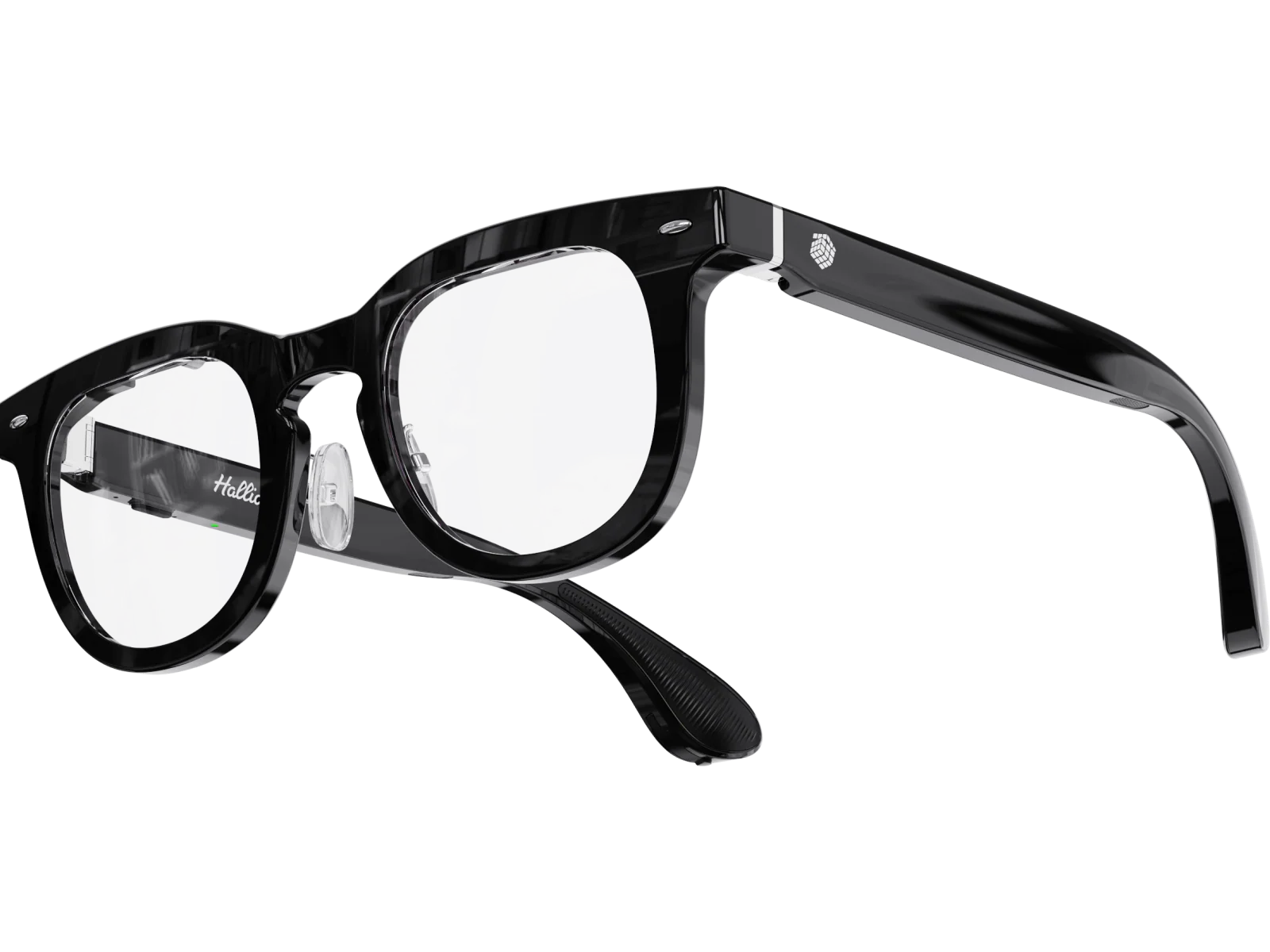
This is where Halliday deserves genuine credit. At roughly 35 grams with standard lenses (27 grams without), the Halliday Glasses are among the lightest smart glasses on the market. The Wayfarer-style frame comes in Black, Tortoise, and a Black-to-Clear gradient, and from a few feet away, they pass as ordinary eyeglasses. That is not a small achievement in a category where most competitors look like props from a science fiction movie.
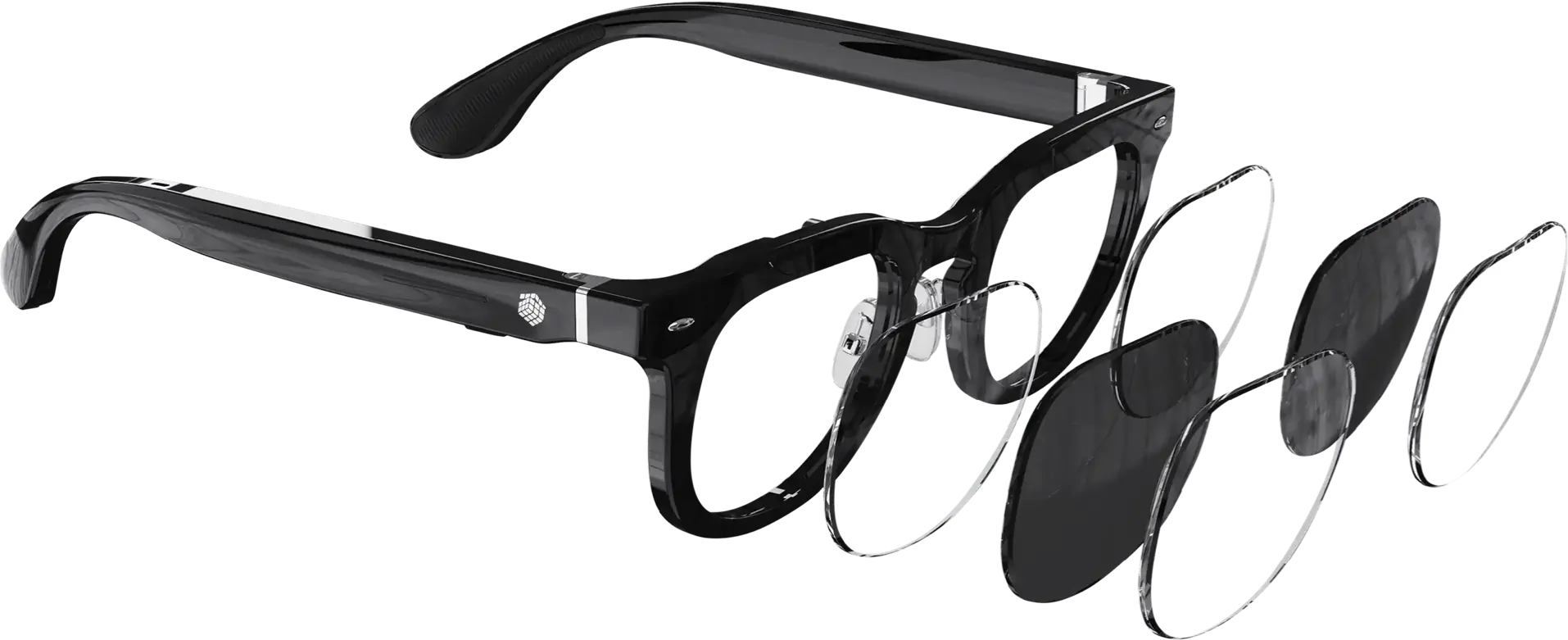
Comfort is excellent for extended wear. The weight distribution is balanced, and the frames sit naturally on the face without the nose-bridge fatigue that plagues heavier competitors. Prescription lens support is a standout – Halliday includes custom prescription lenses in the purchase price, with progressive and photochromic options available. For anyone who needs corrective lenses, this is a meaningful differentiator.
The catch is that "lightweight" and "premium" rarely coexist at this price point. The all-plastic construction feels insubstantial in the hand. The thin plastic lenses do not inspire confidence in durability. The charging port gasket on the temple tip is difficult to access without a tool. These are glasses that look right on your face but feel cheap when you pick them up. Still, the design achievement here is real: Halliday proved that smart glasses do not have to look like smart glasses, and that matters.

Display & Optics
The Halliday display is genuinely novel and genuinely frustrating. Rather than using waveguides – the approach favored by most AR glasses makers – Halliday employs a Cassegrain telescope-style optical system where light from a 3.6mm monochrome green microLED strikes a secondary curved mirror, which reflects it to a larger primary concave mirror that then projects the image directly into the eye. The company calls this the "DigiWindow," and it sits in a small module along the upper-right frame, creating the equivalent of a 3.5-inch virtual screen.
When properly aligned, the image itself is surprisingly sharp. The direct-projection approach avoids some of the contrast and brightness issues that plague waveguide displays, and the green monochrome is legible even in bright outdoor conditions. The technology has real merit.
But the user experience undermines the technology at every turn. To see the display, you must rotate your eyes upward – not a natural or comfortable position for sustained reading. The eye box is small, meaning any head movement can cause you to lose the image, requiring you to hunt for it again. A manual horizontal slider and rotational adjustment let you aim the projector toward your pupil, but the alignment is fiddly and easily disrupted. Reading anything longer than a notification headline causes noticeable eye strain within minutes.
There is also the fundamental question of what a monochrome green, 3.5-inch-equivalent display can actually show you. Notifications and navigation prompts work adequately. But AI-generated text responses – which the product is built around – require reading paragraph-length text on a postage-stamp display while straining your eyes upward. The display's limitations are inextricable from the product's core promise, and that is a design problem no firmware update can solve.

Proactive AI & Features
This is the headline feature, and it is the headline failure. Halliday's proactive AI is an always-listening mode that monitors ambient conversation through the glasses' built-in microphone and autonomously surfaces information it deems relevant. In theory, it could fact-check a colleague in a meeting, suggest follow-up questions during a negotiation, or provide context during a lecture.
In practice, the proactive AI is a chatbot that treats every sound it hears as a prompt. It triggers on coughs, background music, passing conversations, and half-finished sentences. The summaries and suggested questions it generates are shallow at best – the kind of obvious follow-ups that anyone paying even casual attention to a conversation would already have thought of. There is no social situation where having an AI interject with unsolicited commentary improves the interaction.
The reactive AI – where you deliberately ask a question – fares little better. It frequently refuses to answer straightforward queries and, when it does respond, accuracy is inconsistent. Basic geography and science questions trip it up. For a product that positions AI as its reason to exist, the AI simply does not meet the bar.
Then there is the privacy dimension. These glasses have no outward-facing camera, which Halliday frames as a privacy-conscious design choice. But the always-listening microphone that transcribes and processes ambient conversation is arguably more invasive than a camera. The surreptitious recording of other people's conversations raises ethical questions that Halliday has not adequately addressed. The company's defense – that it is no different from recording an audio memo on a phone – misses the point entirely. A phone recording is a deliberate, visible act. An AI silently processing everything said in earshot is something else.
The remaining feature set includes real-time translation (40+ languages), teleprompter mode, notification display with quick replies, audio memo capture with summaries, and live navigation. These are functional but unremarkable – variations of what other smart glasses already offer, delivered through a less comfortable display.
Camera & Audio
There is no camera. This is a significant gap. The absence of a camera means the AI has no visual context – it cannot identify objects, read signs, describe scenes, or do any of the things that have made Meta's Ray-Ban smart glasses genuinely useful in daily life. Whatever privacy benefit the missing camera provides is offset by the dramatic reduction in AI capability. For glasses that cost $120 more than the current Ray-Ban Meta, this is a difficult trade-off to justify.
The audio is the weakest link in an already strained chain. The open-ear speakers in the temple arms produce sound that is catastrophically thin – zero bass, tinny speech, and music so hollow it is functionally unlistenable. For a product that relies on audio for AI responses and notifications, this level of sound quality actively undermines the user experience.
The microphone quality mirrors the speaker quality. Voice input sounds compressed and crackly, which compounds the AI's already inconsistent recognition. If the proactive AI is going to eavesdrop on your conversations, it should at least be able to hear them clearly.

App & Software Experience
The Halliday companion app, available on iOS and Android, handles device pairing, settings adjustment (brightness, volume), and feature configuration. It is functional in the narrowest sense and unpleasant in every other sense.
Software responsiveness is a persistent problem. Inputs from the control ring take seconds to register on screen – if they register at all. The lag between action and response creates a constant feeling of fighting the device rather than using it. Audio playback controls are unreliable; telling the glasses to pause does not always pause, and navigating tracks is an exercise in hoping. The overall software experience feels unfinished, as though the product shipped a full development cycle too early.
The control ring deserves special mention. This silver plastic ring (available in US sizes 8-15) features a small capacitive trackpad with a clickable center. The concept – a discreet input device that lets you interact with your glasses without touching your face – is sound. The execution is not. The ring's only orientation indicator is a small black line, making it trivially easy to put on upside down and discover that all navigation is inverted. The ring rotates freely on the finger, losing its position constantly. It is too thick to be comfortable for extended wear. The magnetic charging requires a separate dongle and cable, meaning you now have two devices to charge nightly with two different charging setups. You will use the ring because you have to, and you will resent it.
Bluetooth connectivity is inconsistent – a recurring complaint that undermines a device depending entirely on a phone connection for its AI features. For smart glasses that cannot function without a tethered smartphone, unreliable Bluetooth is not a minor inconvenience – it is a fundamental reliability problem.
Battery Life
The real battery issue is not capacity – it is logistics. There is no charging case, unlike the Ray-Ban Meta, and the control ring charges separately via its own magnetic dongle. Managing two devices with different charging mechanisms adds daily friction that a more thoughtful product design would have avoided.
Halliday claims 12 hours of active use and 100 hours of standby, but those numbers describe a best-case scenario involving minimal display and AI usage. Under realistic conditions with regular AI queries, display use, and audio, expect closer to four to six hours. That is actually acceptable for the AI smart glasses category, where battery life in this range is standard. USB-C charging with a 45-to-60-minute full charge time is reasonable.
Who It's For / Who Should Skip
Consider the Halliday Glasses if: - You are a developer or early adopter who wants to experiment with proactive AI concepts and does not mind rough edges - You need prescription smart glasses and value a lightweight frame that looks normal - You are specifically interested in the display-in-glasses form factor and want to see how Cassegrain optics compare to waveguides - You backed the Kickstarter at the $369 tier and are willing to wait for software improvements
Skip the Halliday Glasses if: - You want a smart glasses experience that works reliably today – buy the Ray-Ban Meta instead - Audio quality matters to you for music, podcasts, or calls - You expect the proactive AI to be genuinely useful in social or professional settings - You are uncomfortable with always-listening microphones processing your ambient conversations - You want a camera for visual AI queries, photos, or video - You are spending $499 and expect a polished, finished product
The Verdict
The Halliday Glasses are the most ambitious smart glasses you should not buy. The concept is fascinating: lightweight frames with a novel micro-display and an AI that proactively participates in your life. But ambition without execution is just marketing, and the Halliday Glasses fall short on nearly every functional dimension. The proactive AI is intrusive and unhelpful. The display causes eye strain. The audio is among the worst in any consumer electronics product in recent memory. The control ring is a liability. The software is unfinished.
What remains is a genuinely impressive industrial design – light, comfortable, normal-looking, prescription-compatible – attached to technology that is not ready for daily use. At $499, the Halliday Glasses ask for a premium while delivering a prototype-grade experience. The Ray-Ban Meta glasses start at $379, lack a display, but deliver vastly superior audio, a capable camera, and polished software. That comparison is unkind but unavoidable.
For buyers weighing alternatives, the Even Realities G1 takes a more focused approach to the display-in-glasses concept, while the XREAL One Pro pushes AR capability further for those willing to accept a bulkier form factor. Our best smart glasses guide covers the full landscape.
Halliday has demonstrated that proactive AI in glasses is technically possible. The next step is making it actually worth using.
| Category | Weight | Score | Weighted |
|---|---|---|---|
| Core Function (Display/AI/Audio) | 30% | 30/100 | 9.0 |
| Build Quality | 15% | 65/100 | 9.75 |
| User Experience | 20% | 35/100 | 7.0 |
| Value | 20% | 30/100 | 6.0 |
| Battery | 15% | 50/100 | 7.5 |
| Overall | 100% | 39/100 |
WearableBeat Score: 39/100