
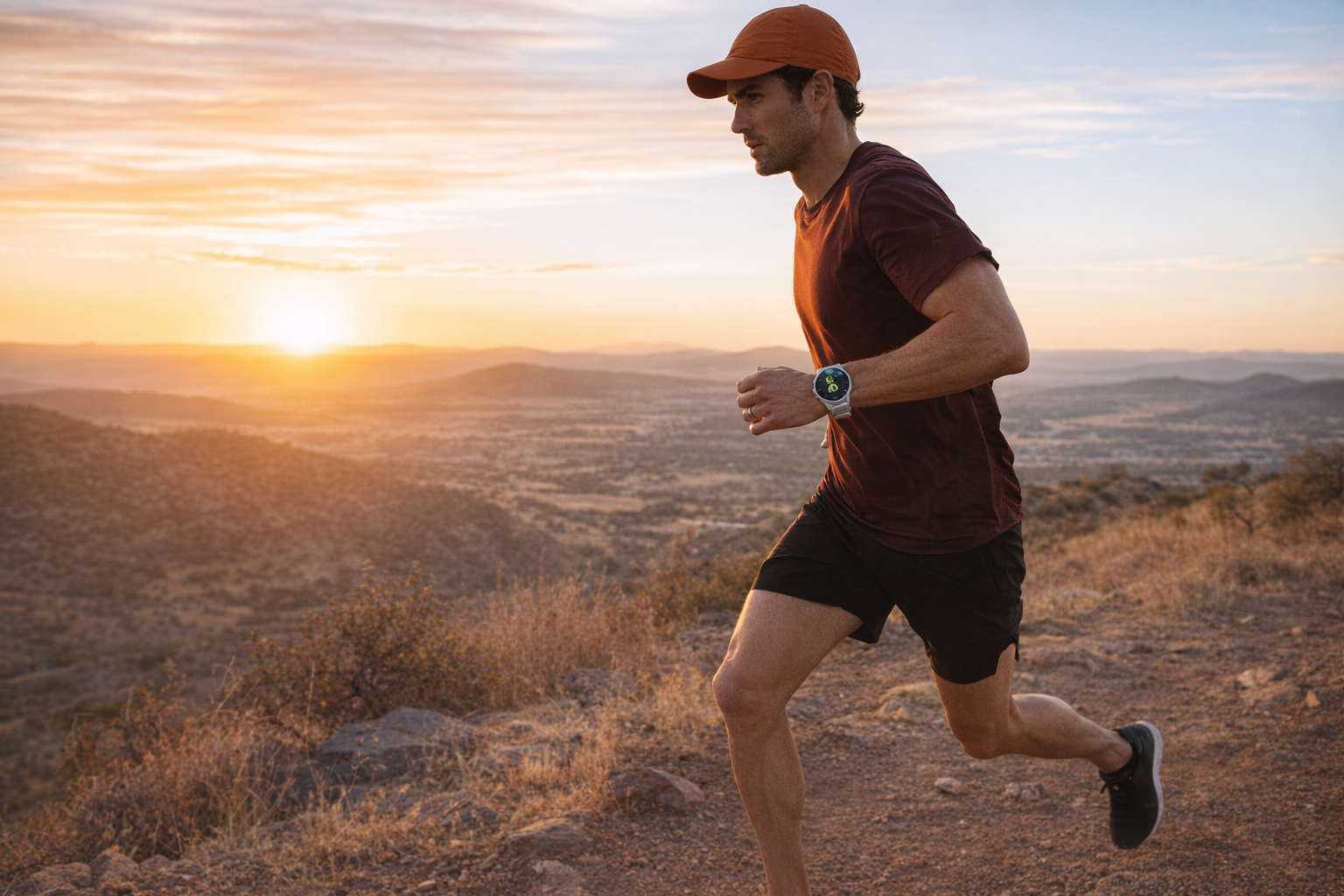
The Garmin Forerunner 965 is the watch that ended the argument. For years, the Forerunner line delivered the deepest training intelligence in the running watch market wrapped in screens that looked like they belonged in 2015. Washed-out memory-in-pixel displays, gray backgrounds, squinting in anything less than direct sunlight – that was the price of admission for Garmin's best software. The Forerunner 965 changed the calculus entirely. It strapped a vivid 1.4-inch AMOLED panel onto the most capable multisport platform available, wrapped it in a titanium bezel, shaved thickness, and still delivered battery life measured in weeks rather than days. It should not have worked this well. It does.
What makes the Forerunner 965 remarkable is not any single feature but the absence of meaningful compromise. The display is gorgeous without destroying battery life. The training metrics are comprehensive without drowning casual users. The build is premium without adding bulk. At its current street price of roughly $449 to $499 – down from the $599.99 launch – it represents a rare convergence of display quality, training depth, and endurance that no competitor has matched in a single package.
Design and Build
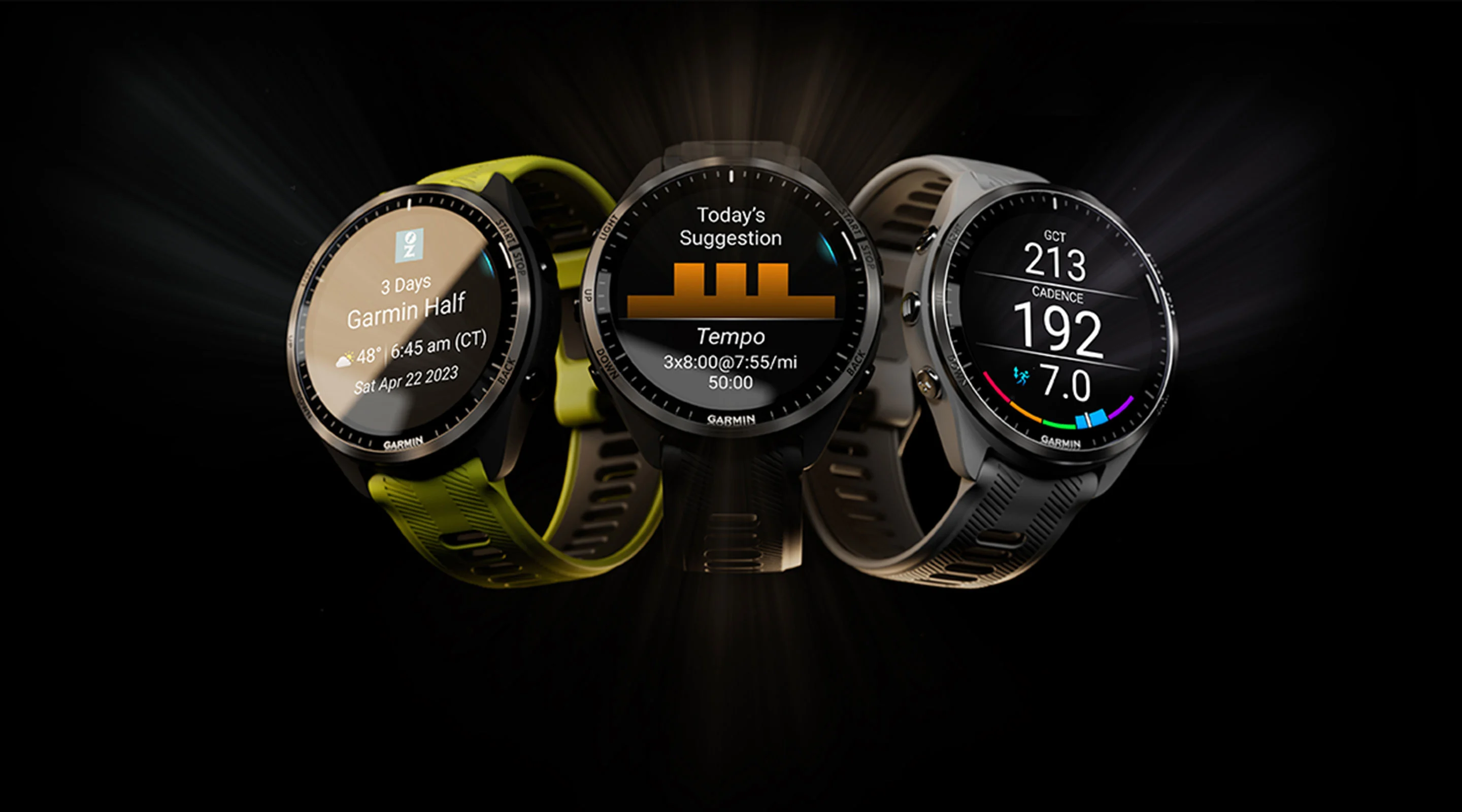
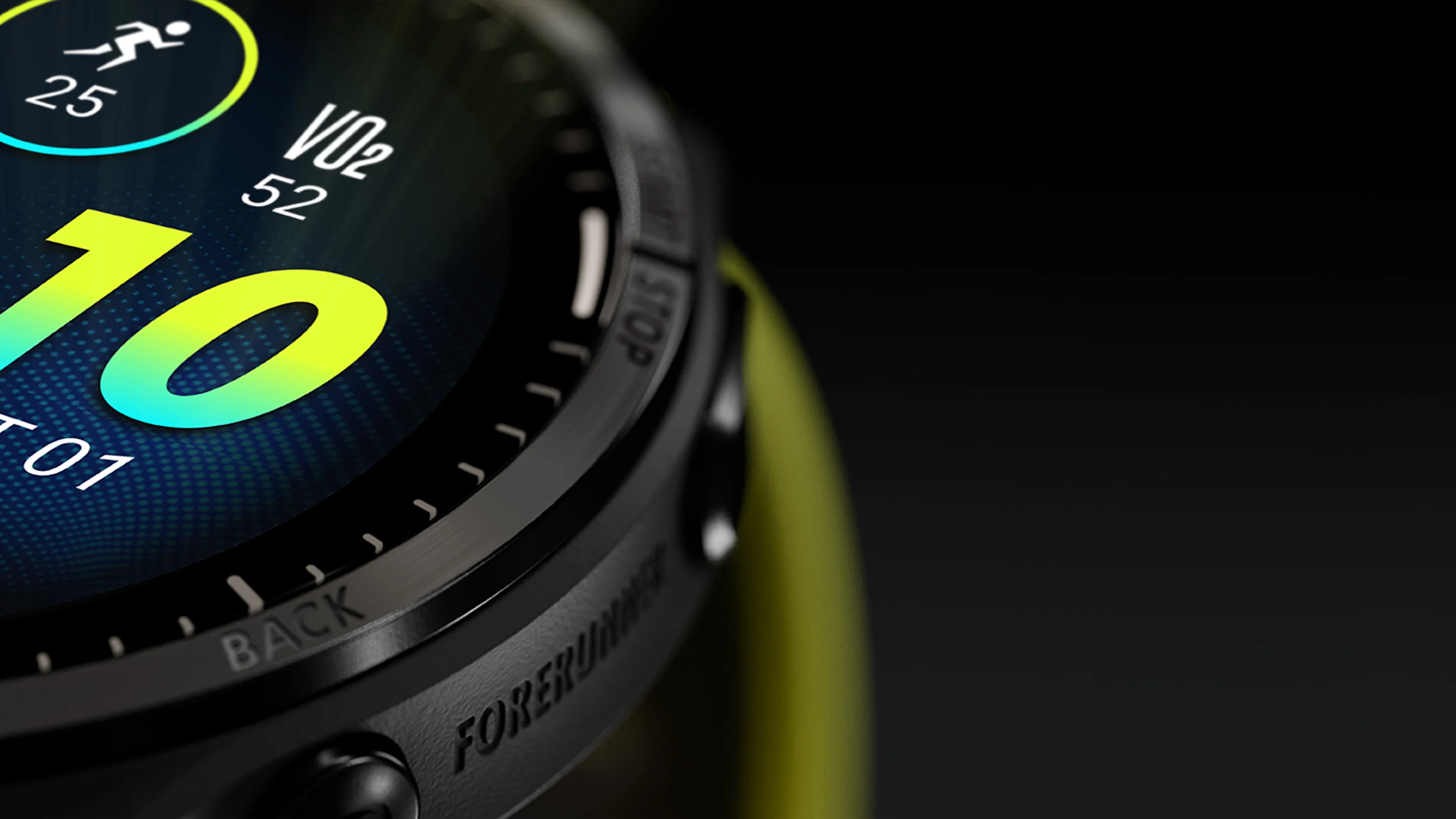
The Forerunner 965 wears its premium credentials on its wrist. The titanium bezel replaces the plastic surround of the Forerunner 955, and the difference is immediately apparent – not just in durability, but in the way light catches the brushed metal finish. This is a watch equally at home with a sport coat as with a race bib, something no previous Forerunner could claim.
At 53 grams and 13.2mm thick, the 965 is lighter than a Fenix 7 by a wide margin and actually thinner than its predecessor (the FR955 measured 14.4mm). The 47.2mm case is only marginally larger than the FR955's 46.5mm, but the visual slimming effect of the thinner profile and the AMOLED display's deep blacks make it appear more refined. It sits flat against the wrist without the wrist-top wobble that plagues thicker sport watches.
The fiber-reinforced polymer case body absorbs impact without complaint, and Corning Gorilla Glass 3 DX protects the display. It is not sapphire – scratches will accumulate over months of hard use, and a screen protector is a worthwhile investment for anyone who regularly scrapes against rocks or gym equipment. 5 ATM water resistance (50 meters) handles pool laps, open-water swims, and monsoon-level rain without hesitation.
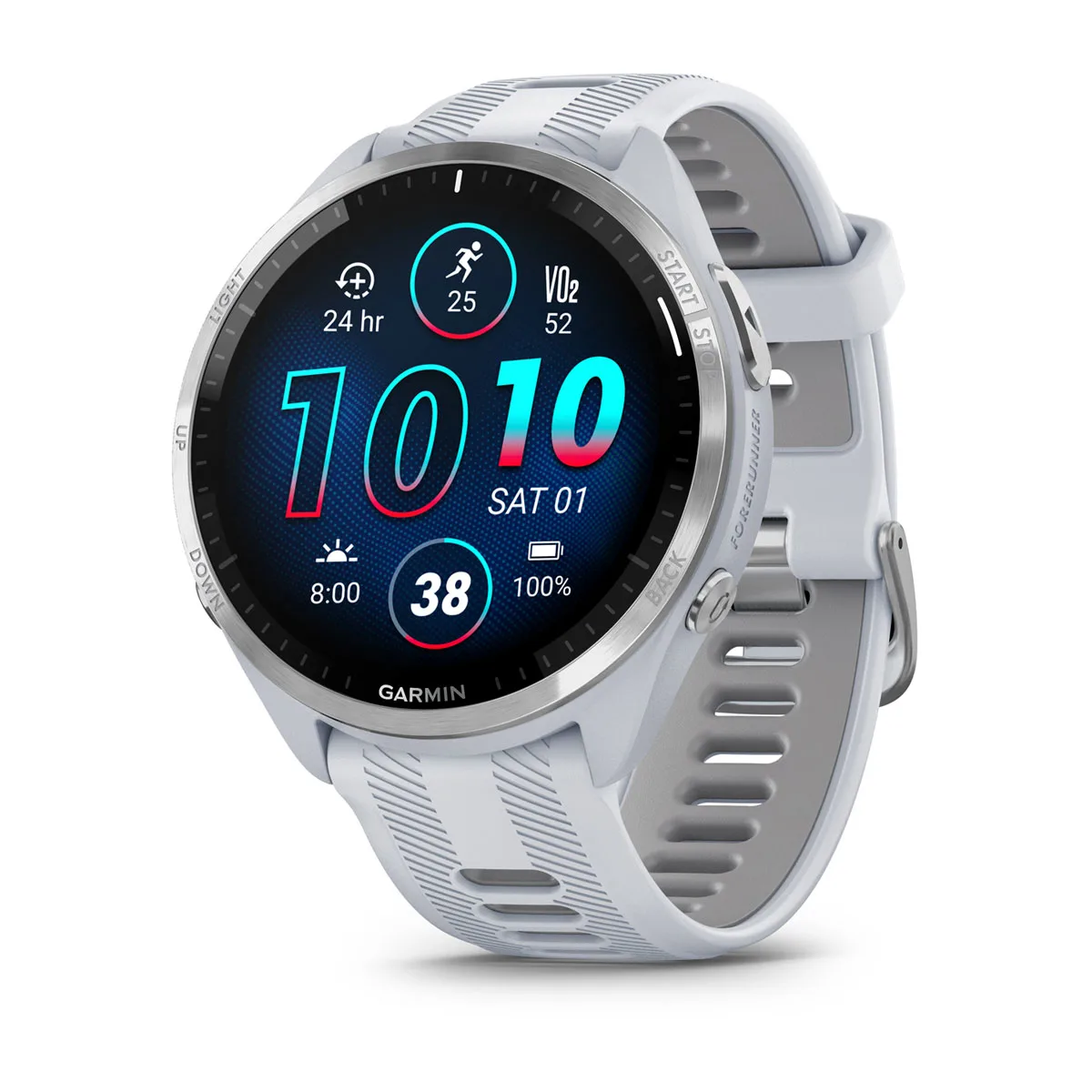
Garmin's traditional five-button layout flanks the case, and each press is crisp with satisfying tactile feedback. The left side houses the light/power button, up/menu, and down buttons; the right side gets start/stop and back/lap. Every button works during swimming, with gloves, in rain – situations where touchscreens become unreliable or entirely useless. The watch also accepts touch input for scrolling and map interaction, creating a dual-input system that is genuinely best-in-class for sport watches.
The switch to a USB-C Garmin charging cable modernizes the charging experience, though it remains a proprietary clip-on connection rather than true universal USB-C.
Display
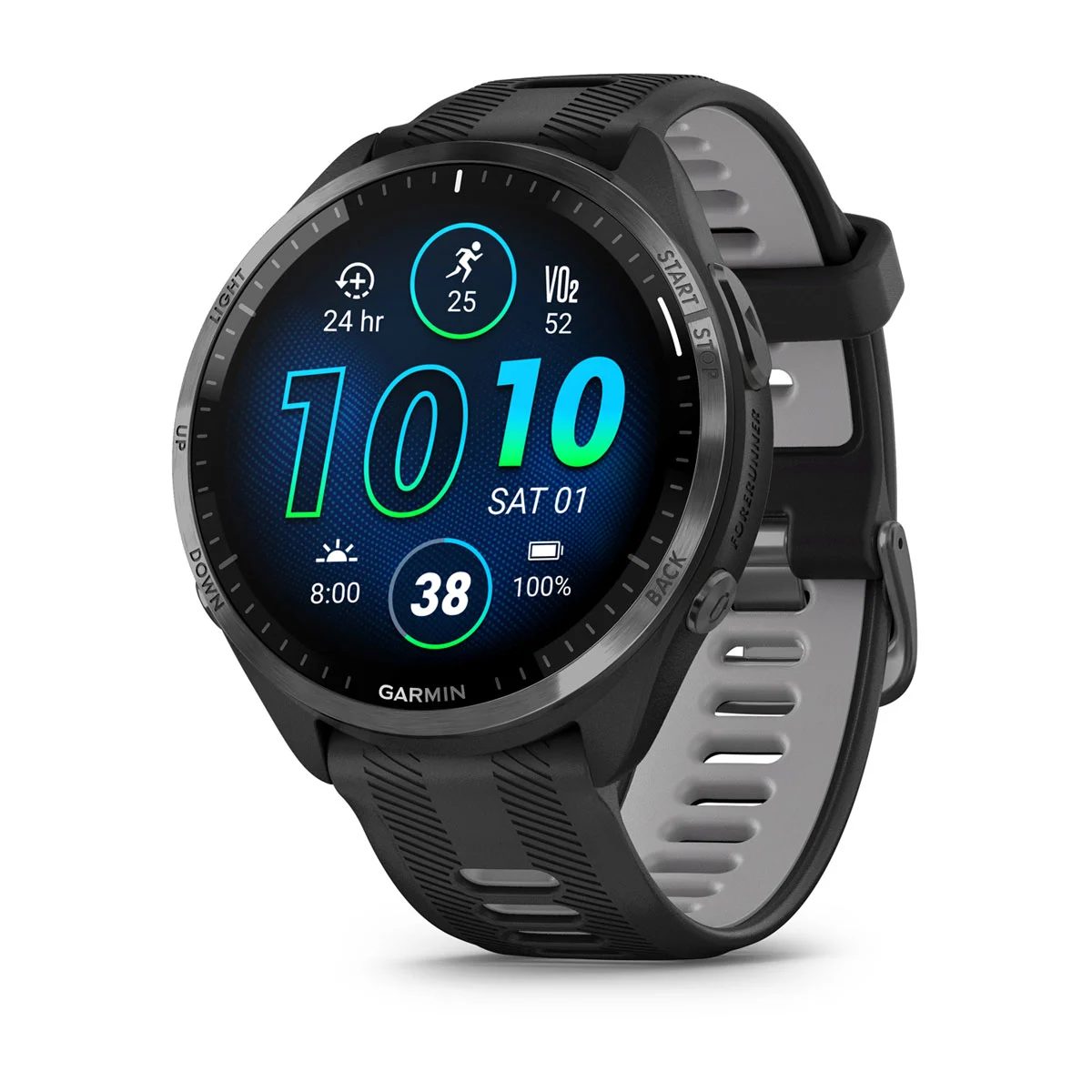
The 1.4-inch AMOLED display is the reason this product exists, and it delivers spectacularly.
Running at 454 x 454 pixels, the panel produces crisp text, vivid data fields, and map detail that the old 260 x 260 MIP screen could never approach. Heart rate zone colors are instantly distinguishable at a mid-stride glance – the difference between zone 3 orange and zone 4 red is unmistakable, which matters enormously during tempo runs and interval sessions. Topographic maps render with enough detail to navigate trail junctions confidently, with contour lines, trail markings, and points of interest all legible without stopping to squint.
Peak brightness handles direct sunlight admirably. This was the historical Achilles' heel of AMOLED sport watches – the technology that looked gorgeous indoors would wash out under a noon sun. The Forerunner 965's panel pushes enough nits to remain readable in bright outdoor conditions, though a transflective MIP display still holds a marginal edge under the harshest midday glare. In practice, this is a non-issue for the vast majority of training situations.
The always-on display mode keeps a simplified watch face visible at all times, which eliminates the raise-to-wake gesture during activities. The penalty is significant: battery life in smartwatch mode drops from the claimed 23 days to approximately 7 days. Most users will find the default raise-to-wake behavior responsive enough to justify the massive battery savings, but the option exists for those who need constant visibility during ultra-distance events.
What the AMOLED screen transforms most profoundly is the daily data experience. Morning Reports with color-coded sleep stages, Training Readiness scores rendered in intuitive green-yellow-red gradients, animated course maps with turn-by-turn cues – all of these features existed on previous Forerunners, but the AMOLED panel makes them feel alive rather than clinical. Data visualization is not just a cosmetic improvement; it directly impacts how quickly information is absorbed and acted upon.
Performance and Features
The Forerunner 965 runs Garmin's most complete software stack, and it feeds into the deepest training ecosystem available on any wrist.
GPS accuracy is market-leading. The watch supports multi-band (dual-frequency) GNSS across GPS, GLONASS, Galileo, QZSS, and IRNSS constellations, with Garmin's SatIQ technology intelligently switching between standard and all-systems satellite modes based on signal quality. In open terrain, traces are razor-clean. In dense urban environments and heavy tree canopy – the environments that historically tortured running watches – multi-band mode produces impressively tight tracks with minimal drift. Route overlays hug actual paths with a precision that puts single-frequency competitors to shame.
Full on-wrist mapping is the feature that separates the 965 from the Forerunner 265 and most competitors. Preloaded topographic and road maps with 32GB of storage enable real-time navigation, breadcrumb trails, and course following without a phone. On the AMOLED display, these maps are genuinely usable – not a gimmick but a legitimate navigation tool for trail runners and explorers. Course creation through Garmin Connect syncs wirelessly, and the watch provides turn-by-turn cues with distance-to-next prompts.
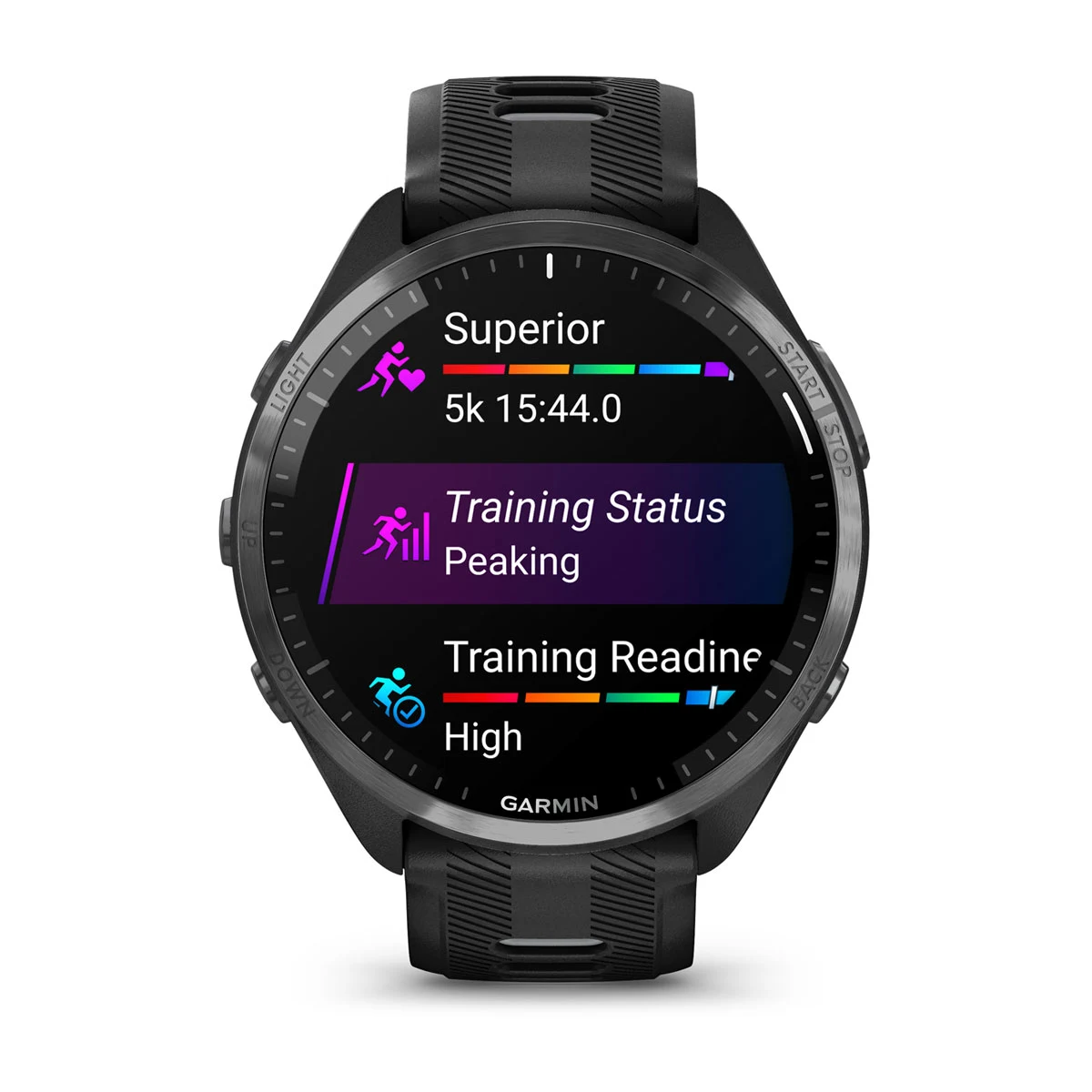
Training Readiness synthesizes HRV status, sleep quality, recovery time, acute training load, and stress levels into a single morning score. Green means push hard. Yellow means proceed with caution. Red means rest. After 2-3 weeks of calibration, the algorithm becomes remarkably predictive of how sessions will feel – and it has steered many runners away from ill-advised hard efforts on depleted legs.
Suggested Workouts build on Training Readiness by automatically generating daily run and ride recommendations calibrated to current fitness level and recovery status. The suggestions are not generic; they adapt based on accumulated training load, recent performance, and upcoming race events. A runner in base-building phase gets easy aerobic work; a runner peaking for a marathon gets race-pace intervals.
Additional training intelligence includes wrist-based running dynamics (cadence, stride length, vertical oscillation, ground contact time – all without an external pod), wrist-based running power, real-time stamina tracking that estimates remaining energy during activities, VO2 Max estimation, Training Status categorization, Chronic Training Load with an acute-to-chronic ratio, and race predictions for 5K through marathon distances. The race predictor skews slightly optimistic for longer distances but serves as a useful benchmark.
Triathlon and multisport modes handle automatic transitions with a single button press, tracking swim-bike-run with sport-specific metrics for each leg. Open water swim tracking, pool lap counting with stroke identification, and cycling power meter integration via ANT+ and Bluetooth round out the multisport package.
Music storage supports offline playlists from Spotify, Amazon Music, and Deezer across the 32GB internal memory. Garmin Pay via NFC, smart notifications, and Connect IQ watch face customization complete the smartwatch feature set. This is not trying to be an Apple Watch – it is a training computer that also handles daily convenience features competently.
Health and Fitness Tracking
The Elevate V4 optical heart rate sensor is the same multi-LED array found across Garmin's current lineup, and it performs well within the expected parameters of wrist-based optical technology. For steady-state running, cycling, and swimming, the sensor tracks within 2-3 BPM of a chest strap in most conditions – genuinely impressive accuracy that makes zone-based training reliable without external hardware.
Where the sensor shows its limitations is during rapid intensity changes. Hard interval sessions with sharp accelerations and recoveries can produce momentary artifacts, where the optical reader briefly lags behind actual heart rate during the first 15-30 seconds of a hard effort. This is not unique to Garmin – every optical wrist sensor shares this limitation to varying degrees. Athletes who live and die by interval heart rate data should still pair a chest strap for those specific sessions.
24/7 heart rate monitoring feeds stress tracking, Body Battery energy scoring, and respiration rate. The overnight data is where the real value lives: the watch tracks HRV (heart rate variability) during sleep and calculates a rolling seven-day HRV status that functions as an early warning system for overtraining, illness, or accumulated fatigue. A sudden HRV drop, visible days before symptoms appear, is one of the most actionable data points any wearable provides.
Sleep tracking scores each night on duration, deep sleep, REM time, light sleep, and awake periods. Stage detection is reasonably accurate for a consumer wrist device, though it occasionally miscategorizes brief wake periods and can log periods of quiet inactivity (reading, watching television) as sleep onset. The trend data across weeks and months is more valuable than any single night's score, and the Morning Report consolidation of sleep, HRV, weather, and training plan makes the information immediately actionable.
SpO2 (blood oxygen) monitoring runs throughout the night by default and can be enabled for all-day tracking at the cost of additional battery drain. The altitude acclimation tracking that builds on SpO2 data is useful for trail runners and mountaineers training at elevation.
The 30+ built-in sport profiles cover everything from track running to open-water swimming, indoor rowing to backcountry skiing, yoga to HIIT. Strength training counts reps and identifies exercises with mixed accuracy – always verify the count – but the automatic set detection works well enough to maintain a log without manual data entry.
Battery Life
Battery life is where the Forerunner 965 makes its most impressive engineering argument. Fitting a vibrant AMOLED display into a multisport watch and still delivering multi-week endurance was the technical challenge that defined this product, and the results are genuinely strong.
Official Garmin claims:
| Mode | Battery Life |
|---|---|
| Smartwatch (display off) | Up to 23 days |
| Smartwatch (always-on display) | Up to 7 days |
| GPS only | Up to 31 hours |
| All-systems GNSS + multi-band | Up to 19 hours |
| SatIQ (auto-select) | Up to 22 hours |
| GPS + music | Up to 10.5 hours |
| SatIQ (auto-select) + music | Up to 9.5 hours |
| All-systems + multi-band + music | Up to 8.5 hours |
Real-world performance depends heavily on usage patterns. With raise-to-wake enabled (always-on display off), daily notifications, 24/7 heart rate monitoring, and 4-5 hours of GPS-tracked workouts per week, expect 12 to 16 days between charges. That is extraordinary for an AMOLED sport watch and competitive with MIP-display competitors that sacrifice visual quality for endurance.
With always-on display enabled, that number drops to roughly 5 to 7 days with similar activity levels. Still respectable – better than most AMOLED competitors – but a meaningful step down that forces a mid-week charging habit for heavy trainers.
For ultramarathon and long-course triathlon athletes, the GPS endurance numbers matter most. Up to 31 hours in GPS-only mode covers virtually any single-day event. The 19 hours in full multi-band mode is sufficient for most 100-mile trail attempts, and the UltraTrac/Expedition modes extend GPS tracking to multiple days for thru-hiking and multi-stage events.
The Garmin proprietary USB-C charger reaches full capacity in roughly two hours.
Who It's For
The serious multisport athlete who wants full mapping, triathlon transitions, and the deepest training analytics available – all on a display that makes the data a pleasure to read. This is the watch for marathon trainers following structured plans, Ironman competitors who need swim-bike-run metrics, and trail runners who navigate by wrist. For a side-by-side look at how it stacks up, see our best running watches guide.
The data-driven runner upgrading from a Forerunner 245/745/945 who wants a generational leap in display quality and training intelligence without moving to the heavier, more expensive Fenix or Epix lines.
The Garmin ecosystem user already invested in Garmin Connect, Connect IQ watch faces, and Garmin's training philosophy. The 965 is the fullest expression of that ecosystem in the lightest, most attractive package.
Who Should Skip
Pure runners who do not need maps. The Forerunner 265 delivers nearly identical training metrics, a similarly excellent AMOLED display (1.3 inches), and strong battery life for $150 less. If on-wrist navigation is not a requirement, the 265 is the smarter purchase.
Smartwatch-first buyers. If app ecosystems, voice assistants, LTE connectivity, and broad third-party app support matter more than training depth, the Apple Watch Ultra or Samsung Galaxy Watch will serve better.
Budget-conscious runners. At $449 to $499, the Forerunner 965 remains a significant investment. The Forerunner 265 or even the Forerunner 165 provide excellent GPS training at lower price points.
Epix Gen 2 owners. The Epix shares most of the same capabilities in a more rugged package with sapphire crystal. Upgrading from an Epix to a Forerunner 965 is a lateral move at best. Fenix 8 owners on MIP displays have a stronger case for the switch, but should weigh the loss of sapphire and superior ruggedness.
The Verdict
The Garmin Forerunner 965 is the watch that proved Garmin could build a beautiful AMOLED sport watch without sacrificing the training depth and battery endurance that define the brand. The 1.4-inch display is stunning. The GPS accuracy is best-in-class. The training intelligence – from Training Readiness to suggested workouts to real-time stamina – remains unmatched in the running watch market. And the battery, even with that power-hungry AMOLED panel, delivers genuinely multi-week performance in daily use.
The main critique is straightforward: beyond the display and titanium bezel, the Forerunner 965 did not offer dramatic hardware upgrades over the Forerunner 955. The sensor is the same Elevate V4. The chipset is the same. The feature set was nearly identical at launch (though Garmin has since added features via firmware). For FR955 owners, the upgrade case was slim. For everyone else – especially those coming from older Forerunners or competing platforms – the 965 represents the most complete multisport watch available at its weight class. Its successor, the Forerunner 970, adds ECG and sapphire glass but at a significant price premium.
At its current street price, it is excellent value for what it delivers. Runners weighing it against non-Garmin alternatives should also consider the COROS PACE Pro, which trades Garmin's ecosystem depth for longer battery life at a lower price.
Score: 88/100
| Category | Weight | Score | Weighted |
|---|---|---|---|
| Core Function (GPS, training, maps, multisport) | 30% | 93 | 27.9 |
| Build Quality (titanium, weight, water resistance) | 15% | 88 | 13.2 |
| User Experience (display, UI, ecosystem) | 20% | 87 | 17.4 |
| Value (price vs. competition) | 20% | 80 | 16.0 |
| Battery Life (all modes) | 15% | 88 | 13.2 |
| Total | 100% | 87.7 -> 88 |
The Forerunner 965 earns an Excellent rating. It is the best multisport AMOLED watch Garmin has ever made and the benchmark against which every serious running watch is now measured. For runners and triathletes who want the complete package – maps, training intelligence, a gorgeous display, and battery life that embarrasses most AMOLED competitors – this is the one.