
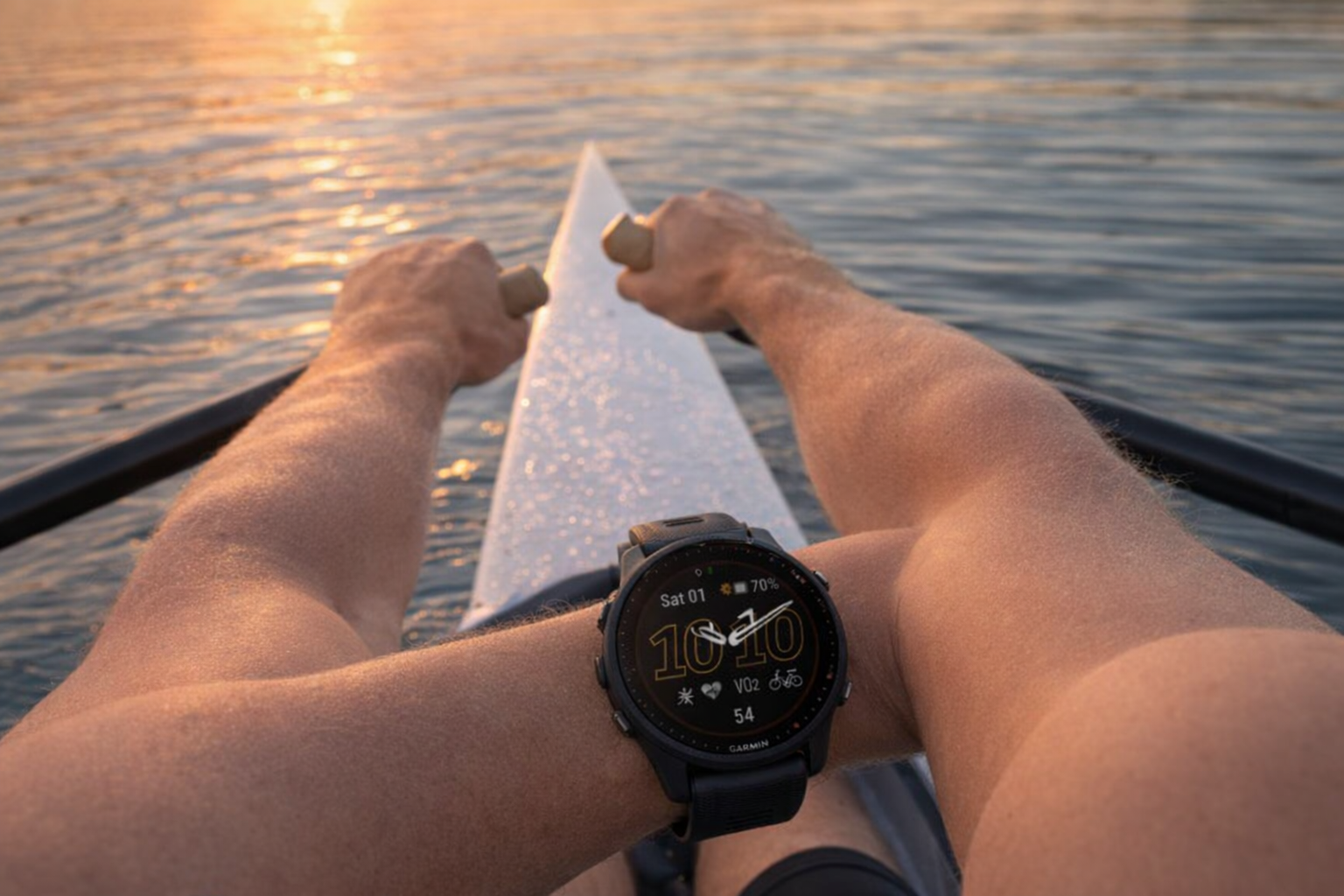
The Garmin Forerunner 955 launched in June 2022 as the most feature-dense Forerunner ever built – multi-band GPS, full-color mapping, Training Readiness, HRV Status tracking, native running power, and an optional solar edition, all in a 52g package. Nearly four years later, it faces an uncomfortable reality: Garmin's own lineup has moved to AMOLED displays, and the 955's memory-in-pixel screen now looks like a relic next to the Forerunner 265 and 965. That dated display is the single biggest reason buyers hesitate – and the single biggest reason the 955 still outlasts every AMOLED rival by days, not hours.
This is a review about trade-offs. The Forerunner 965 succeeded the 955 in March 2023 with a gorgeous AMOLED panel and identical software. The Forerunner 265 undercuts it with a vibrant screen at a lower price. Both watches look better on the wrist. Neither can match what the 955 still delivers where it counts for serious endurance athletes: two-week battery life, full topographic mapping in a Forerunner-weight case, and the deepest training analytics suite Garmin has ever shipped. The question is whether those advantages are worth living with a display that belongs to a previous era.
Design and Build
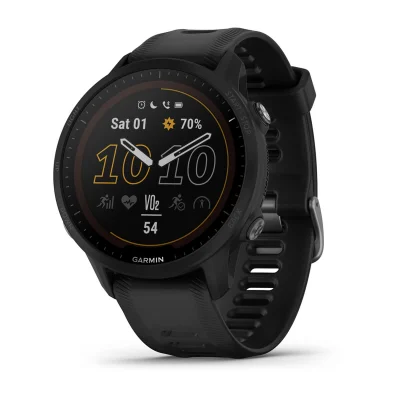
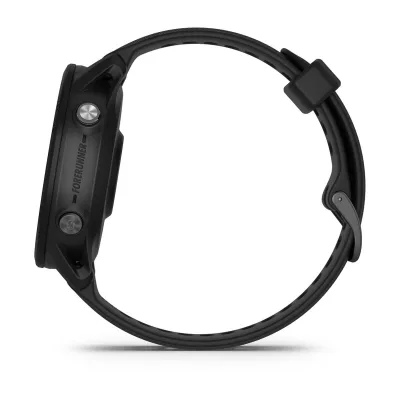
The Forerunner 955 measures 46.5 x 46.5 x 14.4mm and weighs just 52g (53g for the Solar edition) – a figure that makes it noticeably lighter than the Fenix 7 (79g) and only marginally heavier than the Forerunner 265 (47g). The fiber-reinforced polymer case is functional rather than fashionable, with a utilitarian black or whitestone finish that reads as a sports instrument, not a lifestyle accessory. The bezel is polymer rather than stainless steel, which keeps weight down but sacrifices the premium feel of Garmin's Fenix line.
Build quality is solid for the price tier. The Corning Gorilla Glass DX lens on the standard model (Power Glass on the Solar edition) handles gym contact and trail brushes without issue, though it will pick up fine scratches over extended use in a way that a sapphire crystal would not. Water resistance is rated at 5 ATM (50 meters), covering pool and open-water swimming, shower use, and rain without concern. The silicone strap is soft enough for comfortable all-day and overnight wear, and the standard 22mm QuickFit connection makes strap swaps effortless with a massive aftermarket ecosystem.
The five-button layout – three left, two right – is classic Garmin, and it remains the fastest way to navigate during activity. The touchscreen, added to the Forerunner line for the first time with the 955, complements the buttons for map interaction and menu scrolling but is disabled by default during most sport profiles. This is the right call. During intense effort, buttons provide the tactile certainty that a sweaty touchscreen cannot. The touchscreen works well enough for casual scrolling through widgets and zooming on maps, but it lacks the responsiveness of AMOLED implementations – wet fingers and mid-run taps sometimes require a second attempt.
Comfort during extended wear is a genuine strength. At 52g, the 955 disappears on the wrist during long runs, and the slim profile slips under a wetsuit sleeve without fuss. Side sleepers will notice the 14.4mm case height, but it is less intrusive than any Fenix model.
Display
The 955 uses a 1.3-inch transflective memory-in-pixel (MIP) display at 260 x 260 resolution. This is the same display technology found in the Fenix 7 series, and it carries the same tradeoffs – tradeoffs that become more pronounced as AMOLED becomes the industry default.
Outdoors, the MIP panel is superb. Visibility actually improves in direct sunlight, making pace, heart rate, and map data effortlessly readable on bright trails, open roads, and exposed routes without cupping a hand over the screen. The always-on nature of the display means a quick wrist glance delivers every data field instantly, without waiting for a raise-to-wake gesture. For athletes who train primarily outdoors, this sunlight readability is a tangible daily advantage.
Indoors and in dim lighting, the MIP screen shows its limitations. Colors appear muted, contrast is flat, and the backlight produces a cool blue tint that does not flatter the limited color palette. Compared to the AMOLED display on the Forerunner 965 or 265, the 955's screen looks dated. Map rendering is functional but lacks the visual polish that higher-resolution AMOLED panels deliver. Anyone who has spent time with a modern smartphone or AMOLED smartwatch will feel the gap immediately.
This is a deliberate engineering decision, not a cost cut. The MIP display is the primary reason the 955 achieves battery life figures that AMOLED rivals simply cannot match. Whether that tradeoff works depends entirely on priorities – outdoor readability and battery endurance versus indoor vibrancy and visual appeal.
Performance and Features
GPS accuracy is a headline strength. The 955 was the first Forerunner to include multi-band (dual-frequency) GNSS support via Garmin's SatIQ technology, accessing both L1 and L5 satellite frequencies across GPS, GLONASS, and Galileo constellations. In multi-band mode, tracks are exceptionally tight – the watch reliably pinpoints which side of a road a runner occupies, with minimal drift under tree cover and in urban canyons. The improvement over single-band GPS is particularly noticeable in challenging environments: dense forest, tall buildings, and narrow valleys.
SatIQ adds intelligence to the equation by automatically switching between GPS modes based on environment, balancing accuracy against battery consumption. In open terrain where multi-band offers diminishing returns, SatIQ drops to a less power-hungry mode. In challenging terrain, it escalates. The system works transparently and effectively.
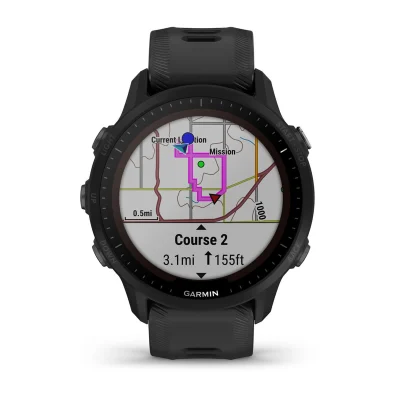
Full-color topographic mapping is available on all 955 models with 32GB of internal storage – enough for comprehensive regional maps, up to 2,000 songs via Spotify, Deezer, or Amazon Music offline playback, and Connect IQ apps without ever running into storage constraints. The mapping implementation includes trail overlays, points of interest, and turn-by-turn navigation with course guidance. While map rendering on the MIP display lacks the crispness of AMOLED implementations, the functional data – trail junctions, elevation contours, route deviations – is all present and usable. For trail runners and ultra-distance athletes who need on-wrist navigation without a phone, the mapping capability alone justifies the 955 over the Forerunner 265.
Native running power debuted on the 955, measuring power output at the wrist without requiring an external sensor – though pairing a Garmin chest strap or Running Dynamics Pod unlocks additional metrics including ground contact time, vertical oscillation, and stride length. The caveat: the 955's running power implementation does not support third-party power sensors from Stryd or other manufacturers, locking users into Garmin's ecosystem for this metric.
The activity profile library covers the full multisport spectrum: running, trail running, cycling, open-water and pool swimming, triathlon, multisport (customizable sport order), hiking, strength training, HIIT, yoga, and dozens more. The triathlon and multisport profiles handle automatic transitions smoothly, making the 955 a legitimate race-day tool for triathletes who previously needed to step up to a Fenix.
Garmin Pay contactless payments, music controls, smartphone notifications, and a weather widget round out the smartwatch functionality – functional but spartan compared to Apple Watch or Wear OS. The Connect IQ app store expands capabilities with custom watch faces, data fields, and widgets, though the third-party ecosystem remains thin compared to mainstream smartwatch platforms. Music streaming support is limited to Spotify, Deezer, and Amazon Music – notable absences include Apple Music and Tidal.
Health and Fitness Tracking
The 955 carries Garmin's Elevate Gen 4 optical heart rate sensor, an upgrade over the Gen 3 unit in the Forerunner 945. For steady-state running, cycling, and 24/7 resting heart rate monitoring, accuracy is solid – readings track closely to chest strap references during easy and moderate efforts. Readings generally track within a few BPM of chest strap references during steady-state activity, which is solid for an optical wrist sensor.
During high-intensity intervals, rapid heart rate transitions, and heavy wrist flexion (weightlifting, rowing), the familiar limitations of optical wrist HR apply. Lag during sudden spikes and dips is common, and readings can diverge 5-10 BPM from a chest strap during threshold efforts. Athletes who pace by heart rate zones during interval sessions should still pair an external chest strap or arm band. The wrist-based HR also struggles with tattoos on the inner wrist – a well-documented limitation across all optical HR watches.
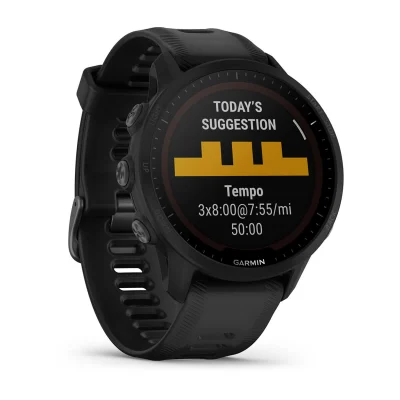
HRV Status tracking was a marquee addition with the 955 – the first Forerunner to offer it. The watch analyzes heart rate variability during sleep to build a personal baseline over approximately three weeks, then reports whether current HRV is balanced, unbalanced, or poor relative to that baseline. The implementation is genuinely useful for detecting accumulated fatigue, stress, and inadequate recovery before it manifests as poor performance. The HRV data feeds directly into the Training Readiness score, creating a cohesive ecosystem rather than an isolated metric.
Training Readiness consolidates HRV status, sleep quality, recovery time, acute training load, and stress history into a daily readiness score from 1 to 100. This single number answers the most practical question an athlete faces each morning: should today be a hard training day, an easy recovery day, or a rest day? The implementation is not perfect – the algorithm can occasionally overweight a single poor night of sleep – but the trend data over weeks is remarkably aligned with subjective feel. It remains one of the most actionable training features on any sports watch.
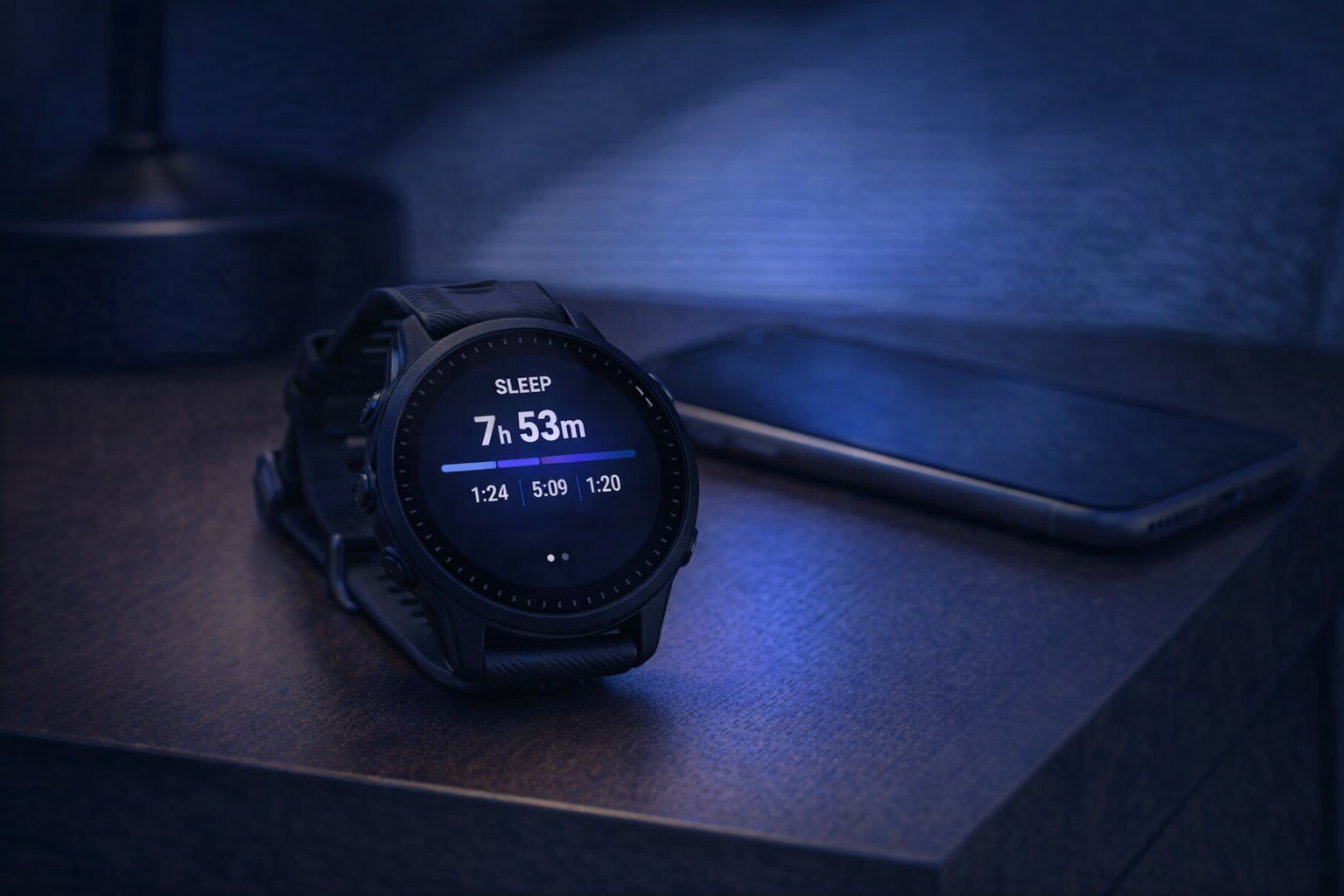
Body Battery tracks energy levels throughout the day using HRV, stress, and activity data. The trend lines are surprisingly accurate at matching perceived energy, though the algorithm takes a few weeks to calibrate to individual patterns and struggles with extreme scenarios like red-eye flights or all-nighters. Sleep tracking breaks down light, deep, and REM stages with a nightly sleep score. Accuracy lags behind dedicated sleep trackers like the Oura Ring – the 955 tends to overestimate total sleep time by logging pre-sleep stillness as light sleep – but the integration with Training Readiness and Body Battery makes the sleep data more actionable on the Garmin than raw sleep metrics alone.
SpO2 (pulse oximetry) monitoring is available for spot checks and overnight tracking, useful primarily for altitude acclimatization. VO2 Max estimates calibrate reasonably well after sufficient data accumulation and serve as useful benchmarks for fitness trending over months.
Battery Life
Battery life is where the 955's MIP display investment pays its most obvious dividend.
The standard Forerunner 955 delivers:
- 15 days in smartwatch mode
- 42 hours in GPS-only mode
- 31 hours in all-systems mode (GPS + GLONASS + Galileo)
- 20 hours in all-systems + multi-band mode
- 80 hours in UltraTrac mode
The Forerunner 955 Solar extends those figures:
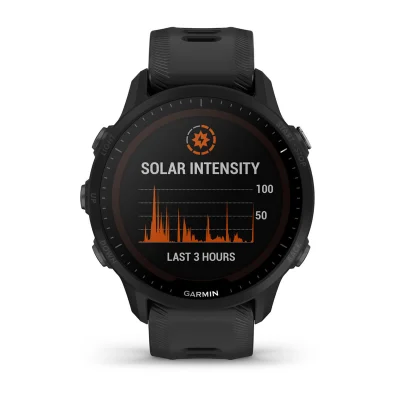
- Up to 20 days in smartwatch mode (with sufficient solar exposure)
- Up to 49 hours in GPS-only mode
- Approximately one additional week of smartwatch endurance under ideal solar conditions
The non-solar claims hold up in practice. With always-on display, notifications enabled, continuous heart rate monitoring, overnight SpO2 and HRV tracking, and one 60-minute GPS activity per day, expect 10 to 14 days between charges. A two-day backpacking trip with 9 hours of continuous GPS-only logging can still leave 75% battery remaining. These numbers are roughly double what the AMOLED-equipped Forerunner 965 achieves and roughly triple the Apple Watch Ultra 2.
The solar edition's real-world gains are more modest than marketing suggests. Under typical mixed indoor/outdoor use, the solar panel adds a day or two of smartwatch runtime – meaningful for extended backcountry trips but marginal for daily training. The $100 premium for the Solar model is hard to justify unless extended off-grid use is a regular scenario.
Charging uses Garmin's proprietary cable with a full charge completing in approximately two hours. The absence of USB-C on the watch body is increasingly conspicuous in a USB-C world, though the charging cable is shared across recent Garmin devices.
Who It's For
Serious runners training for marathons and ultras who want deep training analytics, on-wrist mapping, and battery life that outlasts multi-day training blocks without reaching for a charger. If that sounds like you, we rank the 955 alongside its rivals in our best running watches guide.
Triathletes who need a mature multisport platform with reliable open-water GPS, automatic transition tracking, swim metrics, cycling dynamics support, and race-day reliability – all without paying Fenix prices.
Trail runners and hikers who rely on on-wrist mapping and navigation. The 955 is the most affordable Garmin with full-color topographic maps and multi-band GPS, making it the value entry point for navigated backcountry running. For extended backcountry use, the Garmin Enduro 3 offers even longer battery life with similar mapping capability.
Data-driven athletes who want Training Readiness, HRV Status, and the full Garmin training analytics suite at a lower price point than the Fenix 7.
Anyone who prioritizes battery endurance and outdoor readability over display vibrancy.
Who Should Skip
Display-first buyers should choose the Forerunner 965 or Forerunner 265. If screen quality matters as much as training features, the AMOLED upgrade is worth it – the visual gap between MIP and AMOLED is significant and growing.
Casual runners and fitness newcomers will find the 955's feature depth overwhelming and its price unjustified. The Forerunner 265 or even the Forerunner 165 delivers everything a recreational runner needs with a better display at a lower price.
Apple ecosystem users who want deep phone integration, iMessage replies, and app ecosystem breadth should stay with Apple Watch Ultra 2. Garmin's smartwatch features are functional but minimal.
Budget-conscious buyers should look at the COROS PACE Pro ($229), which delivers excellent GPS accuracy, strong battery life, and solid training features at less than half the 955's list price – though it sacrifices mapping, the Garmin training ecosystem, and build refinement.
Anyone who needs the latest hardware should step up to the Forerunner 965 (AMOLED display, same software) or wait for the next generation. The 955's hardware is 2022 vintage, and while it remains capable, it is no longer current.
The Verdict
The answer to the trade-off question is clear: the Forerunner 955 earns its place on the strength of what it does, not how it looks doing it. Multi-band GPS accuracy ranks among the best in any sports watch – tight tracks under tree canopy, minimal urban canyon drift, and SatIQ's intelligent frequency switching means battery life is not sacrificed for precision. The training analytics stack – Training Readiness, HRV Status, Body Battery, and suggested workouts working in concert – remains the most actionable daily coaching system available on a wrist, translating complex physiological data into a simple morning question answered by a single number. Full-color topographic mapping at this weight class (52g) still has no peer outside the heavier Fenix line.
The concessions are real and worth stating plainly. The MIP display is outdoors-superb and everywhere-else-mediocre, and that gap has only widened as AMOLED has become the standard within Garmin's own catalog. Smartwatch capabilities are spartan – no iMessage replies, no rich app ecosystem, no visual flair. The touchscreen is functional but not responsive enough to impress. Build materials are appropriate for a sports tool but feel utilitarian next to the Fenix series. And the 2022 hardware vintage means buyers are investing in a platform that is closer to end-of-life than beginning.
The value calculation tips decisively in the 955's favor at current street prices. At sub-$350 – a steep drop from the $499 launch MSRP – buyers get roughly 90% of the Fenix 7's capability at 60% of the price, in a package that weighs 25g less. No AMOLED competitor in this price range can match the combination of two-week battery endurance, on-wrist navigation, and training depth. For the serious runner, triathlete, or trail athlete who will use these tools daily, the Forerunner 955 delivers more substance per dollar than any multisport watch currently on the market. For a broader comparison of top picks at every price point, see our best outdoor watches roundup.
| Category | Score | Weight |
|---|---|---|
| Core Function (GPS, tracking, sport modes) | 90 | 30% |
| Build Quality (materials, durability, comfort) | 80 | 15% |
| User Experience (display, app, software, interface) | 79 | 20% |
| Value (price vs. features vs. competition) | 91 | 20% |
| Battery Life | 92 | 15% |
Overall Score: 87/100