
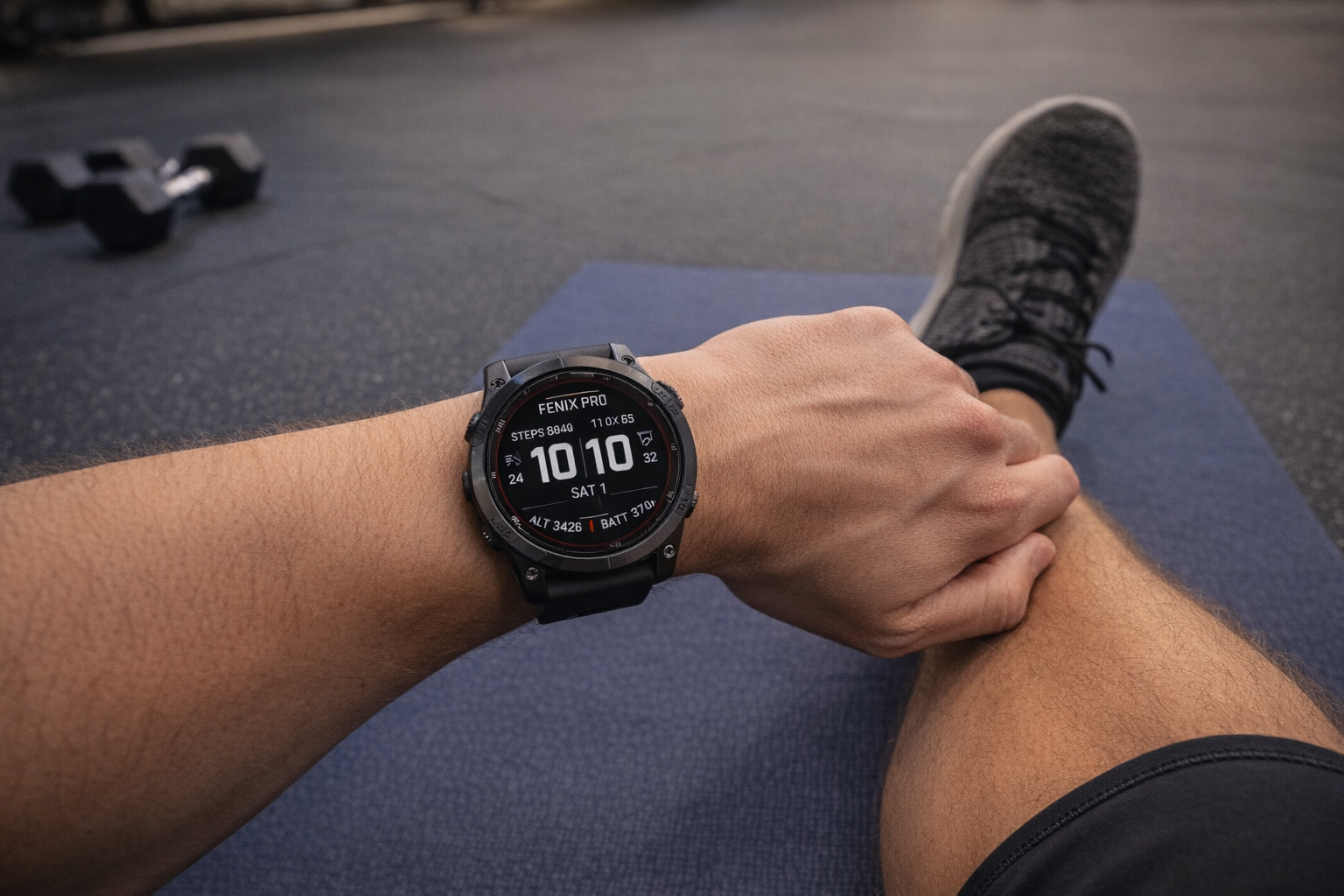
The Garmin Fenix 7 is no longer the newest watch in Garmin's flagship outdoor lineup – the Fenix 8 claimed that title in August 2024 – but that actually works in its favor. At current street prices between $450 and $550 for the standard and Solar editions (down from a $700-$1,000 launch MSRP), the Fenix 7 delivers multi-constellation GPS (with multi-band on Sapphire models), full topographic mapping, a touchscreen-plus-button interface, and marathon-grade battery life in a package that now significantly undercuts both its successor and every serious competitor. The feature set has not aged. The price has simply gotten better.
But does the hardware still hold up four years later? How have Garmin's generous firmware updates changed the calculus? And is the price drop enough to justify buying a previous-generation flagship when the Fenix 8 exists? Those are the questions worth answering – because the Fenix 7's story in 2026 is not about what it lacks compared to its successor, but about whether what it offers is still enough.
Design and Build
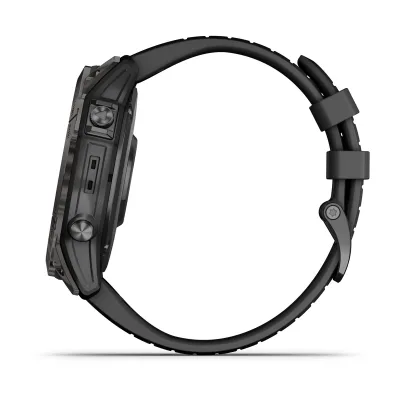
The standard Fenix 7 wears a 47mm fiber-reinforced polymer case that measures 14.5mm thick and weighs 79g with the silicone strap. It is not a small watch, but the polymer case is lighter than the 51mm Fenix 7X and, perhaps surprisingly, heavier than the titanium Sapphire Solar edition at 73g – titanium's lower density more than compensates for the sapphire crystal. The classic Fenix design language is fully intact: a stainless steel bezel with knurled edges surrounds the display, five physical buttons line the left and right sides, and the overall silhouette reads as a tool watch rather than a lifestyle accessory.
Build quality is excellent across the entire lineup but scales with price. The base Fenix 7 uses Corning Gorilla Glass DX over the display and a stainless steel bezel – durable enough for trail running and gym work, but susceptible to deep scratches on rock. The Sapphire Solar editions swap in a sapphire crystal lens (virtually scratch-proof) and a titanium bezel, pushing durability into expedition territory. Water resistance is rated at 10 ATM (100 meters) across all variants, covering swimming, snorkeling, and shower use without concern.
The three-size strategy – 42mm Fenix 7S, 47mm Fenix 7, and 51mm Fenix 7X – remains one of Garmin's smartest moves. The 7S fits smaller wrists without sacrificing core features (though it loses the flashlight and gets shorter battery life). The 7X adds a built-in three-LED flashlight and the longest battery life in the lineup, at the cost of additional bulk. The standard 47mm hits the balance point for most wrists.
Comfort during extended wear is solid. The silicone QuickFit band breathes adequately during workouts and the watch sits flat enough to sleep in, though side sleepers will feel the case thickness. The proprietary QuickFit band system makes swapping straps a two-second affair, and the aftermarket ecosystem for 22mm QuickFit bands is enormous.
Display
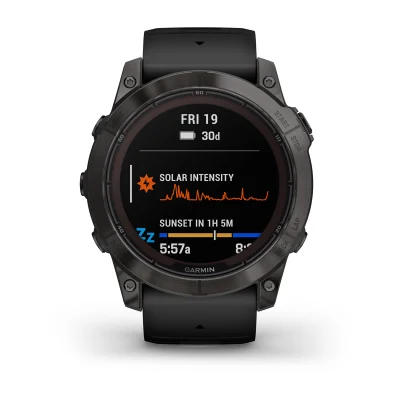
The Fenix 7 uses a 1.3-inch transflective memory-in-pixel (MIP) display at 260 x 260 resolution – and this is the single most polarizing aspect of the watch. In direct sunlight, the MIP panel is extraordinary. Visibility actually improves as ambient light increases, making data fields, map overlays, and workout metrics effortlessly readable on sun-drenched trails, open water, and exposed ridgelines. The always-on nature of the display means a quick glance delivers every data field without waiting for a wrist-raise gesture to wake the screen.
The tradeoff is equally real. Indoors, in dim lighting, and at night, the MIP screen looks flat and washed out compared to the vibrant AMOLED panels on the Garmin Epix series, Apple Watch Ultra 2, or Samsung Galaxy Watch Ultra. Colors are muted, contrast is low, and the blue-tinted backlight does not flatter the already limited 64-color palette. Anyone accustomed to AMOLED phones and watches will feel the difference immediately.
This is a deliberate engineering choice, not a compromise. The MIP display is the primary reason the Fenix 7 achieves its remarkable battery life. An AMOLED screen with always-on functionality would cut GPS runtime roughly in half. For athletes who spend their time outdoors and value battery endurance over screen vibrancy, the MIP panel is the correct answer. For those who want a watch that pops at a dinner table, the Garmin Epix (Gen 2) offers an AMOLED alternative with nearly identical internals.
The touchscreen was the headline hardware addition when the Fenix 7 launched in January 2022 – the first Fenix to offer touch input alongside the traditional five-button interface. The implementation is well-executed. Swiping through widget screens, scrolling maps, and navigating menus by touch feels natural and responsive, even with wet or sweaty fingers. Critically, touch can be disabled per activity profile, so an accidental wrist brush during a trail run will not pause a workout. The buttons remain fully functional for every operation, and many long-time Fenix users will continue to prefer them during intense activity.
Performance and Features
GPS accuracy is a genuine strength, particularly on the Sapphire Solar models that include multi-band (dual-frequency) GNSS support. The Fenix 7 Sapphire pulls signals from GPS, GLONASS, and Galileo across both L1 and L5 frequency bands, producing some of the tightest GPS tracks in the sports watch category. In dense urban canyons and heavy tree cover – environments that historically challenged single-band GPS watches – multi-band mode delivers meaningfully tighter lines and fewer waypoint errors. Against the Coros Vertix 2, GPS track accuracy is competitive – the Fenix 7 holds its own or edges ahead in most environments.
Standard (non-Sapphire) Fenix 7 models use single-band "All Satellites" mode across multiple constellations. Accuracy is still very good – a clear improvement over the Fenix 6 – but the gap between single-band and multi-band is noticeable in challenging terrain. Garmin's SatIQ technology helps by automatically switching between GPS modes to balance accuracy and battery consumption, which works well for most training scenarios.
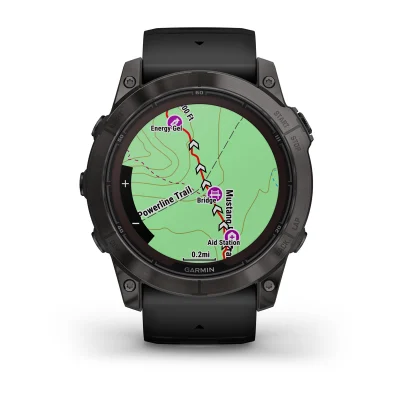
Mapping received a major democratization with the Fenix 7. All models now support free TopoActive map downloads via WiFi (Sapphire editions come with maps preloaded). Full-color topographic maps with trail overlays, points of interest, and turn-by-turn navigation are available directly on the wrist. Map rendering on the MIP display lacks the visual polish of an AMOLED implementation, but the functional data – trail intersections, elevation contours, route deviations – is all present and readable.
Music storage supports Spotify, Deezer, and Amazon Music offline playback, plus direct MP3 transfers. With 16GB of internal storage (32GB on Sapphire models), there is ample room for playlists alongside map data. Bluetooth headphone pairing works reliably for cord-free running.
Garmin Pay contactless payments are supported across all Fenix 7 variants, though bank compatibility varies by region. The convenience factor is real for runners who want to grab coffee mid-route without carrying a wallet.
The activity profile library is Garmin at its most comprehensive: running, trail running, cycling, swimming (pool and open water), triathlon, multisport, hiking, climbing, skiing, golf, surfing, and dozens more. Each profile offers deep customization of data screens, alerts, and auto-lap settings. The breadth here exceeds every competitor except Garmin's own higher-end models.
Health and Fitness Tracking
The Fenix 7 introduced Garmin's Elevate Gen 4 optical heart rate sensor, a meaningful upgrade over the Gen 3 unit in the Fenix 6. The new sensor adds additional red and infrared LEDs with a protective glass covering (addressing the cracking issues that plagued some Fenix 5 units). For steady-state running, cycling, and daily resting heart rate, the Elevate 4 performs well – readings track close to chest strap references during easy and moderate efforts.
The honest assessment for high-intensity work is more nuanced. During intervals, threshold efforts, and rapid heart rate changes, discrepancies of 5 to 10 BPM against a chest strap are common. This is not a Garmin-specific failing – it is the reality of optical wrist-based heart rate across the industry – but athletes who pace intervals by heart rate zones should still pair an external chest strap or arm band via Bluetooth or ANT+.
SpO2 (Pulse Oximetry) monitoring is available for on-demand spot checks and overnight tracking. Accuracy has improved over previous generations and tracks closer to medical pulse oximeters than the Fenix 6, though results remain approximate and should not be used for medical decisions. The primary utility is altitude acclimatization tracking for mountaineers and sleep quality trending.
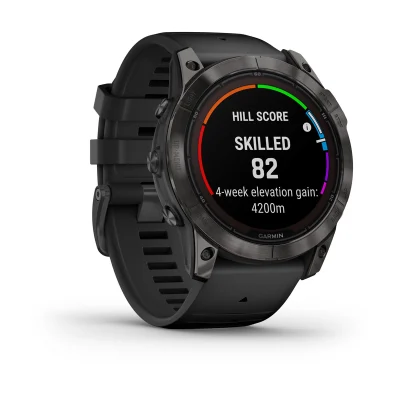
Where the Fenix 7 truly excels is in the training metrics ecosystem that Garmin has built and expanded via firmware updates since launch:
- Training Readiness consolidates sleep quality, HRV status, recovery time, acute training load, and stress history into a daily readiness score. It is one of the most useful "should I go hard today?" tools available on any watch.
- Real-Time Stamina displays a live percentage of remaining energy during workouts, allowing pacing adjustments on the fly. Particularly valuable for races and long efforts.
- Body Battery tracks energy levels throughout the day using HRV, stress, and activity data. The trend lines are surprisingly informative for recognizing overtraining and recovery patterns.
- Morning Report delivers a scrollable summary of sleep, HRV, training readiness, and weather each morning.
- Daily Suggested Workouts adapt based on training load, recovery status, and upcoming race events.
- VO2 Max and Race Predictor estimates are well-calibrated after sufficient data accumulation and serve as reasonable benchmarks, not gospel.
This training intelligence suite has grown substantially since the Fenix 7 launched and now rivals what ships on the Fenix 8. Garmin's decision to backport many features via firmware updates is notable – it extends the Fenix 7's competitive lifespan rather than forcing an upgrade.
Battery Life
Battery life is the Fenix 7's most decisive competitive advantage over AMOLED-equipped rivals. The standard 47mm Fenix 7 is rated for:
- 18 days in smartwatch mode
- 57 hours in GPS-only mode
- 40 hours in all-satellite-systems GPS mode
- 23 hours in all-satellite + multi-band GPS mode (Sapphire models)
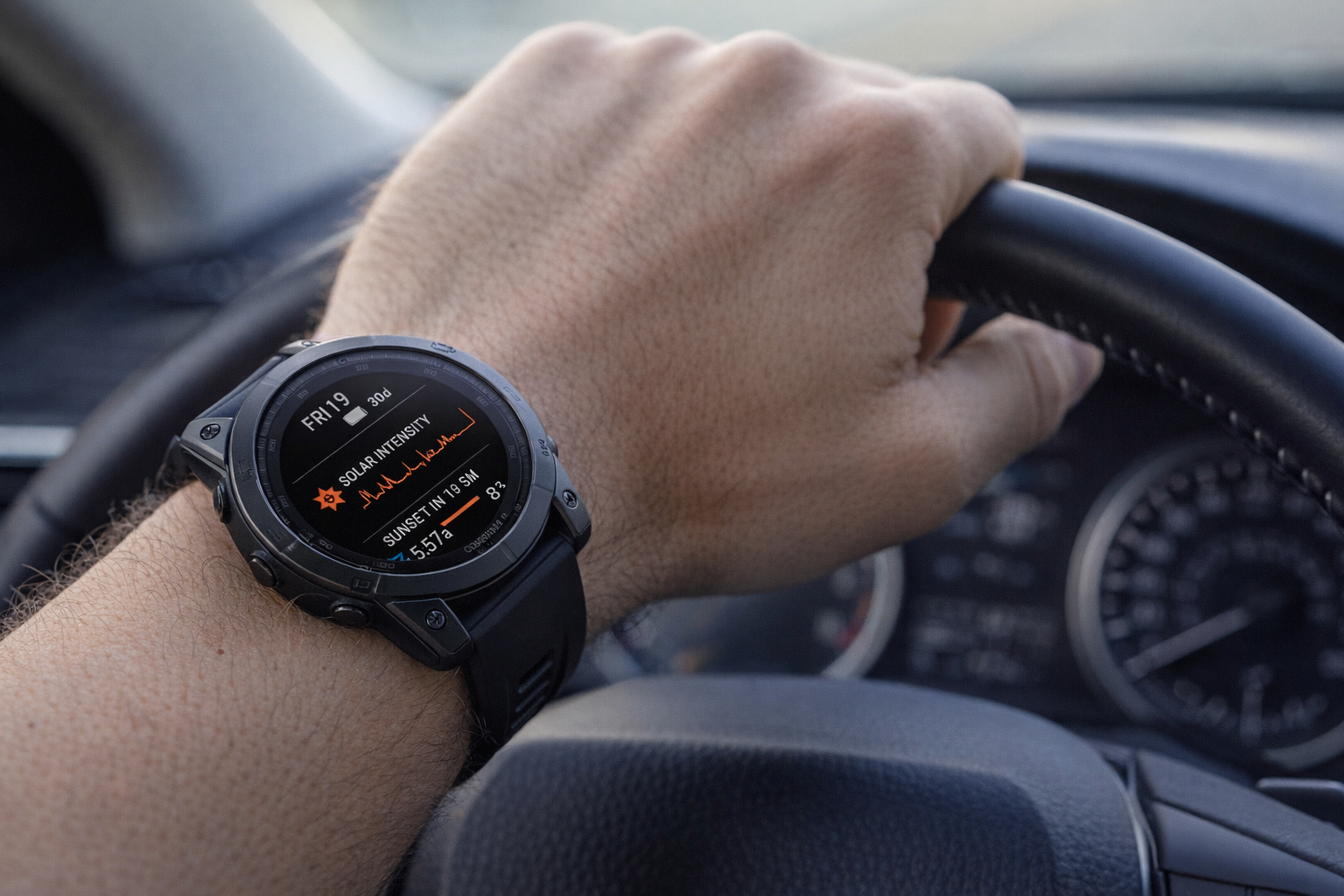
Solar editions extend these figures further, with Garmin claiming up to 22 days in smartwatch mode and 73 hours of GPS with sufficient sunlight exposure. Real-world solar gains depend heavily on outdoor time and conditions – expect modest but meaningful extensions if training outdoors regularly, not the dramatic multipliers the marketing suggests. The solar charging is most impactful on extended backcountry trips where every hour of additional GPS time matters.
In practical daily use with always-on display, notifications enabled, one GPS workout per day averaging 60 minutes, SpO2 overnight tracking, and continuous heart rate monitoring, real-world runtime lands in the 12 to 16 day range between charges. That is roughly three to four times what the Apple Watch Ultra 2 manages and roughly double the Garmin Fenix 8 AMOLED. An hour of GPS activity drains approximately 2 percent of battery – the kind of frugality that means multi-day hiking trips and ultra-distance events happen without packing a charger. For athletes who need even more endurance, the Garmin Enduro 3 pushes GPS battery life into truly staggering territory.
Charging is via Garmin's proprietary plug cable. A full charge from empty takes approximately two and a half hours, with the last stretch from 90 to 100 percent trickling in slowly. The cable is the same across recent Garmin devices, which is convenient for multi-Garmin households but frustrating for anyone hoping for USB-C on the watch body.
Who It's For
Ultrarunners and multi-day trekkers benefit most from the battery endurance – multi-day trips without a charger are routine, not aspirational.
Triathletes get a mature multisport profile with reliable open-water GPS, automatic transition tracking, and deep post-workout analytics.
Hikers and mountaineers gain full topographic maps, barometric altimeter, breadcrumb navigation, and the Sapphire Solar option for extended backcountry durability. For a broader look at top picks in this category, see our best outdoor watches guide.
Serious runners upgrading from a Forerunner 265 or Coros Pace 3 will find the jump transformative in both build quality and training metric depth.
Anyone who prioritizes outdoor readability and battery life over display vibrancy and smartwatch polish.
Who Should Skip
Display-first buyers should look at the Garmin Epix (Gen 2) or Fenix 8 AMOLED. If screen vibrancy and indoor readability matter more than maximum battery life, the MIP display will frustrate.
Apple ecosystem users who want deep phone integration, iMessage notifications, and app ecosystem breadth should stick with the Apple Watch Ultra 2. Garmin's smartwatch features are functional but spartan compared to Apple or Samsung.
Budget-conscious runners who do not need maps, barometric altimeter, or expedition-grade durability will find the Garmin Forerunner 265 or Forerunner 955 deliver excellent training tools at a lower price with an AMOLED display.
Tech-forward buyers who want the latest Garmin hardware – the new Elevate 5 heart rate sensor, AMOLED display option, built-in speaker and microphone, and dive computer capability – should pay the premium for the Fenix 8. The generational hardware gap is real, even if the software gap has narrowed.
The Verdict
The Garmin Fenix 7 is that rare product whose value proposition has actually improved with age. The hardware was outstanding at launch in January 2022, and four years of firmware updates have layered on training features that originally required the Fenix 7 Pro or even the Fenix 8. The MIP display remains a deliberate tradeoff – one that rewards outdoor athletes with unmatched sunlight readability and battery endurance. GPS accuracy, especially in multi-band mode, holds up against current-generation competitors. The build quality will outlast several upgrade cycles.
At current street prices of $450 to $550 for standard and Solar models, the Fenix 7 delivers a feature-to-dollar ratio that nothing else in the premium adventure watch category can match. The Fenix 8 is a better watch, but it is not twice-the-price better. The COROS Pace Pro exceeds expectations at its price point but targets a different audience. The Garmin Instinct 3 offers rugged Garmin capability for less, though with a smaller feature set. The Apple Watch Ultra 2 wins in display quality and phone integration but loses decisively in battery endurance and sport-specific training tools.
The Fenix 7 is not the newest. It is not the flashiest. It is, however, the smartest buy for the serious outdoor athlete who wants premium capability without premium pricing.
| Category | Score | Weight |
|---|---|---|
| Core Function (GPS, tracking, sport modes) | 88 | 30% |
| Build Quality (materials, durability, design) | 87 | 15% |
| User Experience (display, app, software, interface) | 78 | 20% |
| Value (price vs. features vs. competition) | 92 | 20% |
| Battery Life | 93 | 15% |
Score: 87/100 – The Fenix 7 combines premium adventure watch capability with a post-succession price drop that makes it the category's best value.