
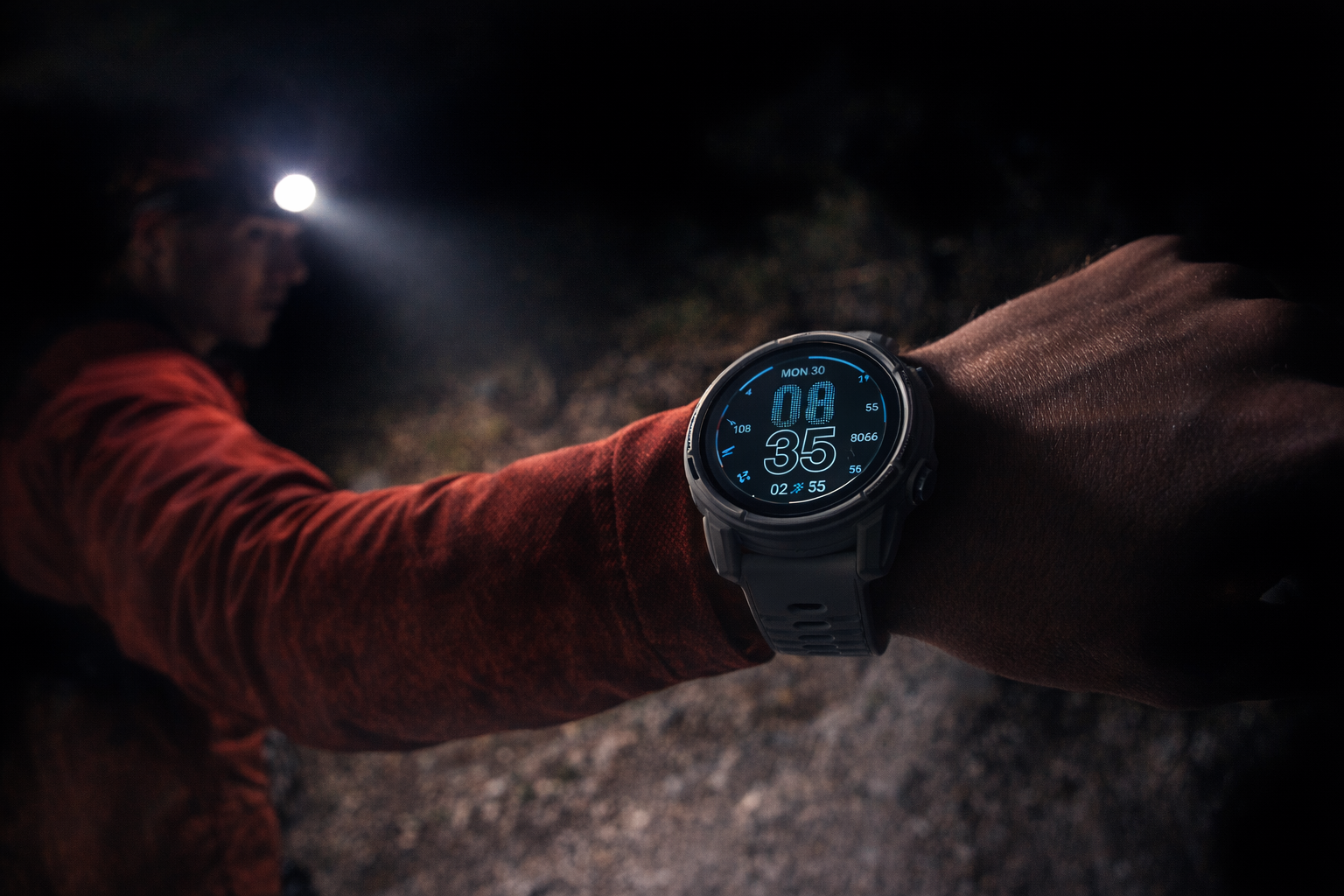
Every major sports watch brand is racing toward brighter, richer AMOLED displays. Garmin put one in the Fenix 8. Suunto built the Race 2 around one. Even Coros itself shipped AMOLED on the Pace Pro. So when the Apex 4 arrived with a third-generation Memory-in-Pixel screen – a technology with roots stretching back a decade in GPS watches – it looked like a company swimming against the current.
Whether that bet pays off depends on what you value. The Apex 4 trades visual flash for multi-day battery life, a screen that thrives in blinding alpine sun, and a GPS engine accurate enough to trust on exposed ridgelines. It is a deliberate, opinionated product – but in late 2025, with AMOLED watches rapidly closing the battery gap, the margin for that opinion is thinner than it used to be. There is also a firmware wrinkle worth flagging upfront: GPS track quality degrades noticeably when route navigation is active, a problem Coros can fix with a software update but has not addressed at launch.
Design and Build
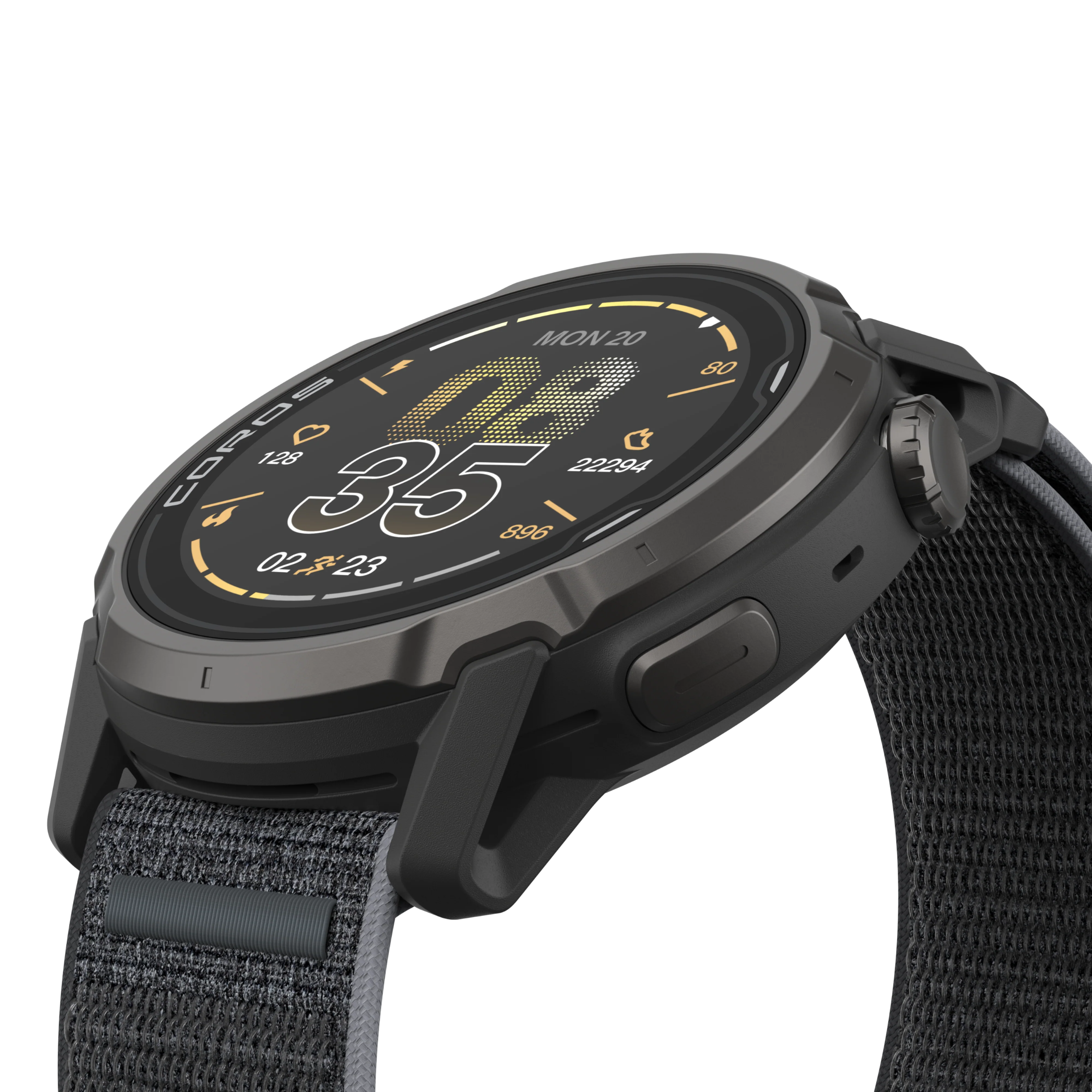
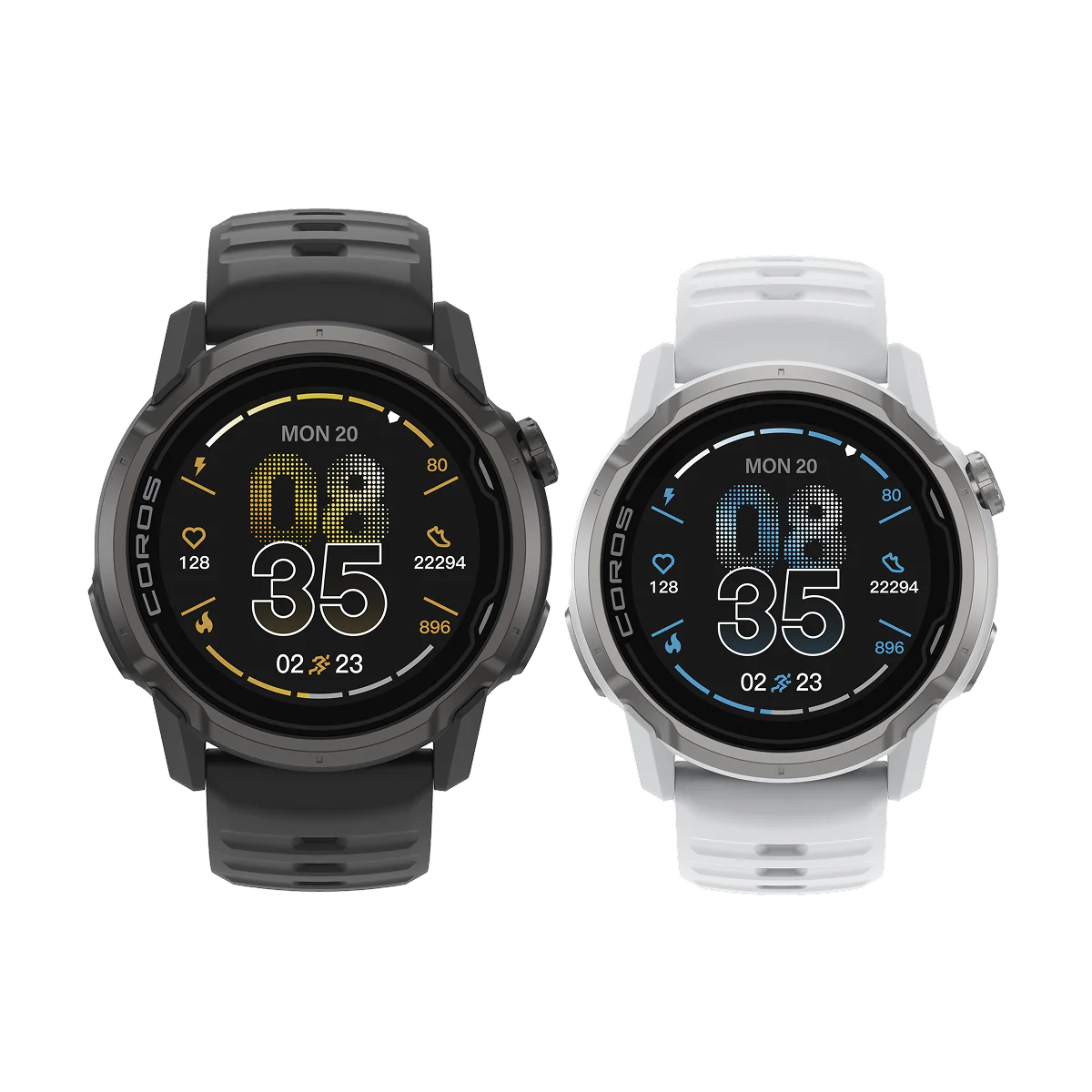
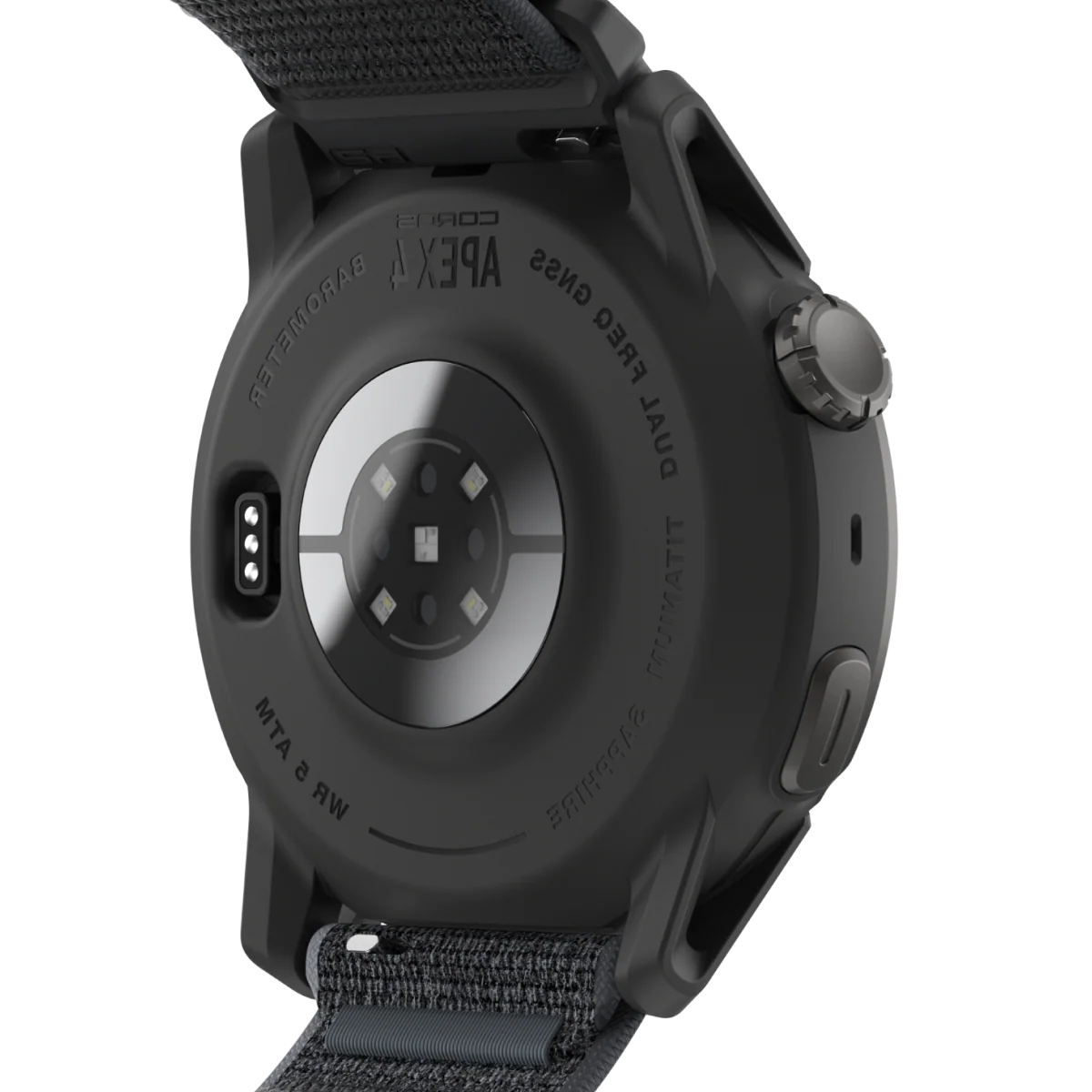
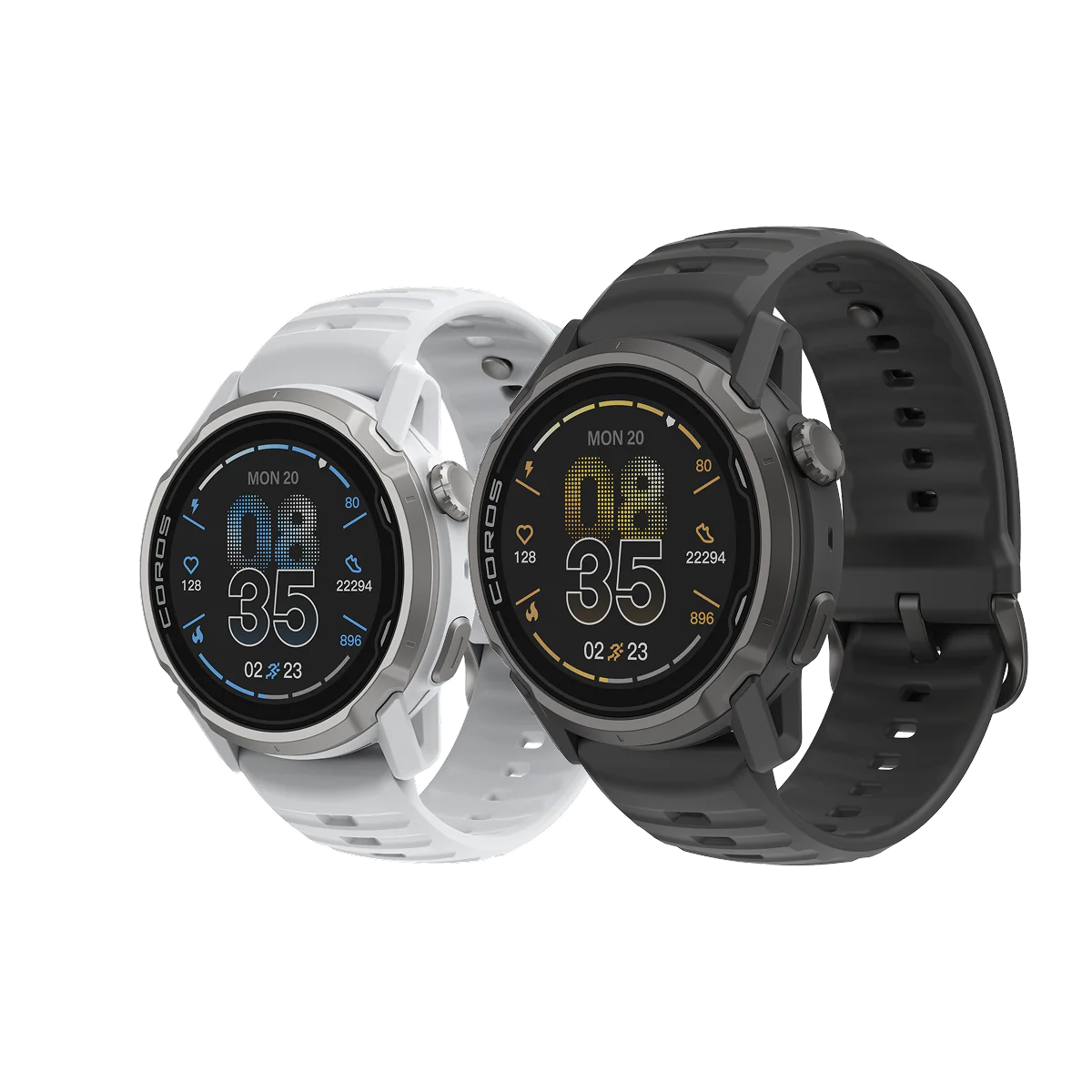
The Apex 4 succeeds the previous Apex 2 and Apex 2 Pro as a unified product line, available in 42mm ($429) and 46mm ($479) sizes. Both feature a Grade 5 titanium alloy bezel, sapphire crystal glass, and a fiber-reinforced polymer case back. The combination strikes a smart balance between durability and weight – the 46mm comes in at just 64g with the silicone strap (51g with the nylon band), while the 42mm drops to 56g and 45g respectively.
For context, the Garmin Fenix 8 47mm weighs 81g with its silicone band. That 17-gram difference sounds trivial on paper, but over a 50-mile ultra or a multi-day fastpacking trip, it is the kind of detail that separates a watch you forget you are wearing from one that annoys you on every steep descent.
The physical controls remain Coros's signature rotary dial on the right side, joined by a new programmable Action button on the left. The Action button is a welcome addition – one press pulls up the map mid-activity, eliminating the awkward hold-and-scroll routine that plagued the Apex 2. Coros also added a speaker and dual noise-canceling microphones, enabling hands-free Bluetooth calls and a clever Voice Pin feature that lets you record audio notes on the trail. The speaker delivers clear, audible pace alerts even at speed, which is a genuine improvement over the old beeper.
The dimensions sit at 46.2 x 46.2 x 13.7mm for the larger model. It wears smaller than those numbers suggest, thanks to the lightweight materials and relatively slim profile. The 42mm variant is genuinely small – among the most compact full-featured GPS watches with offline mapping.
Display
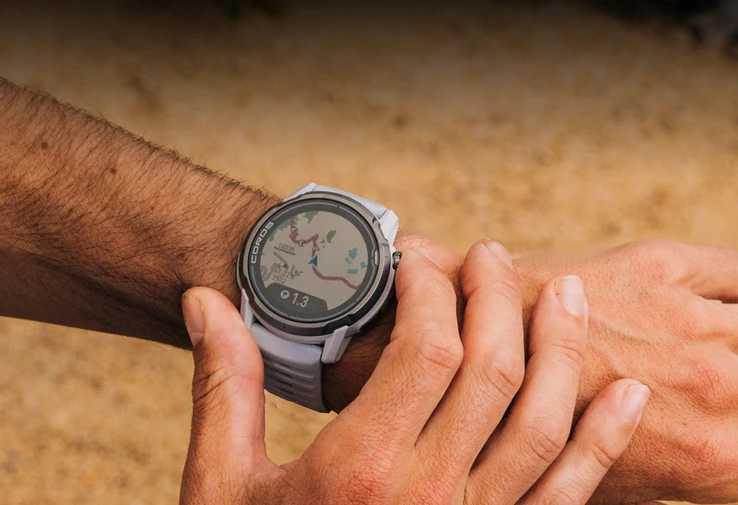
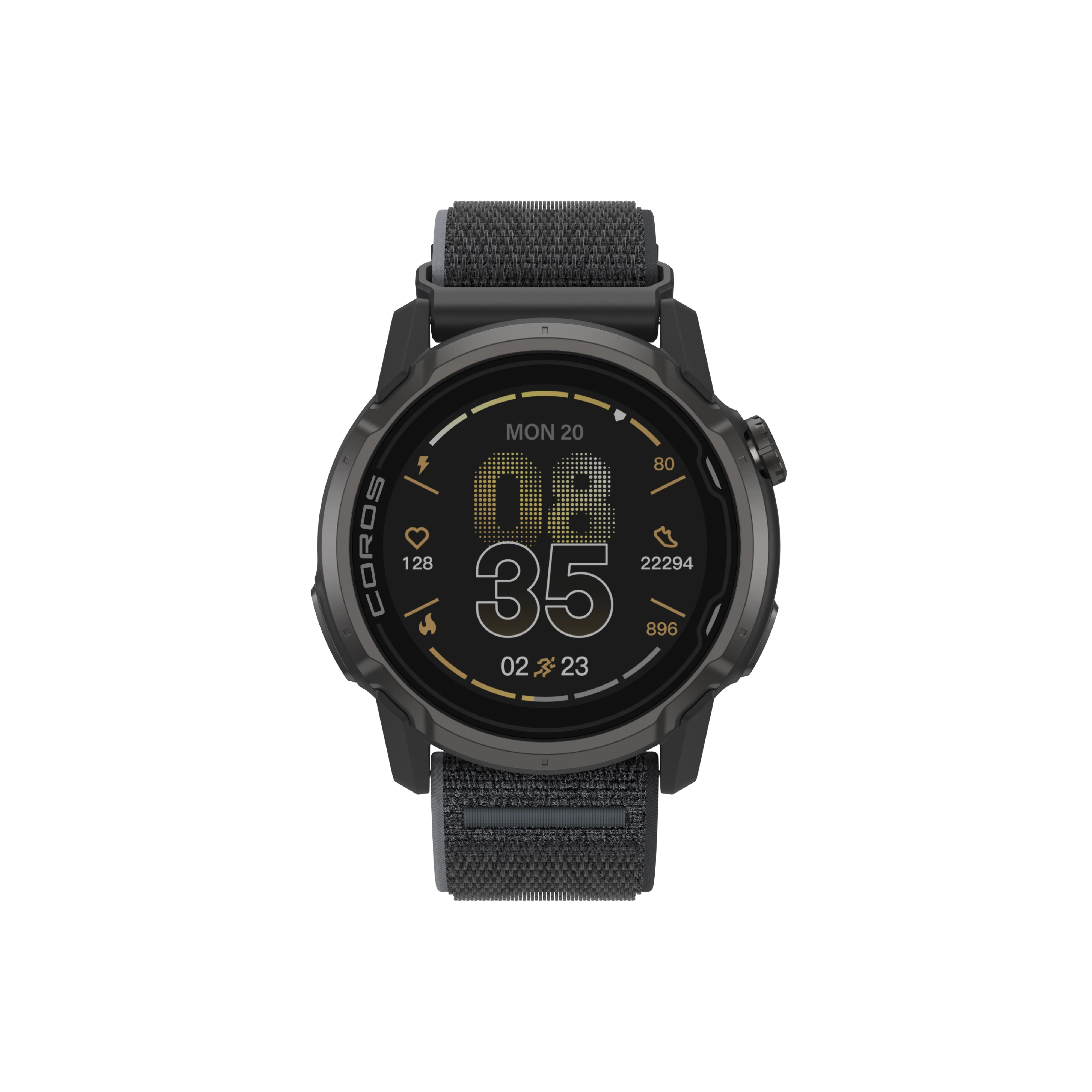
This is where the Apex 4 makes its stand. The 1.3-inch (46mm) or 1.2-inch (42mm) MIP display runs at 260x260 and 240x240 pixels respectively, with what Coros calls its third-generation MIP technology. The contrast improvement over the Apex 2 is noticeable – blacks are deeper, and the interface elements pop more crisply in ambient light.
Outdoors, the MIP display is superb. Direct sunlight that washes out AMOLED screens makes the Apex 4's display more readable, not less. On a snow-covered ridge or a sun-blasted desert trail, this screen delivers data with zero squinting. The always-on nature of MIP means there is no raise-to-wake delay, no tap-to-activate – the data is simply there, every time you glance down.
Indoors is where the compromise lives. Without strong ambient light, the MIP screen looks washed out and dim. Under artificial lighting, it feels like stepping back in time compared to the vibrant AMOLED panels on the Garmin Fenix 8 or Suunto Race 2. The backlight helps but cannot bridge the gap. Dense data screens – particularly the map view – can feel cramped on the lower resolution display.
The honest assessment: for anyone who primarily uses their watch outdoors during training and racing, the MIP display is not a downgrade – it is arguably an upgrade. For anyone who wants their $479 watch to look impressive at a dinner table or in an office, AMOLED wins decisively. The target audience for the Apex 4 overwhelmingly falls into the first camp, making this a sound engineering decision rather than a cost-cutting shortcut.
Battery Life
This is the Apex 4's headline act – and the direct payoff of that MIP display choice. The numbers deliver:
| GPS Mode | 46mm | 42mm |
|---|---|---|
| All Systems GPS | 53 hours | 34 hours |
| Dual-Frequency (All Systems + Multi-Band) | 41 hours | 26 hours |
| Endurance Mode | 65 hours | 54 hours |
| Daily Use (no GPS) | 24 days | 15 days |
Real-world performance meets or exceeds these claims. The Endurance mode – which intelligently switches between satellite constellations rather than simply defaulting to GPS-only – represents a smart engineering choice that preserves accuracy while extending runtime. The 46mm comfortably exceeds the stated 53-hour All Systems GPS figure under favorable conditions.
To put this in competitive context: the Garmin Fenix 8 (non-solar, AMOLED, 47mm) delivers approximately 35 hours in multi-band GPS mode. The Suunto Race 2 manages about 55 hours with its AMOLED panel in full dual-frequency Performance mode – an impressive achievement that narrows the MIP advantage. The Apex 4 still sits in a sweet spot – it delivers comparable accuracy with longer runtime, and it achieves this without requiring solar charging or display dimming tricks.
For ultrarunners and thru-hikers, this battery life is not just convenient – it is functionally enabling. A 100-mile mountain race with full dual-frequency GPS and navigation, or a three-day fastpacking trip without a charger, becomes genuinely possible. That is the MIP dividend, and it is substantial.
Charging is via a proprietary pin adapter that accepts a standard USB-C cable, with a full charge completing reasonably quickly. One note: previous Coros charging cables are incompatible with the Apex 4's new connector, which is mildly annoying for existing Coros owners and means the small charging dongle becomes a critical piece of kit to keep track of.
Performance and Features
GPS Accuracy
The Apex 4 runs an all-satellite dual-frequency GNSS chipset pulling from GPS, GLONASS, Galileo, Beidou, and QZSS. In open terrain and standard running, the accuracy is excellent – tracks align tightly with chest-strap-paired competitors like the Garmin Fenix 8 Pro and Apple Watch Ultra 3. Vertical capture shows meaningful improvement over the Apex 2, with elevation profiles that hold steady under tree canopy where older models would wander.
There is one significant caveat. When route navigation is active – following a loaded course with turn-by-turn guidance – GPS track fidelity degrades noticeably. The watch appears to apply excessive smoothing to the track, cutting corners on switchbacks and losing detail on technical terrain. Distance calculations remain accurate, but the recorded track looks poor. This is a firmware-level issue that Coros can and should fix, but as of launch, it is a real problem for anyone who wants both navigation guidance and a clean GPS record of their mountain route.
Without navigation running, the GPS is among the best in class at this price point. The new Ambiq Apollo 510 processor also delivers a 30x improvement in map rendering speed, making panning and zooming through offline topographic maps fluid rather than frustrating.
Training Features
The Apex 4 runs Coros's EvoLab training platform, which tracks training load, recovery, fatigue, base fitness, and race predictions. EvoLab has matured into a genuinely useful system – its recovery timer and readiness scores are direct and actionable without requiring a degree in exercise physiology to interpret. The Training Load metric still resets weekly rather than using a rolling 7-day average, which is a philosophical choice that some coaches find less useful than Garmin's approach.
Structured workout support covers intervals, targets, and multi-step plans pushed from the Coros app. The sport mode library spans over 50 activities, with dedicated profiles for trail running, climbing, ski touring, and mountain biking. A new underwater depth gauge adds hardware capability, though it lacks diving certification and does not save depth data to the app – it is a novelty rather than a functional tool for divers.
Navigation
Offline maps load globally with street names, trail names, and points of interest. The 32GB of onboard storage (up from 8GB on the non-Pro Apex 2) handles full regional map sets comfortably. Turn-by-turn navigation provides voice alerts through the speaker, and the map itself is now fast enough to be genuinely useful mid-activity rather than an exercise in patience.
What is missing: there is no ClimbPro-style segment breakdown for trail activities, which Garmin has made nearly standard on its upper-tier watches. For mountain runners who want to see upcoming climb profiles with grade and distance-to-summit data, this is a notable gap. Route management also requires manual selection rather than auto-syncing from platforms like Strava or Komoot – a small friction point that adds up over time.
Health and Fitness Tracking
Heart rate accuracy is a strength here, particularly for a wrist-based sensor. Running data – both road and trail – tracks closely with chest strap references across steady-state and interval efforts. Cold weather introduces occasional variance, but the sensor recovers quickly. Indoor cycling tracks well. Outdoor cycling, as with virtually every optical wrist sensor, remains unreliable due to vibration and wrist position – dedicated cyclists should pair a chest strap.
SpO2 monitoring is available on demand and during sleep. Sleep tracking captures sleep and wake times accurately, breaks down sleep phases, and provides written commentary on duration and quality. HRV tracking during sleep feeds into the recovery and readiness metrics within EvoLab. The system is not as granular as Garmin's Body Battery or Whoop's strain metrics, but it provides enough signal for most athletes to make informed training decisions.
Menstrual cycle tracking is a welcome addition to the Apex 4, expanding the health monitoring suite for female athletes.
Who It Is For
Buy the Apex 4 if you are: - A trail runner, ultrarunner, or mountain athlete who values battery life and sunlight readability above all else - Someone who runs multi-day events or fastpacking trips where charging access is limited - A Garmin user frustrated by the shift to AMOLED and shorter battery cycles - An athlete who wants full offline mapping and competent navigation under $500
Skip the Apex 4 if you are: - Someone who wants a smartwatch-level display for daily wear – the MIP screen will disappoint indoors - An athlete who relies heavily on climb-by-climb trail profiles during races - A cyclist who does not want to pair a chest strap for accurate heart rate - Someone who needs Spotify or streaming music – the Apex 4 supports offline MP3 only
Road runners who prioritize display quality and training metrics over battery endurance may prefer the Garmin Forerunner 265 or the higher-end Forerunner 965. For a broader look at the category, see our best running watches roundup. And if your priorities lean more toward backcountry navigation and rugged builds, our best outdoor watches guide compares the Apex 4 against its closest trail rivals, including the Coros Vertix 2S and the Suunto Race S.
The Verdict
The Coros Apex 4 is a focused instrument built for a specific kind of athlete. It sacrifices visual polish for functional endurance, and for its target audience, that trade-off pays clear dividends. The GPS accuracy (with the navigation caveat noted), the featherweight build, the titanium-and-sapphire construction, and above all the battery life make it one of the strongest mountain sports watches available in its price bracket.
The MIP display is not a compromise born of cheapness – it is a conviction. Whether that conviction aligns with yours depends entirely on where you spend your time. On a mountain, the Apex 4 is outstanding. At a desk, it is merely adequate. For the athletes Coros built this watch for, that is exactly the right priority order.
| Category | Weight | Score |
|---|---|---|
| Core Function (GPS, training, navigation) | 30% | 84 |
| Build Quality | 15% | 88 |
| User Experience | 20% | 76 |
| Value | 20% | 81 |
| Battery | 15% | 95 |
Score: 84/100 – An excellent mountain sports watch that earns its keep through outstanding battery life and GPS accuracy, held back by a dimmer display experience and a few missing software features.