
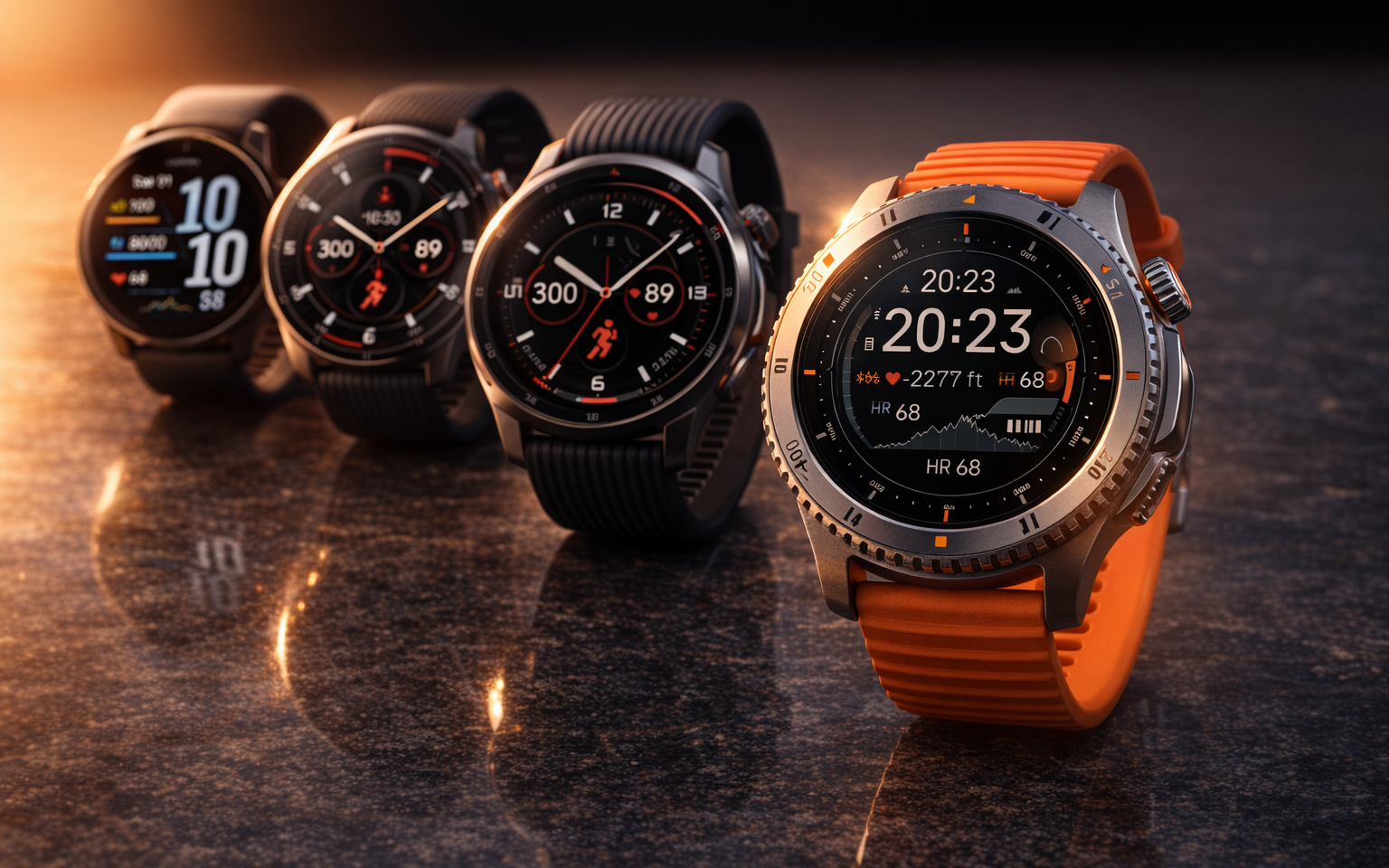
There is a meaningful difference between a running watch that happens to have smart features and a smartwatch that happens to be great for running. Dedicated running watches like the Garmin Forerunner 970 or Coros Pace Pro exist to optimize training – they prioritize GPS accuracy, battery endurance, and sport-specific metrics above everything else. Smartwatches exist to be extensions of your phone that also track your runs. If you want the best pure running tool, check out our Best Running Watches 2026 guide instead. This guide is for everyone else.
The "everyone else" category is enormous. Most runners don't need a dedicated training computer. They need a watch that handles notifications, plays music on Bluetooth headphones, pays for a post-run coffee with a tap, and – critically – tracks their runs accurately enough to trust the data. The tradeoff is always battery life. A Garmin Enduro 3 lasts weeks; an Apple Watch Series 11 lasts a day and a half. But if you're charging nightly anyway and your runs are under three hours, that tradeoff disappears.
GPS accuracy has improved dramatically across mainstream smartwatches. Dual-frequency GNSS, once exclusive to premium sports watches, now appears in everything from the Apple Watch Ultra 3 down to the OnePlus Watch 3. The gap between a $300 smartwatch and a $500 running watch has never been smaller – at least for runs under marathon distance. Here are the seven smartwatches that handle running best in 2026.
Our Top Picks
Apple Watch Ultra 3: Best Overall Smartwatch for Running (iOS)
$799
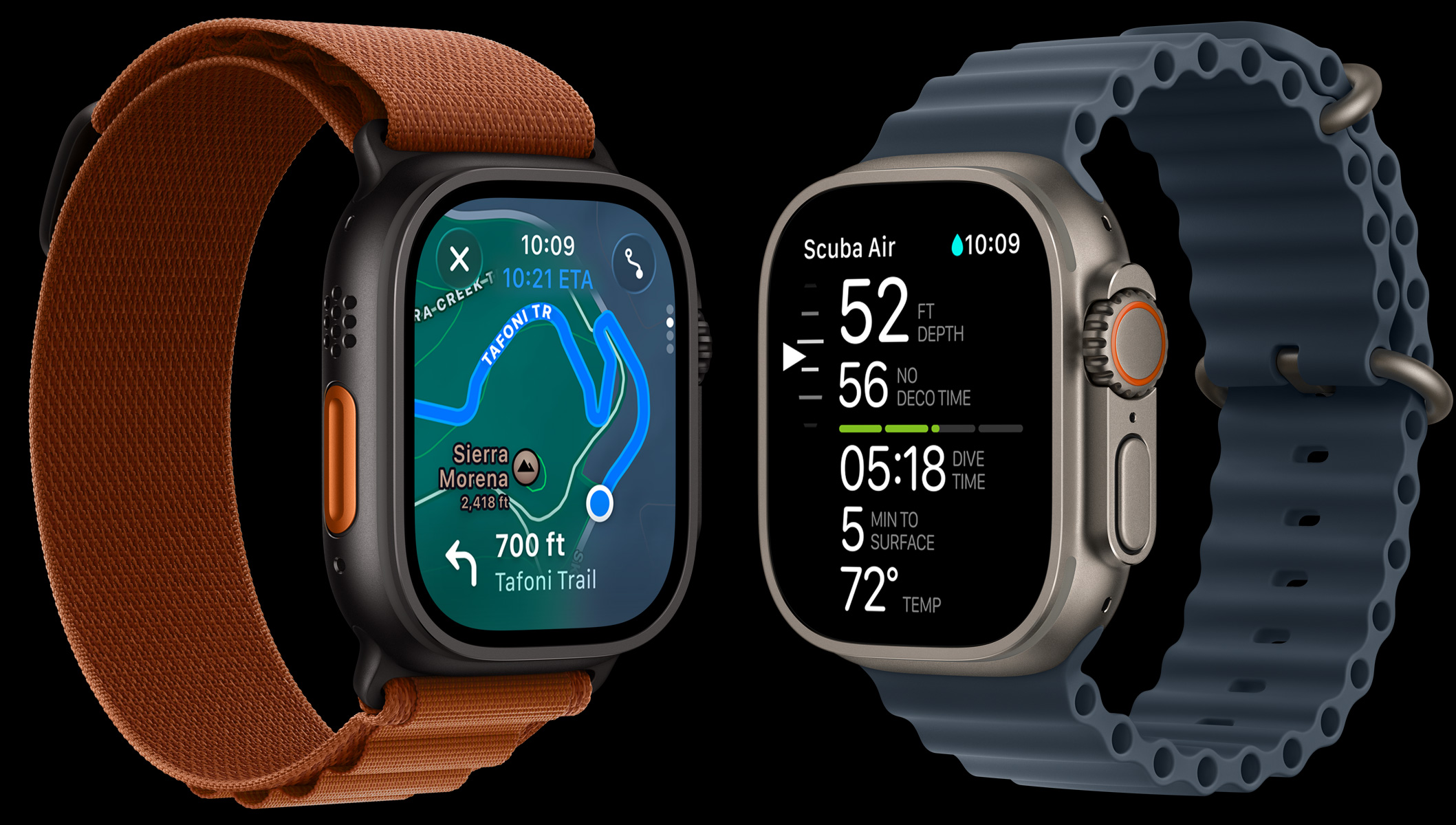
The Ultra 3 is the only smartwatch that genuinely rivals dedicated running watches on GPS accuracy while delivering the full Apple ecosystem. Dual-frequency L1/L5 GNSS locks onto satellites faster and holds signal more reliably than any other smartwatch, including Samsung's Galaxy Watch Ultra. Urban canyon runs – between skyscrapers, under overpasses, along tree-lined streets – show measurably tighter track accuracy than previous generations. The 49mm titanium case is built for abuse, and the 42-hour battery life (72 in low-power mode) means back-to-back marathon training days without touching a charger. The hard prerequisite: you need an iPhone. Android users should skip to the Galaxy Watch Ultra below.
The Action Button is a legitimate running feature. Mapped to lap splits, it eliminates fumbling with a touchscreen mid-interval. The always-on display is readable in direct sunlight, and the built-in cellular means you can leave your phone at home and still stream Apple Music, take emergency calls, or get turn-by-turn directions. WatchOS workout views are customizable with pace zones, cadence, ground contact time, and running power – metrics that used to require a Garmin or COROS.
Beyond the iPhone requirement, the size is polarizing – 49mm wears large on smaller wrists, and some runners find the weight noticeable during tempo work. And while battery life is excellent for a smartwatch, it still can't match a Forerunner 970's multi-day GPS endurance. But if you run with an iPhone and want one watch that does absolutely everything, the Ultra 3 has no equal.
Samsung Galaxy Watch Ultra: Best Overall Smartwatch for Running (Android)
$649
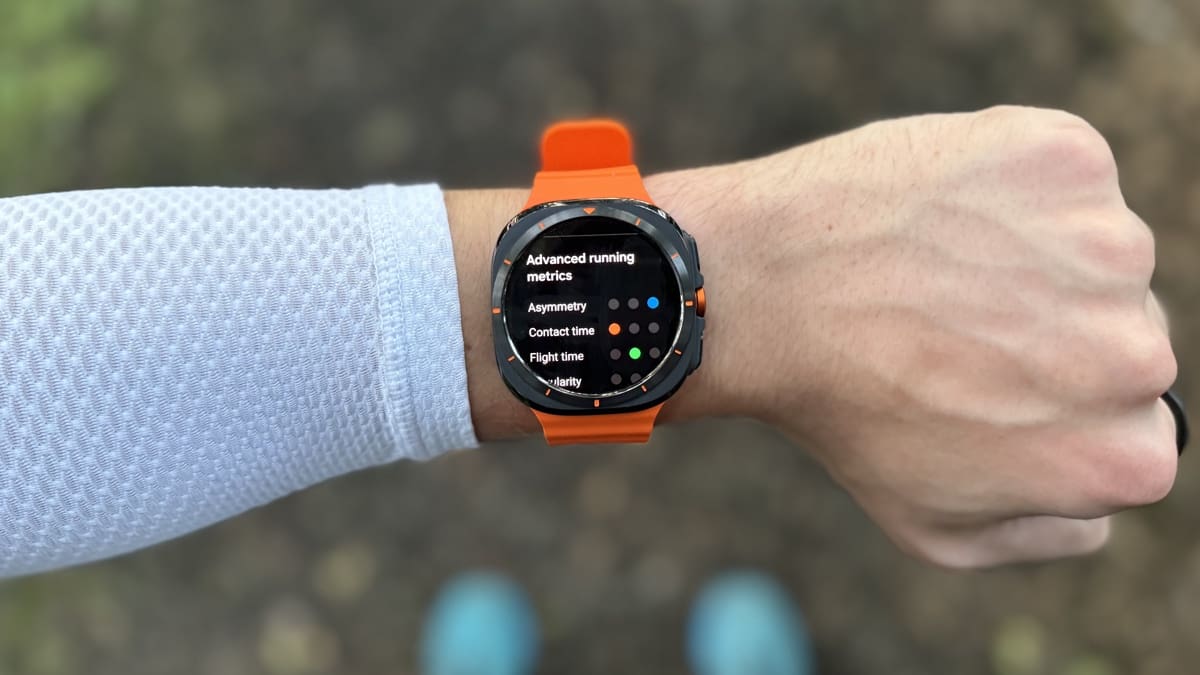
Samsung's answer to the Apple Watch Ultra delivers a genuinely premium running smartwatch for Android users. The cushion-shaped titanium case houses dual-frequency GPS that tracks runs with strong accuracy – not quite Ultra 3 levels in dense urban environments, but close enough that most runners won't notice the difference. The 47mm case with its Quick Button mirrors Apple's Action Button utility, giving you physical lap control without touchscreen hassle. One important caveat up front: full health features require a Samsung Galaxy phone – non-Samsung Android users lose ECG and some advanced metrics.
The Galaxy Watch Ultra runs Wear OS with Samsung's One UI overlay, which means full access to Google Maps, Spotify, Google Wallet, and thousands of third-party apps. Samsung's own health stack is deep: advanced running metrics include asymmetry analysis, ground contact time, and a Running Coach feature that adapts interval sessions to your current fitness level. The 60-hour battery claim holds up at roughly 48 hours with typical use including a daily GPS run – still meaningfully longer than a standard Galaxy Watch 8.
The tradeoff: Samsung's health platform requires a Samsung phone for full functionality. Pair it with a Pixel or OnePlus device and you lose some health features and the ECG sensor won't activate. The watch also runs warm during extended GPS sessions in hot weather, and the thickness makes it less comfortable as a sleep tracker than slimmer alternatives. At $649, it undercuts the Apple Watch Ultra 3 by $150 while matching most of its running credentials – a compelling proposition for Android runners who want the best.
Apple Watch Series 11: Best Mid-Range Smartwatch for Running
$399 (42mm) / $429 (46mm)
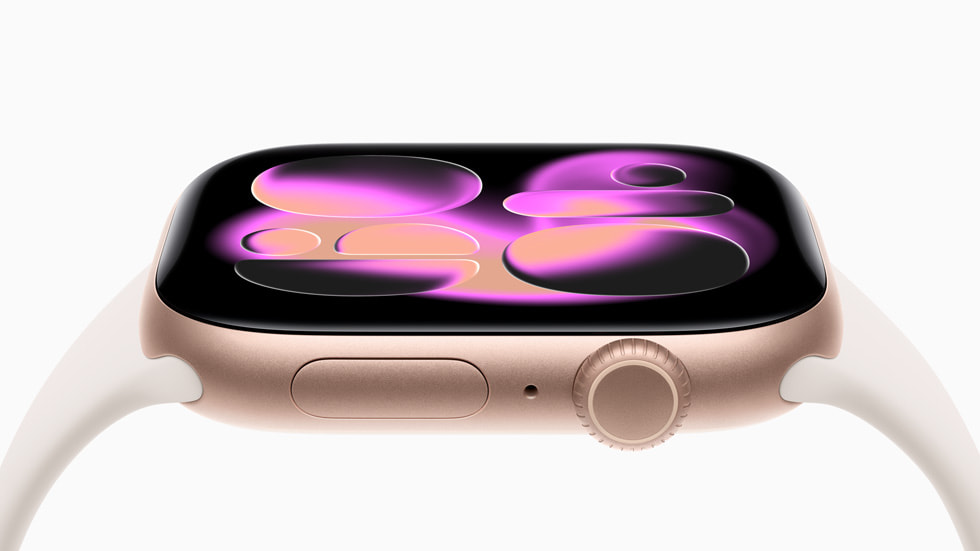
The Series 11 is the smartwatch most runners should actually buy. It delivers the same core running metrics as the Ultra 3 in a lighter, slimmer, more comfortable case that disappears during runs. The thinner profile and reduced weight make a real difference over 10+ miles – wrist fatigue is nonexistent in a way that heavier watches can't match. The always-on OLED display is gorgeous, and the new S10 chip keeps everything snappy.
The running feature set is comprehensive: pace alerts, cadence tracking, route mapping, running power estimation, and customizable workout views. The key differences from the Ultra 3 are GPS (single-frequency L1 vs. dual-frequency L1/L5), durability (aluminum vs. titanium), water resistance (50m vs. 100m), and battery life – the Series 11 gets up to 24 hours depending on usage, which means daily charging is mandatory. GPS accuracy is still strong for most routes, though the Ultra 3 pulls ahead in urban canyons and dense tree cover. For runners who charge every night and rarely run ultras, this is a non-issue.
The biggest limitation remains battery life for long events. A marathon that takes four-plus hours with GPS active will drain the Series 11 to critically low levels. Low Power Mode helps but disables the always-on display and reduces heart rate sampling frequency. If your longest run is a half marathon, the Series 11 handles it with room to spare. If you're training for ultras or multi-day adventures, step up to the Ultra 3.
Garmin Venu 4: Best for Serious Training
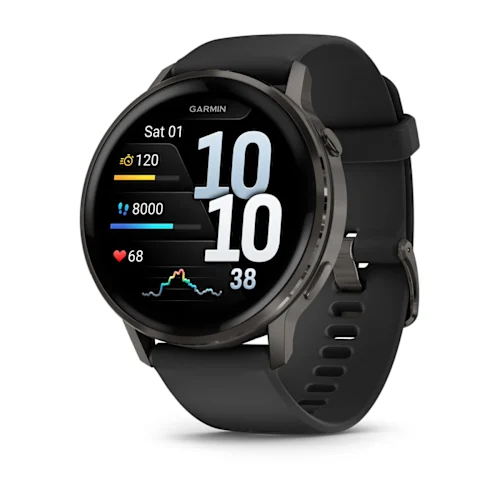
$549
The Venu 4 is Garmin's answer to a question only Garmin could ask: what if a lifestyle smartwatch had the training engine of a Forerunner? The result is a watch that looks refined enough for daily wear – AMOLED display, slim 12.5mm case, premium build – while packing Garmin's full training suite underneath. Training Readiness, Body Battery, HRV Status, race predictions, and structured workout support are all here, pulled directly from Garmin's sport watch lineup.
Where the Venu 4 truly separates from Apple and Samsung is battery life. Twelve days in smartwatch mode, with up to 20 hours of continuous GPS tracking, fundamentally changes how you use the watch. No nightly charging. No anxiety about making it through a long run. You charge it once a week and forget about it. For runners who also want Garmin Connect's unrivaled training ecosystem – adaptive training plans, detailed recovery metrics, performance condition tracking – the Venu 4 is the only smartwatch that delivers it all without compromise.
The caveat: Garmin's smart features trail Apple and Samsung significantly. There is no robust app store. Notifications work but feel clunky compared to watchOS or Wear OS. Music storage is limited and streaming requires a Wi-Fi download rather than cellular streaming. Garmin Pay works but with fewer supported banks than Apple Pay or Google Wallet. The Venu 4 is $549 – more expensive than an Apple Watch Series 11 – and it delivers a worse smartwatch experience while delivering a better training experience. That tradeoff is either perfect or disqualifying depending on your priorities.
Google Pixel Watch 4: Best Wear OS for Running
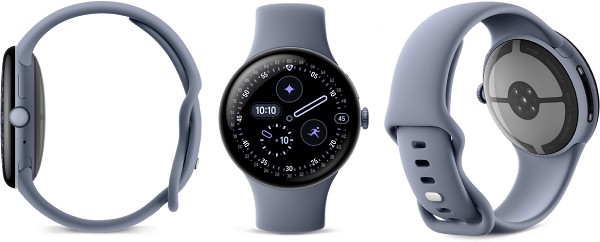
$349 (41mm) / $399 (45mm)
The Pixel Watch 4 is the most polished pure Wear OS experience available, and the Fitbit integration makes it a surprisingly capable running companion. The redesigned Fitbit running dashboard presents real-time pace, heart rate zones, cadence, and distance in a clean, glanceable layout. The 45mm model's larger display makes mid-run data checks painless. GPS accuracy has improved substantially over the Pixel Watch 3 – dual-frequency GNSS now tracks reliably in urban environments, though it still occasionally drifts under heavy tree cover.
Google's ecosystem advantages shine for runners who live in the Android world. Google Maps navigation on the wrist, Google Wallet for contactless payments, YouTube Music streaming, and the best Google Assistant integration on any watch. The Fitbit health stack underneath tracks Daily Readiness Score, sleep stages, and Active Zone Minutes. For runners who want health insights without Garmin's data-heavy approach, Fitbit's presentation is more accessible and easier to act on.
Battery life is the Pixel Watch 4's Achilles' heel. The 41mm model struggles to last a full day with a GPS run included. The 45mm version fares better at roughly 40 hours, but that still demands every-other-day charging. Fitbit Premium ($9.99/month) gates some of the more detailed health analytics behind a subscription, which stings on a $399 watch. And the rounded dome design, while beautiful, makes the watch slightly top-heavy on thinner wrists during runs.
OnePlus Watch 3: Best Budget Smartwatch for Running
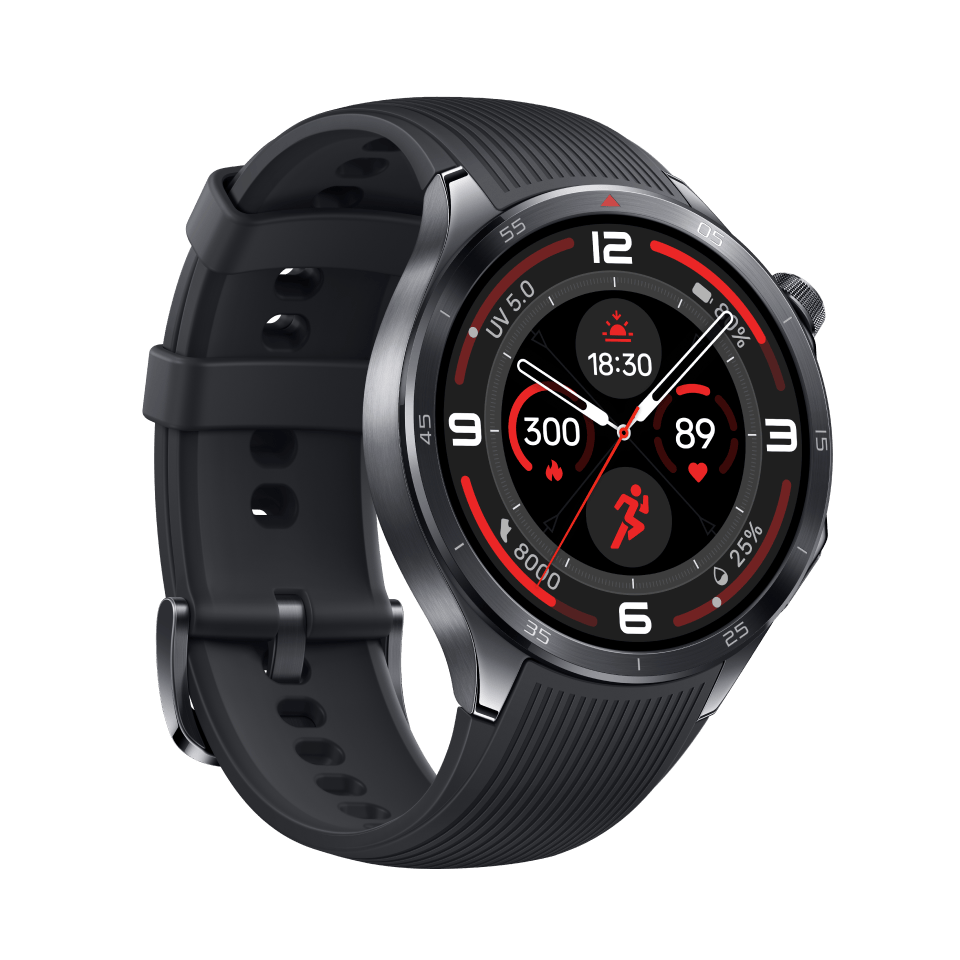
$329
The OnePlus Watch 3 is the budget running smartwatch to beat in 2026. It runs full Wear OS – not a stripped-down proprietary OS – which means Google Maps, Google Wallet, Spotify, and the complete Play Store app library. The 120-hour battery life claim is aggressive, but even real-world usage delivers 4-5 days between charges with a daily GPS run included. That's two to three times what you get from an Apple Watch or Pixel Watch, at a lower price.
Dual-frequency GPS tracks runs accurately, and the Snapdragon W5 Gen 1 processor keeps the interface responsive. The 1.5-inch AMOLED display is bright and sharp. OnePlus's health tracking covers the essentials – continuous heart rate, SpO2, sleep tracking, and over 100 sport modes with running-specific pace and distance metrics. The titanium bezel and sapphire crystal give it a premium feel that belies the price.
The limitations are real. OnePlus's health ecosystem is shallow compared to Apple Health, Samsung Health, or even Fitbit. Running metrics are basic – you get pace, distance, heart rate, and cadence, but no training load analysis, no recovery advisor, no race predictions. The watch doesn't work with iPhones at all. And OnePlus's track record for long-term software updates is unproven compared to Apple or Samsung. But if you want Wear OS, multi-day battery life, and accurate GPS tracking for under $350, the OnePlus Watch 3 is the clear value pick.
Amazfit Balance 2: Best Battery Life on a Budget
$299
The Amazfit Balance 2 pushes battery life to absurd levels for a smartwatch with an AMOLED display. Twenty-one days in standard mode, up to 33 hours with continuous GPS – numbers that put it in Garmin territory while costing half the price of a Venu 4. For runners who despise charging rituals or want a watch that survives a full training week (or two) without thinking about a cable, the Balance 2 delivers.
The 1.5-inch AMOLED display is large and vivid. Zepp Coach provides AI-driven training plans that adapt to your fitness level and recovery status. GPS accuracy is solid for a sub-$300 device – dual-band positioning keeps routes tight on open roads, though it can wander in dense urban areas. The watch tracks over 170 sport modes, supports offline maps for route navigation, and includes continuous heart rate, SpO2, stress, and comprehensive sleep tracking without any subscription fees.
The tradeoff is ecosystem. Amazfit's Zepp app is functional but lacks the depth and third-party integrations of Apple Health, Google Fit, or Garmin Connect. There is no third-party app store – you get Zepp's built-in apps and nothing else. Notification handling is basic, and there's no NFC payment support in the US. Music storage is limited to transferring files manually rather than streaming. The Balance 2 is a fitness watch with some smart features, not a full smartwatch with fitness features. But at $299 with that battery life, it earns its spot for budget-conscious runners who prioritize endurance over ecosystem.
How We Chose
GPS accuracy was the first filter. A smartwatch for running must track distance and pace reliably – within 1-2% of a known course distance. Watches with frequent GPS drift or poor urban canyon performance were eliminated regardless of their other strengths.
Smartwatch features separated this guide from our running watch guide. Every pick here delivers notifications, app ecosystems, contactless payments, and music playback. If it can't handle a text message and a tap-to-pay coffee run, it belongs in the running watch category, not here.
Battery life during GPS use matters more than standby time. A watch that lasts 14 days but only records 10 hours of GPS isn't serving runners well. GPS endurance matters more here, especially for picks aimed at marathon and ultra runners.
Training metrics beyond basics earned bonus points. Pace and distance are table stakes. Watches that offer training load, recovery recommendations, race predictions, and structured workout support ranked higher than those offering only raw data.
Comfort during runs is subjective but critical. Weight, case thickness, and band ventilation all affect wrist feel during arm swing. A technically superior watch that shifts around during intervals fails the most important test.
Who Should Buy What
iPhone runners who want the absolute best: Apple Watch Ultra 3. No compromises on GPS, durability, or smart features.
iPhone runners on a budget: Apple Watch Series 11. Nearly identical running features to the Ultra 3, lighter on the wrist, and frequently discounted to $299.
Android runners who want premium: Samsung Galaxy Watch Ultra. The most complete Android running smartwatch with genuine training depth.
Runners who prioritize training data: Garmin Venu 4. Garmin's training ecosystem is unmatched, and the 12-day battery eliminates charging anxiety.
Android runners who want clean Wear OS: Google Pixel Watch 4. Best Google integration and Fitbit's accessible health platform.
Budget-conscious Android runners: OnePlus Watch 3. Full Wear OS, multi-day battery, accurate GPS, $349.
Battery-first runners on a budget: Amazfit Balance 2. Three weeks between charges, solid GPS, no subscriptions, $299.
What To Avoid
Garmin Venu X1: The ultra-thin design is impressive, but the compromised GPS antenna and reduced battery life make it a poor choice specifically for running. It's a great lifestyle watch; it's a mediocre running watch. If you want Garmin's training stack, spend the extra for the Venu 4.
Samsung Galaxy Watch 8 Classic for running: The rotating bezel is a fantastic smartwatch interface, but the bezel adds weight and width that make the Classic less comfortable during runs than the standard Galaxy Watch 8. The Classic is the better daily smartwatch; the standard Galaxy Watch 8 is the better running smartwatch. If you want Samsung's best running experience, step up to the Galaxy Watch Ultra.
Prices reflect MSRP as of March 2026. Street prices may vary – the Apple Watch Series 11 in particular is frequently discounted to $299-$329.