
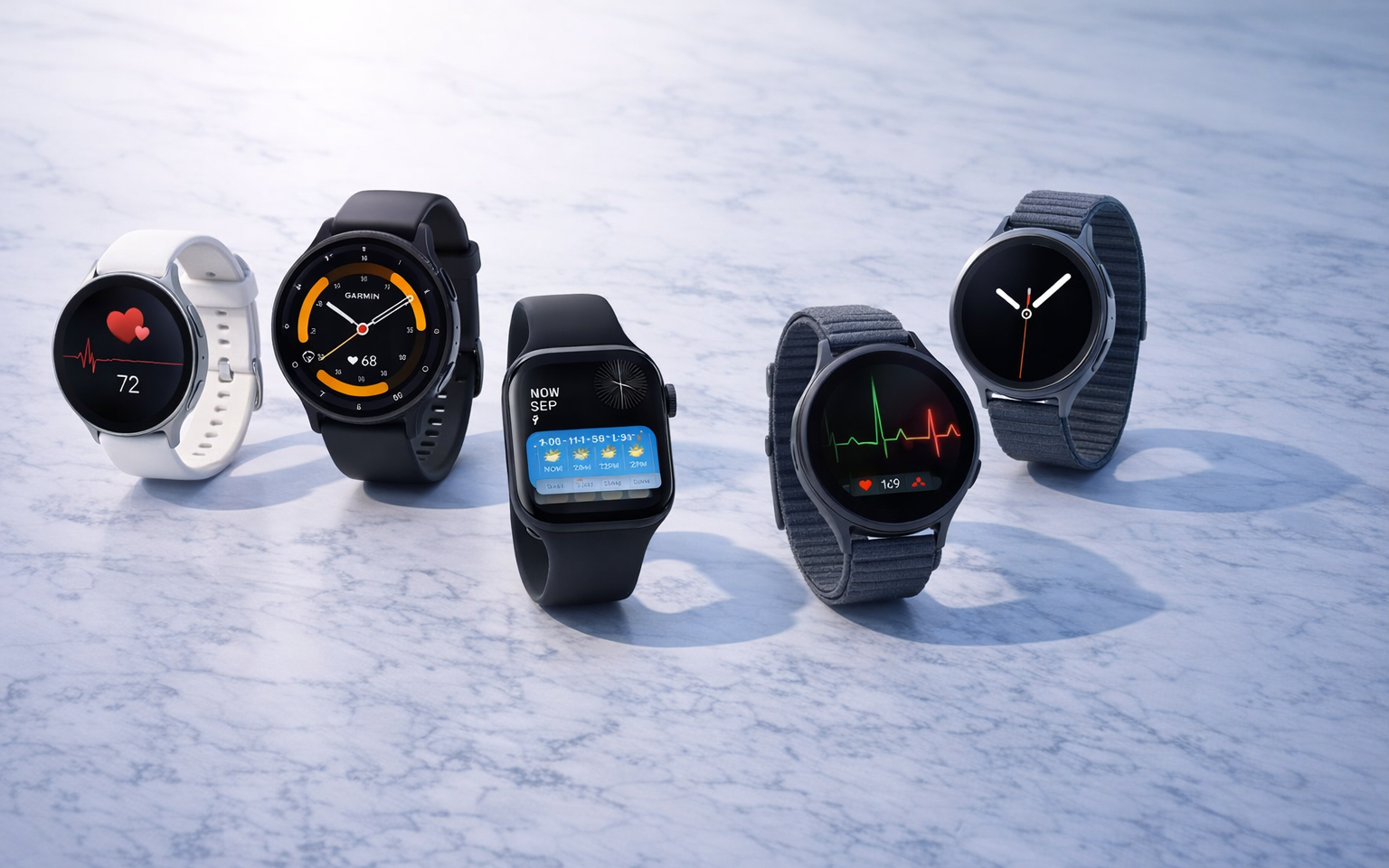
Every major smartwatch in 2026 can take an ECG and measure blood oxygen. That is no longer the differentiator. The real question is what happens with the data after it is collected – and whether the watch stays on your wrist long enough to collect it in the first place. A health monitor that dies by dinner is a fitness tracker, not a medical tool. One that lives on your nightstand because it is uncomfortable is worse than useless. And the gap between a watch with genuine FDA clearance and one that markets itself as "medical-grade" is wider than any spec sheet will tell you.
The two tensions that define this category right now are sensor depth versus battery life and FDA-cleared features versus wellness marketing. Apple just earned FDA clearance for hypertension screening notifications, a genuine clinical milestone. Meanwhile, other companies are pushing blood pressure readings as vague "wellness insights" to dodge regulatory scrutiny. The picks below cut through the noise: these are the health monitoring watches that pair meaningful sensor suites with the kind of wearability that makes continuous tracking actually work.
Apple Watch Series 11 – Best Overall Health Monitor
$399
The Series 11 earns the top spot for one reason above all others: FDA-cleared hypertension screening. No other mainstream consumer smartwatch can alert you to early signs of high blood pressure with regulatory backing. The feature does not replace a blood pressure cuff – it flags trends that warrant a conversation with your doctor – but that distinction matters. Hypertension is called the silent killer precisely because most people never check. A watch that nudges you toward early intervention could be genuinely life-changing.
Beyond the headline feature, the Series 11 delivers the full health monitoring suite you would expect: ECG with atrial fibrillation detection, blood oxygen measurement, continuous temperature sensing, and sleep tracking that feeds into a comprehensive health record through the Apple Health ecosystem. The S10 chip and 5G RedCap connectivity keep everything responsive, and Crash Detection and Fall Detection add a genuine safety net.
The battery story is the other major development. Apple finally pushed past the all-day barrier – the Series 11 reliably lasts through a full day and night of continuous monitoring, including sleep tracking, without hitting the charger. The catch: iPhone-only, and still a daily charger. Modest compared to Garmin or Withings multi-week battery life – but for Apple Watch owners who previously had to choose between sleep tracking and a working watch the next morning, it changes the calculus entirely. If you are on Android or want to charge less often, keep reading.

Withings ScanWatch 2 – Best for Set-and-Forget Health Tracking
$349.95
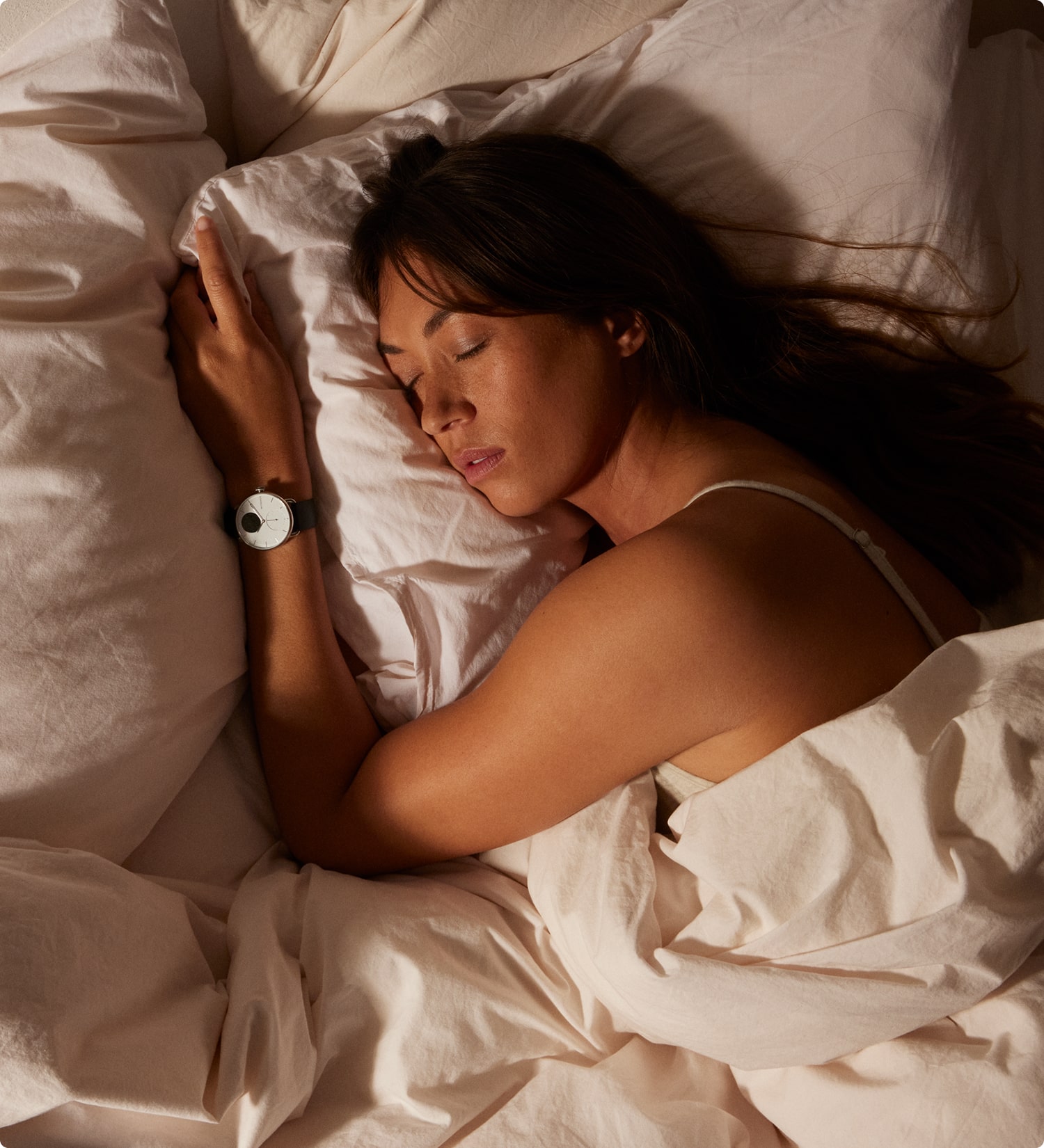
The ScanWatch 2 solves the biggest problem in health monitoring: compliance. Its 35-day battery life means you wear it to bed, wear it in the shower, wear it on vacation – and never think about charging. That uninterrupted data stream matters more than any individual sensor specification. You cannot detect a nighttime arrhythmia if the watch is on a charging puck.
The health sensor suite punches well above what the analog-style face suggests. FDA-cleared ECG handles atrial fibrillation detection. SpO2 monitoring runs continuously during sleep and powers an FDA-cleared sleep apnea detection feature that flags breathing disturbances. The TempTech24/7 continuous temperature sensor tracks baseline variations that can indicate illness onset before symptoms appear. Sleep staging is detailed and accurate, breaking nights into deep, light, and REM phases with respiratory disturbance tracking layered on top.
The hybrid design – real watch hands over a small digital display – is polarizing. There is no color touchscreen, no app grid, no quick replies to messages. This is a health monitoring instrument that tells time beautifully, not a smartwatch that happens to have health sensors. For people who want their watch to do everything, that is a dealbreaker. For people who want a health tracker that looks like a proper watch and never needs charging, it is the entire point. The sapphire crystal and stainless steel construction feel genuinely premium at $350.
Garmin Venu 3 – Best for Active Lifestyles
$449.99
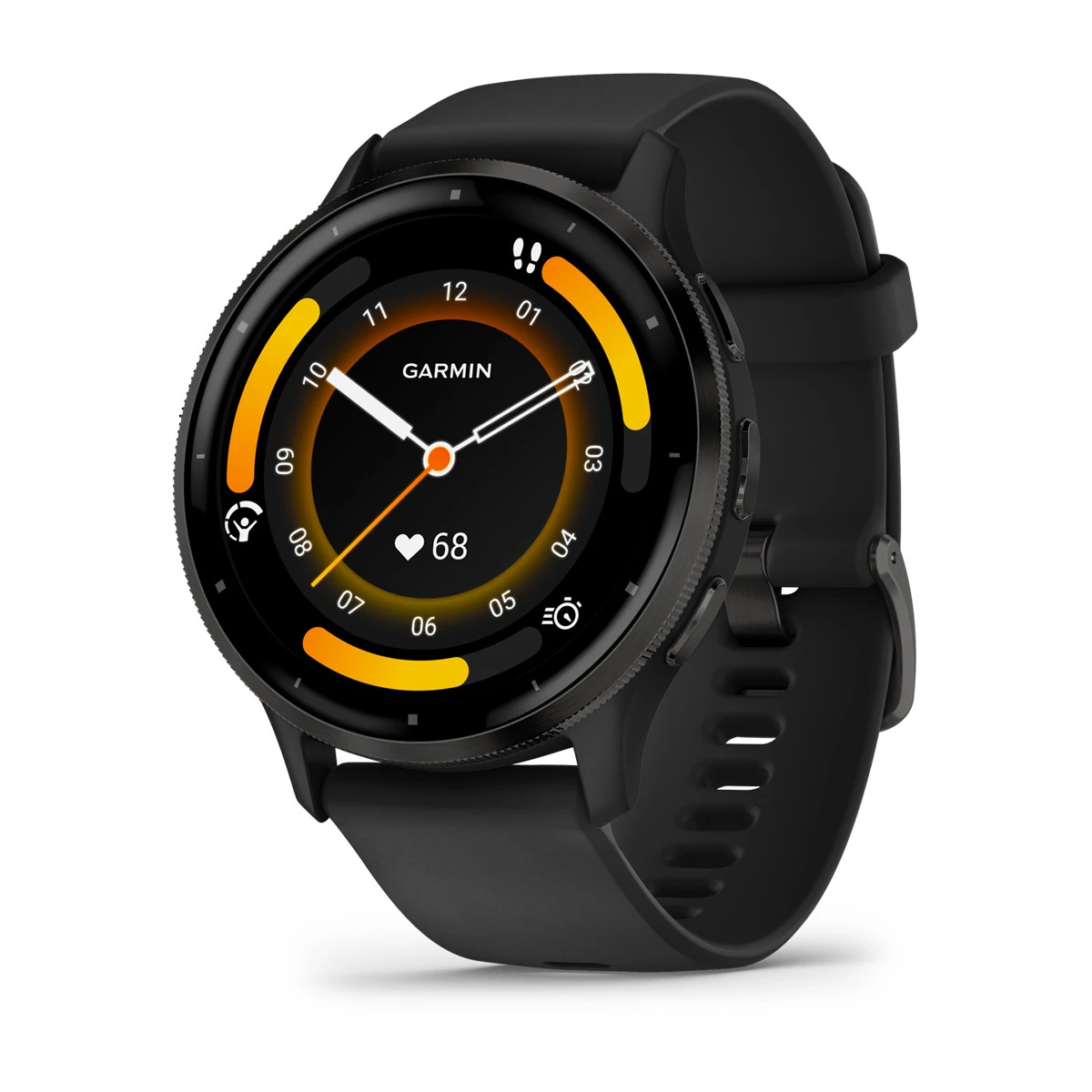
The Venu 3 bridges the gap between health monitoring and fitness tracking better than anything else on the market. It pairs FDA-cleared ECG and comprehensive health sensors with Garmin's multi-system GPS and 30-plus sport profiles, giving you a single device that satisfies both your doctor and your training plan.
The health monitoring side covers all the essentials: ECG for atrial fibrillation screening, SpO2, continuous skin temperature, and HRV tracking that feeds into Garmin's Body Battery energy management system. Sleep tracking is among the best available, with sleep staging, a sleep score, and a sleep coaching feature that provides personalized recommendations based on your patterns. The 14-day battery life – up to 5 days with the always-on display enabled – means health monitoring runs continuously without the anxiety of daily charging.
Where the Venu 3 separates itself is in fitness capability. Built-in multi-system GPS (GPS, GLONASS, Galileo) delivers accurate route tracking. Over 30 sport profiles cover everything from running and cycling to golf and tennis. Music storage for offline playlists, Bluetooth calling directly from the watch, and Garmin Pay round out the daily-use feature set. The AMOLED display is vibrant and readable in direct sunlight. If your definition of health includes both clinical metrics and consistent physical activity, this is the watch that does not force you to compromise on either side. Just know that athletes who need advanced training metrics – VO2 max intervals, structured workout builders, power meter pairing – should look at Garmin's Forerunner or Fenix lines instead.
Samsung Galaxy Watch 8 – Best for Android Users
$349.99 (frequently discounted to ~$260)
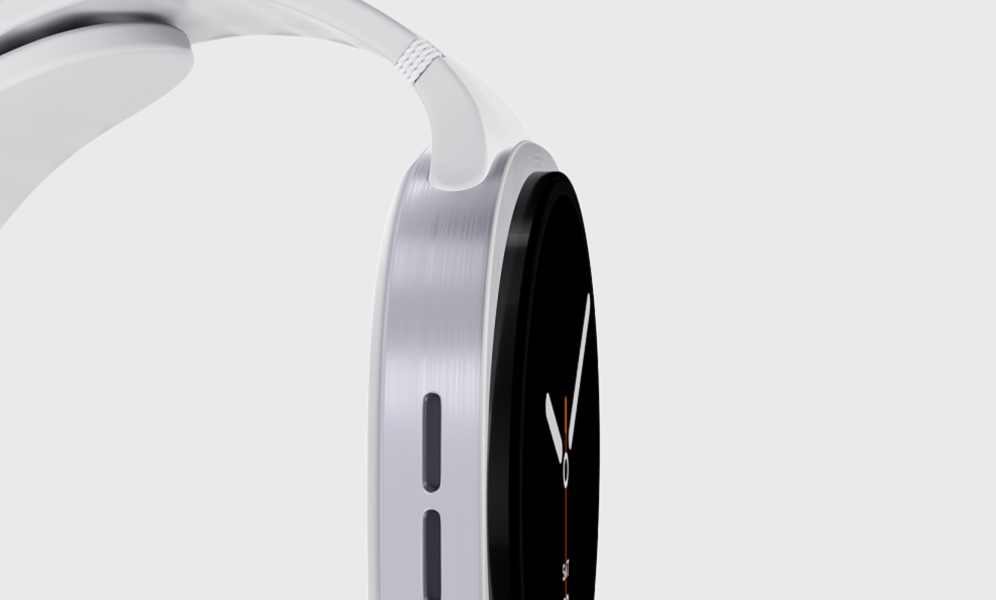
Android users have historically settled for second-best in health monitoring. The Galaxy Watch 8 closes that gap. Its body composition analysis via bioelectrical impedance is unique among mainstream smartwatches, measuring skeletal muscle mass, body fat percentage, body water, and BMI directly from the wrist. It is not as accurate as a DEXA scan, but as a trend-tracking tool for fitness and weight management, nothing else in the smartwatch category matches it.
The tradeoff you accept upfront: up to 40 hours of battery life (30 hours with always-on display), meaning daily or nightly charging is the norm. That is the price of packing this many sensors into an 8.6mm-thin case. The broader health suite is comprehensive – ECG, SpO2, continuous skin temperature monitoring, and an experimental antioxidant index sensor – and the 3000-nit AMOLED display is the brightest in its class. The Exynos W1000 processor keeps Wear OS 6 fluid, and Gemini AI integration handles voice queries and contextual suggestions.
The new band attachment system means existing Galaxy Watch bands will not fit, which is frustrating for upgraders. And Samsung Health, while improved, still lacks the clinical depth of Apple Health or the athletic analytics of Garmin Connect. But for Android users who want a complete health monitoring suite in a polished, modern smartwatch – and who can live with nightly charging – the Galaxy Watch 8 is the clear pick, especially at the sub-$260 street prices that have become common.
Withings ScanWatch Nova – Best Premium Health Tracker
$499.95
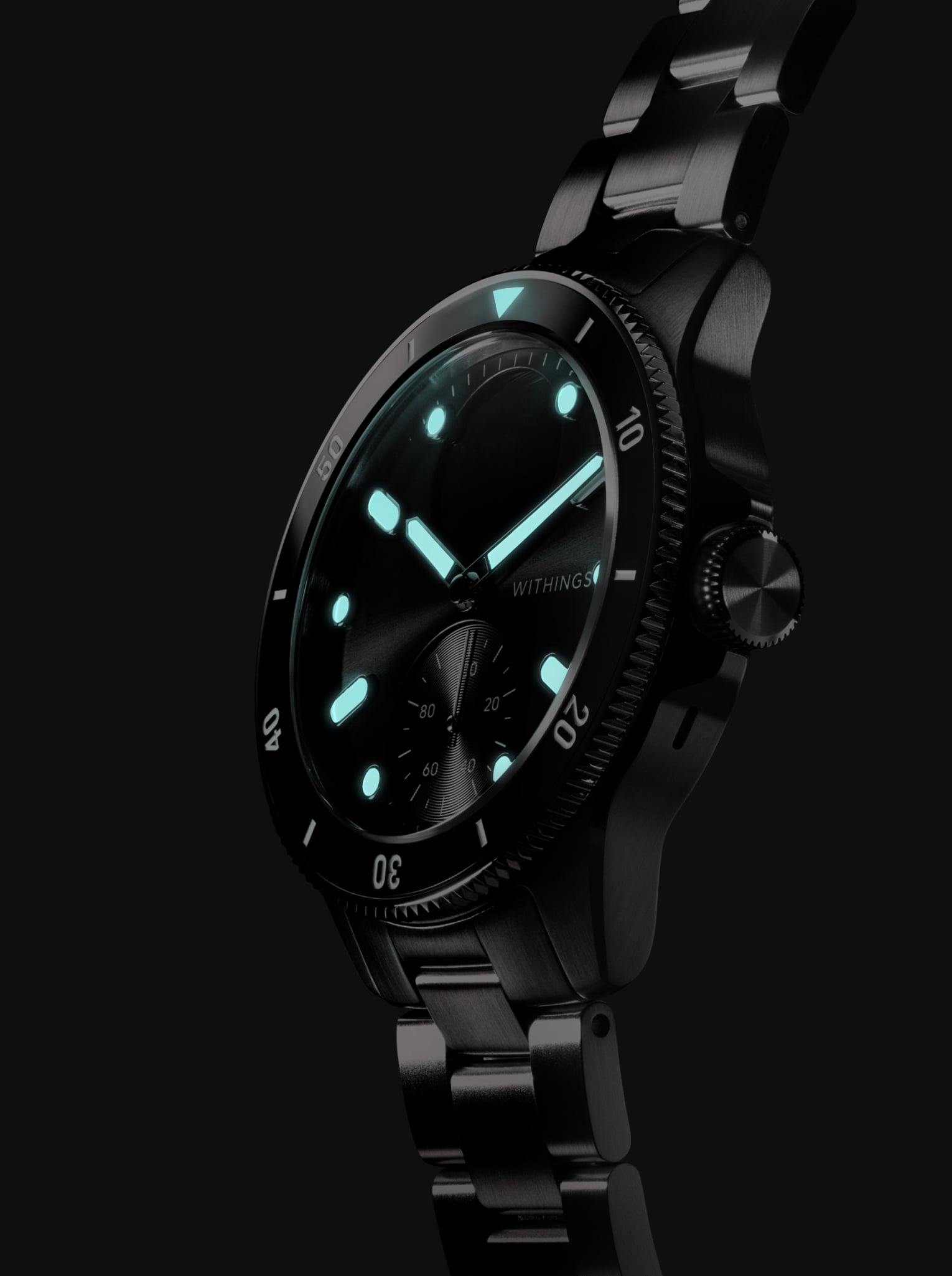
The ScanWatch Nova is the most sensor-dense health watch you can buy. Its 16-channel multi-wavelength PPG sensor array represents the most advanced optical heart monitoring available in a consumer wearable, capturing cardiovascular data with a precision that single-channel watches simply cannot match. Combined with FDA-cleared ECG, continuous SpO2, and TempTech24/7 temperature monitoring, it carries the most complete clinical-grade sensor package on this list. This is a passive health monitoring instrument, not a smartwatch – and at $500, that distinction is either the entire point or a dealbreaker.
The design justifies the premium positioning. A sapphire crystal face sits in a ceramic and stainless steel case rated to 10ATM – genuine dive watch territory. The rotating crown and applied indices would not look out of place next to a mechanical timepiece. The 30-day battery life means this level of monitoring runs continuously for a month between charges.
At around $500, the Nova demands serious commitment, and the value equation is not straightforward. It lacks built-in GPS, so runners and cyclists will still need a phone for route tracking. Smart features are minimal – no app ecosystem, no voice assistant, no music storage. You are paying for the sensor suite and the design, period. For someone who wants the most advanced passive health monitoring available in a watch they would be proud to wear with a suit, the Nova delivers. For anyone who expects smartwatch functionality alongside their health data, the price-to-feature ratio tilts against it.
Apple Watch Series 10 – Best Value
$229-$299 (down from $399)
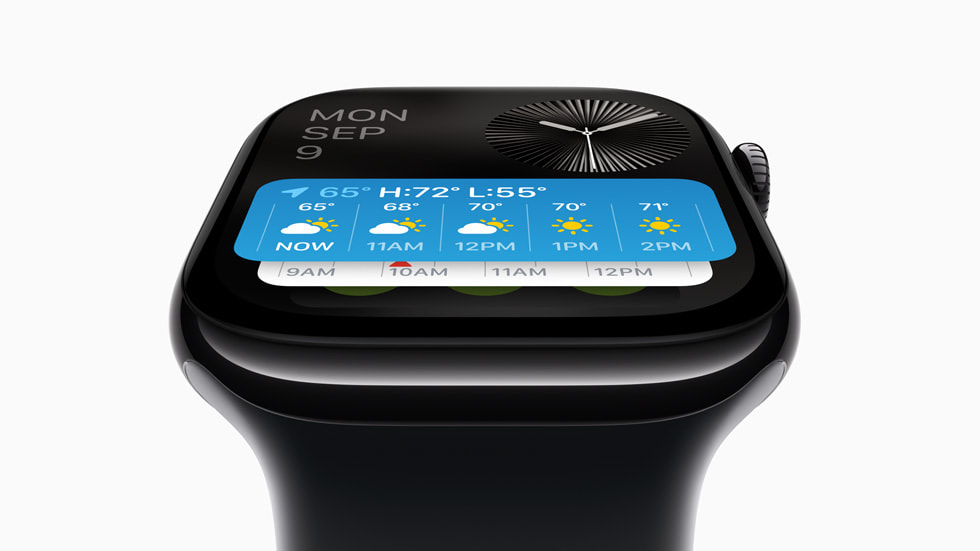
With the Series 11 now on shelves, the Series 10 has dropped to genuinely compelling prices – regularly available between $229 and $299 depending on size and retailer. That puts a watch with FDA-cleared sleep apnea detection and ECG in budget smartwatch territory, which is a remarkable value proposition.
The health feature set remains strong: ECG with atrial fibrillation detection, temperature sensing, and the sleep apnea notification that earned its own FDA clearance. The LTPO3 OLED display is gorgeous, and at its launch, the Series 10 was the thinnest Apple Watch ever made. Fast charging gets you to 80% in about 30 minutes.
There are two caveats worth knowing. First, blood oxygen monitoring on U.S. units was disabled from January 2024 through August 2025 due to the Masimo patent dispute; Apple has since restored it via a workaround that processes sensor data on the paired iPhone, though the legal dispute remains unresolved. Second, the 18-hour battery life is noticeably behind the Series 11's improvement, making overnight sleep tracking a tighter squeeze. If hypertension screening and better battery matter to you, the $100 premium for the Series 11 is worth it. But if you want a capable health monitoring smartwatch at the lowest possible price in the Apple ecosystem, the Series 10 at current street prices is hard to argue with.
What Makes a Health Monitoring Watch Worth Buying
Five criteria separate genuinely useful health monitoring watches from wellness marketing dressed up as medicine:
Health sensor breadth and FDA clearance status. Every pick on this list carries an FDA-cleared ECG. Beyond that baseline, the depth and clinical validation of additional sensors matters – SpO2, temperature, sleep apnea detection, hypertension screening, body composition. Features with regulatory clearance deserve more weight than those marketed as vague wellness estimates.
Battery life for continuous monitoring. A health watch only works if you wear it, and you will only wear it if it does not demand constant charging. Battery life deserves more weight than any single sensor spec because interrupted monitoring means incomplete data. A watch that dies overnight cannot track sleep apnea or nighttime arrhythmias.
Daily wearability and comfort. Size, weight, design, and display quality all determine whether a watch becomes a daily companion or a drawer resident. The likelihood of sustained daily wear across different lifestyles matters more than a spec sheet advantage that goes unworn.
Data ecosystem and actionable insights. Raw sensor data is only valuable if the companion app translates it into something you can understand and act on. A platform's value is measured by how clearly it presents health trends, flags anomalies, and integrates with healthcare providers.
Value relative to health features. What you actually get for the price in terms of health monitoring capability matters more than total feature count. A $350 watch with validated health sensors can deliver more clinical value than a $600 watch with flashy but unvalidated features.
Who Should Buy What
You have an iPhone and want the most clinically advanced health monitoring available: Apple Watch Series 11. The hypertension screening alone sets it apart from every other consumer wearable on the market.
You want health monitoring that runs in the background without intervention: Withings ScanWatch 2. Charge it once a month, glance at the app when you remember, and trust that it is capturing everything in between.
You are active and want one device for both health tracking and fitness: Garmin Venu 3. It is the only pick here that pairs clinical-grade health sensors with proper GPS sport tracking and multi-week battery life.
You use an Android phone and want comprehensive health data: Samsung Galaxy Watch 8. Body composition analysis and the full health sensor suite in the most polished Wear OS package available.
You want a luxury watch that happens to be a health monitor: Withings ScanWatch Nova. The design and sensor suite are unmatched, if you can accept the premium price and limited smart features.
You want the best health monitoring value in the Apple ecosystem: Apple Watch Series 10 at its current discounted pricing. FDA-cleared ECG and sleep apnea detection for under $300 is exceptional.
You prioritize a specific health concern: If sleep apnea detection is your primary need, the ScanWatch 2 and Apple Watch Series 10 both carry FDA clearance for it. If blood pressure trends concern you, only the Apple Watch Series 11 offers FDA-backed screening.
What to Avoid
Whoop MG ($359/year, mandatory subscription). Despite carrying an FDA-cleared ECG sensor, the Whoop MG is difficult to recommend at any price – and the mandatory annual subscription makes the value proposition even harder to justify. The blood pressure monitoring feature launched under the banner of "Blood Pressure Insights," but the FDA issued a warning letter in mid-2025 stating the feature constituted an uncleared medical device. While updated FDA guidance in January 2026 allows optical blood pressure readings as wellness data if no medical claims are made, the regulatory back-and-forth should give any health-conscious buyer pause. A class action lawsuit was filed following the warning letter. The band attachment system has also drawn reliability complaints from early adopters. If you want recovery-focused analytics, the standard Whoop 5.0 at a lower subscription tier is a better bet – and if you want validated health monitoring, nearly every other pick on this list delivers more for less.
Any smartwatch marketing "medical-grade" blood pressure monitoring without explicit FDA clearance. The January 2026 FDA guidance clarified that optical blood pressure readings can be offered as wellness features, but this is not the same as clinical accuracy. If a company implies their wrist-based blood pressure reading can replace a cuff measurement, treat that claim with significant skepticism. The only FDA-cleared blood pressure-adjacent feature on a major smartwatch today is Apple's hypertension trend notification – and even that is a screening alert, not a measurement.
Older-generation health watches at full price. The Apple Watch Series 10 at $229 is a better health monitor than most watches at $350. Check street prices before assuming MSRP is the going rate – this category sees aggressive discounting, especially after new models launch.