
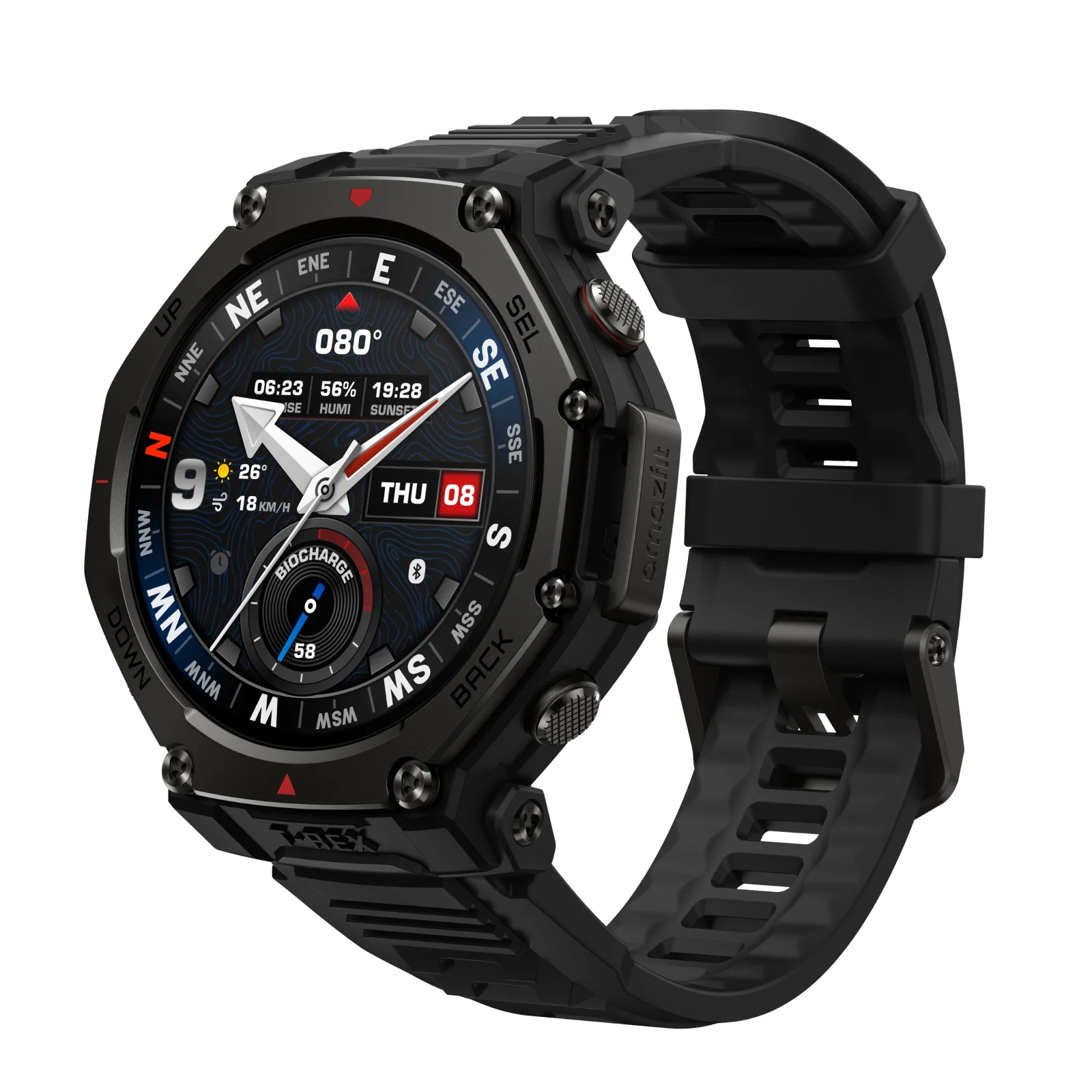
A titanium-and-sapphire adventure watch with offline maps, dual-band GPS, and a display that embarrasses watches three times its price. The Amazfit T-Rex 3 Pro is the most compelling argument yet that you don't need to spend over a thousand dollars to get a serious outdoor watch – but "compelling argument" is not the same as "equal replacement." At $400, this watch delivers roughly 80–85% of what the Garmin Fenix 8 Pro offers for about a third of the cost. The remaining 15–20%? Software maturity, training depth, safety features, and ecosystem breadth.
The T-Rex 3 Pro is not a Garmin killer. It is a Garmin alternative – a genuinely excellent one – built for people who are priced out of the Fenix ecosystem or who simply don't need deep training analytics, structured coaching, the safety net of crash detection and satellite SOS, or a smooth iPhone experience. If that sounds like a concession, it is. But it's a concession that saves you $800.
Design & Build
Pick up the T-Rex 3 Pro and the first thing that registers is the weight – or rather, the lack of it. The 48mm model comes in at 52 grams, the 44mm at just 46.8 grams. That's lighter than most rugged watches in this category, and it makes a tangible difference on multi-hour trail runs where every gram tugging at your wrist compounds into fatigue.
The Grade 5 titanium alloy bezel and buttons give the watch a cold, dense feel that reads as expensive. Pair that with sapphire crystal glass and you have a watch face that shrugs off granite scrambles and doorframe collisions alike. At this price point, titanium and sapphire together is genuinely remarkable – the Garmin Fenix 8 charges three times as much for the same material combination.
Military-grade durability credentials are present and accounted for: MIL-STD-810H certification covers the usual gauntlet of temperature extremes, shock, and humidity. Water resistance hits 10 ATM with scuba certification down to 45 meters, which puts open-water swimming and recreational diving firmly on the table.
The built-in LED flashlight – both white and red modes – is one of those features that sounds gimmicky until you're fumbling for a headlamp at a pre-dawn trailhead. Red mode preserves night vision. White mode throws enough light to read a map or find your way back to camp. It's a small addition that punches above its novelty.
Available in two sizes (48mm and 44mm), the watch accommodates a wider range of wrist sizes than the previous generation. The included strap, however, is a weak point. It develops an unpleasant sticky quality after sweaty workouts, and the quick-release mechanism is fiddly enough to be annoying rather than convenient. Budget an extra $20–30 for an aftermarket strap.
Display
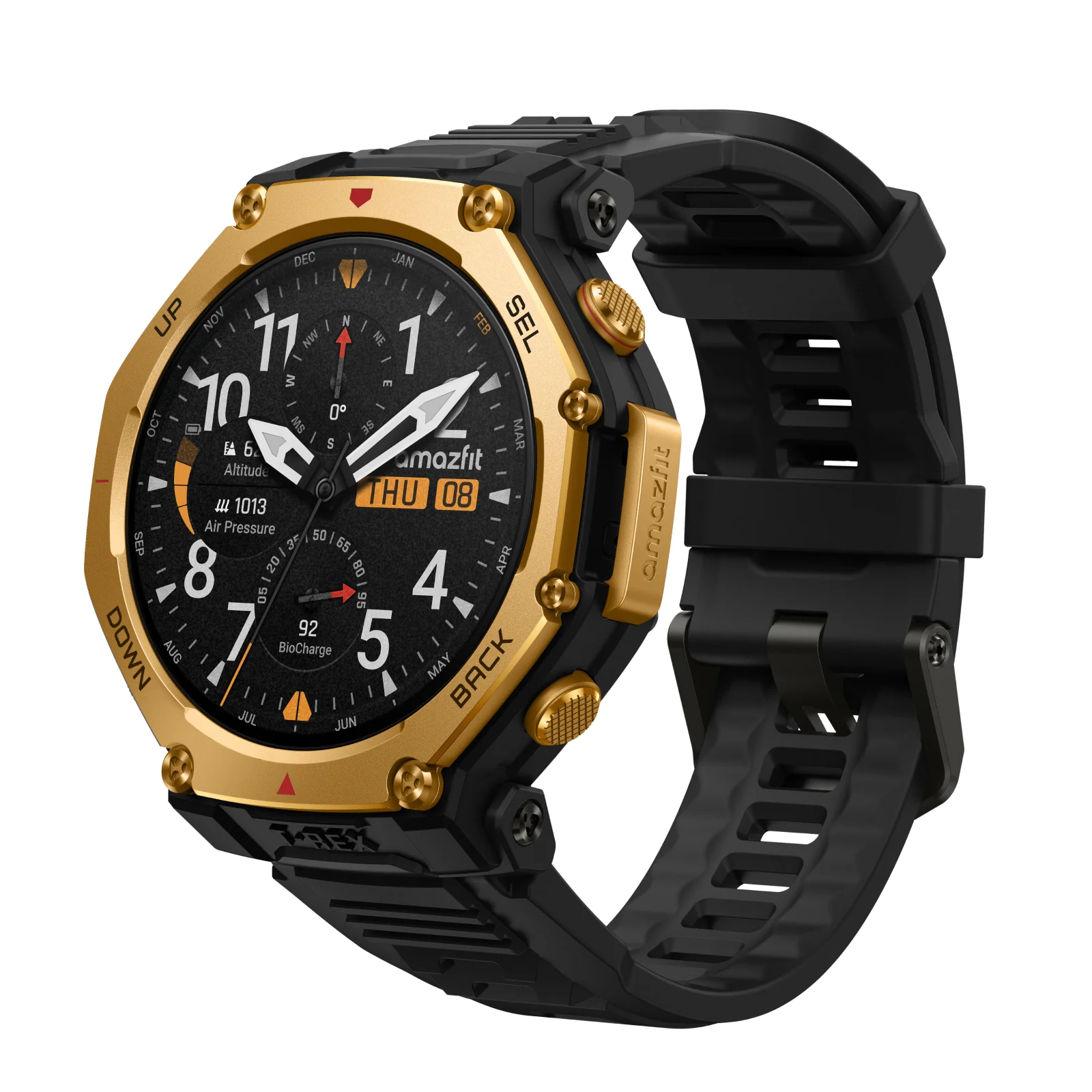
The 1.5-inch AMOLED panel on the 48mm model (1.32 inches on the 44mm) delivers 480x480 resolution on the larger size and 466x466 on the smaller, with a peak brightness of 3,000 nits. To put that number in context: it exceeds the Garmin Fenix 8 Pro AMOLED's output. In direct midday sunlight – the exact condition where most smartwatch displays wash out into illegibility – the T-Rex 3 Pro remains crisp and readable. Pace data, map details, and heart rate zones all stay visible without squinting or cupping your hand over the face.
Colors are saturated and punchy without tipping into oversaturation. The always-on display mode is well-implemented, offering enough information at a glance (time, date, step count) without demolishing battery life – though "without demolishing" still means a measurable hit, which we'll address in the battery section. Turn AOD off and you're rewarded with noticeably longer endurance between charges.
This is, flatly, one of the best displays available on any sport watch at any price. It is the single spec where the T-Rex 3 Pro doesn't just compete with the Fenix 8 Pro – it wins outright.
Performance & Features
Dual-band GPS with six satellite systems delivers fast, accurate positioning. Cold-start GPS lock consistently lands in the 3–8 second range, and track accuracy holds up well against the best in the business. Recorded routes overlay cleanly on known trails, with minimal drift in tree cover and urban canyons. For the vast majority of runners, hikers, and cyclists, GPS performance here is functionally equivalent to Garmin's top tier.
Offline maps with fully routable turn-by-turn navigation transform the T-Rex 3 Pro from a fitness tracker into a legitimate backcountry tool. Maps render clearly on the high-resolution display, and the turn-by-turn prompts are timely enough to keep you on-trail. That said, the route import process is more cumbersome than it should be – loading GPX files requires more steps and more patience than Garmin's streamlined workflow. Auto-rerouting when you miss a turn is inconsistent; sometimes it recalculates quickly, sometimes it doesn't recalculate at all.
Zepp OS 5.0 is functional but unpolished. Menus are responsive, transitions are smooth enough, and the core interface is learnable within a day. But there's a ship-and-patch quality to the software that surfaces in small irritations: occasional sync delays, the odd UI inconsistency, and a general sense that features were prioritized over refinement. The Zepp smartphone app amplifies this – syncing can be slow, the interface feels chaotic, and third-party sync to platforms like Strava and TrainingPeaks works but with occasional reliability hiccups.
And here's the ecosystem gap that matters most: there are essentially no third-party apps. No Spotify or streaming music apps. No Google Maps fallback. No Connect IQ equivalent with thousands of watch faces, data fields, and widgets. If Garmin's ecosystem is an app store, Amazfit's is a locked cabinet.
The watch syncs with Strava, RunKeeper, and TrainingPeaks – the three platforms most athletes actually use – but the sync pipeline can be unreliable enough to require manual intervention on occasion.
Health & Fitness
The BioTracker 6.0 PPG sensor is a genuine step forward from previous Amazfit hardware. During moderate-intensity activities – zone 2 runs, hiking, cycling at conversational pace – heart rate accuracy lands within ±2–4 BPM of a chest strap reference. That's competitive with any optical wrist sensor on the market.
Push into high-intensity intervals, hill sprints, or heavy weightlifting, and variance increases to ±10 BPM. This is not unusual for optical sensors – even Garmin's Elevate 5 exhibits similar drift during high-intensity, wrist-flexing efforts – but it's worth acknowledging for anyone who depends on precise heart rate zones during VO2 max intervals.
SpO2 monitoring, sleep tracking, and stress measurement are all present. Sleep tracking provides stage breakdown (light, deep, REM) and a sleep quality score, with the optional Zepp Aura Premium subscription layering on AI-driven sleep coaching. The core sleep tracking features work without the subscription, and the data is broadly consistent with what competing platforms report – though the granularity and actionability of insights fall short of what Garmin offers through its more mature analytics engine.
VO2 Max estimation and training load metrics exist but lack the depth of Garmin's Training Readiness, HRV Status, and Body Battery ecosystem. There are no structured workouts pushed from coaches, no ClimbPro equivalent for ascent management, and no deep multi-sport analysis for triathletes. For the runner who wants to track pace, distance, heart rate, and weekly mileage – this is more than sufficient. For the athlete who builds periodized training plans and obsesses over training effect breakdowns – Garmin's software advantage is significant.
One quirk worth noting: step counting can run slightly low compared to an iPhone's built-in pedometer. It's a minor discrepancy, but if you're the type who walks 9,800 steps and wants credit for 10,000, it may irk you.
Battery Life
Amazfit claims 25 days of typical use and 38 hours of continuous accurate GPS for the 48mm model's 700 mAh battery. Real-world results, as always, tell a more grounded story.
Expect 10–18 days of typical use depending on notification volume, workout frequency, and feature usage. With always-on display enabled, that window tightens to 9–10 days. With AOD off and moderate use, stretching past two weeks is realistic, and three weeks is achievable for light users. Marketing claims landing 30–50% above real-world performance is standard across the industry – Garmin, Apple, and Samsung all play the same game – so this shouldn't be held uniquely against Amazfit.
GPS battery life during continuous tracking is strong. Expect roughly 12–14 hours of continuous GPS tracking before hitting empty – more than enough for a dawn-to-dusk hiking day with maps rendering and heart rate monitoring active.
In AMOLED-to-AMOLED comparisons, the T-Rex 3 Pro is competitive with the Garmin Enduro 3 in typical use and edges ahead in some profiles – a notable achievement given the price gap.
The Garmin Question
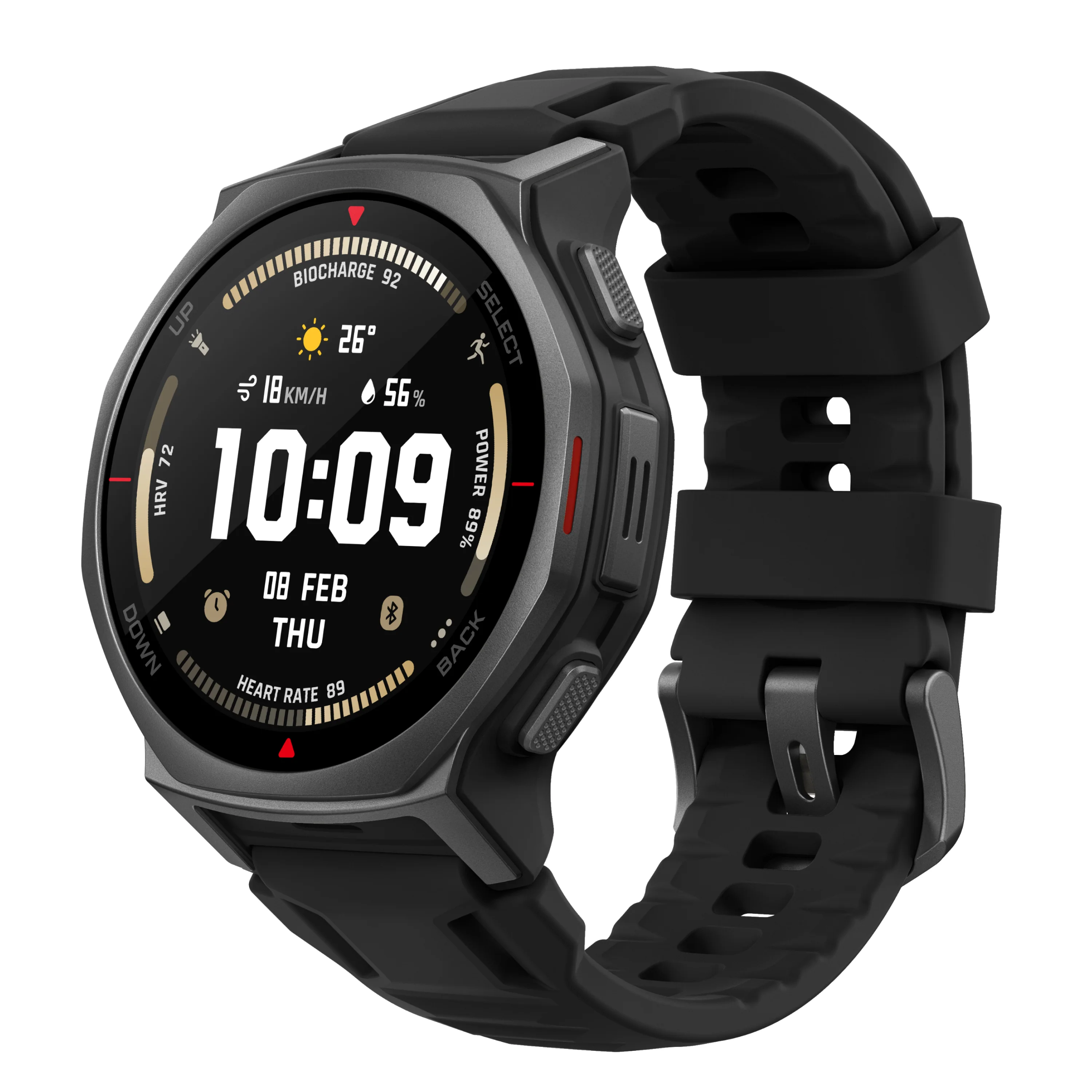
The Garmin Fenix 8 Pro (47mm AMOLED) starts at $1,200. The Amazfit T-Rex 3 Pro costs $400. That $800 gap is enormous, and it demands an honest accounting of what each side of that gap contains.
What the T-Rex 3 Pro matches or beats:
- Build materials: Titanium and sapphire at both price points, but the Amazfit achieves this for a third of the cost
- Display: 3,000 nits peak brightness exceeds the Fenix 8 Pro's AMOLED output
- Battery: Competitive, and in some usage profiles, superior
- GPS accuracy: Functionally equivalent for most users
- Offline maps: Present and usable on both
- Basic fitness tracking: Heart rate, steps, sleep, SpO2 – all covered
What you give up for $800 less:
- Training ecosystem: No structured workouts from coaches, no ClimbPro, no Training Readiness score, no HRV Status, no deep recovery analytics. This is the single biggest functional gap.
- Third-party apps: Garmin's Connect IQ marketplace versus Amazfit's empty shelf.
- Safety features: No crash detection, no fall detection, no satellite SOS (inReach), no LTE option. For solo backcountry travelers, this is a serious omission.
- Software maturity: Garmin's firmware is battle-tested over decades. Zepp OS is competent but younger and rougher.
- Navigation refinement: Route import, auto-rerouting, and breadcrumb trails are all more polished on Garmin.
- ECG: Not available on the T-Rex 3 Pro.
- Music streaming: No Spotify or music streaming apps. MP3 files can be uploaded for offline playback, but there is no on-watch music store.
- iOS experience: Notably worse than Garmin's. iPhone users face real problems: the Zepp app drains battery in the background, music control is limited to play/pause, and there's no Apple Health nutrition sync. It's enough to generate genuine buyer's remorse.
The Coros Vertix 2S at $700 and the Samsung Galaxy Watch Ultra at $650 occupy the middle ground, but neither matches the T-Rex 3 Pro's specific combination of premium materials, display quality, and aggressive pricing.
Who It's For
Buy it if you're: A hiker, trail runner, or outdoor enthusiast who wants premium build quality and reliable GPS without the Garmin tax. An Android user who tracks workouts, monitors health basics, and wants offline maps for weekend adventures. Someone upgrading from a $150–250 fitness watch who wants the next tier of hardware without jumping to four figures.
Skip it if you're: A serious endurance athlete who depends on structured training plans, recovery metrics, and deep performance analytics. An iPhone user who expects seamless integration. A solo backcountry traveler who needs crash detection, satellite SOS, or LTE as a safety lifeline. Someone who wants Spotify or music streaming services on their wrist. A triathlete who needs granular multi-sport analysis.
The Verdict
The Amazfit T-Rex 3 Pro is the best adventure watch under $500 – full stop. Its titanium-and-sapphire construction, class-leading display, and reliable GPS make it a legitimate contender in a space that Garmin has dominated through sheer pricing power. The trade-offs are real – software polish, training depth, safety features, and ecosystem breadth all favor Garmin – but they are trade-offs, not dealbreakers, for the audience this watch is built for. If you want to see how it stacks up against its non-Pro sibling, check out the Amazfit T-Rex 3 as well. For a broader look at top picks, see our guide to the best outdoor watches and best running watches.
| Category | Score | Weight | Weighted |
|---|---|---|---|
| Core Function | 78/100 | 30% | 23.4 |
| Build Quality | 90/100 | 15% | 13.5 |
| User Experience | 58/100 | 20% | 11.6 |
| Value | 95/100 | 20% | 19.0 |
| Battery | 85/100 | 15% | 12.75 |
| Overall | 80/100 |
Score: 80/100 – Phenomenal hardware and value undermined by software that hasn't yet caught up to the ambition of the product – the T-Rex 3 Pro is a $400 watch that wears like a $700 one and thinks like a $250 one.