
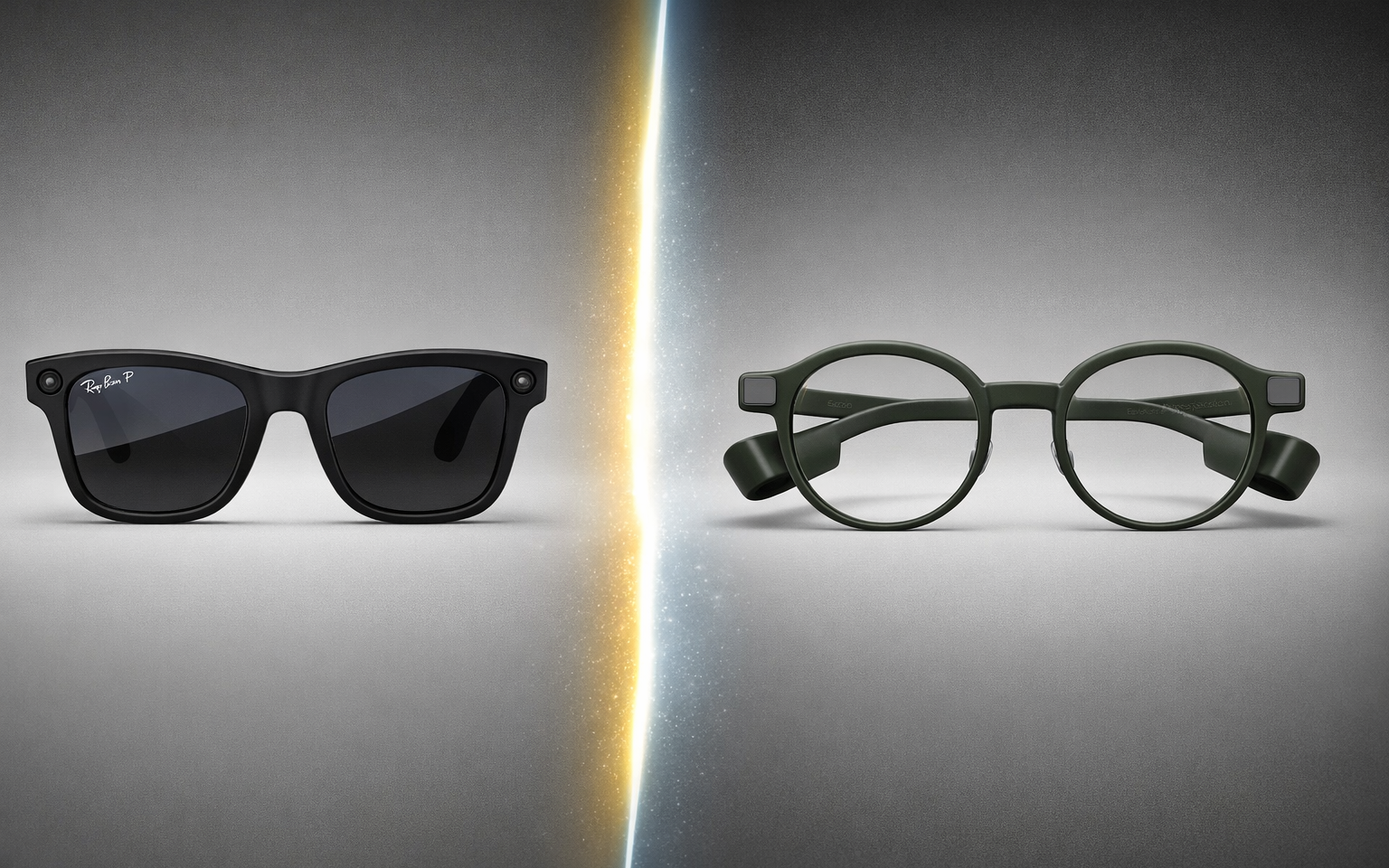
Smart glasses have spent a decade trying to escape the shadow of Google Glass, and in 2025, two products prove the category has finally found its footing -- by heading in completely opposite directions. The Ray-Ban Meta Gen 2 doubles down on cameras, AI smarts, and open-ear audio packed into iconic Wayfarer frames. The Even Realities G1 strips all of that away and bets everything on a micro-LED heads-up display hidden inside frames that could pass for something you would pick up at any optician.
This is not a minor spec difference. These glasses represent two fundamentally different philosophies about what wearable computing on your face should actually do. One says your glasses should see what you see and talk back. The other says your glasses should quietly surface the right information at the right moment and otherwise disappear. Choosing between them means deciding what role you want smart glasses to play in your daily routine -- and which tradeoffs you can live with.
Both are genuinely good products -- but they share almost no feature overlap, which means the right choice comes down to a single question: do you want your glasses to capture and communicate, or to inform and disappear?
Camera and AI: The Ray-Ban Meta's Killer Features
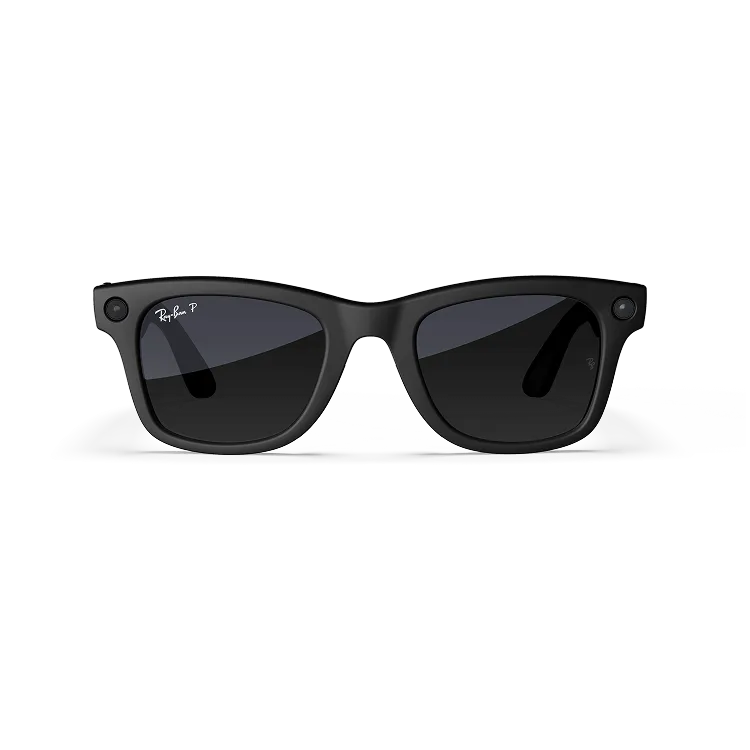
The Ray-Ban Meta Gen 2 ships with a 12-megapixel ultra-wide camera capable of shooting 3K video at 30 frames per second or 1200p at 60fps. The image quality sits below a modern flagship smartphone, but that misses the point. The value is in the capture angle -- first-person, hands-free, in the moment. A birthday party, a hike, a street performance: you tap the temple, and the glasses record exactly what you were looking at without the social friction of pulling out a phone and holding it up.
Meta AI is the other headline feature. Recent software updates have made it noticeably faster and more conversational. You can ask it to identify a landmark, summarize a menu in another language, or just answer a random question while your hands are full. Visual understanding lets you point at something, ask "Hey Meta, what is this?" and get a spoken answer. It is not infallible, but it is genuinely useful in ways that feel like a glimpse of the future.
The Even Realities G1 has no camera at all. This is a deliberate design choice, not a cost-cutting measure. Even Realities positions the absence of a camera as a feature: it eliminates the privacy complications that follow any face-mounted lens, and it keeps the weight and form factor closer to ordinary eyewear. The G1 does have two microphones for voice input, and it can interact with an AI assistant through its companion app, but responses arrive as text on the HUD rather than spoken audio. The AI can be slow -- sometimes painfully so -- and the phone dependency undermines the hands-free promise.
Winner: Ray-Ban Meta Gen 2. The camera and conversational AI are the most compelling reasons smart glasses exist right now, and Meta executes on both better than anyone else in the market.
Display Technology: Where the G1 Has No Competition
Here is where the conversation flips. The Ray-Ban Meta Gen 2 has no display. None. Every interaction is audio-only -- voice commands in, spoken responses out. If you want a visual display, Meta sells the separate Ray-Ban Display model for $799, which is a different product entirely.
The Even Realities G1 packs a 640 x 200 monochrome green micro-LED waveguide display into each lens, with a 25-degree field of view and up to 1,000 nits of brightness. It functions as a heads-up display that surfaces notifications, calendar events, navigation directions, stock tickers, news headlines, real-time translation subtitles, and a teleprompter -- all projected as green text floating in your lower peripheral vision.
The display is not high-resolution, and it is limited to green monochrome. But the information it delivers is the kind you actually glance at: the next turn on your route, an incoming message preview, the time. The teleprompter feature is a standout -- it scrolls your script in your line of sight during presentations or video recordings, and it can pace itself automatically to match your speaking speed. For anyone who gives talks, records content, or just wants to stop glancing at their phone 150 times a day, this is a genuinely transformative feature.
Winner: Even Realities G1. You cannot win a display category without a display. The G1's HUD is limited but functional, and nothing in the Ray-Ban Meta Gen 2 competes with it.
Design and Style
Both products understand that smart glasses live or die on whether people will actually wear them in public. The Ray-Ban Meta Gen 2 leverages one of the most recognizable frame designs in history -- the Wayfarer -- along with Headliner and Skyler options. Multiple colorways, lens types including Transitions and polarized options, and the Ray-Ban logo on the temples all contribute to glasses that read as fashion-forward rather than tech-forward. The temples are thicker than standard Wayfarers to accommodate the electronics, but not dramatically so.
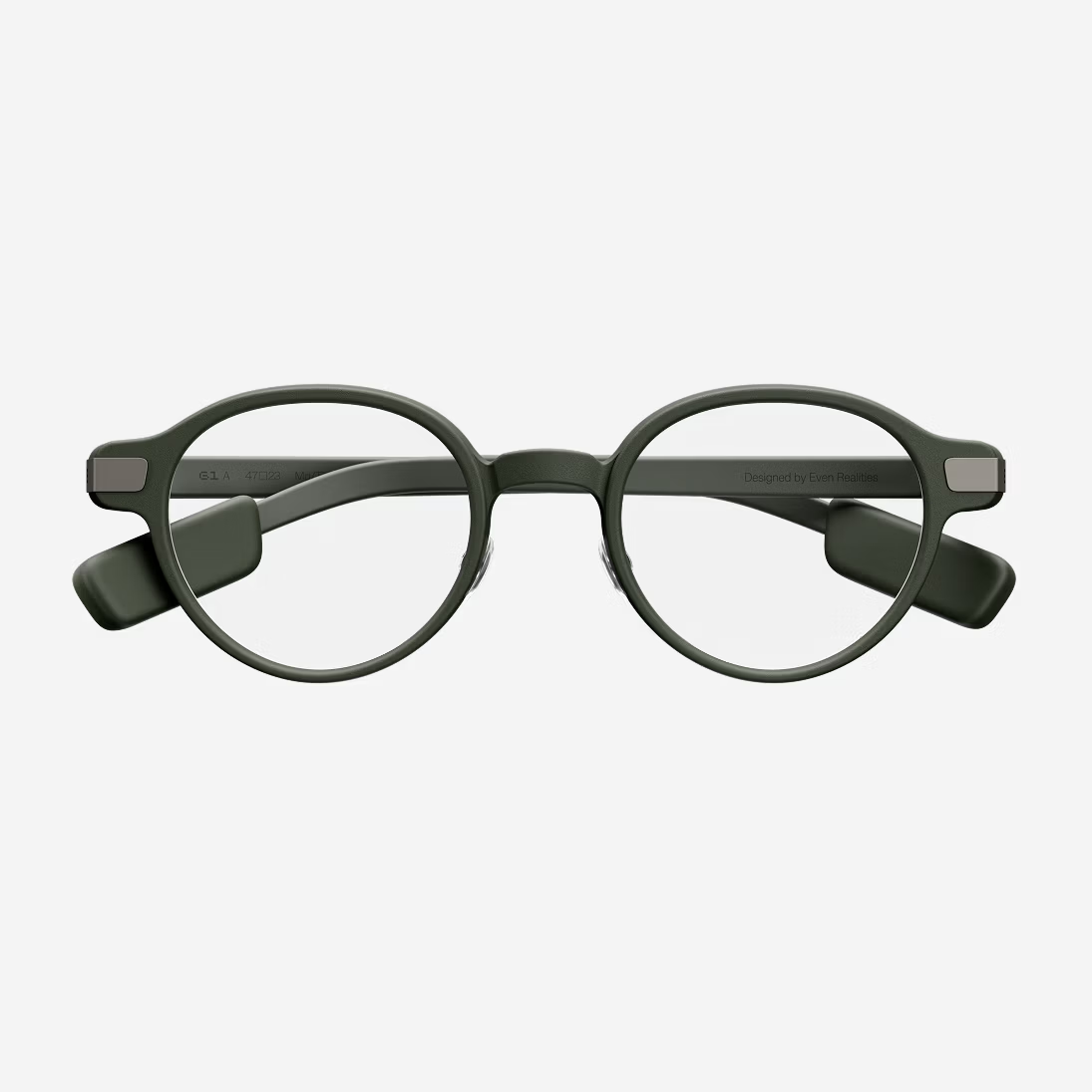
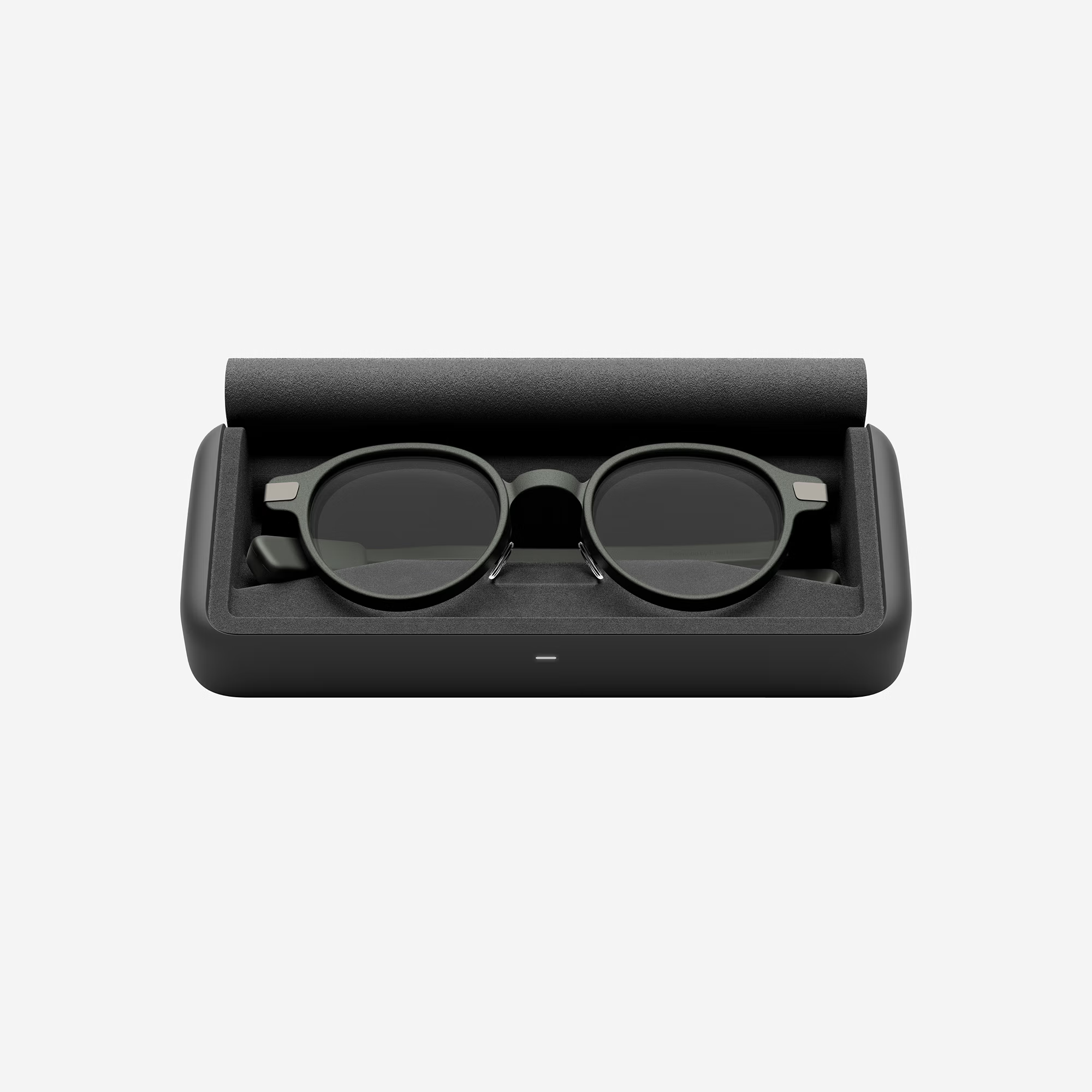
The Even Realities G1 takes invisibility even further. The frame -- magnesium alloy with titanium alloy temples -- comes in two shapes -- Panto (G1A) and Rectangular (G1B) -- and looks almost aggressively like normal glasses. The waveguide is essentially invisible in the lenses unless you know exactly what to look for. The G1 passes unnoticed in social settings -- even after weeks of daily wear around friends, colleagues, and strangers, the glasses draw no attention. Only the very observant notice a faint gold tint in the lenses.
Winner: Even Realities G1. The Ray-Ban Metas look great, but they still look like tech. The G1 achieves something harder -- it looks like nothing at all.


Audio and Calls
The Ray-Ban Meta Gen 2 features open-ear speakers that are 50% louder than the first generation, with improved bass response. They handle podcasts, music, phone calls, and Meta AI responses with surprising clarity for speakers that sit on your temples rather than in your ears. Call quality is excellent -- five beamforming microphones isolate your voice even on busy streets. You will not mistake them for AirPods Pro, but for situations where you want audio without blocking out the world, they deliver.
The Even Realities G1 has no speakers. The four built-in microphones handle voice input for AI queries and the translation feature, but all output is visual -- text on the HUD. If you want to listen to music, take a call, or hear a spoken AI response, you need separate earbuds or headphones.
Winner: Ray-Ban Meta Gen 2. Open-ear audio is one of the strongest daily-use features in any smart glasses, and the G1 simply does not compete here.
Battery Life
The Ray-Ban Meta Gen 2 delivers up to 8 hours of mixed use -- a significant improvement over the Gen 1's roughly 4-hour runtime. The charging case holds enough juice for about six full charges, giving you roughly 48 hours of total battery before needing an outlet.
The Even Realities G1 claims up to 1.5 days of heavy use, and that claim holds up in practice. The 160mAh battery per arm is supplemented by a 2,000mAh charging case that provides approximately 2.5 full charges. The absence of a camera, speakers, and a high-refresh display all contribute to remarkably efficient power consumption for a product that includes a waveguide HUD.
Winner: Even Realities G1. A day and a half versus eight hours is not close, even accounting for the G1's lighter feature load.
Prescription Lens Support
Both products support prescription lenses, but the implementation differs significantly. The Ray-Ban Meta Gen 2 offers prescription lenses through Ray-Ban's official configurator, Meta's website, participating opticians, and third-party providers. Transitions lenses are available. The process mirrors ordering any pair of prescription Ray-Bans.
The Even Realities G1 goes a step further: prescription lenses are optically bonded directly to the waveguide, meaning the display and your vision correction share the same optical path. Single-vision prescriptions start at $150 on top of the base price, and progressive lenses are available in some regions. The result is a seamless integration that does not compromise the HUD experience.
Winner: Even Realities G1. Both support prescriptions, but the G1's bonded waveguide approach is more elegant and purpose-built for daily wear as your primary glasses.
Privacy and Social Acceptability
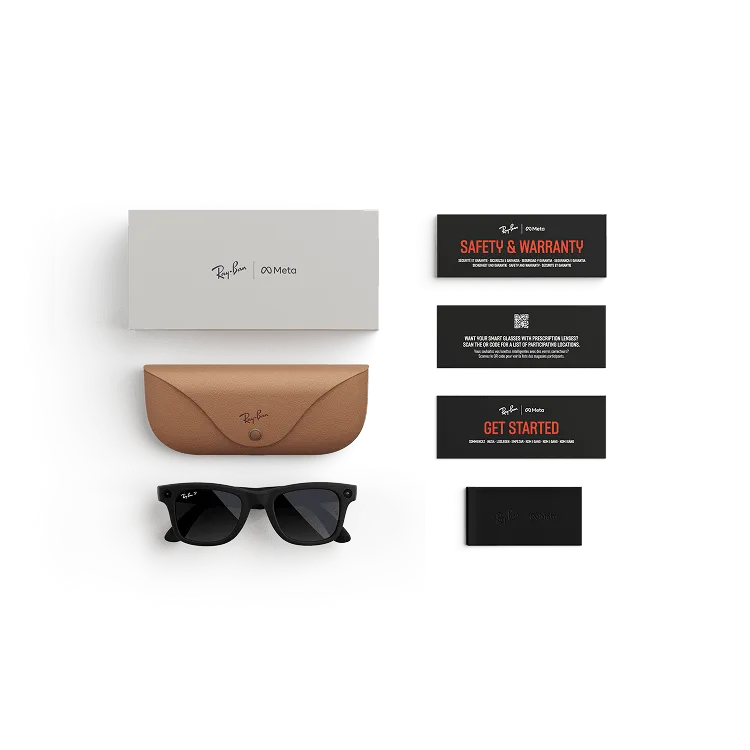
This is where the philosophical split between these two products becomes most tangible. The Ray-Ban Meta Gen 2 has a camera. That camera has a small white LED that illuminates when recording. In theory, this signals to people around you that the glasses are capturing. In practice, the LED is small enough that most people never notice it, and a widely reported $60 modification kit can disable it entirely. Reports of the glasses being used for covert recording in social situations have generated real controversy. Bars and restaurants have begun posting no-smart-glasses policies. The social friction is real and growing.
The Even Realities G1 sidesteps all of this by having no camera. There is nothing to record, nothing to signal, nothing to worry about. You can wear the G1 into any meeting, any social setting, any country with strict recording laws, and the only thing on your face is a pair of glasses that happen to show you your notifications.
Winner: Even Realities G1. The absence of a camera is not a limitation here -- it is a feature that makes the G1 welcome in places where camera-equipped glasses are not.
Who Should Buy What
Buy the Ray-Ban Meta Gen 2 if you: - Want hands-free photo and video capture for travel, events, or social content - Listen to podcasts, music, or audiobooks and prefer open-ear audio to earbuds - Want a conversational AI assistant you can talk to while cooking, walking, or working - Already use Meta's ecosystem (Instagram, WhatsApp, Facebook) - Want the most versatile smart glasses available under $400
Buy the Even Realities G1 if you: - Give presentations or record videos and want a built-in teleprompter - Travel frequently and need real-time translation displayed in your field of view - Work in environments where camera-equipped glasses would be inappropriate or unwelcome - Want prescription smart glasses that are truly indistinguishable from regular eyewear - Value battery life that lasts a full day and then some without reaching for a charger - Prefer getting notifications at a glance without any audio component
Our Verdict
The Ray-Ban Meta Gen 2 is the better smart glasses for most people. At $379, it packs a capable camera, a genuinely useful AI assistant, solid open-ear audio, and all-day battery life into frames that most people will compliment rather than question. The software ecosystem is mature and actively improving, and the feature set addresses the widest range of daily use cases. If you are buying your first pair of smart glasses, this is where to start.
But the Even Realities G1 is the more important product. At $599, it costs more and does less in raw feature count, yet it proves that smart glasses can deliver real utility -- a heads-up display, real-time translation, a teleprompter -- without sacrificing the one thing that matters most for something you wear on your face: invisibility. Nobody will know you are wearing a computer. For professionals, presenters, and privacy-conscious users, that is worth every penny of the premium.
The Ray-Ban Meta Gen 2 is the smart glasses you buy today. The Even Realities G1 is the smart glasses philosophy that wins tomorrow.
Specs at a Glance
| Spec | Ray-Ban Meta Gen 2 | Even Realities G1 |
|---|---|---|
| Price | $379 | $599 (+$150 Rx lenses, +$100 sunglass clip) |
| Weight | ~50-52g | Under 40g (official) |
| Frame Material | Injected nylon | Magnesium alloy frame, titanium alloy temples |
| Frame Styles | Wayfarer, Headliner, Skyler | Panto (G1A), Rectangular (G1B) |
| Camera | 12MP ultra-wide | None |
| Video | 3K @ 30fps / 1200p @ 60fps | None |
| Display | None | 640x200 monochrome green micro-LED waveguide per lens |
| Display FoV | N/A | 25 degrees |
| Display Brightness | N/A | Up to 1,000 nits |
| Speakers | Open-ear (50% louder vs Gen 1) | None |
| Microphones | 5 (beamforming) | 2 |
| AI Assistant | Meta AI (visual understanding) | Even AI (text-only HUD responses) |
| Battery Life | Up to 8 hours mixed use | Up to 1.5 days heavy use |
| Charging Case | ~6 full charges (~48 hrs) | ~2.5 full charges (2,000mAh) |
| Water Resistance | IPX4 | Not rated |
| Connectivity | Bluetooth, Wi-Fi | Bluetooth LE 5.2 |
| Prescription Support | Yes (via Ray-Ban/Meta/third-party) | Yes (optically bonded to waveguide, +$150) |
| Translation | Via Meta AI (spoken) | 24 languages, real-time text on HUD |
| Teleprompter | No | Yes (manual, auto, or AI-paced scrolling) |
| Tethered/Standalone | Standalone (pairs with phone for full features) | Tethered (requires phone for most features) |