
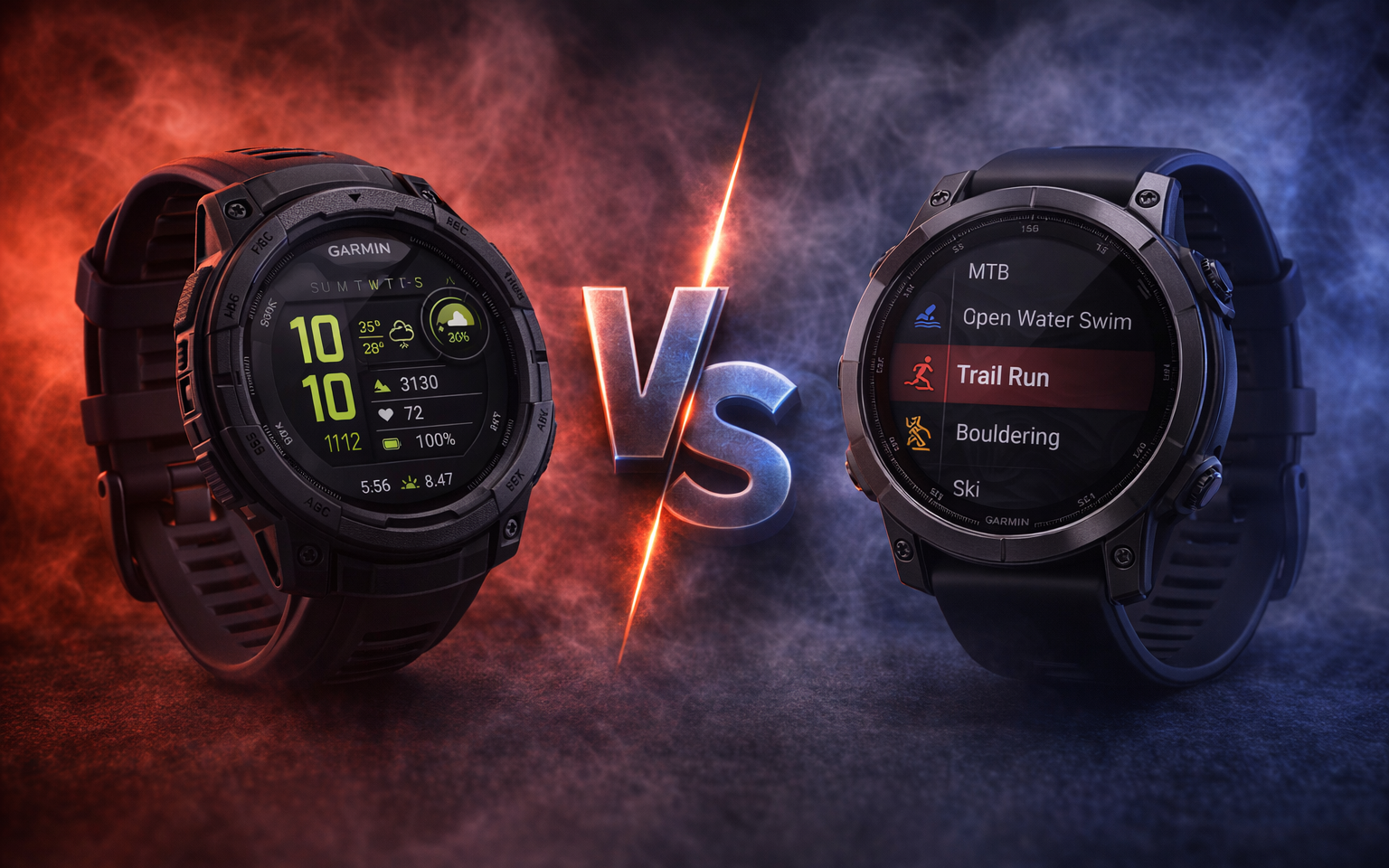
The Garmin Instinct 3 and Fenix 8 sit on opposite ends of Garmin's rugged watch lineup, but they share something surprising: the same multi-band GNSS technology. Both deliver multi-band GNSS with SatIQ, both meet MIL-STD-810 durability standards, and both carry 10 ATM water resistance. So why does the Fenix 8 cost $500 to $700 more?
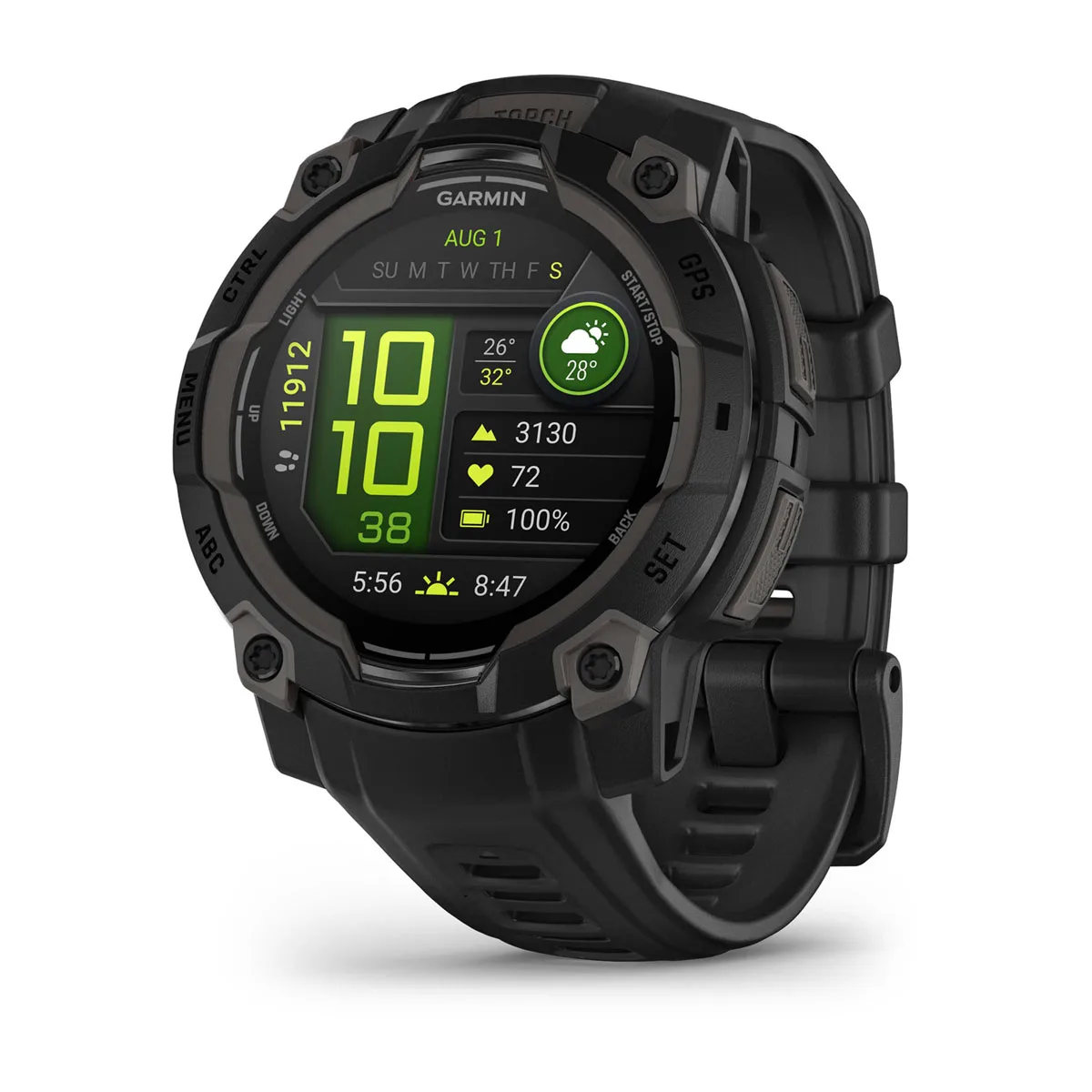
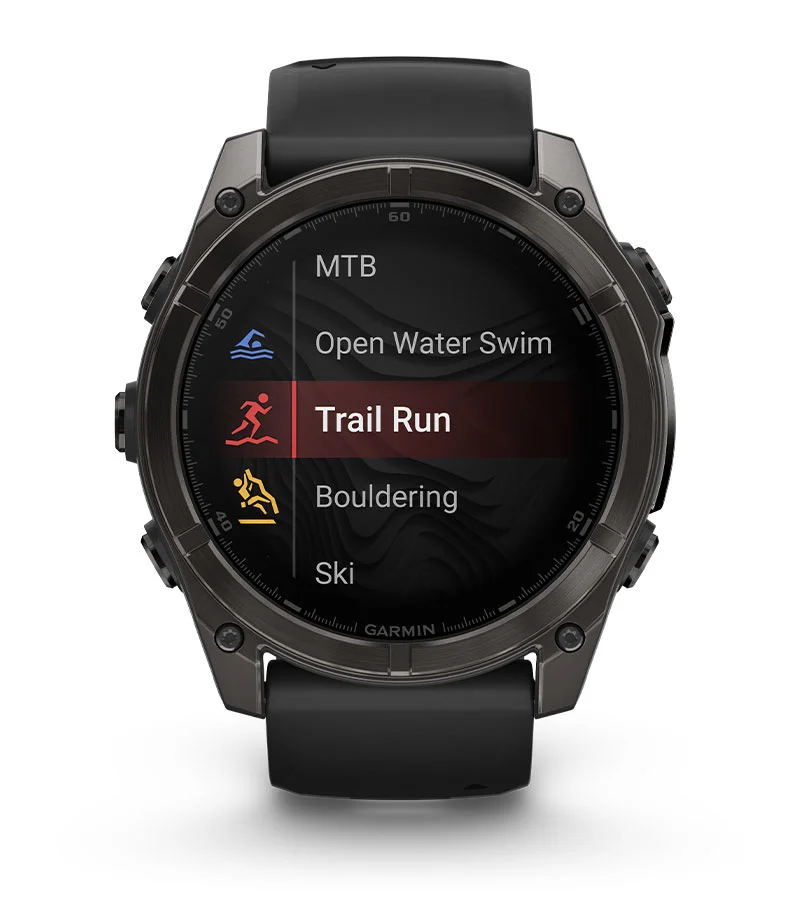
That price gap buys real features — offline topographic maps, onboard music, a touchscreen, a certified dive computer, and Garmin's newest heart rate sensor. The Instinct 3 strips those extras away in favor of lighter weight and longer battery life at roughly half the price. The Fenix 8 packs everything Garmin makes into one premium package. The question is whether those extras are worth double the investment — and the answer depends on what you actually do on the trail.
GPS Accuracy: An Identical Foundation
This is the comparison's most important data point, and it levels the playing field immediately. The Instinct 3 and Fenix 8 run the same multi-band GNSS technology with SatIQ, Garmin's intelligent satellite management system that toggles between single-band and multi-band to balance accuracy against battery life. They use different underlying chipsets but deliver an identical feature set and near-identical accuracy in practice. Track overlays in dense forests, canyon switchbacks, and urban corridors look functionally identical between the two watches.
For trail runners, hikers, and cyclists who prioritize position accuracy above all else, this is the entire argument for the Instinct 3. You get flagship-grade GPS in a watch that costs roughly half as much.
Navigation: Breadcrumbs vs. Full Maps
This is the sharpest feature divide between the two watches and, for many buyers, the single category that justifies — or eliminates — the Fenix 8's price premium.
The Instinct 3 offers breadcrumb navigation. It shows your track as a line on a blank background, plots waypoints, and can follow pre-loaded routes. It works well enough on established trails where getting lost means missing a turn at a signed junction.
The Fenix 8 delivers full offline topographic maps with turn-by-turn directions, contour lines, trail networks, and points of interest. For backcountry navigation — off-trail scrambles, unmarked route finding, multi-day wilderness traverses — this is a genuine capability gap, not a luxury. Knowing where you are relative to a ridgeline, drainage, or trail junction three miles ahead is qualitatively different from following a breadcrumb track.
If your outdoor activity rarely takes you off marked trails, breadcrumb navigation is perfectly adequate. If you routinely navigate unfamiliar terrain without cell service, the Fenix 8's maps are worth every dollar of the price difference.
Heart Rate Tracking: A Generational Gap
The Instinct 3 uses Garmin's Elevate Gen 4 optical sensor, while the Fenix 8 steps up to the Gen 5. In steady-state efforts — zone 2 runs, long hikes, casual cycling — both sensors perform well. The gap widens during high-intensity interval work, where the Gen 4 shows noticeable lag catching up to heart rate spikes and tends to underread peak values during burst efforts. The Gen 5 in the Fenix 8 handles rapid transitions more cleanly, particularly in cold conditions where blood flow to the wrist drops.
The Fenix 8 also adds ECG capability and a dedicated skin temperature sensor, neither of which exist on the Instinct 3.
The practical workaround is straightforward: pair a chest strap for interval sessions. A $50 heart rate monitor closes the sensor gap entirely, and many serious athletes already own one. But if you train by heart rate zones and refuse to wear a chest strap, the Fenix 8's Gen 5 sensor is meaningfully better where it counts.
Battery Life: The Instinct 3's Quiet Advantage
Both watches offer AMOLED and solar MIP display options, and the Instinct 3 edges ahead in efficiency. The AMOLED Instinct 3 delivers around 18 to 24 days in smartwatch mode depending on size, compared to the Fenix 8's 10 to 29 days depending on case size — the compact 43mm gets roughly 10 days, the midsize 47mm hits 16, and the large 51mm reaches 29. The solar Instinct 3 can theoretically run indefinitely with sufficient sunlight exposure (roughly three hours per day at 50,000 lux), while the solar Fenix 8 tops out around 48 days.
The Instinct 3's battery advantage comes partly from what it lacks. No touchscreen to power, no Wi-Fi radio, no music playback, no maps rendering — fewer features drawing current means more days between charges. For multi-day expeditions where charging opportunities are scarce, that efficiency matters. The Instinct 3 Solar is one of the few watches on the market that can genuinely outlast any trip you're physically capable of completing.
Build Quality and Comfort
The Instinct 3 uses a fiber-reinforced polymer case with a metal-reinforced bezel, weighing between 53 and 59 grams depending on size. The Fenix 8 uses the same polymer case body but adds a stainless steel or titanium bezel and rear cover, with a sapphire crystal option on select models, coming in at 73 to 95 grams depending on size and material — the 47mm titanium is 73 grams, the 47mm steel is 81 grams, and the 51mm models climb higher still. Both meet MIL-STD-810 standards for thermal shock, humidity, vibration, and drop resistance.
The weight difference is noticeable on the wrist. At 53 grams, the smaller Instinct 3 practically disappears during runs — it is lighter than most dedicated running watches. The Fenix 8 makes its presence known, particularly during high-cadence activities. The titanium models trim some weight but add significantly to the cost.
Both watches include Garmin's built-in LED flashlight, a feature that has proven far more useful in practice than it sounds on paper.
The Fenix 8 adds leakproof inductive buttons and a certified dive computer rated to 40 meters under the EN13319 standard. For recreational divers, this eliminates the need for a separate dive instrument — a genuine consolidation play that the Instinct 3 simply cannot match.
Display and Interface
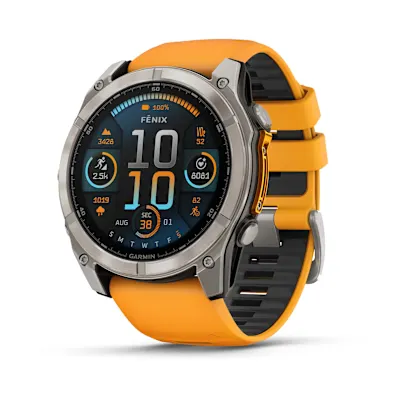
The Fenix 8's AMOLED display is slightly larger (1.3 to 1.4 inches versus 1.2 to 1.3 inches for the Instinct 3 AMOLED), brighter, and adds touchscreen input alongside physical buttons. Instinct 3 Solar models use smaller MIP displays, at approximately 0.9 and 1.1 inches depending on case size. The Instinct 3 relies exclusively on buttons — no touch input at all.
Touchscreen versus buttons is partly preference, but the Fenix 8's dual-input approach is objectively more versatile. Scrolling through maps or long menus is faster with touch. Navigating mid-workout when your hands are wet or gloved is better with buttons. Having both means you use whatever suits the moment. The Instinct 3 locks you into buttons only, which works fine for most interactions but feels limiting when panning across a route — except, of course, the Instinct 3 has no maps to pan across.
Smart Features and Music
The Instinct 3 handles phone notifications and basic Garmin Connect IQ apps. That is essentially the extent of its smart capability. No Wi-Fi, no music storage, no speaker, no microphone.
The Fenix 8 adds 32 GB of onboard storage for offline playlists from Spotify, Deezer, and Amazon Music. It includes Wi-Fi for syncing workouts and downloading maps without a phone. Its speaker and microphone enable phone calls directly from the wrist.
The music capability alone saves carrying a phone on runs and hikes where you want audio but do not want the distraction or weight of a smartphone. Whether that convenience is worth several hundred dollars depends on how often you would use it. For runners who always carry a phone anyway, it is irrelevant. For minimalist trail runners who hate carrying anything extra, it is a meaningful quality-of-life upgrade.
Who Should Buy the Instinct 3
- Trail runners and hikers who stick to marked trails — breadcrumb navigation handles established routes just fine
- Athletes who already own a chest strap — a $50 HR monitor closes the sensor gap entirely
- Ultrarunners and expedition athletes — the Solar variant's effectively unlimited battery life is unmatched
- Budget-conscious Garmin buyers — at $399 to $499, you can buy an Instinct 3 and still have money left over compared to a base Fenix 8
- Anyone who views a watch as a training tool, not a wrist computer — if you do not need maps, music, or calls, do not pay for them
If you are comparing the Instinct 3 against competitors outside Garmin's lineup, our Instinct 3 vs Amazfit T-Rex 3 comparison covers that ground.
Who Should Buy the Fenix 8
- Backcountry navigators who need offline topo maps — not want, need — this is a potentially trip-saving capability
- Recreational divers — consolidate your dive computer and sport watch into one device
- Athletes who refuse chest straps — the Gen 5 sensor handles intervals and cold conditions meaningfully better
- Runners who leave their phone at home — gain Spotify, Deezer, and Amazon Music offline on your wrist
- Anyone who wants one watch for everything — phone calls, Wi-Fi sync, touchscreen, and music make the Fenix 8 a viable daily driver
For those considering the Fenix 8 against other premium options, our Apple Watch Ultra 3 vs Fenix 8 breakdown covers the cross-platform decision, and the best outdoor watches for 2026 roundup provides broader context.
Our Verdict
The Instinct 3 is the better buy for most people.
The $500 to $700 separating these two watches buys genuine capability — maps, music, dive, ECG, touchscreen, Wi-Fi — but none of it changes the core tracking experience. Both watches record your run with the same GPS accuracy. Both survive the same abuse. Both last long enough on a charge to outlast any reasonable training week. The Instinct 3 delivers the vast majority of the Fenix 8's core tracking capability at roughly half the cost, and the remaining gap can be largely closed with a chest strap that costs a fraction of the price difference.
The Fenix 8 is the better watch. It is not the better value. If you genuinely need offline maps for backcountry navigation, or want a single device that handles diving, music, and phone calls alongside elite-level training metrics, the Fenix 8's premium is justified. For everyone else — and that is most outdoor athletes — the Instinct 3 does the job and leaves $500 in your pocket for gear that makes a bigger difference on the trail.
Specs at a Glance
| Spec | Garmin Instinct 3 | Garmin Fenix 8 |
|---|---|---|
| Price | $399–$499 | $999–$1,199 |
| Case Sizes | 45mm, 50mm | 43mm, 47mm, 51mm |
| Weight | 53–59g | 73–95g (size/material dependent) |
| Case Material | Fiber-reinforced polymer | Polymer case, steel or titanium bezel |
| Display | AMOLED or Solar MIP | AMOLED or Solar MIP |
| Touchscreen | No | Yes |
| GPS | Multi-band GNSS + SatIQ | Multi-band GNSS + SatIQ |
| HR Sensor | Elevate Gen 4 | Elevate Gen 5 |
| ECG | No | Yes |
| Offline Maps | No | Yes (topo) |
| Music Storage | No | 32 GB |
| Wi-Fi | No | Yes |
| Speaker/Mic | No | Yes |
| Dive Rating | 10 ATM | 10 ATM + 40m dive (EN13319) |
| Battery (AMOLED) | 18–24 days | 10–29 days (size-dependent) |
| Battery (Solar) | Unlimited with solar | Up to 48 days |
| Flashlight | Yes | Yes |
| Durability | MIL-STD-810 | MIL-STD-810 |