
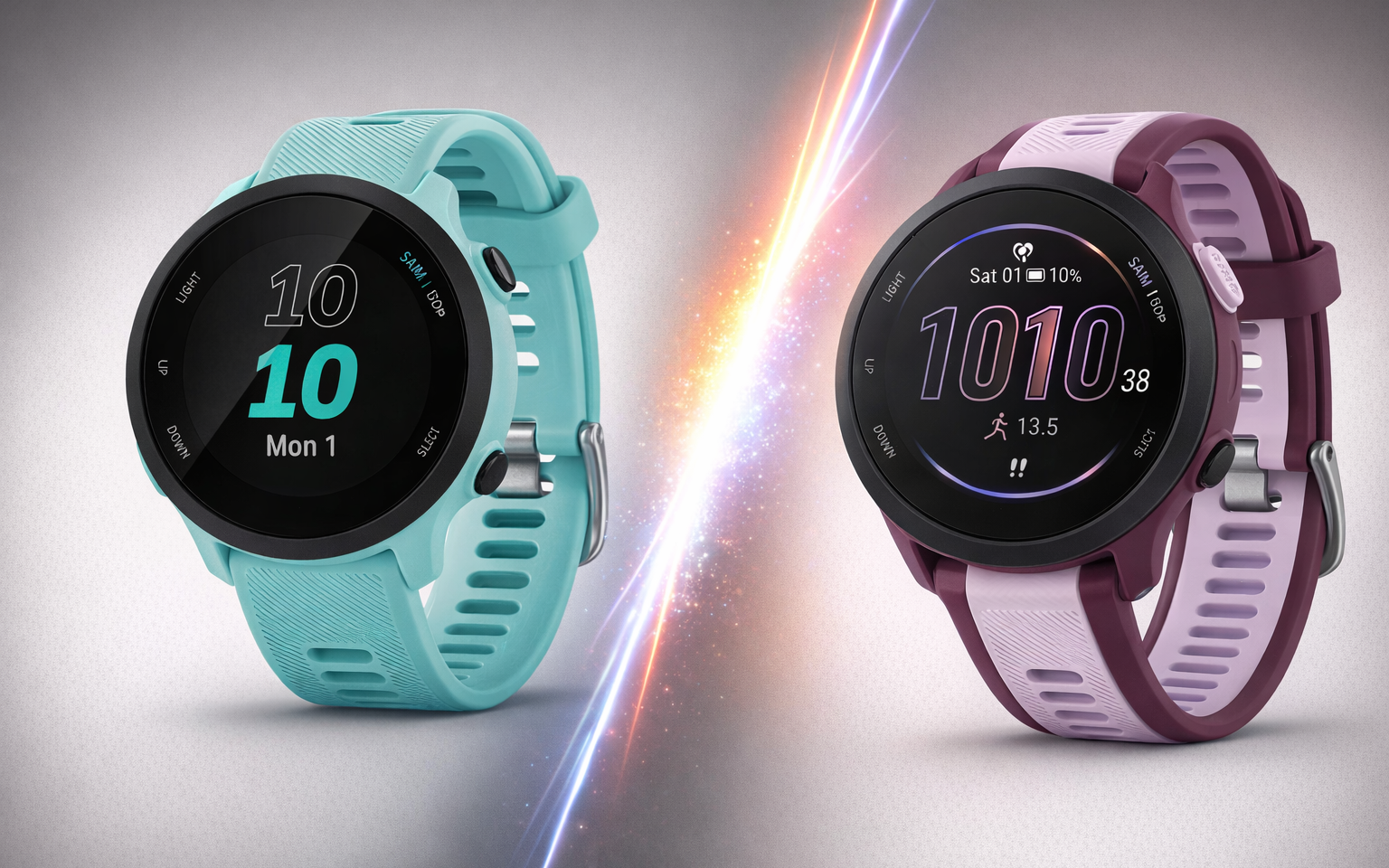
The Garmin Forerunner 55 has been the default recommendation for beginner runners since 2021. It does the basics well, costs less than a pair of premium running shoes, and carries the Garmin name. But Garmin shook up its own entry-level lineup in early 2024 with the Forerunner 165 — a watch that borrows heavily from its more expensive siblings while keeping the price relatively accessible. The question isn’t whether the FR165 is better on paper. It obviously is. The real question is whether the $80–$100 price difference actually translates to a meaningfully better experience on your wrist.
The answer leans heavily in the FR165’s favor — but the FR55 still has a role to play. Here’s how these two stack up across every category that matters.
Display: Night and Day
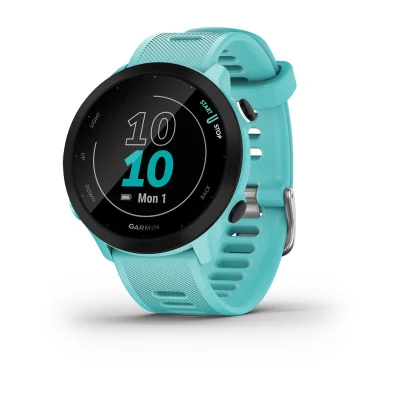
This is the single biggest difference between these two watches, and it’s not close. The Forerunner 55 uses a 1.04-inch transflective memory-in-pixel (MIP) display running at 208x208 resolution. It’s functional — readable in direct sunlight, always visible — but it looks like a watch from a decade ago. Data fields feel cramped, colors are washed out, and there’s no touchscreen.
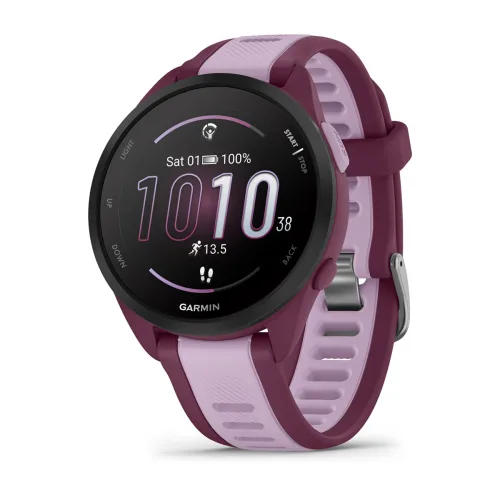
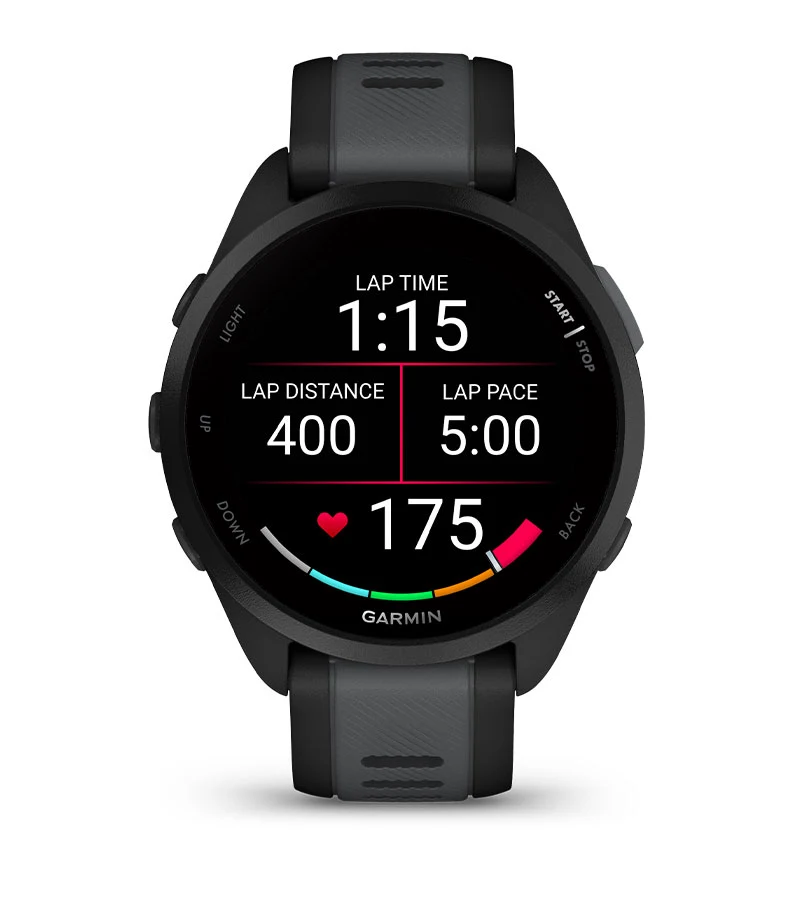
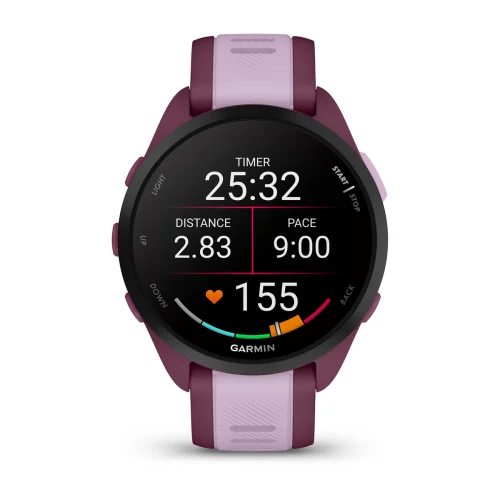
The Forerunner 165 jumps to a 1.2-inch AMOLED display at 390x390 resolution. The difference is immediately striking. Colors pop, text is razor-sharp, and workout data is dramatically easier to read mid-run. The touchscreen adds fluid navigation through menus and maps, while Garmin wisely kept five physical buttons for reliable mid-workout control. You get the best of both input methods.
The AMOLED display isn’t just cosmetic. It makes the entire Garmin software experience more usable — widgets are easier to parse, workout screens are clearer at a glance, and notifications are actually pleasant to read. Once you’ve used an AMOLED Garmin, the MIP screens feel like going back to a flip phone.
Edge: Forerunner 165, by a wide margin.
Battery Life: The FR55’s One Clear Win
The MIP display does have one genuine advantage: efficiency. The Forerunner 55 delivers up to 14 days in smartwatch mode and 20 hours of continuous GPS tracking. The Forerunner 165 manages 11 days and 19 hours respectively. With the AMOLED display set to always-on mode, the FR165 drops to roughly 4 days of smartwatch use.
For most runners, this difference is academic. Both watches will comfortably last a week of daily training with GPS tracking. Both will handle a marathon without dying. But if you’re an ultrarunner eyeing 20+ hour efforts, or you simply hate charging watches, the FR55’s edge here is real.
The FR165 does offer a battery saver mode that extends smartwatch life to about 20 days by disabling the always-on display and limiting background features. It’s a reasonable compromise.
Edge: Forerunner 55, but the gap is smaller than it looks.
Training Features: Where the FR165 Pulls Away
The Forerunner 55 covers the basics: GPS pace and distance, optical heart rate, VO2 Max estimates, daily suggested workouts, PacePro pacing guidance, Garmin Coach training plans, and race time predictions. For a runner who just wants to lace up and track their miles, it’s genuinely sufficient.
The Forerunner 165 includes all of that and adds a layer of training intelligence that transforms how you interact with your data. HRV Status tracks your heart rate variability overnight, giving you a window into recovery and readiness that the FR55 simply cannot provide. Training Effect breaks down the aerobic and anaerobic impact of each workout. Running Dynamics support is built into the watch via a wrist-based accelerometer, providing cadence, ground contact time, vertical oscillation, stride length, and vertical ratio data without any external accessory.
The FR165 also adds a barometric altimeter for accurate elevation tracking — essential for hill runners and trail enthusiasts. The FR55 relies on GPS-based elevation, which is noticeably less reliable.
One notable absence from the FR165: Training Readiness, Garmin’s daily score that synthesizes sleep, HRV, stress, and training load into a single readiness number. That feature currently lives on the Forerunner 265 and above. Some users have speculated that Garmin may bring it to the FR165 via a future firmware update, but there is no official commitment, and buyers should not purchase the FR165 expecting it to arrive.
Edge: Forerunner 165, decisively.
GPS and Heart Rate Accuracy
Both watches use single-band (non-multiband) GPS with support for multiple satellite constellations. The FR55 supports GPS, GLONASS, and Galileo. The FR165 adds broader multi-GNSS support and benefits from Garmin’s newer satellite processing.
In practical terms, both deliver reliable GPS tracks for road running. The FR165 shows slightly tighter tracking on complex routes — think tight switchbacks, tree-covered trails, and urban canyons — but the difference is incremental, not transformative. Neither watch will satisfy someone who demands the pinpoint accuracy of multiband GPS found on the Forerunner 265 or 965.
For heart rate, the FR55 uses Garmin’s Elevate V3 optical sensor, while the FR165 upgrades to the Elevate V4. In practice, the difference is modest: both handle steady-state running well and struggle somewhat with high-intensity intervals (as all wrist-based sensors do). The V4 sensor in the FR165 does show slight improvements in responsiveness during pace changes, but the gap is not dramatic enough to be a deciding factor on its own. Both watches pair reliably with external chest straps for those who want clinical accuracy.
Edge: Slight nod to the FR165, but functionally close.
Music and Smart Features
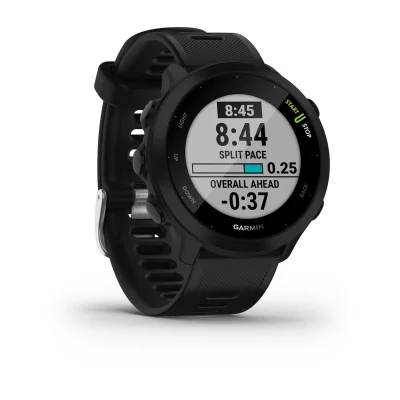
The Forerunner 55 has no music storage or playback capability. You can control music playing on your phone, but that’s it.
The Forerunner 165 Music ($299) stores up to 500 songs and syncs with Spotify, Amazon Music, and Deezer for offline playlists. Pair Bluetooth earbuds and leave your phone at home. The base FR165 ($249) lacks music storage, so choose accordingly.
The FR165 also adds Garmin Pay for contactless payments — handy for grabbing a coffee mid-run without carrying a wallet. The FR55 doesn’t have it. Both watches support smart notifications, Connect IQ apps, and phone connectivity.
Edge: Forerunner 165.
Health and Wellness Tracking
Both watches track heart rate, steps, calories, sleep, stress, and Body Battery energy levels throughout the day. Both provide women’s health tracking for menstrual cycle monitoring.
The FR165 adds SpO2 (blood oxygen saturation) monitoring and HRV-based health insights that the FR55 lacks. Sleep tracking is more detailed on the FR165, with sleep score breakdowns and nap detection.
These additions won’t matter to every runner, but they contribute to a more complete picture of overall health — and they’re features you’d expect on a watch released in 2024.
Edge: Forerunner 165.
Build Quality and Comfort
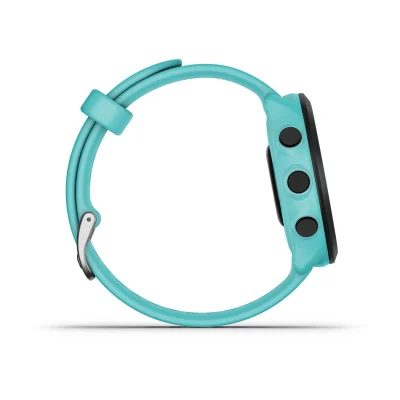
The Forerunner 55 weighs 37 grams. The FR165 weighs 39 grams. Both are among the lightest GPS watches available, and both disappear on the wrist during runs. The size difference is similarly negligible: 42mm vs 43mm case diameter, identical 11.6mm thickness.
Both use reinforced polymer cases with chemically strengthened glass. Both are rated at 5 ATM water resistance (swim-safe to 50 meters). Both use Garmin’s standard quick-release 20mm bands.
The FR165 looks and feels more modern thanks to its slimmer bezels and the vibrant display, but neither watch will win design awards. These are purpose-built running tools, not fashion accessories.
Edge: Tie.
Who Should Buy the Forerunner 55
The FR55 makes sense in one specific scenario: you want a reliable GPS running watch at the absolute lowest possible price. At its current street price of $149–$169, it remains a capable tool for tracking runs, following Garmin Coach plans, and monitoring basic health metrics. If your entire goal is "track my runs with GPS and see my pace," the FR55 does that without fuss.
It’s also the right pick for runners who prioritize battery life above all else — ultrarunners or multi-day adventurers who need every hour of GPS tracking they can get.
But be honest about whether that’s really you. Most runners who start with a basic watch quickly want more data, better visuals, and smarter insights. The FR55 doesn’t leave much room to grow into.
Who Should Buy the Forerunner 165
Almost everyone else. The FR165 is the better watch for new runners who want to understand their training, not just log it. It’s the better watch for anyone who’s ever squinted at a dim MIP display and wished for something more readable. It’s the better watch for runners who want the option to leave their phone at home with music on their wrist.
The $80–$100 premium over the FR55 buys you a dramatically better display, meaningfully richer training data, modern health tracking, and a watch that won’t feel outdated in a year. For a device you’ll wear every day and train with for years, that’s a smart investment.
If you’re debating between the base FR165 and the FR165 Music, the $50 upgrade for music storage is worth it if you regularly run without your phone. If your phone always comes along, save the money.
Our Verdict
The Garmin Forerunner 165 is the entry-level GPS running watch to buy. The AMOLED display alone would justify the upgrade, but the richer training features, upgraded heart rate sensor, HRV tracking, SpO2, and Garmin Pay make the case overwhelming. It borrows so aggressively from Garmin’s mid-range lineup that the Forerunner 265 should be nervous.
The Forerunner 55 isn’t a bad watch — it’s a good watch that’s been thoroughly surpassed. At $149 on sale, it’s still a reasonable impulse buy for someone who just wants basic GPS run tracking with zero frills. But for $80–$100 more, the FR165 delivers a fundamentally better experience in almost every measurable way. That’s not a hard trade-off. That’s a no-brainer.
Specs at a Glance
| Spec | Forerunner 55 | Forerunner 165 |
|---|---|---|
| Display | 1.04" MIP, 208x208 | 1.2" AMOLED, 390x390 |
| Touchscreen | No | Yes (+ 5 buttons) |
| Weight | 37g | 39g |
| Case Size | 42 x 42 x 11.6mm | 43 x 43 x 11.6mm |
| Battery (Smartwatch) | Up to 14 days | Up to 11 days |
| Battery (GPS) | Up to 20 hours | Up to 19 hours |
| GPS | GPS / GLONASS / Galileo | Multi-GNSS |
| HR Sensor | Elevate V3 | Elevate V4 |
| SpO2 | No | Yes |
| HRV Tracking | No | Yes |
| Barometric Altimeter | No | Yes |
| Music Storage | No | Up to 500 songs (Music edition) |
| Garmin Pay | No | Yes |
| Water Rating | 5 ATM (50m) | 5 ATM (50m) |
| Training Effect | No | Yes |
| Running Dynamics | No | Yes (wrist-based, built-in) |
| MSRP | $199.99 | $249.99 / $299.99 (Music) |
| Typical Street Price | $149–$169 | $249–$299 |