
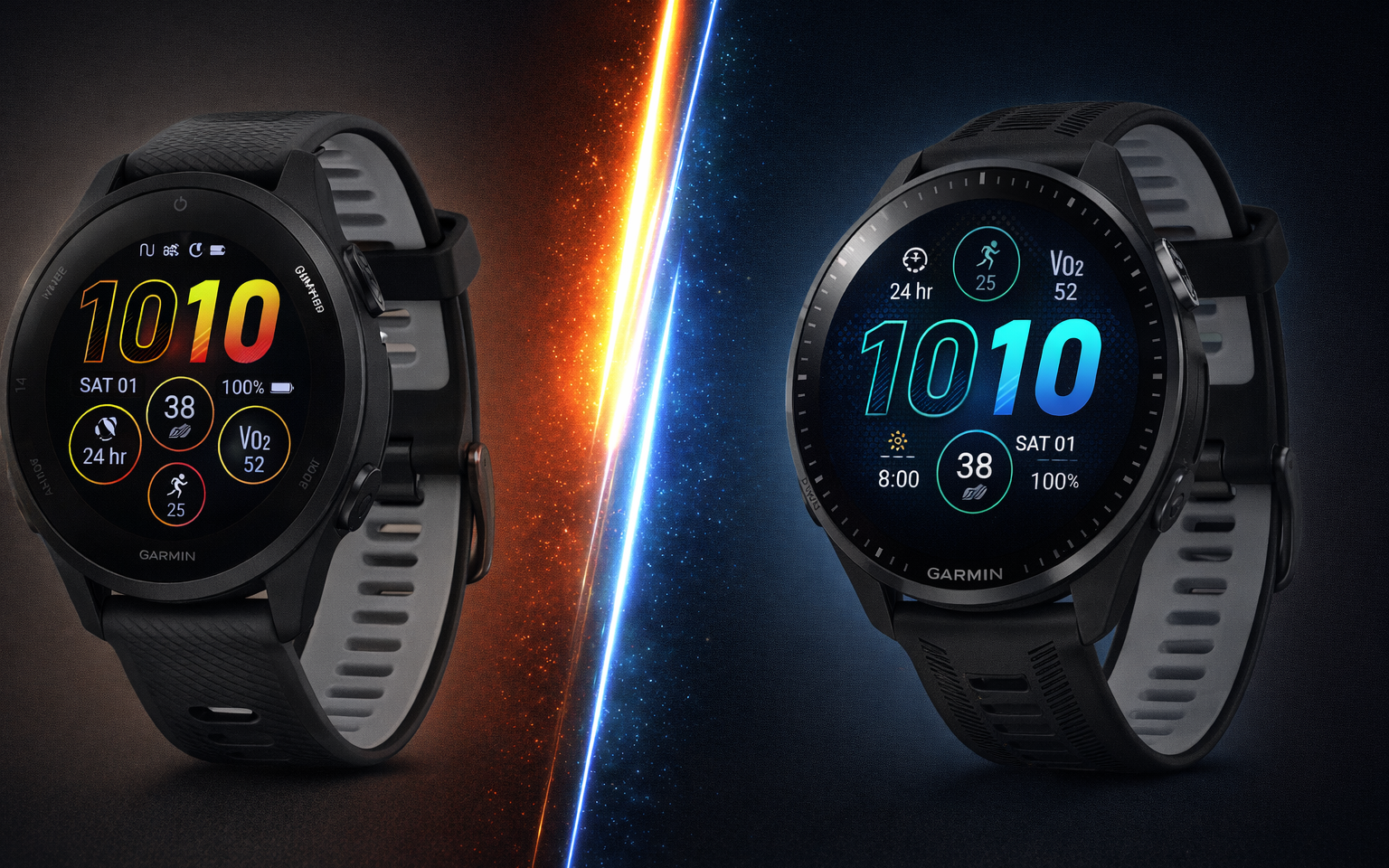
The Garmin Forerunner 265 gives you over 90% of the Forerunner 965 for $100-150 less. Same GPS chipset, same heart rate sensor, same AMOLED display technology, same training ecosystem. The features that matter on every run — Training Readiness, Running Dynamics, HRV Status, daily suggested workouts — are identical. For most runners, the 265 is the better buy.
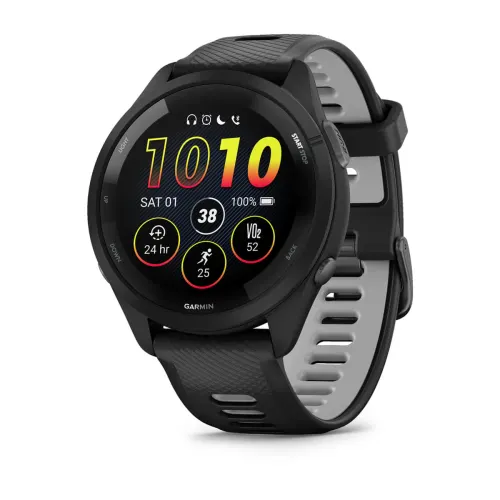
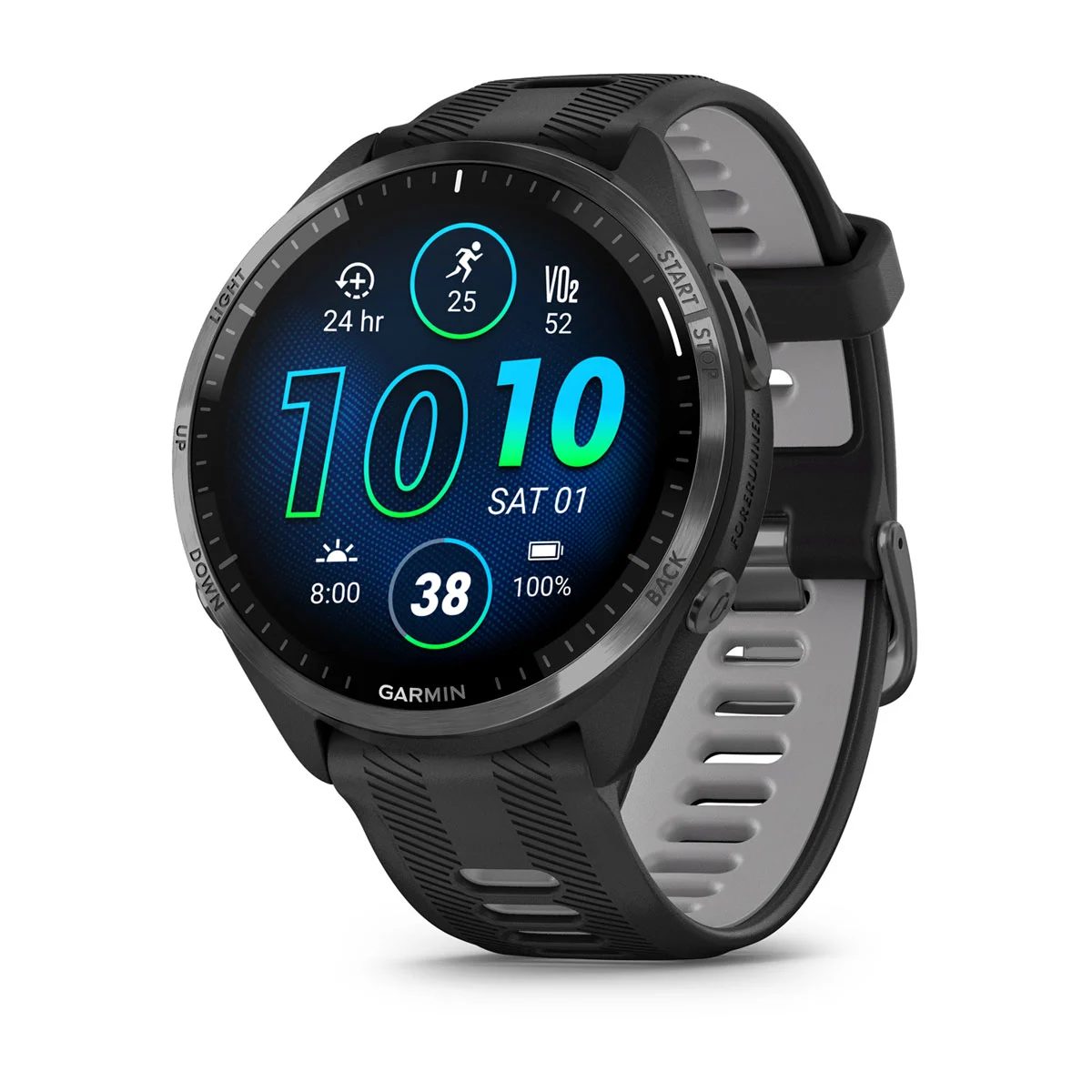
So what does the 965's premium actually get you? Three things: topographic maps, extended battery life, and a titanium bezel. That is a narrow list. If you run trails in unfamiliar terrain or race ultras past 50K, those three things are worth every dollar. If you run roads, tracks, and familiar routes — which most runners do — they are features you will pay for and never use.
Both watches are among the best running watches you can buy right now, and at current street prices ($300-350 for the 265, $400-500 for the 965), neither is a bad purchase. But capability you never use is just weight on your wrist — and on your wallet.
GPS and Navigation: The Biggest Differentiator
Both watches use identical multi-band (dual-frequency) GPS that delivers excellent accuracy in challenging environments — urban canyons, dense tree cover, steep valleys. Track accuracy between the two is virtually indistinguishable. You will not get a more accurate GPS fix from the 965 than from the 265.
The real separation is what each watch does with that position data.
The Forerunner 265 supports course following, breadcrumb navigation, and TracBack (retrace your route back to the start). Create a route on Garmin Connect, sync it to the watch, and follow a line on the screen. Veer off course and the watch alerts you. It works well for out-and-back routes, familiar trail systems, and pre-planned race courses. But there is no underlying map — just a line on a blank screen.
The Forerunner 965 has full-color topographic maps with roads, trails, elevation contours, and points of interest. Turn-by-turn navigation, real-time rerouting, TracBack to retrace your route, and the ability to browse the map and find new trails on the fly. For trail runners in unfamiliar terrain, this is transformative. Head out without a plan, explore new trail networks, and never worry about getting lost.
This is the single biggest difference between the two watches, and it should be the primary factor in your decision. If you run roads, tracks, and familiar routes, you will never miss the maps. If you run trails in new places, the maps alone justify the price premium.
Edge: Forerunner 965 — maps are the 965's killer feature and the 265's most notable absence.
Display: Premium Glass, Marginal Size Difference
Both watches use vibrant AMOLED displays that make the old MIP screens on previous Forerunners look like something from a decade ago. Colors pop, text is sharp, and outdoor readability in direct sunlight is excellent on both.
The Forerunner 965 gets a 1.4-inch panel at 454x454 resolution behind Gorilla Glass 3 DX with a titanium bezel. The Forerunner 265 gets a 1.3-inch panel at 416x416 behind Gorilla Glass 3 with a polymer bezel. In daily use, the 0.1-inch size difference is barely perceptible when you are glancing at pace, heart rate, and distance during a run. Both displays are crisp enough that data fields are easy to read at a glance, even with four or five metrics on screen simultaneously.
Where the size gap actually matters is maps — scrolling a topo map on the 965's larger screen is noticeably better, but since the 265 lacks maps entirely, this advantage exists in isolation.
The glass tells a different story. Gorilla Glass 3 DX on the 965 is meaningfully more scratch-resistant than the standard Gorilla Glass 3 on the 265. If you are bushwhacking through trails, bumping doorframes, or just hard on watches, the DX lens holds up better over years of daily wear. The titanium bezel on the 965 also resists dings that would mark the 265's polymer. It is a genuine durability advantage — but not one most road runners will ever encounter.
Edge: Forerunner 965 — but the advantage is durability and premium feel, not a meaningfully better running experience.
Training Features: Closer Than You Think
Here is where the marketing creates more separation than the reality. Both watches share a deep and impressive training feature set:
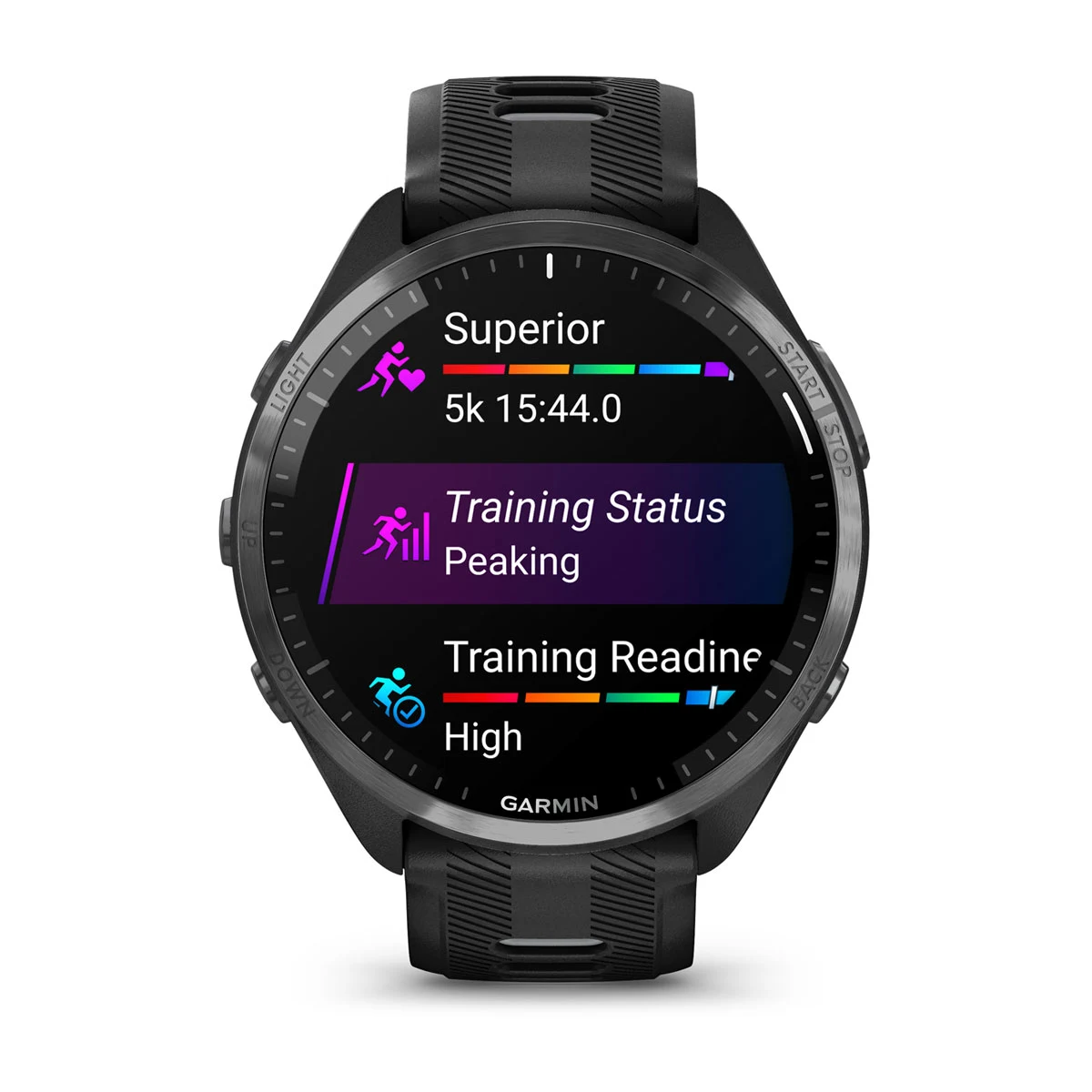
- Training Readiness Score — synthesizes sleep, HRV, recovery time, and training load into a single daily number that tells you whether to push hard or pull back
- Morning Report — surfaces weather, sleep quality, HRV status, and training readiness on your wrist before you even lace up
- Running Dynamics — cadence and stride length from the wrist sensor; ground contact time and vertical oscillation require a compatible chest strap or Running Dynamics Pod
- VO2 Max estimation — tracks aerobic fitness trends over time
- HRV Status — tracks heart rate variability trends with overnight recording
- Lactate threshold estimation — identifies your threshold pace and heart rate
- Race Predictor — estimates finish times for 5K through marathon
- Daily Suggested Workouts — adapts to your training load and fitness level
- Recovery Time Advisor — tells you when you are ready for the next hard effort
That is an enormous amount of training intelligence, and it all runs identically on both watches.
The Forerunner 965 adds a handful of features on top:
- Real-Time Stamina — shows remaining energy as a percentage during activity, useful for pacing in races and long runs
- ClimbPro — breaks upcoming climbs into segments with gradient, distance, and elevation gain on mapped courses
- Training Load Ratio — compares acute load to chronic load to identify injury risk
- Chronic Training Load — longer-term training load trend
- Heat and altitude acclimatization — tracks how adapted you are to environmental conditions
- Cycling Dynamics — advanced metrics from compatible Garmin power meters
These are not trivial features. Real-Time Stamina is genuinely useful for marathon pacing — watching your stamina drain in real time teaches more about pacing discipline than any training plan. Training Load Ratio helps competitive athletes balance volume and intensity across training cycles. ClimbPro is excellent for hilly trail races.
But here is the honest truth: Training Readiness on the 265 covers what most runners actually need. If you run recreationally, train for road races, or are working on your first or second marathon, the 265's training suite is more than comprehensive enough. The 965's extras become meaningful when you are doing structured periodized training, racing competitively, or managing training load across multiple sports.
Edge: Forerunner 965 — but the practical gap is much narrower than the spec sheet implies.
Battery Life: Nearly Double, But Context Matters
The numbers are straightforward:
| Mode | FR 265 | FR 965 |
|---|---|---|
| Smartwatch | 13 days | 23 days |
| GPS (GPS-Only GNSS) | 20 hours | 31 hours |
| GPS (SatIQ/default) | 16 hours | 22 hours |
| GPS + Music | 7 hours | 10.5 hours |
The 965 nearly doubles the 265 in every battery mode. That is a real and measurable advantage. The question is whether it changes your experience.
For daily smartwatch use, 13 days is already excellent. You charge the 265 roughly twice a month. The 965 stretches that to about once every three weeks. The practical difference is negligible for most people.
For GPS activities, 20 hours handles a marathon with room to spare and covers most 50K ultras. The 965's 31 hours becomes essential for 100-mile ultras, multi-day stage races, and backcountry adventures where a charger is not available. If you run 50-milers or longer, the 965's battery is not a luxury — it is a requirement.
For GPS with music, the gap tightens to 7 versus 10.5 hours. If you stream Spotify on long runs, the 265's 7-hour limit could clip a slow marathon.
Edge: Forerunner 965 — but the 265's battery is more than adequate for everything up to and including most ultramarathons.

Comfort and Size: The 265's Quiet Advantage
The Forerunner 265 weighs 47 grams. The 965 weighs 53 grams. Six grams does not sound like much until you wear both back-to-back. The 265 disappears on the wrist more quickly, sits a fraction thinner (12.9mm versus 13.2mm), and offers something the 965 does not: a 42mm size option.
The 265S (42mm version) is a genuine differentiator for runners with smaller wrists. At 39 grams, it is lighter than most running watches on the market and wears comfortably on wrists where the 965's 47mm case looks oversized. The 965 comes in 47mm only — take it or leave it.
For daily wear, sleeping, and race day, lighter is better. The 265 wins this category cleanly.
Edge: Forerunner 265 — lighter, thinner, and available in a size the 965 cannot match.
Build Quality: Titanium vs. Polymer
The Forerunner 965's titanium bezel gives it a premium look and feel that the 265's polymer cannot match. Pick up both watches and the 965 feels like it costs more — because it does. The titanium resists scratches and scuffs better than polymer, and paired with Gorilla Glass 3 DX, the 965 will look newer after two years of hard use.
The 265 is not cheap-feeling — the build is solid and the polymer is durable — but it reads as a mid-range sports watch rather than a premium instrument. Both share a fiber-reinforced polymer case back, 5 ATM water resistance, and 22mm quick-release silicone straps.
Edge: Forerunner 965 — premium materials that look and feel the part.
Storage and Music
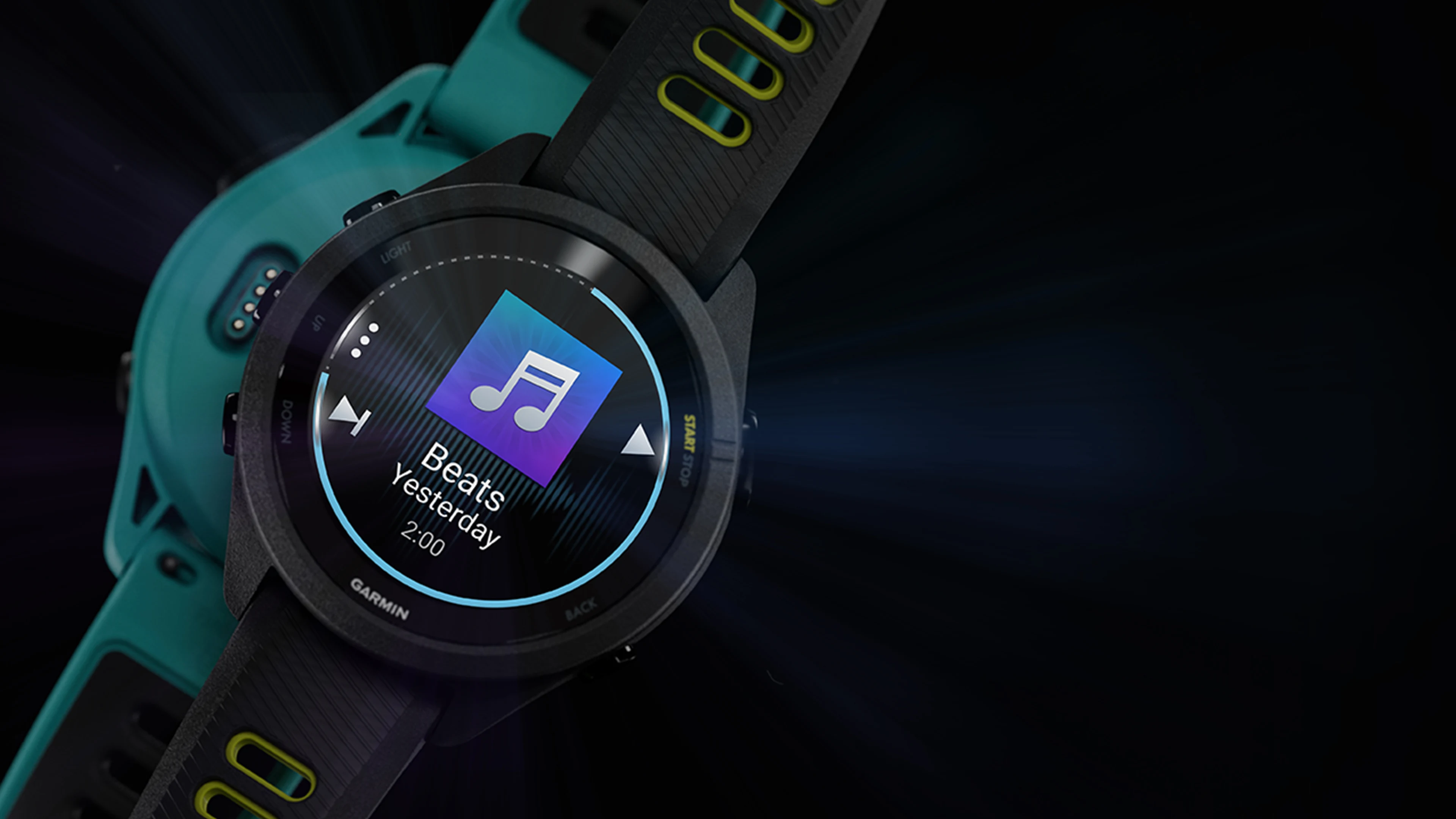
The 965 packs 32GB of storage versus the 265's 8GB. In practice, that is roughly 2,000 songs versus 500. Both watches support offline playlists from Spotify, Amazon Music, and Deezer, so you can run phone-free with Bluetooth earbuds.
Five hundred songs covers a couple of solid running playlists. Two thousand matters if you load entire albums or want your full library on the wrist. Neither watch streams over cellular — both require pre-downloaded playlists.
Edge: Forerunner 965 — though 500 songs is sufficient for most runners.
Smart Features: A Dead Heat
Garmin Pay, smartphone notifications, quick replies on Android, weather widgets, calendar, phone finder, incident detection — all identical on both watches. Neither is a smartwatch in the Apple Watch sense. Both are running watches that happen to show your texts.
Edge: Tie.
The Value Equation
At MSRP, the Forerunner 265 costs $449.99 and the 965 costs $599.99 — a $150 gap. At current street prices in 2026, with both watches regularly discounted since the Forerunner 970 launched, the 265 sits around $300-350 and the 965 around $400-500. The real-world gap is roughly $100-150.
That $100-150 gets you: maps, 11 extra hours of GPS battery, titanium bezel, Gorilla Glass 3 DX, 24GB more storage, Real-Time Stamina, ClimbPro, Training Load Ratio, and heat/altitude acclimatization.
What it does not get you: better GPS accuracy, better heart rate tracking, better Training Readiness, better Running Dynamics, better daily suggested workouts, or any improvement to the features you interact with on every single run.
The 265 is the better value for the majority of runners. It delivers the core Garmin training experience — the features that actually change how you train and race — at a price that is $100-150 less. If you have been eyeing the Forerunner 570 vs 265 comparison and wondering whether to step up further, the 265 hits a sweet spot that is hard to argue against.
Who Should Buy the Forerunner 265
You run primarily on roads, tracks, and familiar trails. You want a watch that delivers serious training metrics — Training Readiness, HRV, Running Dynamics, VO2 Max — without paying for features you will not use. You run 5Ks through marathons and occasionally a 50K. You want a lighter, more comfortable watch that comes in two sizes. You would rather put the $100-150 savings toward a race entry, new shoes, or a solid pair of running headphones.
Who Should Buy the Forerunner 965
You run trails in unfamiliar terrain and need real-time navigation with topographic maps. You run ultramarathons where 31 hours of GPS battery is not a luxury but a necessity. You are a competitive runner who wants Real-Time Stamina for pacing long races and Training Load Ratio for managing periodized training cycles. You are a triathlete who uses a Garmin power meter and needs Cycling Dynamics. You want the premium feel of titanium and the scratch resistance of Gorilla Glass 3 DX. You plan to use this watch for multi-day hiking and backpacking trips where reliable navigation matters.
Our Verdict
The Forerunner 265 is the better watch for most runners. It delivers the same GPS accuracy, the same heart rate sensor, and the same core training intelligence as the 965 — Training Readiness, Running Dynamics, HRV Status, VO2 Max, daily suggested workouts — in a lighter, more comfortable package at a meaningfully lower price. The features that matter on every run are identical. The features that differ matter on specific runs that most runners never do.
The editorial question was whether the 965 is "worth double the price." At current street prices, it is not double — it is roughly 30-40% more. And for the right runner, it absolutely justifies that premium. Trail runners will find the maps indispensable. Ultra runners who push past 50K will rely on the extended battery. Competitive athletes will appreciate Real-Time Stamina and Training Load Ratio.
But for the road runner training for a half-marathon, the recreational runner building consistency, or the first-time marathoner who wants intelligent training guidance — the Forerunner 265 does everything the 965 does where it counts, for $100-150 less on a lighter wrist.
Save the money. Spend it on the race.
Specs at a Glance
| Spec | Forerunner 265 | Forerunner 965 |
|---|---|---|
| Release | March 2023 | March 2023 |
| Display | 1.3" AMOLED, 416x416 | 1.4" AMOLED, 454x454 |
| Lens | Gorilla Glass 3 | Gorilla Glass 3 DX |
| Bezel | Polymer | Titanium |
| Weight | 47g | 53g |
| Dimensions | 46.1 x 46.1 x 12.9mm | 47.2 x 47.2 x 13.2mm |
| Size Options | 42mm / 46mm | 47mm only |
| Water Rating | 5 ATM | 5 ATM |
| GPS | Multi-band | Multi-band |
| Maps | No (breadcrumb only) | Yes (full topo) |
| Storage | 8GB (~500 songs) | 32GB (~2,000 songs) |
| Garmin Pay | Yes | Yes |
| Battery (smartwatch) | 13 days | 23 days |
| Battery (GPS, GPS-Only) | 20 hours | 31 hours |
| Battery (GPS + music) | 7 hours | 10.5 hours |
| MSRP | $449.99 | $599.99 |
| Street Price (2026) | ~$300-350 | ~$400-500 |