
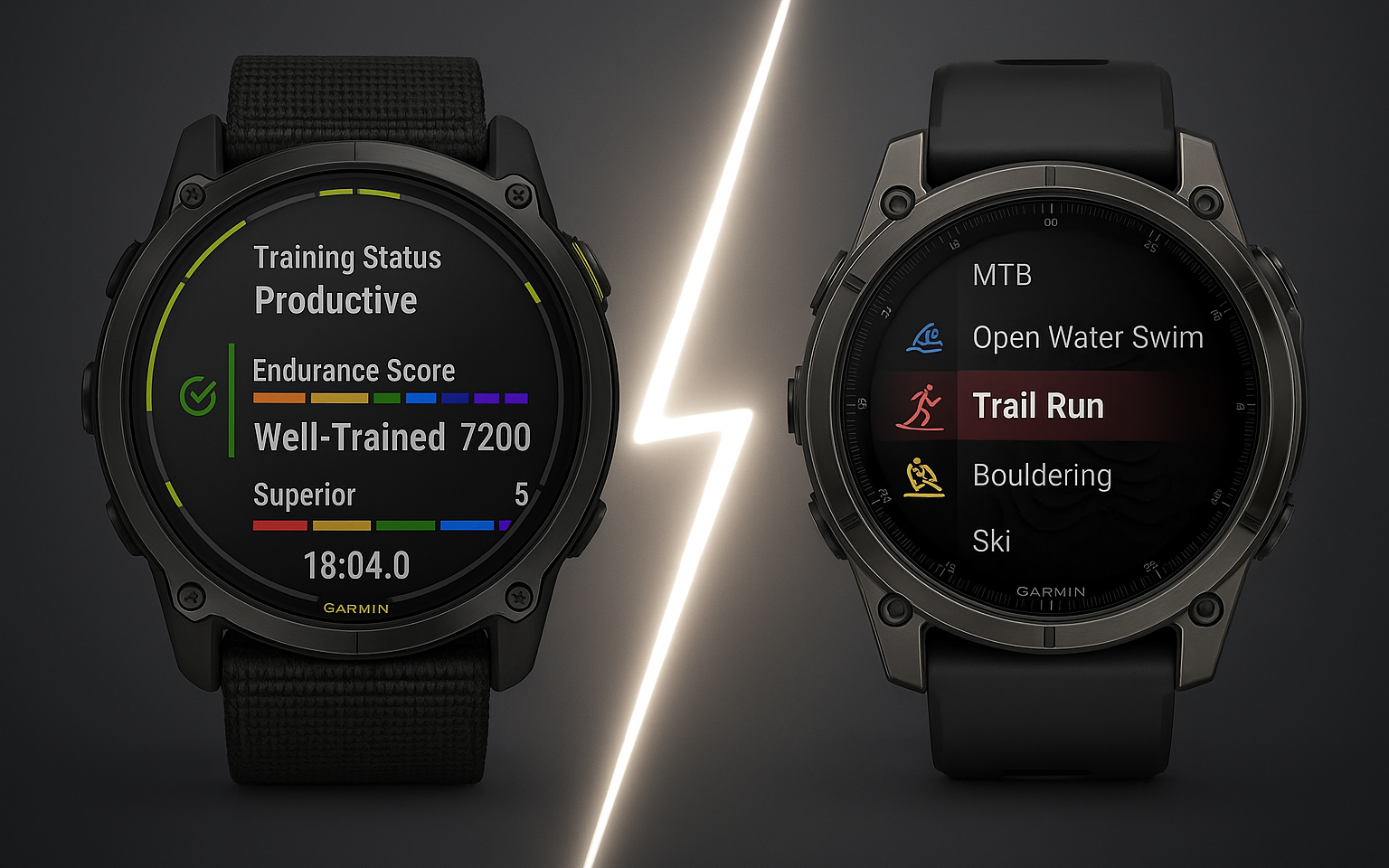
Garmin released two flagship watches in August 2024, forcing a choice: do you prioritize ultra-endurance battery life or cutting-edge features? The Enduro 3 costs $899 and promises up to 90 days of battery life with solar charging. The Fenix 8 starts at $999 (43mm AMOLED) and climbs to $1,200 (51mm), bringing the first AMOLED display to the Fenix line, plus a speaker, microphone, and dive computer.
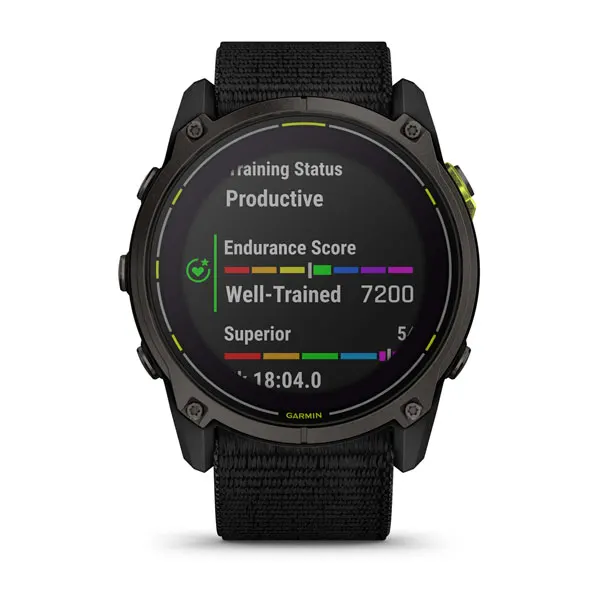
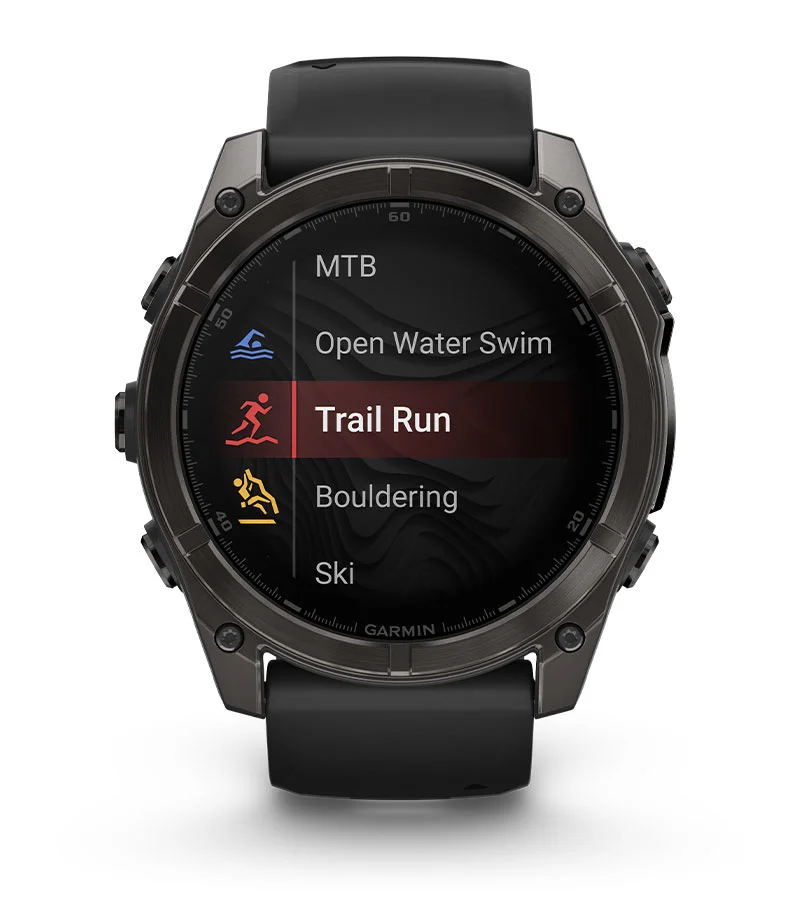
Both watches share the same GPS accuracy, training metrics, and navigation tools. Both include Garmin's Gen 5 Elevate heart rate sensor, multi-band GPS, preloaded TopoActive maps, and the full suite of advanced training features. The Enduro 3 essentially takes the Fenix 7X Pro's DNA and merges it with the Fenix 8's updated software, minus a few premium features.
The $100-$300 price premium for the Fenix 8 needs to justify losing 60+ days of battery life. Here's how they compare across every category that matters.
Battery Life: Enduro 3 Wins by a Mile
This is where the Enduro 3 embarrasses the Fenix 8. The Enduro 3 delivers up to 90 days in smartwatch mode with optimal solar exposure, or 36 days without any solar charging. In GPS mode, it lasts up to 320 hours with solar — more than 13 days of continuous tracking. Even with multi-band GPS for maximum accuracy, it still provides 60 hours (90 hours with solar).
The Fenix 8's battery life depends heavily on which model you choose. The 51mm AMOLED lasts up to 29 days in smartwatch mode and 84 hours in GPS mode with gesture control (65 hours with always-on display). The 47mm AMOLED drops to just 16 days smartwatch and 47 hours GPS. The 51mm Solar model performs better — up to 48 days in smartwatch mode with optimal solar exposure (30 days without) — but it still can't touch the Enduro 3's longevity.
Real-world use confirmed the spec gap. The Fenix 8 47mm required charging every six to seven days with moderate use. The 51mm AMOLED stretched to 12-13 days. The Enduro 3? Three weeks of mixed training with multiple GPS activities per week barely dented it past the halfway mark.
The Enduro 3's solar charging is also more effective in practice. The larger solar surface area and overall battery capacity translate to dramatically better real-world endurance, especially during extended outdoor adventures.
Winner: Enduro 3 — and it's not even close. If you run ultras, thru-hike, or spend weeks in the backcountry, this battery life advantage alone justifies the Enduro 3.
Display & Readability: Fenix 8 AMOLED Dominates Indoors
The Fenix 8 AMOLED models (47mm and 51mm) feature a stunning 454 x 454 pixel display (416 x 416 on the 43mm) that makes the Enduro 3's 280 x 280 pixel MIP (memory-in-pixel) screen look dated. The AMOLED delivers vibrant colors, deep blacks, and crisp animations that make navigating menus and viewing maps genuinely enjoyable. Indoors, in dim light, or at night, the AMOLED's brightness and clarity are unmatched.
But step outside into bright sunlight, and the tables turn. The Enduro 3's transflective MIP display becomes more readable as ambient light increases — it literally uses sunlight to improve visibility. The display stays always-on without hammering battery life. Side-by-side in direct sun, the Enduro 3 is easier to read at a glance, especially mid-activity when you don't want to lift your wrist or tap the screen.
The Fenix 8 Solar models use the same MIP technology as the Enduro 3, so if you choose a Solar Fenix 8, you get identical outdoor readability but lose the AMOLED's indoor brilliance.
Winner: Fenix 8 AMOLED for overall display quality and indoor use. Enduro 3 for outdoor readability and always-on convenience.
Health & Fitness Features: Fenix 8 Adds Depth — Literally
Both watches use the identical Gen 5 Elevate optical heart rate sensor with multi-LED arrays (green, red, infrared) for improved accuracy across skin tones. Both track heart rate, SpO2, sleep quality, HRV, stress, Body Battery, and offer the same VO2 max estimates, training load, training status, recovery time, and race predictions. Both also include ECG capability, allowing users to record their heart rhythm and check for signs of atrial fibrillation in supported regions.
Heart rate accuracy is comparable on both — typically within 2-3 BPM of a chest strap during steady-state running, though both occasionally struggle during high-intensity intervals with rapid HR changes. For serious heart rate zone training, pair either watch with an external chest strap.
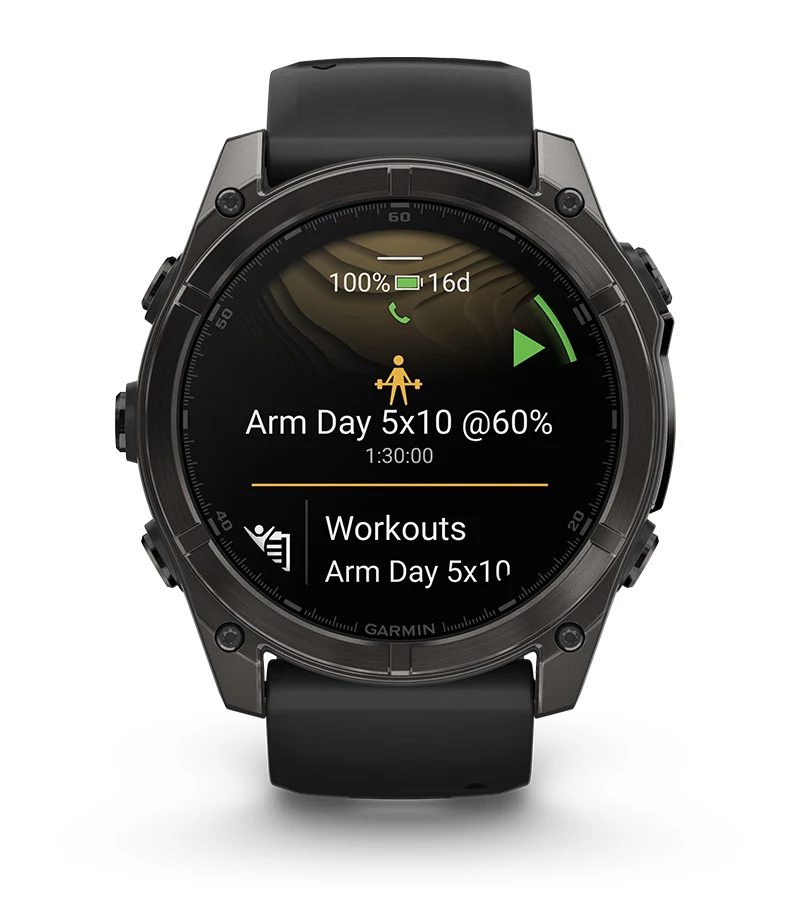
Where the Fenix 8 pulls ahead: advanced strength training features with muscle maps showing which muscle groups you've targeted during workouts, plus structured 4-6 week strength training plans. The Fenix 8 also includes enhanced dive mode with depth tracking to 40 meters for recreational scuba and apnea diving, complete with Buhlmann decompression algorithms — a feature the Enduro 3 lacks entirely.
Both handle multisport activities identically, auto-detecting transitions in triathlons. Both offer extensive sport profiles, animated workouts, and advanced run metrics like ground contact time and vertical oscillation.
Winner: Fenix 8 for strength training features and dive mode, but the Enduro 3 matches it for running, cycling, hiking, and general multisport use.
Smart Features & Connectivity: Fenix 8 Brings Voice to Your Wrist
The Fenix 8 includes a built-in speaker and microphone — features completely absent from the Enduro 3. This enables Bluetooth phone calls directly from your wrist, voice commands to control watch functions (set timers, start activities, save locations), and voice note recording with geotagging for documenting trail observations or reminders.
Both watches support smart notifications, music storage (up to 32GB), Garmin Pay contactless payments, and Connect IQ app downloads. Both sync with the Garmin Connect app for detailed training analysis. Neither watch has cellular connectivity — you'll need your phone nearby for calls and notifications.
Both have a built-in LED flashlight with variable brightness, red mode, and strobe — genuinely useful for nighttime navigation or finding gear in your tent.
Winner: Fenix 8 — the speaker and microphone add meaningful daily convenience that the Enduro 3 can't match.
Navigation & GPS: Dead Heat
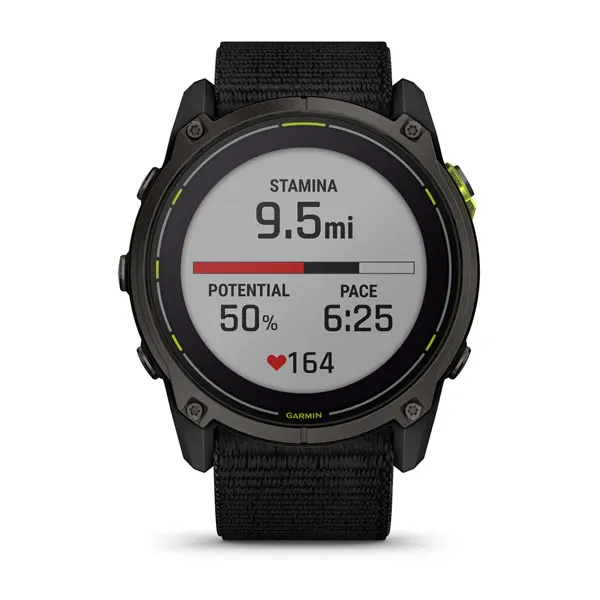
Both watches use the same multi-band GPS chipset with support for GPS, GLONASS, Galileo, BeiDou, and QZSS satellite systems. Both include SatIQ technology, which intelligently switches between single-band and multi-band GPS to balance accuracy and battery life. GPS accuracy is essentially identical — both track within fractions of a mile of each other over marathon distances.
Both come with preloaded TopoActive maps worldwide, NextFork map guide for trail intersections, turn-by-turn navigation, and ClimbPro ascent planner. Both support dynamic round-trip routing and 32GB of internal storage for music and additional maps. Both offer preloaded maps for thousands of golf courses and over 2,000 ski resorts.
The only practical difference: the Fenix 8's AMOLED makes viewing maps more pleasant indoors and in low light, while the Enduro 3's MIP display wins on the bright trail.
Winner: Tie — identical navigation capabilities.
Build Quality & Comfort: Enduro 3 Disappears on Your Wrist
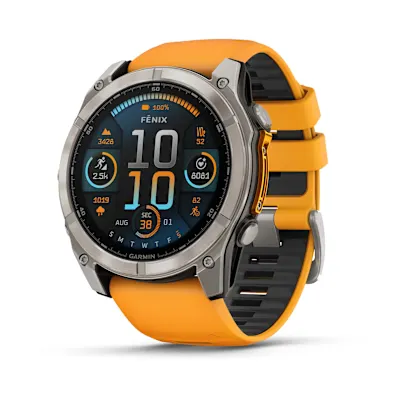
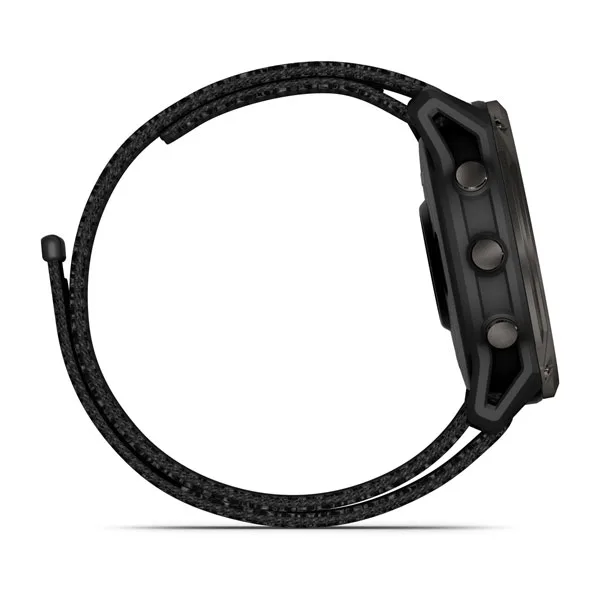
The Enduro 3 weighs just 63 grams with its UltraFit nylon band. The 51mm Fenix 8 AMOLED weighs roughly 95 grams with its silicone band, and even the 43mm model comes in at around 60g before the band.
On your wrist, the Enduro 3 disappears. The lightweight nylon UltraFit band is more breathable, easier to micro-adjust, and less prone to skin irritation than the Fenix 8's silicone QuickFit bands. For all-day and overnight wear during multi-day adventures, the Enduro 3 is noticeably more comfortable.
Both watches use a titanium bezel and sapphire crystal lens. The Enduro 3 has a fiber-reinforced polymer case back to save weight, while the Fenix 8 uses a titanium or stainless steel back depending on the model. Both are rated to 10 ATM water resistance (100 meters), though only the Fenix 8 adds dive computer functionality.
The Fenix 8 comes in three sizes (43mm, 47mm, 51mm), multiple case materials (titanium, stainless steel), various colorways, and both AMOLED and Solar display options. The Enduro 3 comes in exactly one configuration: 51mm titanium with MIP display. If you have a smaller wrist or want customization, the Fenix 8 wins. If you want the lightest, most comfortable option for ultra-distance events, the Enduro 3 takes it.
Winner: Enduro 3 for weight and comfort; Fenix 8 for customization and size options.
Price & Value: Enduro 3 Delivers More for Less
The Enduro 3 costs $899. The Fenix 8 starts at $999 for the 43mm AMOLED, $1,100 for the 47mm (AMOLED or Solar), and $1,200 for the 51mm (AMOLED or Solar).
The Enduro 3 costs $100-$300 less than comparable Fenix 8 models, yet includes nearly identical GPS, training, and navigation features. You sacrifice the AMOLED display, voice features, dive mode, and strength training muscle maps. In return, you gain vastly superior battery life, lighter weight, and a more comfortable band.
The Fenix 8 justifies its higher price if you genuinely need AMOLED, voice calls, dive tracking, or the full range of smart features. But for pure outdoor performance — trail running, ultramarathons, thru-hiking, bikepacking — the Enduro 3 delivers better battery life and equal GPS/training features for less money.
Winner: Enduro 3 — better value for outdoor athletes; Fenix 8 justified only if you'll actually use its exclusive features.
Who Should Buy the Enduro 3
Buy the Enduro 3 if you're an ultra-distance athlete or serious outdoor adventurer who prioritizes battery life above all else. Ultrarunners, thru-hikers, bikepacking cyclists, and multi-day adventure racers will appreciate going weeks between charges. The lightweight design and comfortable nylon band make it ideal for 24/7 wear during expeditions.
The Enduro 3 is also the smarter choice if you prefer always-on displays with excellent outdoor readability, don't need voice features or dive mode, and want to save $100-$300 compared to a similarly-equipped Fenix 8.
Who Should Buy the Fenix 8
Choose the Fenix 8 if you want the most versatile Garmin watch with cutting-edge features. The AMOLED display makes indoor use, menu navigation, and map viewing dramatically better. Voice calls, voice commands, and dive mode expand what the watch can do beyond pure fitness tracking.
The Fenix 8 is ideal for multisport athletes who want one watch for everything: trail running, road cycling, gym workouts with strength tracking, scuba diving, and daily smart features. It's also the right choice if you have a smaller wrist (43mm or 47mm options), want customization (multiple sizes, materials, colors), or simply want Garmin's absolute flagship with every feature packed in.
If you charge your watch weekly anyway and value a beautiful display and smart features over extreme battery life, the Fenix 8 AMOLED is worth the premium.
Our Verdict
The Enduro 3 wins for dedicated outdoor athletes. The battery life advantage is game-changing for ultra-distance events and multi-day adventures. You get 95% of the Fenix 8's outdoor features for $100-$300 less, in a lighter, more comfortable package. For trail runners, ultramarathoners, and backcountry explorers, the Enduro 3 is the smarter buy.
But the Fenix 8 AMOLED is the better all-around smartwatch for everyday athletes who want one device for everything. The AMOLED display genuinely improves the user experience. Voice features add daily convenience. Dive mode and enhanced strength training expand capabilities. If you'll actually use these features, the Fenix 8 justifies its higher price.
The Fenix 8 Solar models occupy an awkward middle ground — priced at $1,100-$1,200 compared to the Enduro 3's $899, they offer worse battery life and lack the AMOLED's visual appeal. Unless you specifically need dive mode or voice features, the Enduro 3 beats the Fenix 8 Solar on value.
Bottom line: Buy the Enduro 3 if outdoor performance and battery life matter most. Buy the Fenix 8 AMOLED if you want the best all-around smartwatch with cutting-edge features. Either way, you're getting one of the most capable GPS watches ever made.
Specs At A Glance
Garmin Enduro 3 - Display: 1.4" MIP, 280 x 280 pixels, always-on - Battery: Up to 90 days smartwatch (solar), 320 hours GPS (solar) - Weight: 63g with nylon band - Water resistance: 10 ATM (100m) - GPS: Multi-band (GPS, GLONASS, Galileo, BeiDou, QZSS) - Heart rate: Gen 5 Elevate optical sensor, ECG - Maps: Preloaded TopoActive worldwide, 32GB storage - Flashlight: Built-in LED with red/strobe modes - Price: $899
Garmin Fenix 8 (51mm AMOLED) - Display: 1.4" AMOLED, 454 x 454 pixels - Battery: Up to 29 days smartwatch, 84 hours GPS (gesture) - Weight: ~95g with silicone band - Water resistance: 10 ATM (100m), dive mode to 40m - GPS: Multi-band (GPS, GLONASS, Galileo, BeiDou, QZSS) - Heart rate: Gen 5 Elevate optical sensor, ECG - Maps: Preloaded TopoActive worldwide, 32GB storage - Flashlight: Built-in LED with red/strobe modes - Voice: Speaker, microphone, voice commands - Price: $1,200 (43mm AMOLED: $999, 47mm: $1,100)