
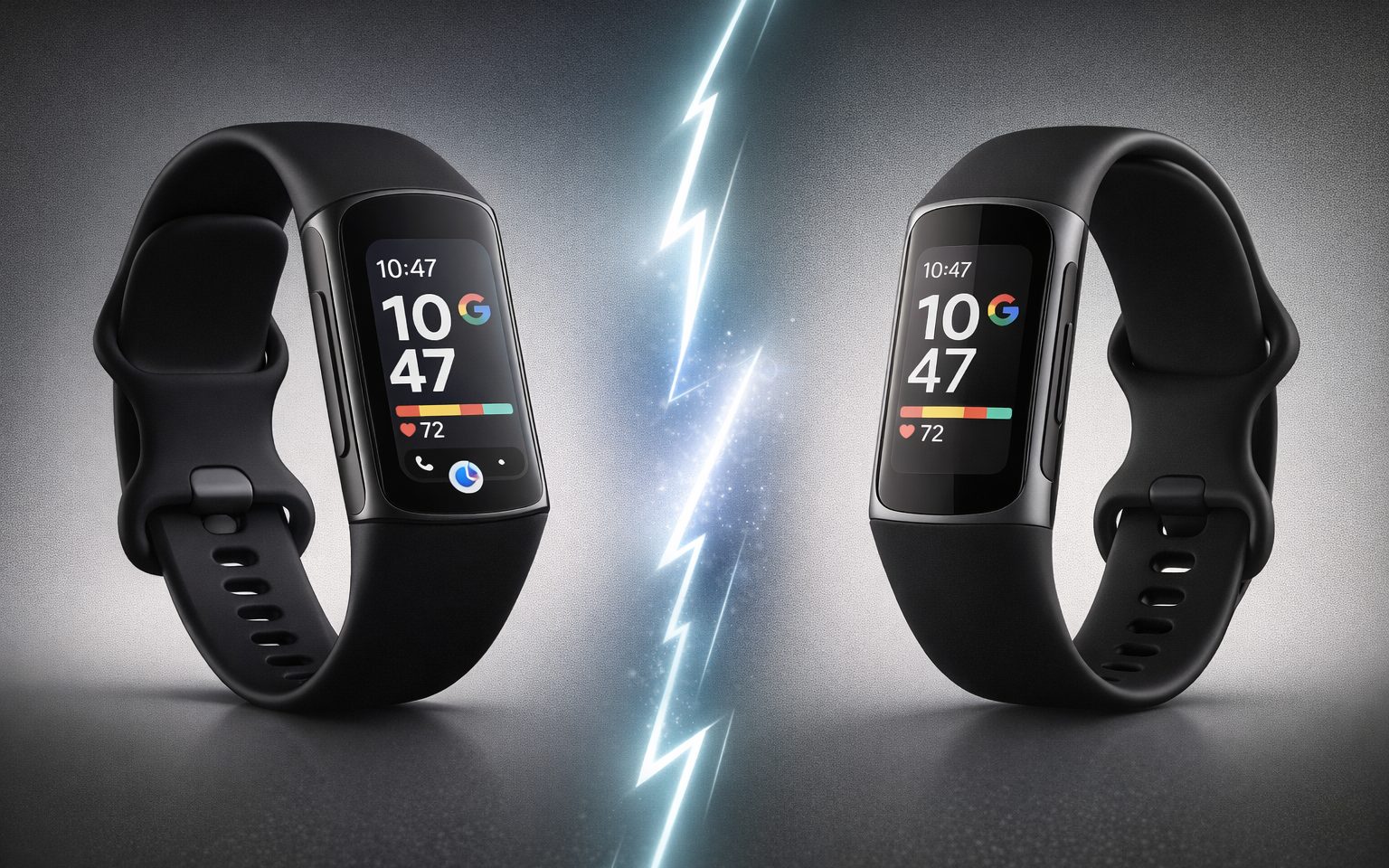
Fitbit does not release a new Charge tracker every year, so when the Charge 6 arrived in October 2023 as a successor to the 2021 Charge 5, the two-year gap between them raised an obvious question: is the newer model a meaningful upgrade, or just a spec-sheet refresh with Google branding?
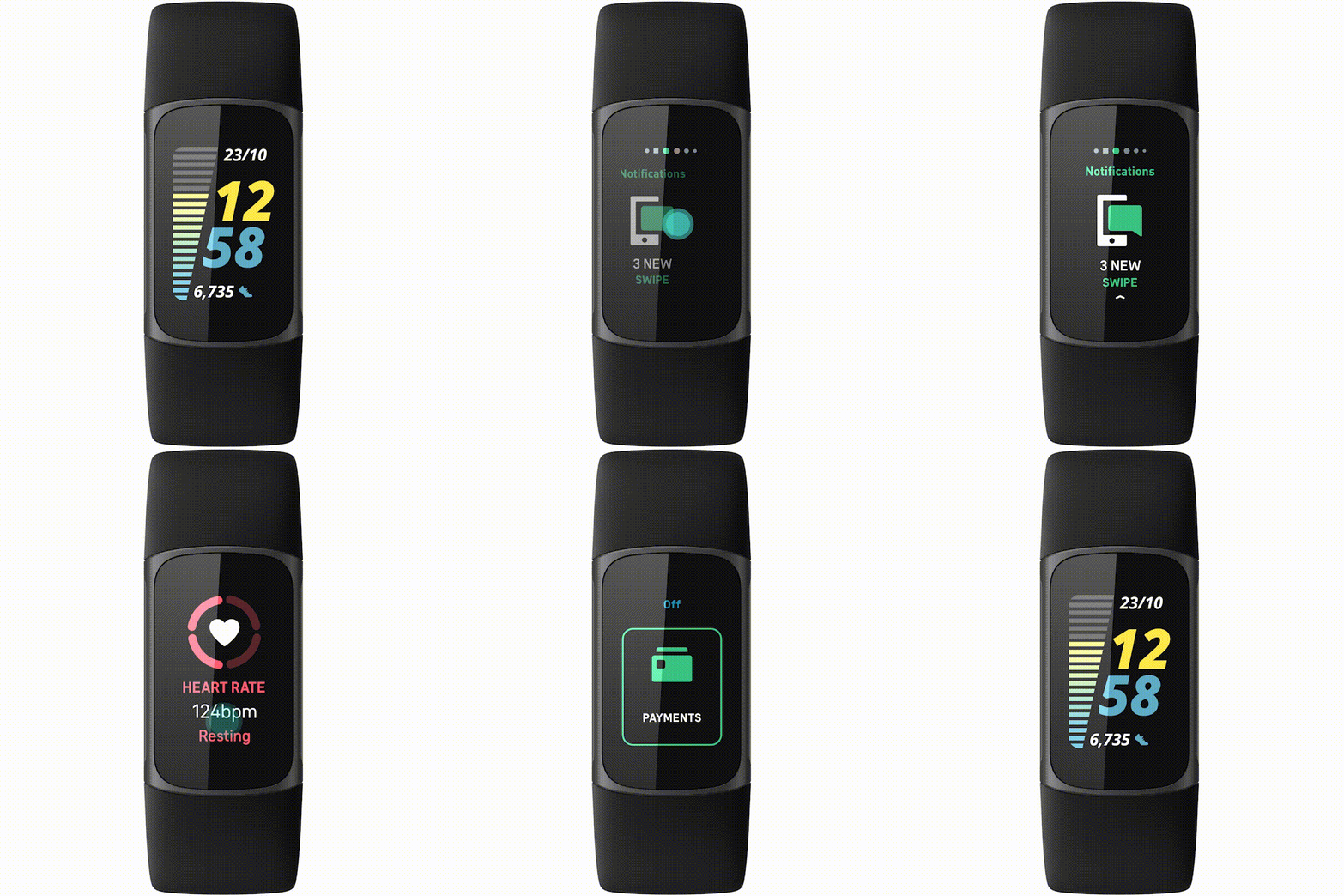

The answer matters because both trackers still show up at similar price points in 2026. The Charge 5, now discontinued, floats around $80 to $120 on remaining stock. The Charge 6 regularly drops to $99 during sales. With that kind of overlap, it is tempting to grab whichever one is cheapest. That would be a mistake. These two trackers share the same display and the same health sensor suite, but the differences between them are more significant than the spec sheets suggest — and they all tilt in one direction.
Heart Rate Accuracy
The Charge 5 uses Fitbit's standard optical heart rate sensor. It handles steady-state cardio reasonably well — walking, jogging, cycling at a consistent pace — but falls apart during high-intensity interval training, circuit work, or anything involving rapid changes in effort. The sensor simply cannot keep up with fast heart rate swings, which is a problem for the growing number of people doing HIIT, CrossFit, or boot camp-style workouts.
The Charge 6 uses the same optical hardware but runs Google's updated heart rate algorithms. Fitbit claims a 60 percent improvement in accuracy during vigorous exercise. The real-world improvement is closer to 40 percent, which is still substantial. Heart rate readings during intervals and high-effort bursts track noticeably closer to a chest strap reference. There is still some lag when switching between intensities quickly, and neither device will match a dedicated Polar or Garmin chest strap, but the Charge 6 is meaningfully better where it counts most.
Edge: Charge 6. The algorithmic improvements make a real difference during the kinds of workouts where heart rate accuracy matters most.
Controls and Navigation
This is the single most universally criticized aspect of the Charge 5. Fitbit removed the physical button entirely and went with a touchscreen-only interface. Swiping through menus, starting workouts, and navigating the interface with wet or sweaty fingers is genuinely frustrating. The Charge 4 had a physical button; removing it was a meaningful step backward.
The Charge 6 brought back a physical haptic side button. The combination of touch navigation plus a tactile button for confirming selections and pausing workouts makes the device dramatically easier to use, especially mid-exercise. It is a small hardware change that transforms the daily experience.
Edge: Charge 6. The return of the physical button is not a nice-to-have — it is a fundamental usability fix.
Fitness and Workout Features
The Charge 5 offers 20 exercise modes. The Charge 6 doubles that to over 40, covering everything from HIIT and weightlifting to dance, martial arts, and outdoor rowing. More importantly, all 40-plus modes are accessible directly on the device. The Charge 5 only let you access roughly six modes from the tracker itself, requiring the app to configure the rest.
The Charge 6 also introduces Bluetooth heart rate broadcasting — the ability to beam your live heart rate to compatible gym equipment like Peloton bikes, NordicTrack treadmills, and Tonal machines. This eliminates the need for a separate chest strap at the gym, and it is a feature typically found on more expensive sports watches. Gym-goers who want their heart rate displayed on equipment screens will find this alone worth the upgrade. The Charge 5 does not support heart rate broadcasting at all.
Edge: Charge 6. Double the workout modes and heart rate broadcasting to gym equipment. The fitness feature gap is wide.
Smart Features and Google Integration
The Charge 5 launched before Google's acquisition of Fitbit had fully integrated into the product line. It originally supported Fitbit Pay for contactless payments (since migrated to Google Wallet) and displays phone notifications, but that is about it for smart functionality. No Google apps, no music controls (Fitbit actually removed Spotify support that the Charge 4 had), and no navigation.
The Charge 6 represents the first true Google-Fitbit integration on a band tracker. Google Wallet replaces Fitbit Pay for tap-to-pay. Google Maps delivers turn-by-turn navigation on the wrist — limited by the small screen, but functional for walking directions. YouTube Music lets you control playback on your phone from the tracker. These are genuine quality-of-life improvements that make the Charge 6 feel like a more complete daily wearable rather than just a fitness tool.
Neither device has a microphone or speaker, so there are no calls or voice commands on either one. If you want those features, the Fitbit Versa 4 is the place to look.
Edge: Charge 6. Google Wallet, Maps, and YouTube Music control add practical daily utility the Charge 5 simply does not have.

Display and Design
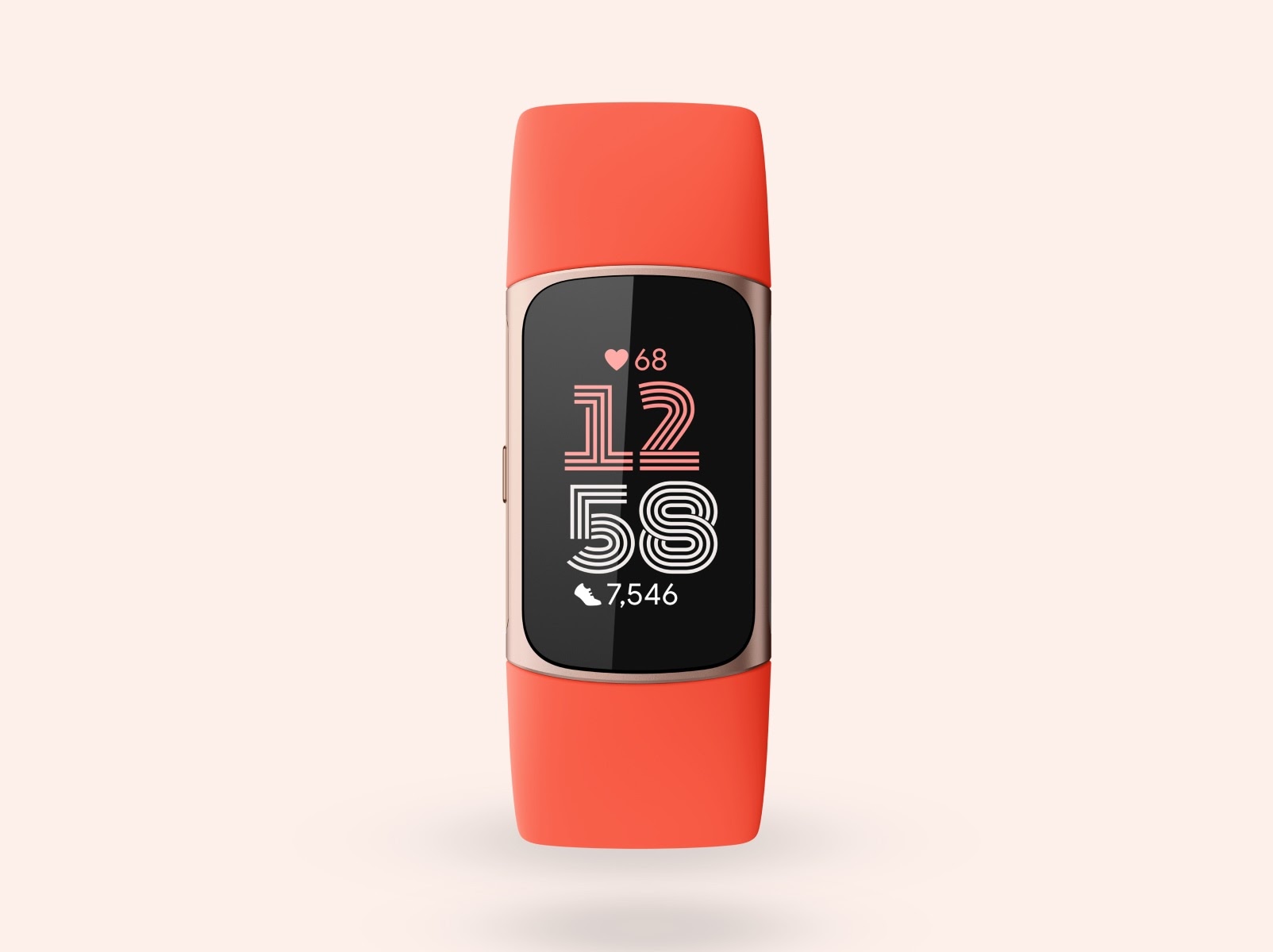
Here is where these two trackers are nearly identical. Both feature a 1.04-inch AMOLED display with always-on display support. The screens look the same, perform the same, and have the same limitations — vivid colors and sharp contrast for a band tracker, but small enough that reading notifications or detailed workout data requires scrolling and squinting.
Physically, the two trackers are nearly identical in size and weight. Both weigh around 30 grams with a band, use Fitbit's proprietary infinity band system, and are water resistant to 50 meters (5 ATM). The Charge 6's case is made from 100 percent recycled aluminum, a minor materials improvement, and the bands are cross-compatible between the two models.
In practice, these two trackers look and feel almost interchangeable on the wrist.
Edge: Tie. Same display, nearly identical dimensions. Neither has a meaningful design advantage.
Battery Life
Both trackers claim seven days of battery life. Real-world performance tells a more nuanced story.
The Charge 5 typically delivers five to six days with standard use — 24/7 heart rate monitoring, sleep tracking, and a few GPS workouts per week. Turn on the always-on display and expect two to three days.
The Charge 6 edges ahead with five to seven days in standard mode. More notably, it handles the always-on display more efficiently, stretching to three to five days with AOD active. That extra day or two with the screen always visible is a meaningful difference for people who want to check the time without flicking their wrist.
Both devices drain battery aggressively during GPS-tracked workouts. Fitbit rates about five hours of continuous GPS use on a full charge, so plan accordingly. Charging takes about two hours on both via their proprietary magnetic chargers.
Edge: Charge 6 (marginal). Slightly better battery life overall, with a more noticeable advantage when using the always-on display.
GPS
This is the elephant in the room, and it deserves an honest assessment: GPS is poor on both devices.
The Charge 5 has built-in GPS, but a fundamental design flaw undermines it. Wearing the band tight enough for accurate heart rate readings partially blocks the GPS antenna, degrading signal quality. Loosen the band for better GPS and heart rate accuracy suffers. You cannot optimize for both simultaneously. GPS lock is slow, tracks are erratic, and distance readings are unreliable for anything beyond rough estimates.
The Charge 6 inherits the same problem. Despite two years of development, the GPS/band-tightness tradeoff was not resolved. Both trackers also support connected GPS — using your phone's GPS signal instead — which is more accurate but defeats the purpose of built-in GPS. For casual use, connected GPS works fine. For runners who want to leave their phone behind, neither Charge tracker is the right tool.
If GPS accuracy is a priority, a dedicated running watch from Garmin or COROS will serve you far better. Both Charge trackers are gym and daily activity devices first, GPS devices a distant second.
Edge: Tie (both poor). Neither tracker delivers reliable standalone GPS. Use connected GPS with your phone if distance accuracy matters.
Health Sensors
The sensor suites are identical. Both trackers include:
- Optical heart rate monitoring (24/7)
- FDA-cleared ECG for atrial fibrillation detection
- EDA (electrodermal activity) sensor for stress management
- SpO2 blood oxygen monitoring
- Skin temperature sensing
- Sleep tracking with sleep stages
The difference is not what sensors are present, but how well they perform. The Charge 6's improved heart rate algorithms make the shared optical sensor more useful during exercise, as covered above. The ECG, EDA, SpO2, and skin temperature sensors function identically on both devices.
Both trackers also lock several advanced health insights behind Fitbit Premium at $9.99 per month after an initial six-month trial. Daily Readiness Score, detailed sleep analysis, and guided wellness programs all require the subscription. This is equally frustrating on both devices, and it is worth factoring the ongoing cost into any purchase decision. For more on what you get at every price tier in the fitness tracker market, check out our best budget fitness trackers under $100 guide.
Edge: Tie. Identical sensor hardware. The Charge 6's software advantage in heart rate accuracy is covered in its own category above.


Value and Pricing
The Charge 5 launched at $179.95. The Charge 6 launched at $159.95 — twenty dollars cheaper for a better product. That pricing dynamic is unusual in consumer electronics, where new generations almost always cost the same or more.
In 2026, the gap has narrowed on the street. The Charge 5, now discontinued, sells for roughly $80 to $120 where remaining stock exists. The Charge 6 regularly hits $99 during sales and sits between $99 and $130 at most retailers. At the $99 price point, the Charge 6 is one of the strongest values in the fitness tracker market.
But the pricing comparison obscures a more important point: the Charge 5 is a discontinued product. Fitbit is no longer manufacturing it, and software support has an expiration date. Buying a Charge 5 in 2026 means buying a device that is already at end-of-life, with no guarantee of future firmware updates or bug fixes. The Charge 6 remains the current-generation Charge tracker with active software support.
Even if you find a Charge 5 for $60 or $70, the Charge 6 at $99 is a better use of that money. The feature improvements are too significant and the price gap too small to justify buying discontinued hardware.
Edge: Charge 6. Better in every category AND cheaper at MSRP. At current street prices, the small savings on a discontinued Charge 5 are not worth the tradeoffs.
Who Should Buy What
Get the Fitbit Charge 6 if you:
- Want the best band-style fitness tracker available under $150
- Work out at the gym and want heart rate broadcasting to equipment
- Do HIIT, intervals, or any high-intensity training where heart rate accuracy matters
- Want Google Wallet, Maps, and YouTube Music on your wrist
- Prefer a physical button for workout navigation
- Are looking for a reliable daily tracker with strong sleep and health monitoring
Consider the Fitbit Charge 5 only if you:
- Find one for under $60 and understand it is end-of-life
- Need a basic daily activity and sleep tracker and nothing more
- Are comfortable with a device that will not receive future software updates
Skip both and look elsewhere if you:
- Need accurate GPS for running or cycling (consider Garmin or COROS)
- Want a large, readable display (consider the Fitbit Versa 4 or a smartwatch)
- Refuse to pay for Fitbit Premium and want full features included with your hardware
Our Verdict
The Fitbit Charge 6 is the clear winner — and it is not particularly close.
This is a rare generational upgrade where the newer product is better in every functional category and costs less than the device it replaced. The Charge 6 delivers meaningfully improved heart rate accuracy, double the workout modes, heart rate broadcasting to gym equipment, Google app integration, a physical button that fixes the Charge 5's most frustrating flaw, and slightly better battery life. It does all of this at a lower MSRP and a street price that frequently hits $99.
The Charge 5 was a strong tracker when it launched in 2021. It introduced ECG and EDA sensors to the Charge line and brought a color AMOLED display to the band form factor for the first time. Those were meaningful innovations. But the Charge 6 kept everything good about the Charge 5, fixed its biggest problems, added features the Charge 5 never had, and dropped the price. With the Charge 5 now discontinued and the Charge 6 available for under $100, there is no scenario where the older tracker is the smarter purchase.
The bigger question for budget-conscious shoppers is not whether to choose the Charge 6 over the Charge 5 — that answer is obvious. It is whether the Charge 6 at $99 justifies itself against even cheaper alternatives from Xiaomi or Samsung. For anyone who values accurate health sensors, a mature fitness ecosystem, and Google integration in a comfortable band form factor, it does.
Specs At A Glance
| Spec | Fitbit Charge 5 | Fitbit Charge 6 |
|---|---|---|
| MSRP | $179.95 | $159.95 |
| Street Price (2026) | ~$80-$120 (discontinued) | ~$99-$130 (often $99) |
| Release Date | September 2021 | October 2023 |
| Status | Discontinued | Current |
| Display | 1.04" AMOLED | 1.04" AMOLED |
| Physical Button | No | Yes (haptic side button) |
| Heart Rate Sensor | Standard Fitbit optical | Google-improved algorithms |
| ECG | Yes | Yes |
| EDA Stress Sensor | Yes | Yes |
| SpO2 | Yes | Yes |
| GPS | Built-in + connected | Built-in + connected |
| Exercise Modes | 20 | 40+ |
| HR Broadcasting | No | Yes (Bluetooth) |
| NFC Payments | Google Wallet (migrated from Fitbit Pay) | Google Wallet |
| Google Maps | No | Yes |
| YouTube Music | No | Yes (control only) |
| Battery Life | 5-6 days (2-3 AOD) | 5-7 days (3-5 AOD) |
| Water Resistance | 5 ATM | 5 ATM |
| Weight | ~30g (with band) | ~30g (with band) |
| Compatibility | iOS 16.4+, Android 11+ | iOS 16.4+, Android 11+ |