
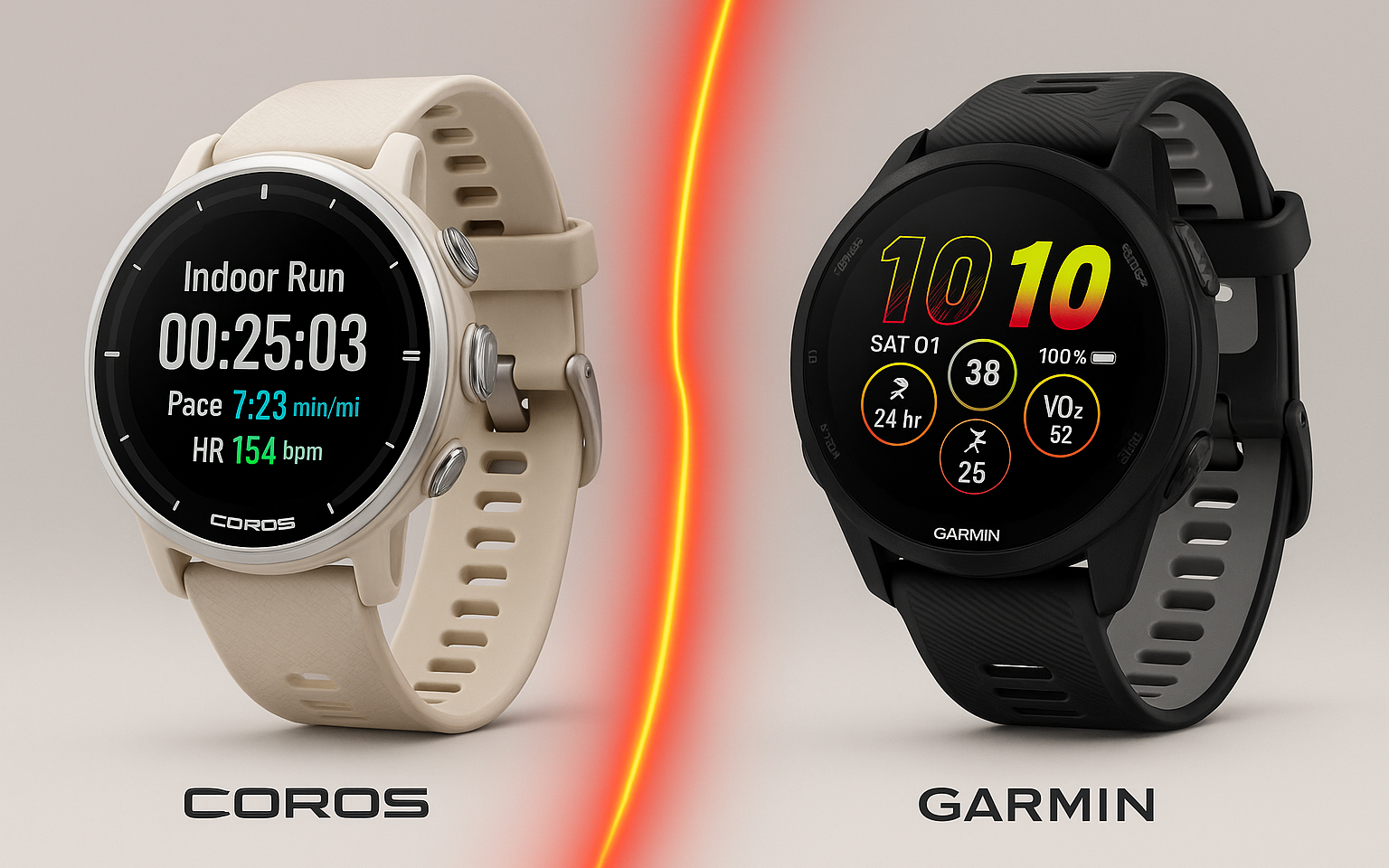
The COROS Pace Pro and Garmin Forerunner 265 represent two fundamentally different philosophies in the sub-$450 running watch market. The COROS, now permanently priced at $299 following a November 2025 price drop, makes a compelling case as the budget champion with offline maps, extreme battery life, and the brightest AMOLED display in its class. The Garmin, holding steady at $449.99, counters with a more polished ecosystem, music streaming, contactless payments, and the kind of refined user experience that has made Garmin the default choice for serious runners.

On paper, these watches look remarkably similar. Both pack 1.3-inch AMOLED displays with 416 x 416 resolution (standard 46mm FR265), both offer dual-frequency GPS for multiband accuracy, and both deliver the training metrics that modern runners expect. But spend a week with each, and the differences become impossible to ignore. The COROS is the ultralight minimalist that goes the distance without complaint. The Garmin is the sophisticated all-rounder that integrates seamlessly into your digital life.
The real question is not which watch has better specs. It is whether Garmin's premium justifies a 50% price increase over a watch that delivers comparable--and in some cases superior--core running functionality. For runners focused purely on training data, GPS accuracy, and battery life, the answer depends entirely on whether you view your watch as a training tool or a daily wearable.
Key Differences
Display: Brightness vs Polish
Both watches feature 1.3-inch, 416 x 416 AMOLED displays (comparing the standard 46mm Forerunner 265; the smaller 265S uses a 1.1-inch, 360 x 360 panel), but COROS makes a statement with 1,500 nits of peak brightness--among the brightest sports watches available. In direct sunlight, the Pace Pro remains perfectly readable without squinting. The tradeoff? Mineral glass instead of Garmin's more scratch-resistant Gorilla Glass 3, and watch faces that lack the visual polish of Garmin's offerings.
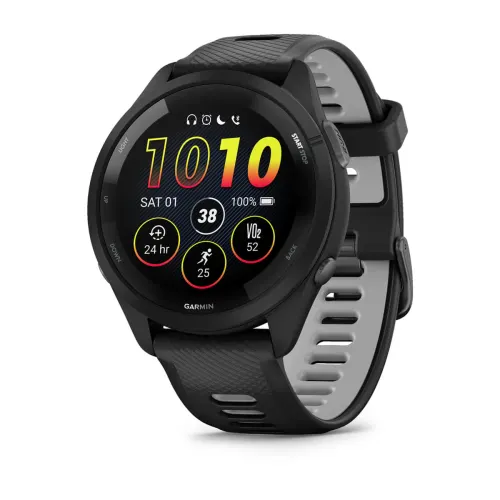
The Forerunner 265's display does not match the Pace Pro's raw brightness specs, but it compensates with a more responsive touchscreen interface and richer watch face options. Garmin's UI feels snappier when swiping through widgets, and the overall aesthetic is more refined. Both watches offer always-on display modes, though activating this feature cuts battery life significantly on the Garmin (down to roughly 5 days) while the COROS still manages 6 days.
For outdoor visibility in harsh lighting conditions, the COROS wins decisively. For everyday usability and visual appeal, the Garmin edges ahead.
Battery Life: COROS Dominates
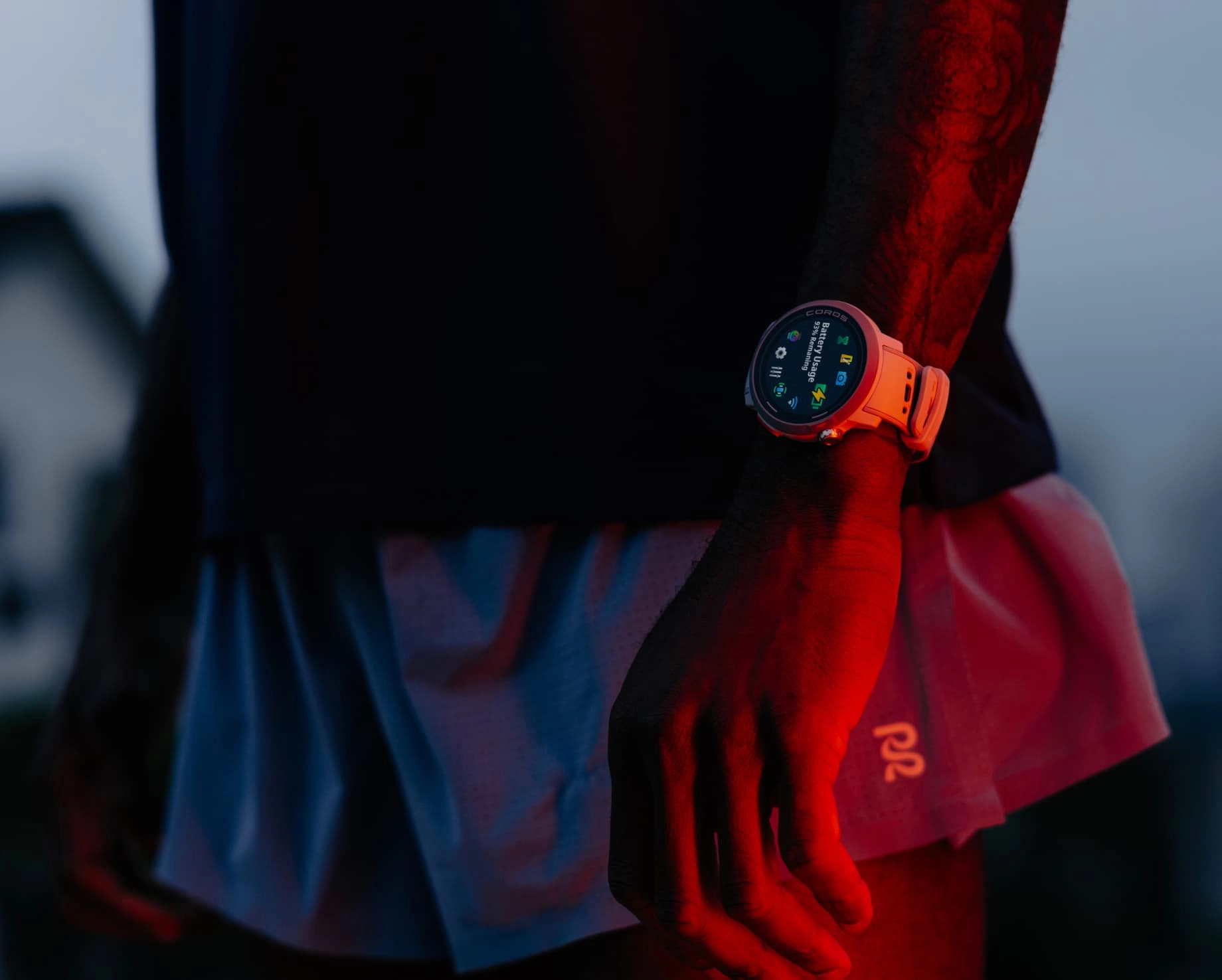
This is where the Pace Pro separates itself from nearly every AMOLED competitor. COROS claims up to 20 days in standard smartwatch mode and up to 38 hours of GPS tracking in all-systems mode. Real-world testing confirms these are not marketing exaggerations--DC Rainmaker logged approximately 4 days with always-on display enabled and heavy GPS use, conservative compared to COROS's claims, but still impressive.
The Forerunner 265 manages up to 13 days in smartwatch mode (standard 46mm; up to 15 days for the 265S) and up to 14 hours in multiband GPS mode. With always-on display, expect closer to 5 days. These numbers are respectable by AMOLED standards, but the COROS lasts nearly twice as long in GPS mode.
For ultrarunners, adventure racers, or anyone who resents frequent charging, the Pace Pro's endurance is transformative. Weekend warriors will not notice the difference--both watches easily survive a week of normal training--but for heavy users, COROS's battery engineering is exceptional.
GPS and Heart Rate Accuracy: A Virtual Tie
Both watches deliver excellent GPS accuracy thanks to dual-frequency/multiband support. In Tom's Guide's head-to-head 10K race test, the COROS Pace Pro tracked closer to the official course distance, with lap alerts hitting nearer to course markers than the Garmin. DC Rainmaker's extensive GPS testing found both watches performed solidly on running and trail routes, with only minor deviations on technical trails.
Heart rate accuracy is more situational. The COROS occasionally reads high at the start and end of runs, while the Garmin can read low during sustained efforts. For cycling, the Pace Pro's optical sensor falters significantly--DC Rainmaker called it "one of the worst optical HR performances" he had seen in 2024, blaming road vibrations and hand position. The Forerunner 265 handles cycling better but still trails dedicated chest straps.
For running-focused athletes, both watches deliver trustworthy data, with the COROS showing a slight edge in course-distance accuracy in head-to-head testing. Serious cyclists should pair either watch with a chest strap for reliable heart rate tracking.
Navigation: Offline Maps vs Breadcrumbs
The COROS Pace Pro delivers a feature almost unheard of at $299: offline color topographical maps. These are not routable--the watch will not recalculate directions if you stray--but they provide crucial visual context for trail navigation. If you leave the trail, the Pace Pro gives you an off-course warning and uses a compass to point you back.
The Forerunner 265 offers only breadcrumb navigation: a simple trail line on a blank screen. No background map, no terrain features, just a digital Hansel and Gretel trail. For road runners following pre-planned routes, this works fine. For trail runners and hikers, the COROS's maps are a game-changer.
Offline maps on the Pace Pro are not as sophisticated as what you will find on the Garmin Forerunner 965 or Fenix series, but at $299, having them at all is remarkable.
Training Features: Different Approaches to the Same Goal
Both watches deliver comprehensive training metrics, but with different philosophies. The COROS Pace Pro offers EvoLab, a suite of tools including training load, VO2 max estimates, race predictions, and recovery recommendations. The data is rich and detailed, but accessing and interpreting it requires more manual digging through menus.
Garmin's Training Readiness feature takes a more automated approach, synthesizing training load, sleep quality, stress, and recovery into a single morning score that tells you whether you are ready for a hard workout or should dial it back. Daily workout suggestions adapt to your fitness level and goals. The presentation is cleaner and more intuitive.
For data-obsessed runners who enjoy analyzing every metric, COROS provides all the raw material you need. For runners who want actionable guidance without deep analysis, Garmin's Training Readiness delivers it without analysis paralysis. COROS rewards deeper engagement.
Smartwatch Features: Garmin's Clear Advantage
This is where the $150 price gap becomes most visible. The Forerunner 265 offers music streaming from Spotify, Amazon Music, Deezer, and YouTube Music directly on the watch. The COROS Pace Pro has 32GB of internal storage for MP3 files, but it only works with files dragged and dropped via computer--a workflow that feels like it belongs in 2010.
Garmin Pay enables contactless payments. The COROS has no NFC. Garmin's Connect IQ store provides third-party apps, widgets, and data fields. COROS's app ecosystem is virtually nonexistent. Notification handling is more refined on the Garmin, and safety features like incident detection and LiveTrack are better integrated.
If you want a watch that doubles as a capable smartwatch for everyday life, the Forerunner 265 is the only real choice here. The COROS is unapologetically a running and training device first, with smartwatch features as an afterthought.
Weight and Comfort: Ultralight vs Versatile
The COROS Pace Pro weighs just 37 grams with the nylon band, making it one of the lightest AMOLED sports watches available. The fiber-reinforced polymer case keeps weight down--it is not premium-feeling, but it is barely noticeable on the wrist during long runs.
The Garmin Forerunner 265 weighs 47 grams in the standard 46mm size, or 39 grams in the smaller 265S (42mm) variant. Both Garmin models are thicker and feel more substantial, though still comfortable. The Forerunner's fiber-reinforced polymer case has a slightly more premium feel than the COROS's construction.
For marathoners and ultrarunners who prioritize forgetting the watch exists, the Pace Pro's feather-light design is ideal. For runners who also want a watch they are proud to wear off the trail, the Forerunner looks more refined.
Price and Value: The Decision Maker
At $299 (permanent price as of November 2025), the COROS Pace Pro undercuts the Forerunner 265's $449.99 price tag by $150. That is a 50% premium for the Garmin. What does that $150 buy you? Music streaming. Contactless payments. A more polished UI. Better smartwatch integration. A more refined ecosystem.
What does it not buy you? Better GPS accuracy (both are excellent). Longer battery life (COROS wins decisively). Offline maps (exclusive to COROS in this price range). Lighter weight (COROS again).
For pure running performance per dollar, the COROS Pace Pro is extraordinary value. For a well-rounded sports watch that feels like a modern smartwatch, the Garmin justifies its premium.
Who Should Buy What
Buy the COROS Pace Pro if you: - Prioritize battery life above all else and hate charging devices - Run trails or unfamiliar routes where offline maps provide real value - Want the lightest possible watch for long-distance running - Care primarily about training data and GPS accuracy, not smartwatch features - Have $299 to spend and want maximum performance for the price - Do not need music streaming or contactless payments on your wrist
Buy the Garmin Forerunner 265 if you: - Want a watch that seamlessly integrates music streaming and payments - Value a polished, intuitive user interface and ecosystem - Prefer training guidance that is presented automatically (Training Readiness) - Need better cycling heart rate performance - Want access to third-party apps via Connect IQ - Are willing to pay $150 more for refinement and smartwatch capabilities - Already use other Garmin devices and want ecosystem continuity

Our Verdict
The COROS Pace Pro wins on pure running value. For $299, you get exceptional battery life, offline maps, dual-frequency GPS accuracy that matches watches twice its price, and the brightest display in its class. This is a watch built by runners, for runners, without compromise on the metrics that matter most for training. The trade-offs--no music streaming, basic smartwatch features, a utilitarian build--will not bother athletes who view their watch as a training tool first.
But the Garmin Forerunner 265 wins on overall user experience. The extra $150 buys you a watch that feels modern beyond the trail, with seamless music integration, refined software, and the kind of ecosystem polish that makes daily use genuinely pleasant. Training Readiness is more actionable than COROS's EvoLab for most runners, and the smartwatch features make the 265 a legitimate all-day wearable.
Here is the bottom line: if you are a serious runner focused on training data and long-distance performance, the COROS Pace Pro delivers unbeatable value at $299. It is the better running watch. But if you want a device that balances running excellence with modern smartwatch expectations, the Forerunner 265 justifies its premium. It is the better overall watch.
For budget-conscious runners, trail enthusiasts, and ultramarathoners, the Pace Pro is the clear winner. For runners embedded in the Garmin ecosystem, those who value convenience features like music and payments, or anyone who wants their running watch to double as a daily smartwatch, the Forerunner 265 is worth the extra $150.
The $150 question has two correct answers, depending on what kind of runner you are.
Specs At A Glance
COROS Pace Pro - Price: $299 - Display: 1.3" AMOLED, 416 x 416, 1,500 nits, mineral glass - Weight: 37g (nylon band) - Case: Fiber-reinforced polymer, 46mm - Battery: Up to 20 days smartwatch / 38h GPS (all-systems) / 6 days always-on - GPS: Dual-frequency, all satellite systems - Maps: Offline color topographical maps (non-routable) - Music: 32GB storage for MP3 files (no streaming) - Payments: None - Heart Rate: Optical sensor (struggles with cycling) - Training: EvoLab suite, VO2 max, race predictions, training load
Garmin Forerunner 265 - Price: $449.99 - Display: 1.3" AMOLED, 416 x 416, Gorilla Glass 3 - Weight: 47g (46mm) / 39g (42mm 265S) - Case: Fiber-reinforced polymer, 46mm or 42mm - Battery: Up to 13 days smartwatch (46mm) / 14h multiband GPS / ~5 days always-on - GPS: Dual-frequency SatIQ, multiband - Maps: Breadcrumb navigation only - Music: Spotify, Amazon Music, Deezer, YouTube Music streaming - Payments: Garmin Pay (NFC) - Heart Rate: Optical sensor with wrist-based running dynamics - Training: Training Readiness, daily workout suggestions, VO2 max, race predictions