
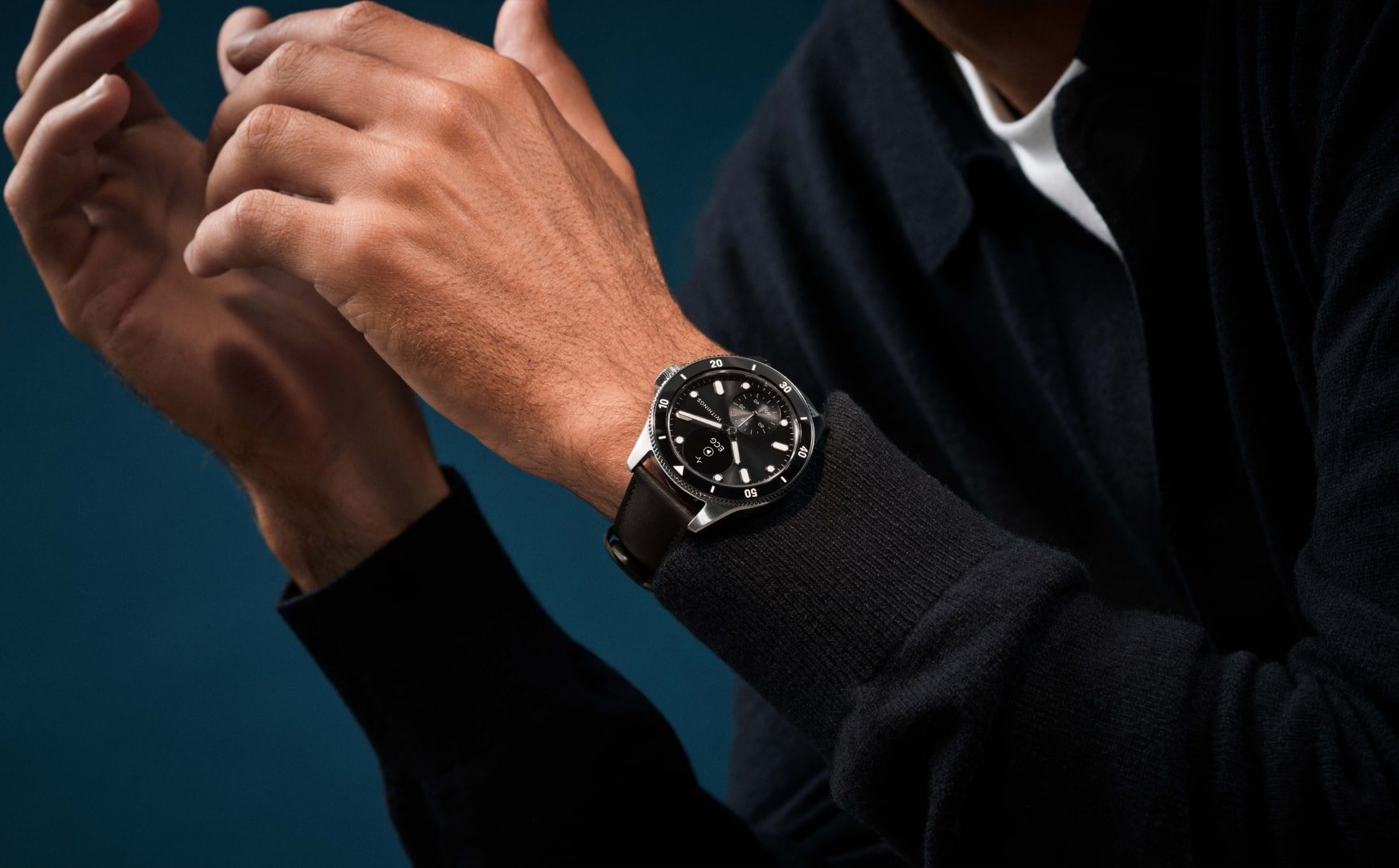
Most smartwatches announce themselves the moment you walk into a room. That glossy rectangular screen, the rubber sport band, the constant glow of notifications – they practically shout "I'm tracking you." The Withings ScanWatch Nova takes the opposite approach. It whispers. From across a table, it could easily pass for a $2,000 dive watch: polished stainless steel case, ceramic rotating bezel with laser-engraved dive markings, Super-LumiNova hands that glow a soft green in the dark. Only when you tilt your wrist and catch the tiny OLED sub-dial flickering to life does the secret slip out – this elegant 42mm timepiece is hiding an FDA-cleared ECG, a clinical-grade pulse oximeter, and a 24/7 skin temperature sensor behind that sapphire crystal.
At $499.95 to $599.95 (depending on color), the ScanWatch Nova sits in uncomfortable territory. It costs more than an Apple Watch SE and more than a Garmin Venu 3, yet it cannot run apps, take phone calls, or even find its way home without your phone's GPS. What it can do is monitor your cardiovascular health with genuine medical-grade accuracy, track your sleep with startling granularity, and last well over a month on a single charge – all while looking like something that belongs in a watch boutique rather than a Best Buy. The question is whether that trade-off is worth six hundred dollars.
Health & Fitness
Health monitoring is where the ScanWatch Nova justifies its existence and its price tag. The sensor array on the caseback includes a multi-wavelength PPG module with 16 optical channels for heart rate tracking, an FDA-cleared single-lead ECG for detecting atrial fibrillation, an SpO2 sensor built on Withings' clinically validated pulse oximetry platform (3.0% RMSE in UCSF Hypoxia Lab testing, beating the FDA's 3.5% threshold), and Withings' proprietary TempTech24/7 module combining four sensors for continuous skin temperature monitoring.
The ECG is the headline act. Navigate to ECG mode using the crown, then place your fingers on the stainless steel bezel for 30 seconds while the watch records a medical-grade single-lead electrocardiogram. The data syncs to the Withings app and can be exported as a PDF to share with your cardiologist. This is not a gimmick – it is a genuinely useful diagnostic tool.
Continuous heart rate tracking is reliable, aligning closely with chest strap readings during steady-state cardio. The SpO2 sensor performs well in controlled conditions, though on-demand spot checks occasionally return "inconclusive" readings – usually a strap-fit issue, but still frustrating when you are trying to get a quick number. The temperature sensor is more subtle in its utility: it tracks your baseline over days and weeks, flagging deviations that might indicate an oncoming illness or, for cycle tracking, ovulation patterns.
Sleep tracking is a genuine strength. The Nova detects light sleep, deep sleep, REM (including paradoxical sleep), and naps with impressive reliability. Respiratory disturbance tracking monitors your breathing patterns overnight and flags potential sleep apnea indicators. The sleep score and detailed breakdowns in the Withings app are among the best in the wearable space.
Where things falter is in active fitness tracking. The watch supports 40+ sport modes, but without built-in GPS, any outdoor run, ride, or hike depends on connected GPS from your phone. Auto-workout detection exists but is notoriously unreliable – it has a tendency to log casual walks as swims or cycling sessions. Step counting, however, is solid and tracks closely with iPhone pedometer data.
The bottom line: the ScanWatch Nova is a health tracker, not a fitness tracker. If your priority is monitoring your heart, blood oxygen, temperature, and sleep with clinical rigor, it is exceptional. If you want accurate pace splits for your morning 5K, look elsewhere.
Design & Build
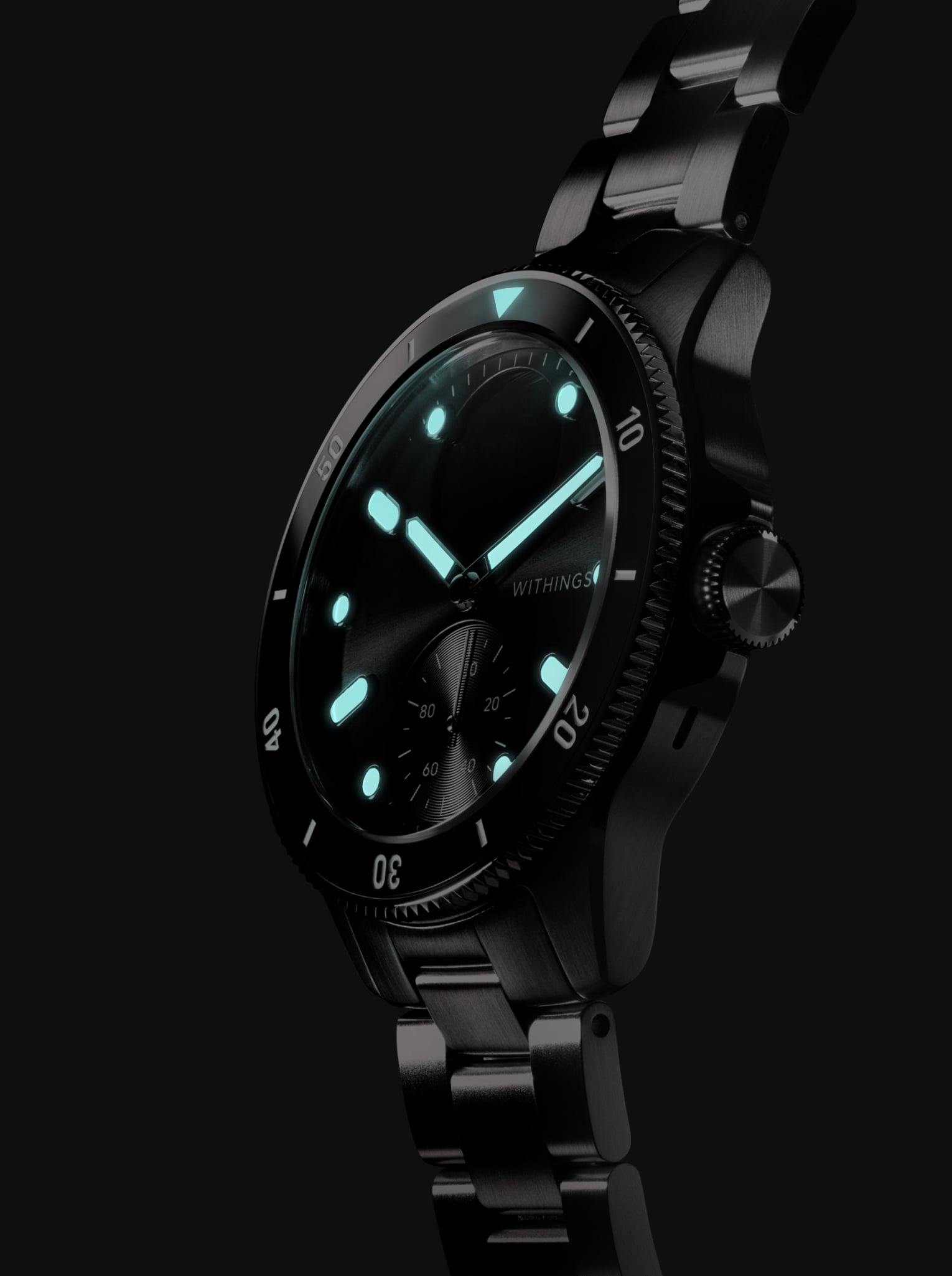
The ScanWatch Nova borrows its visual DNA from classic dive watches, and it borrows well. The 42mm stainless steel 316L case has mirror-polished edges that catch light at every angle. The ceramic-and-stainless-steel rotating bezel clicks with satisfying resistance and follows proper dive watch convention – it only turns counter-clockwise, so any accidental nudge shortens your tracked time rather than extending it. The sunray dial behind the anti-reflective sapphire glass shifts between dark charcoal and a warm grey depending on the light, and the raised indices and hollow hands all carry Super-LumiNova coating that glows softly in the dark.
At 63 grams without the strap and 12.79mm thick, the Nova has real wrist presence without feeling like a hockey puck. It ships with two bands: a stainless steel Oyster-style bracelet that tapers from 20mm to 18mm (complete with a link removal tool), and a fluoroelastomer (FKM) sport strap for workouts and sleep. Both use standard 20mm quick-release lugs, so third-party options are plentiful.
The 10ATM (100m) water resistance rating is not decorative. This is a genuine swim-and-snorkel watch, and wearing it in the shower or pool inspires zero anxiety. The one aesthetic letdown is the charger: a cheap plastic USB-C cradle that feels like it was borrowed from a $40 fitness band. At this price point, a magnetic puck or something with a bit of heft would have been more appropriate.
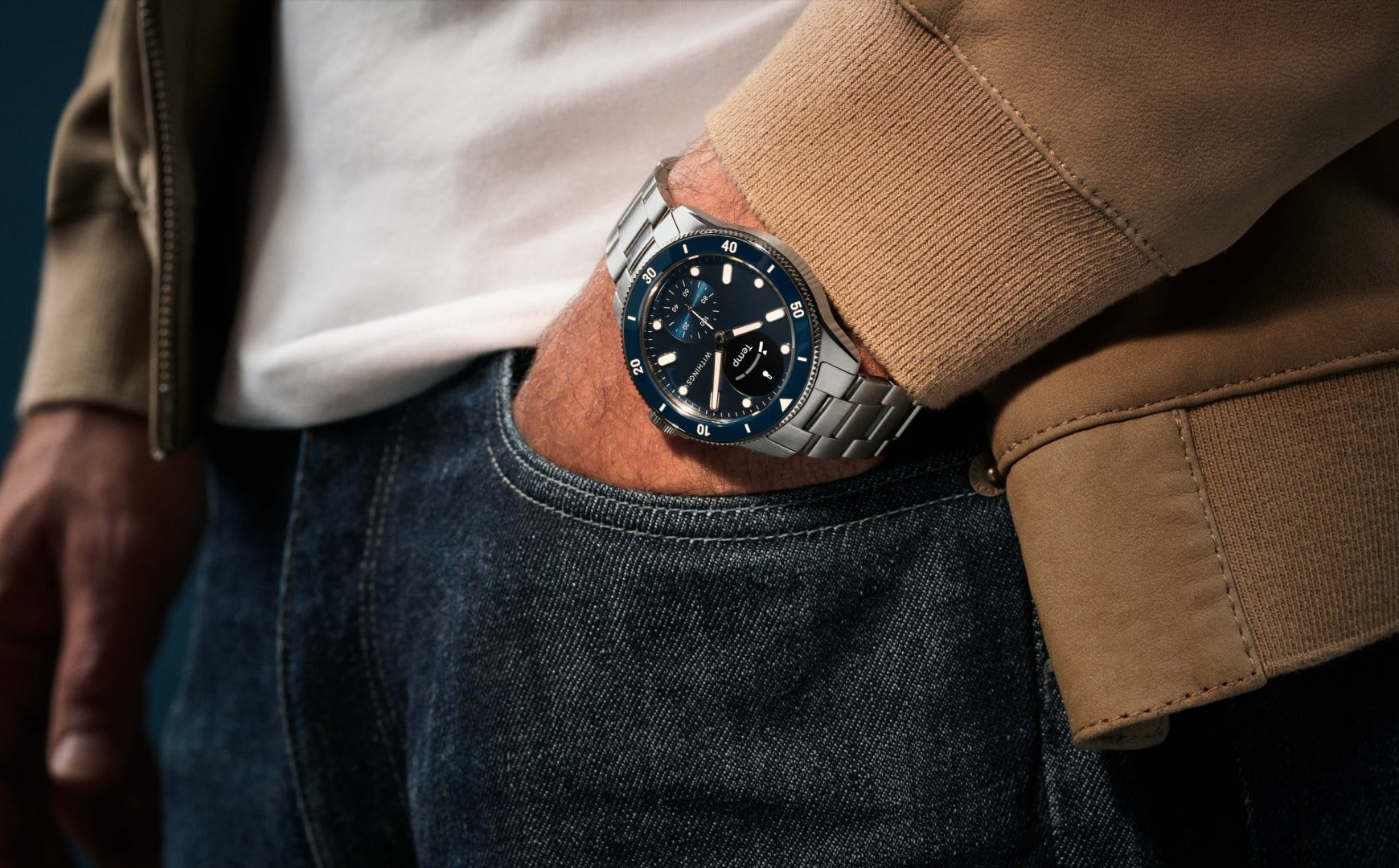
Three color options are available: Black, Blue, and Green – all handsome, all carrying that same dive-watch gravitas.
Display
Here is where the hybrid compromise becomes most visible. The ScanWatch Nova is an analog watch first, with real physical hands sweeping across the dial, and a secondary mechanical sub-dial at 6 o'clock that tracks your daily step goal as a percentage. The digital component is a 0.63-inch grayscale OLED display nestled at the 12 o'clock position – Withings calls it the DeepGray OLED Gen 3, and it packs 14,504 pixels at 282 PPI.
For its size, the screen is genuinely sharp. Scrolling through heart rate, temperature, SpO2 readings, workout modes, notifications, and alarms feels smooth and responsive, driven by the rotating crown on the right side of the case. Under direct sunlight, the OLED remains legible – a meaningful improvement over earlier ScanWatch models.
But there is no getting around the fact that this screen is tiny. Reading a full text notification requires patience and squinting. Forget about replying to messages – that is simply not a capability here. If you have come from an Apple Watch or Galaxy Watch with a full-color always-on display, the adjustment period is real. The trade-off, of course, is that this minuscule screen is precisely why the battery lasts a month instead of a day.
Performance & Features
The Withings app is the control center for everything the ScanWatch Nova collects, and it is one of the better companion apps in the wearable space. Available on iOS (16+) and Android (9.0+), it presents health data in clean, scrollable dashboards with trend charts that actually make sense. ECG recordings, sleep scores, temperature baselines, activity summaries, and SpO2 history are all easily accessible. Data syncs to Apple Health and Google Health Connect, so your information flows into broader health ecosystems without friction.
The optional Withings+ subscription ($9.95/month or $99.50/year) unlocks deeper insights: AI-powered health analysis via HealthSense 4, a Health Improvement Score, four cardio check-ups per year (on the annual plan), and personalized recommendations. The core tracking features work without the subscription, but the advanced analytics layer adds genuine value for anyone who takes their health data seriously.
On the "smart" side, the ScanWatch Nova is deliberately minimal. Notifications from your phone push to the OLED display – calls, texts, calendar alerts, and app notifications all come through. But they are read-only. There is no reply function, no voice assistant, no music control, no NFC for contactless payments, and no app store. It connects via Bluetooth Low Energy only – no Wi-Fi, no LTE.
For some, this minimalism is the entire point. The ScanWatch Nova does not buzz and flash and demand attention every thirty seconds. It is a health instrument that happens to tell the time beautifully and occasionally lets you know someone texted. For others – particularly anyone who has grown dependent on wrist-based quick replies or Apple Pay – the limitations will feel suffocating.
One persistent pain point worth flagging: notification reliability can be inconsistent across firmware versions. Some updates have temporarily broken notification delivery, and fixes from Withings can take weeks to arrive. It is not a deal-breaker, but it is a pattern that shows up repeatedly in long-term ownership.
Battery Life
This is the ScanWatch Nova's trump card, and it plays it beautifully. Withings claims up to 35 days of battery life, and in practice, three weeks of continuous wear – with heart rate monitoring, sleep tracking, temperature sensing, and regular notifications – is entirely realistic. Dialing back to lighter use or turning off respiratory tracking during sleep can push that closer to the full 35-day mark.
Compare that to an Apple Watch Series 11 that needs charging every 36 hours, or a Samsung Galaxy Watch 8 that taps out after about two days, and the difference is transformative. Charging anxiety simply does not exist with the ScanWatch Nova. You can wear it to bed for sleep tracking, wear it in the shower, wear it through a two-week vacation, and never think about a charger.
When you do need to charge, the USB-C magnetic cradle takes approximately two hours from zero to full. Not fast by modern standards, but given the infrequency, it barely matters. One charge session every three to four weeks is a fundamentally different ownership experience than the daily ritual demanded by every full-featured smartwatch on the market.
The long-term battery health question is worth noting. Some owners have reported noticeable capacity degradation after 12-18 months, and the battery is not user-replaceable. Withings offers battery replacement service, but it is something to factor into the total cost of ownership.
The Verdict
Score: 76/100 – The ScanWatch Nova is the best-looking health tracker money can buy, with genuinely clinical-grade sensors and month-long battery life. But at $500 to $600, the missing GPS, limited smart features, and a user experience that trails far behind modern smartwatches make it a tough recommendation for anyone not specifically shopping for a luxury health monitor.
| Category | Weight | Score | Weighted |
|---|---|---|---|
| Core Function (health tracking) | 30% | 78 | 23.4 |
| Build Quality | 15% | 92 | 13.8 |
| User Experience | 20% | 65 | 13.0 |
| Value | 20% | 62 | 12.4 |
| Battery | 15% | 90 | 13.5 |
| Total | 76.1 |
Who It's For
The ScanWatch Nova is made for a specific person: someone who cares deeply about their cardiovascular health, wants clinically validated sensors on their wrist, refuses to wear anything that looks like consumer electronics, and does not need or want a miniature smartphone strapped to their arm. If you are a professional who wears a suit to work and wants to track your heart rhythm and sleep quality without looking like you are training for a triathlon, this is your watch. If you already own Withings scales, blood pressure monitors, or sleep trackers, the Withings ecosystem integration makes it even more compelling. For those weighing alternatives, the ScanWatch 2 and ScanWatch Light offer similar health-first philosophy at lower price points.
Who Should Skip
If you run, cycle, or hike regularly and need GPS tracking, the ScanWatch Nova will frustrate you – spend less on a Garmin Venu 4 or Forerunner 265 and get better fitness features. If you rely on wrist-based quick replies, Apple Pay, or voice assistants, this watch simply cannot do those things. And if $500 to $600 feels steep for a watch that cannot load Spotify or show you a map, you are not wrong – the Apple Watch SE at $249 does more as a smartwatch, even if it cannot match the Nova's health sensors or battery life.
If you are still deciding between health-focused wearables, our guide to the best health monitoring watches covers the full landscape, and our best smartwatches roundup compares the Nova against the leading full-featured alternatives.