
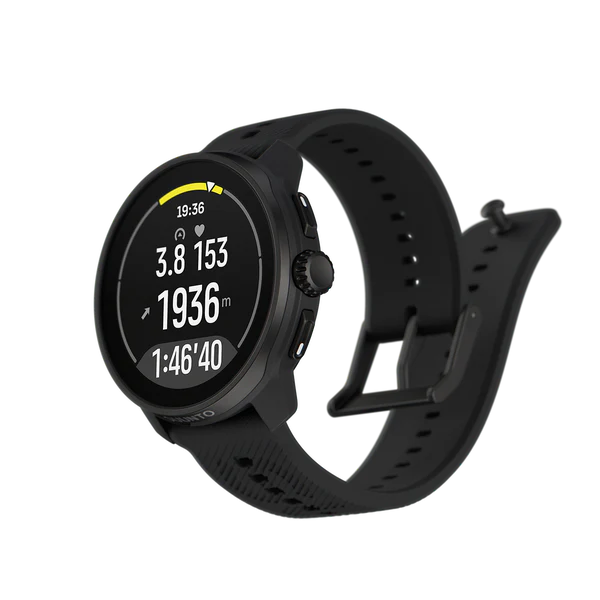
There is a persistent assumption in the GPS sports watch world that serious training tools cost serious money. Garmin reinforces it with a $449 price tag on the Forerunner 265. COROS challenged it with the PACE Pro at $299. But Suunto may have found the sweet spot with the Race S at $349 – a watch that delivers roughly 90% of what that Garmin offers while keeping 22% of the purchase price in your pocket.
The Race S is Suunto's compact riff on the well-regarded Race, shrunk from 49mm to 45mm, trimmed from 83g to 60g, and priced $100 below its bigger sibling. It is not a watered-down version. The Race S actually packs a newer optical heart rate sensor, the same dual-frequency GPS, the same 32GB of offline map storage, and the same 115+ sport modes. The trade-offs are real – heart rate accuracy trails Garmin, battery life is middling for the category, and smart features are minimal – but for runners, triathletes, and trail athletes who want a feature-dense AMOLED sports watch without the Garmin tax, this may be the best deal in the category.
Design and Build
The first thing that registers when you strap on the Race S is the weight – or rather, the lack of it. At 60 grams with the silicone strap (53g if you spring for the Titanium edition at $449), it sits lighter than most watches in this class. The 45mm case diameter and 11.4mm thickness keep it from looking like a hockey puck on smaller wrists, which was a genuine complaint about the 49mm Race.
The case is glass fiber reinforced polyamide with a stainless steel bezel on the standard model. It feels more expensive than it is. The aluminum accents and the smoothly integrated crown button give it a clean, Scandinavian-design look that works equally well with a trail running kit or a casual weekend outfit. Suunto clearly sweated the industrial design here.
Where the cost savings show up is in the glass and water resistance. Every Race S variant – including the Titanium edition – uses Gorilla Glass rather than the sapphire crystal found on the larger Suunto Race 2, and water resistance drops from 100m to 50m (5 ATM). For pool swimmers and open-water training, 50m is more than adequate. For serious divers, look elsewhere. The Gorilla Glass has held up well in testing – no scratches after weeks of trail runs, gym sessions, and daily wear – but it lacks the peace of mind that sapphire provides against rock strikes on scrambles.
The strap uses a clever clip-style closure that eliminates the tail-end flapping you get with traditional buckles. It is comfortable enough to sleep in, though the 11.4mm profile means side sleepers will occasionally notice it.
Display
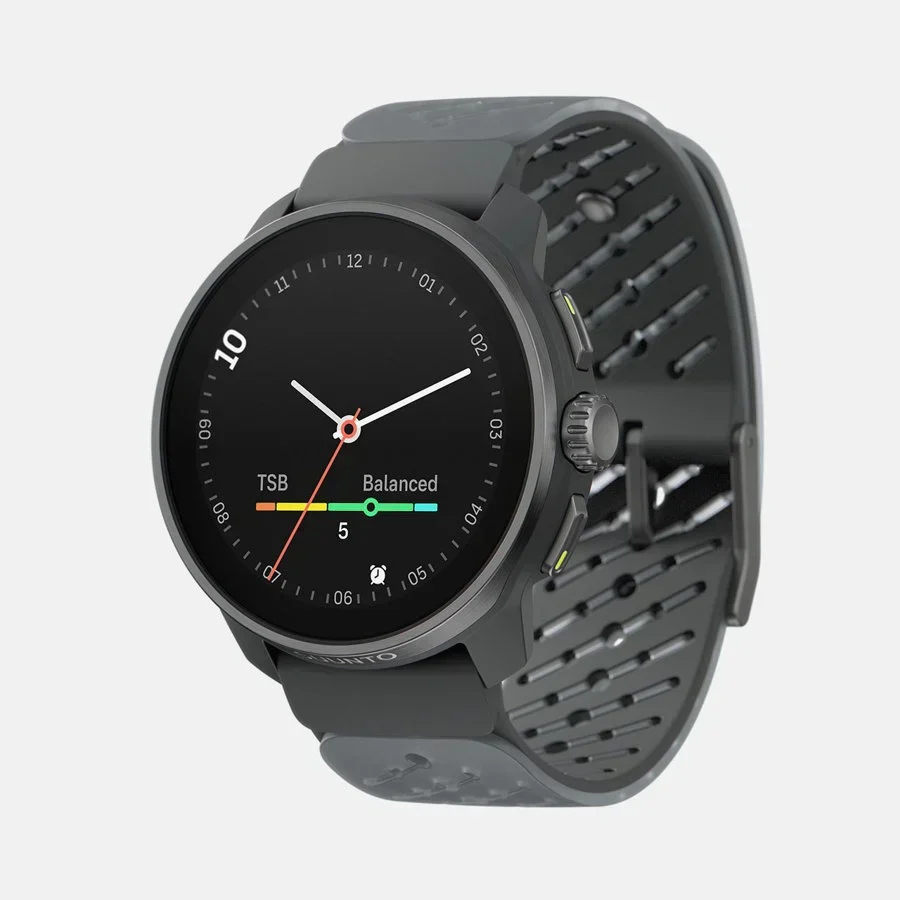
The 1.32-inch AMOLED display is the crown jewel of the Race S, and it punches well above its price class. At 466 x 466 resolution and 1,000 nits peak brightness, this screen is crisp, vibrant, and readable in direct sunlight without squinting. Text is razor-sharp. The color rendering on map overlays is excellent. If you have been squinting at a dim MIP display on an older GPS watch, the upgrade is transformative.
Touch response is generally good, though not quite as snappy as a Garmin Forerunner 265. There is an occasional beat of lag when scrolling through menus or loading map tiles that Garmin and COROS have eliminated from their latest devices. It is not a dealbreaker, but it is noticeable if you are coming from one of those watches.
The crown button on the right side handles most navigation, and it works well for scrolling through data screens mid-run when your fingers are too sweaty for reliable touch input. However, the crown's tactile click is a touch mushy compared to the satisfying detents on a Garmin or Apple Watch crown. Again, minor, but it is one of those fit-and-finish details where the price difference reveals itself.
Performance and Features
GPS Accuracy
This is where the Race S earns its keep. The dual-frequency GPS system (L1 + L5 across five satellite constellations – GPS, GLONASS, Galileo, QZSS, and BeiDou) delivers excellent positional accuracy. On road runs, urban routes with tall buildings, and wooded trail sections, the tracks are clean and consistent, matching or beating what I have seen from the Garmin Forerunner 265 in the same conditions.
Trail running is where the Race S truly excels. Routes through dense tree cover and narrow canyon sections produced accurate traces with minimal jitter. Open-water swim GPS – historically a weak point for Suunto – has seen massive improvement with the Race S, producing reasonable tracks where the original Race would wander.
The 32GB of onboard storage holds global offline maps, and having detailed topographic maps on your wrist during a trail run is a game-changer at this price. The Garmin Forerunner 265 does not offer offline maps at all. The COROS PACE Pro does, but at $299 with a slightly smaller display. Downloading maps is the one pain point – expect an hour or more for a large state or region. Plan ahead.
Training Features
The Race S inherits Suunto's full training toolkit: VO2 max estimation, training load tracking, recovery time recommendations, race pace planning, and automatic interval detection for swimming. Strava segment integration syncs starred routes directly to the watch, and the Race Pacer feature provides real-time pacing guidance during events.
Suunto's SuuntoPlus ecosystem adds modular training apps – power-based running zones, climb guidance for trail runners, and ghost tracking against previous performances. The limitation is that you can only load two SuuntoPlus apps per sport profile, which forces you to choose between features rather than running them all simultaneously.
The Suunto app handles activity syncing, route planning, and third-party connections to Strava, TrainingPeaks, and other platforms. It is functional and improving, but it still lacks the depth and polish of Garmin Connect. Training plan integration, community features, and data visualization are all areas where Garmin's ecosystem maintains a clear lead. If you live and breathe Garmin Connect for training analysis, switching to Suunto's app will feel like a downgrade. If you primarily use Strava anyway, the difference matters less.
Smart Features
This is the gap in the "90% of Garmin" equation. The Race S handles smartphone notifications and music control competently. That is about the extent of its smart ambitions. There is no NFC for contactless payments. There is no offline music storage. There is no LTE option. There is no third-party app store.
For athletes who view their sports watch as a training tool first and a smartwatch second, none of this matters. For anyone who wants to leave their phone at home and pay for a post-run coffee with their wrist, the Garmin Forerunner 265 with Garmin Pay and music storage justifies its premium.

Health and Fitness Tracking
The Race S features a new optical heart rate sensor with six LEDs and four photodetectors (doubled from the original Race's three LEDs). Suunto revamped the algorithms alongside the hardware, and the results are noticeably better – particularly for running.
During steady-state road runs and tempo efforts, the wrist-based heart rate tracked within 2-3 BPM of a chest strap reference. Interval sessions with rapid heart rate swings showed slightly more lag, but the data was still usable for zone-based training. This is a genuine improvement from the original Race, which had one of the weakest optical sensors in the category.
Cycling is the weak spot. Wrist-based heart rate during cycling remains unreliable, with frequent dropouts and inaccurate readings – a common problem across most wrist-based sensors due to the grip pressure on handlebars. Serious cyclists will want a chest strap or arm-band heart rate monitor.
Daily health metrics cover the expected bases: 24/7 heart rate, HRV tracking, SpO2 (blood oxygen), sleep staging with quality scores, stress monitoring, and step counting. The sleep tracking is reasonable but less granular than what Garmin or Whoop provide. The SpO2 readings are useful for altitude acclimatization on mountain adventures but should not be treated as medical-grade data.
Battery Life
Suunto claims up to 30 hours in the best-accuracy dual-frequency GPS mode, up to 40 hours in all-systems GPS, up to 120 hours in tour mode (reduced GPS accuracy, HR off), and up to 9 days in smartwatch mode with heart rate monitoring enabled.
Real-world testing tells a slightly different story. GPS battery life is genuinely impressive – a four-hour trail run in best-accuracy mode consumed roughly 15% of the battery, which extrapolates to around 26-27 hours. That is close enough to the 30-hour claim to call it honest, and it is more than sufficient for marathon training, ultramarathon pacing, and multi-hour trail adventures.
Smartwatch endurance is where the Race S shows the limitations of its compact case. With always-on display, 24/7 heart rate, sleep tracking, and a daily GPS workout, expect to charge every 3-4 days. With the raise-to-wake display setting, that stretches to 5-6 days. Either way, you are looking at one to two charges per week with active use – acceptable, but well behind the Garmin Forerunner 265's up to 13-day claim and nowhere near the COROS PACE Pro's up to 20 days.
Fast charging partially compensates: roughly an hour from empty to full, with 10 minutes giving enough juice for a 2-hour training session. The proprietary magnetic charging cable (USB-A, annoyingly) is compact enough for travel, though it is finicky to align and easy to knock loose.
Who It Is For
The Suunto Race S is built for runners, trail runners, triathletes, and outdoor athletes who want serious training features without paying serious training-watch prices. It is ideal if you:
- Want offline maps and dual-band GPS for under $350
- Prefer a smaller case that does not overwhelm a medium or small wrist
- Train primarily in running, trail running, swimming, or triathlon
- Sync to Strava and do most of your analysis there
- Prioritize GPS accuracy and sport tracking over smartwatch features
Who Should Skip It
- Garmin ecosystem loyalists: If Garmin Connect is central to your training workflow, the Suunto app will feel like a step backward.
- Smartwatch-first buyers: No payments, no music storage, and no app ecosystem. Get a Garmin Venu or Apple Watch instead.
- Cyclists without a chest strap: Wrist heart rate during cycling is unreliable.
- Battery anxious athletes: If charging twice a week irritates you, the COROS PACE Pro or Garmin Forerunner 265 offer more endurance.
The Verdict
Score: 81/100 – The Suunto Race S does not beat the Garmin Forerunner 265 at everything. Garmin wins on heart rate accuracy, smartwatch features, battery life, and ecosystem depth. But the Race S matches or beats it on GPS accuracy, display quality, offline maps, and sport-specific training tools – while costing $100 less. That is a remarkable value equation.
At $349, you get a dual-frequency GPS watch with a stunning AMOLED display, 32GB of offline maps, and a training feature set that would have been flagship-tier two years ago. The heart rate sensor has improved dramatically from the original Race, even if it still falls short of Garmin's best. The Suunto app is functional if not inspired. The battery life is adequate for all but the longest ultras.
The competitive landscape is fierce. The COROS PACE Pro at $299 offers longer battery life and offline maps with a lighter body, but its display and training ecosystem are less refined. The Garmin Forerunner 165 at a lower price point is worth considering if you can live without maps and the AMOLED upgrade. The Garmin Forerunner 265 at $449 is the more complete package, but that $100 premium buys you features – music, payments, better battery – that many dedicated athletes never use.
For runners shopping across this price range, our best running watches guide compares all the top contenders, and budget-conscious buyers should also check our best budget smartwatches roundup.
For the trail runner who wants maps on their wrist, the road runner who wants accurate GPS without the Garmin price tag, or the triathlete who needs a versatile multisport tool at a fair price, the Suunto Race S delivers. It is not perfect. It is not trying to be. It is trying to be the best value in the mid-range sports watch market, and on that measure, it succeeds.