
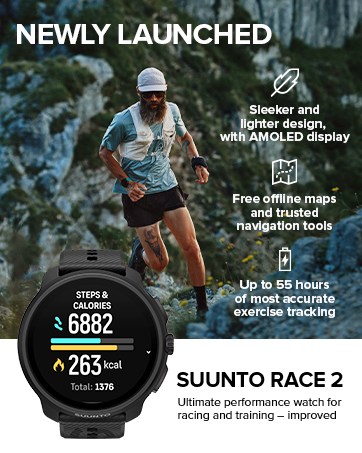
For years, Suunto made some of the best-looking, longest-lasting multisport watches on the planet – and then fumbled the one thing that matters most. Heart rate accuracy on the original Suunto Race was, to put it charitably, a suggestion. Solid GPS. Gorgeous AMOLED screen. Battery life that embarrassed the competition. But strap it on for intervals, and the optical sensor seemed to be tracking someone else's workout entirely.
The Suunto Race 2 arrives at $499 with one clear mission: fix that weakness without breaking what already worked. A redesigned optical heart rate sensor sits flush against the wrist in a new layout, paired with a bigger and brighter 1.5-inch AMOLED display, a processor that is twice as fast, and battery life that stretches to a staggering 55 hours of dual-frequency GPS tracking in gesture mode. The result is the most complete Suunto watch ever made – though still missing music storage and NFC payments – and a legitimate threat to Garmin's iron grip on the endurance sports market.
Design & Build
The Race 2 refines rather than reinvents. The 49mm case is now 12.5mm thick, shaving nearly a full millimeter off its predecessor, and that slim-down is immediately noticeable on the wrist. The stainless steel model weighs 76g (down from 83g), while the titanium variant drops to 65g – light enough to disappear during a long run, substantial enough to feel like a proper tool watch.
Every model ships with sapphire crystal glass, the same stuff protecting watches that cost three or four times as much. The glass-fiber-reinforced polyamide case body keeps weight down while the stainless steel or titanium bezel ring absorbs trail abuse. Flip it over and the redesigned sensor housing sits flatter against skin, with the new charging pins using a magnetic snap connector that actually holds – a welcome fix after the original Race's charger had an infuriating habit of falling off mid-charge.
Water resistance hits 100 meters, making this a genuine open-water and triathlon companion, not just a pool swimmer. The three physical buttons retain their satisfying click, and the 22mm quick-release straps swap in seconds. Color options span All Black, Wave Blue, Coral Orange, and Feather Gray in steel, with Titanium Black and Titanium Trail for the premium tier.
The one ergonomic caveat: the stock silicone strap needs to be cinched tight for the heart rate sensor to maintain consistent contact. A fabric or textile strap is a worthwhile upgrade that improves both comfort and accuracy on longer efforts. If you prefer a smaller case, the Suunto Race S delivers most of the same features in a more compact 45mm package.
Display
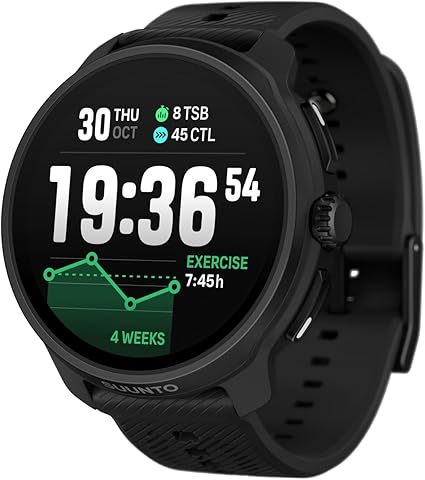
This is the screen that makes Garmin owners do a double-take. The 1.5-inch LTPO AMOLED panel pushes 2,000 nits of peak brightness – double the original Race's output – and it transforms outdoor legibility. Mid-run in direct sunlight, pace, heart rate, and map data pop with crisp clarity. The LTPO technology adapts its refresh rate dynamically, throttling down when displaying a static watch face and ramping up during navigation or scrolling, which is a major reason battery life remains exceptional despite the larger, brighter panel.
Resolution holds at 466 x 466 pixels, which sounds modest until you see it in person. The pixel density on a 1.5-inch canvas is tight enough that text is razor-sharp and map contour lines are genuinely readable, even at the 0.5-mile zoom level. The always-on display option dims intelligently and barely dents battery life in daily wear, though toggling it off during GPS activities can claw back a few extra hours.
If there is a weakness, it is the black bezel border between the display edge and the case. Suunto has shrunk it compared to the original, but it is still visible – a minor cosmetic nitpick on a display that otherwise punches well above its price class. This is comfortably one of the best screens in the endurance watch category, rivaling options that cost $200 or more extra.
Performance & Features
Under the hood, a new MCU processor delivers roughly twice the speed of the original Race, and the improvement is immediately tangible. Swiping through menus, loading maps, switching sport profiles – everything feels snappier and more responsive. The lag that occasionally plagued earlier Suunto watches is gone.
GPS performance remains strong thanks to dual-band (L1 + L5) positioning across five satellite systems: GPS, GLONASS, Galileo, BeiDou, and QZSS. Satellite lock typically arrives within 10 seconds, and tracks are accurate and consistent for road running, trail running, and cycling. During a half-marathon test, the Race 2 matched a Garmin Enduro 3 to within 16 meters over 13.1 miles – essentially identical. Urban canyon performance is respectable, though not quite class-leading; dense high-rise environments can introduce minor track wobbles that the latest Garmin and COROS chipsets handle slightly better.
The 32GB of onboard storage means offline maps cover massive regions without constant management. Route creation through the Suunto app is intuitive, with waypoint naming and labeling that carries over to the watch's turn-by-turn navigation. Climb Guidance is Suunto's answer to Garmin's ClimbPro, displaying color-coded elevation profiles with waypoint overlays that help pace effort on mountainous routes. For ultrarunners and trail athletes, it is a genuinely useful feature.
115+ sport modes cover everything from trail running and open-water swimming to ski mountaineering and padel. Multisport mode handles triathlon transitions cleanly. Suunto Coach now includes AI-enhanced training plans that adapt based on training load, recovery, and progression trends. Structured interval workouts finally sync from the app, closing a gap that frustrated Suunto users for years.
Where the Race 2 still lags behind Garmin is in smartwatch features. There is no offline music storage – phone-based music control only. No NFC payments. No smart assistant integration. Notifications work fine, with Android users able to send predefined replies, but this is fundamentally a sports-first instrument that treats "smart" features as an afterthought. If controlling Spotify from the wrist matters, look elsewhere.
Health & Fitness Tracking
Here is the headline: the heart rate sensor is dramatically improved. The redesigned optical sensor layout sits flush and makes better skin contact, and the data reflects it. Steady-state runs track within a few beats per minute of a chest strap. Cycling heart rate – historically Suunto's worst optical HR scenario – is now genuinely usable, the best wrist-based cycling performance from any Suunto watch to date.
The improvement is most striking during steady aerobic efforts, where the Race 2 locks onto heart rate quickly and holds it with minimal drift. During high-intensity intervals and the opening minutes of cold-weather runs, there are still occasional spikes – overshooting by 10-20 BPM – and lag as the sensor hunts for a stable reading. It is not yet at Garmin or Apple levels for interval precision, but the gap has narrowed from embarrassing to acceptable. For the vast majority of training sessions – tempo runs, long rides, hikes, swim sets – the data is trustworthy.
SpO2 monitoring runs continuously or on-demand, and nightly blood oxygen readings are consistent. Heart rate variability (HRV) tracking during sleep feeds into a recovery score that requires at least three nights per week to calibrate properly. Once established, the HRV trends provide meaningful insight into training readiness, though Suunto's presentation of this data relies on abbreviations and numbers (TSB, CTL, TSS from TrainingPeaks methodology) that may confuse newcomers. Garmin and Polar do a better job contextualizing these metrics for non-coaching-literate athletes.
Sleep tracking captures duration, deep sleep, awake periods, and nightly heart rate trends. It is functional but unremarkable – accurate enough for general patterns, but it lacks the granularity and sleep coaching that Garmin and Oura provide. The Resources widget, Suunto's version of Garmin's Body Battery, provides a daily readiness gauge based on sleep quality and recovery. It is useful at a glance, though the underlying algorithm feels less refined than Garmin's equivalent.
Battery Life
This is where the Suunto Race 2 does not just compete – it dominates. 55 hours of dual-frequency GPS tracking in gesture mode – or 50 hours with the always-on display – is market-leading for any AMOLED sports watch, period. Dial down to single-frequency GPS and that number stretches further. For everyday smartwatch use with 24/7 heart rate monitoring and no workouts, expect roughly up to 18 days between charges.
In real-world testing with daily training (45-60 minutes of GPS activity per day, always-on display, all-day health monitoring, and notifications), the Race 2 consistently lasts 10 to 12 days before needing the charger. A three-hour ride in full dual-frequency GPS mode with navigation consumed battery at almost exactly the rate Suunto claims, validating those headline numbers.
For ultra-distance events, the math is remarkable: a 100-mile race finished in under 30 hours has battery to spare with room for real-time navigation and full data recording. The Garmin Forerunner 970 manages about 19 hours of dual-frequency GPS, and the COROS PACE Pro hits around 31 hours in the same mode – both excellent, but the Race 2's 55-hour mark with a brighter, larger AMOLED display is a genuine engineering achievement.
Who It's For
Buy the Suunto Race 2 if you are: - A trail runner or ultrarunner who needs maps, navigation, and multi-day battery in one package - A triathlete looking for a 100m water-resistant multisport watch with dual-frequency GPS under $500 - Someone who trains primarily by heart rate zones during steady aerobic efforts - A Suunto loyalist who has been waiting for the sensor accuracy to catch up to the hardware quality - Anyone who values battery life and display quality above all else
Skip it if you are: - An interval junkie who demands chest-strap-level wrist HR accuracy during high-intensity sessions - A Garmin ecosystem user who relies on music storage, Garmin Pay, or Connect IQ apps - Someone who needs the most polished training analytics and recovery insights available - A casual fitness user who would benefit more from a smartwatch with broader lifestyle features
The Verdict
Score: 79/100 – The Suunto Race 2 is the most convincing Suunto sports watch in a decade – a strong buy for endurance athletes, but not quite an all-rounder.
The heart rate sensor – Suunto's Achilles' heel for years – has gone from unreliable to genuinely useful. The 1.5-inch AMOLED display is among the best in the business. Battery life is simply unmatched in the AMOLED category. And at $499, it undercuts the Garmin Forerunner 970 by $250 while delivering sapphire glass and offline maps that the $449 Forerunner 265 lacks.
But it is not a clean sweep. The Suunto app ecosystem still trails Garmin Connect in polish and depth. Smartwatch features remain bare-bones. And while heart rate accuracy has leaped forward, it has not quite reached the consistency of Garmin's Elevate 5 sensor during max-effort intervals. The $50 price increase from the original Race also stings, especially with the COROS PACE Pro delivering exceptional value at $299.
For runners and trail athletes comparing options in this range, our best running watches and best outdoor watches guides break down the full competitive landscape.
| Category | Weight | Score | Weighted |
|---|---|---|---|
| Core Function (GPS, HR, sport modes, mapping) | 30% | 78 | 23.4 |
| Build Quality (materials, durability, water resistance) | 15% | 90 | 13.5 |
| User Experience (software, app, daily comfort) | 20% | 68 | 13.6 |
| Value ($499 vs competitors) | 20% | 75 | 15.0 |
| Battery Life (vs category expectations) | 15% | 92 | 13.8 |
| Total | 100% | 79 |
A powerful, beautiful, and battery-dominant sports watch that has finally addressed its most critical flaw – and in doing so, transformed from a niche Finnish curiosity into a mainstream contender that Garmin cannot afford to ignore.