
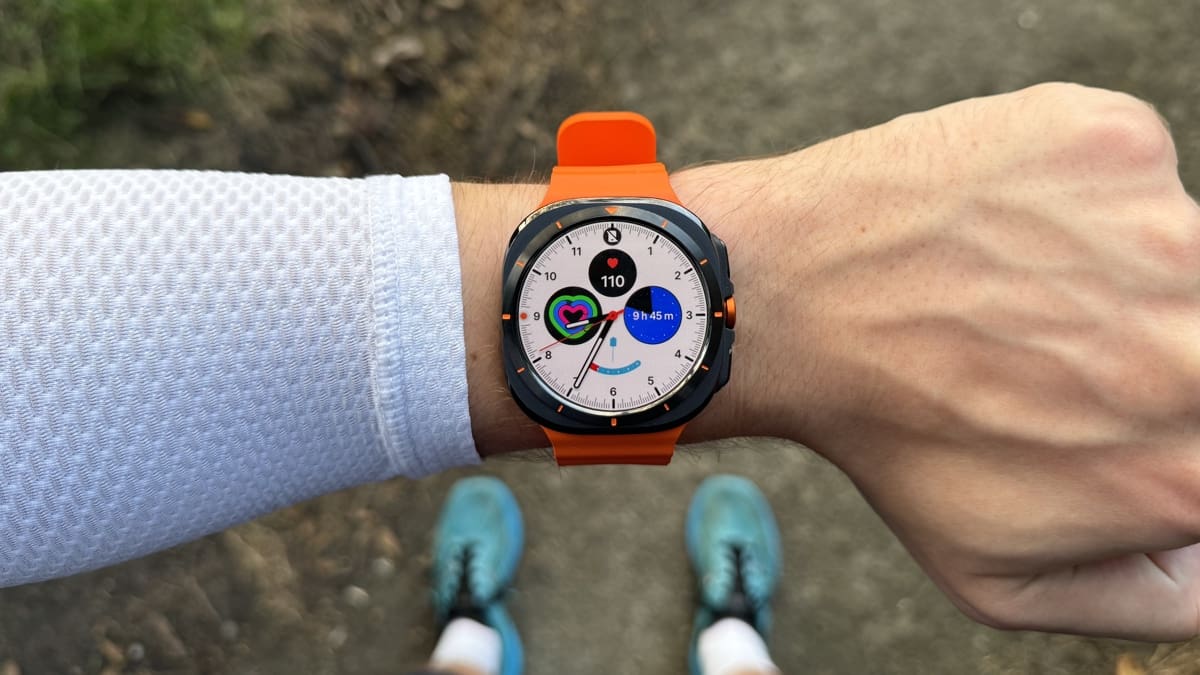
The Samsung Galaxy Watch Ultra is the most capable Android smartwatch you can strap to your wrist right now – and it is not enough. That is the uncomfortable truth at the heart of this $650 titanium tank: Samsung finally nailed the hardware fundamentals that held its watches back for years, particularly GPS accuracy and build quality, but the software depth and battery endurance still leave a meaningful gap between this watch and the Garmin and Apple alternatives it is chasing.
If you are an Android user who wants a single device for daily smart features and weekend trail runs, the Galaxy Watch Ultra is genuinely excellent. If you are a serious endurance athlete shopping for a training tool first and a smartwatch second, you will find the battery and training analytics frustratingly shallow for the price.
Design & Build
The Galaxy Watch Ultra makes a strong first impression. The Grade 4 titanium case feels immediately premium in a way that no other Wear OS watch matches. At 47.4 mm across and 12.1 mm thick, this is an imposing piece of hardware – there is no mistaking it for a dress watch. The "cushion case" shape, somewhere between round and square, is polarizing. I find it distinctive rather than derivative, though I understand why the Apple Watch Ultra 3 comparisons persist.
At 60.5 grams without the band, the Ultra is heavy enough to notice during all-day wear but not so heavy that it becomes a burden. That said, anyone with wrists under about 160 mm circumference should try this on before buying. The case creates noticeable gaps against smaller wrists, and the raised bezels can dig in during certain movements. For medium to large wrists, the comfort is excellent even overnight for sleep tracking, though the weight does take a couple of nights to get used to.
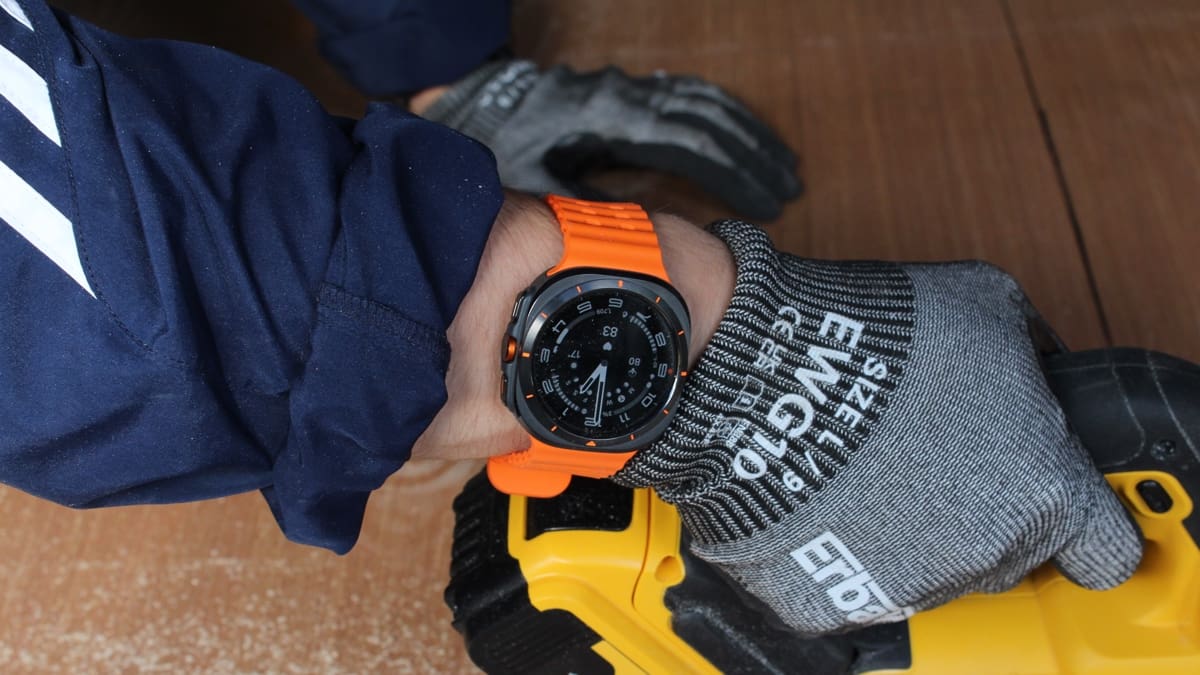
The 10ATM water resistance rating means this watch handles swimming in pools, open water, and even high-speed water sports without concern. Samsung tested it in salt and chlorinated water, and after weeks of pool sessions and ocean swims, I had zero issues. The MIL-STD-810H certification adds peace of mind for drops, vibration, and extreme temperatures, though I would not recommend deliberate abuse testing.
The band system uses proprietary lugs, which limits third-party options compared to standard 22mm spring bars. The included Marine Band is excellent for workouts – grippy, quick-drying, and secure. Samsung offers Trail and Peakform bands as well, but the aftermarket ecosystem is still catching up.
The standout hardware addition is the Quick Button – that orange nub nestled between the two standard side buttons. A single press can launch a workout, toggle the flashlight, or start a stopwatch. A long press triggers an 86 dB emergency siren, loud enough to attract attention in a genuine backcountry emergency. The Quick Button is genuinely useful and something neither Apple nor Garmin offers in quite the same way. It can be customized to single or double press, and the siren can be disabled if accidental activation is a concern.
Display
The 1.5-inch Super AMOLED panel produces stunning visuals. Colors pop, blacks are inky, and text is razor-sharp at 480 x 480 resolution. But the real story is the 3,000-nit peak brightness. Under direct midday sun on a desert trail, I never once struggled to read pace, heart rate, or navigation data. This is comfortably the best outdoor-readable display on any Wear OS watch and competitive with the Apple Watch Ultra 3's equally bright panel.
The one functional frustration is the touchscreen's behavior when wet. During rain runs and after sweating heavily in humid conditions, phantom touches and missed inputs become noticeable. The physical buttons mitigate this – and you should get comfortable using them – but for a watch rated to 100 meters of water resistance, the wet-screen usability should be better.
One valid criticism: the 1.5-inch screen is the same size as the display in the regular 44mm Galaxy Watch 8. Given the Ultra's larger 47mm case, Samsung could have pushed the screen bigger. That extra case real estate goes to the protective titanium bezel, which admittedly does a great job absorbing impacts, but a larger display would have been a stronger justification for the size increase.
The always-on display mode works well and the sapphire crystal has proven impressively scratch-resistant across months of daily wear including accidental scrapes against rock walls and metal railings.
Performance & Features
The Exynos W1000 processor is a revelation for Wear OS. Built on Samsung's 3nm process, this penta-core chip makes the Galaxy Watch Ultra feel faster than any Android watch before it. Apps launch in under a second, transitions are buttery smooth, and the watch never stutters even when logging GPS, heart rate, and music playback simultaneously. After years of Wear OS watches feeling sluggish compared to Apple Watch, the W1000 closes that gap decisively.
The software stack is Wear OS 6 with Samsung's One UI 8 Watch layered on top (the 2024 original shipped with Wear OS 5 and One UI 6 Watch). Samsung's customization layer adds genuine value here: the watch face options are extensive, the tile system is intuitive, and Samsung Health is one of the most comprehensive health platforms on any wearable. Google Maps, Google Wallet, and the full Play Store round out a mature app ecosystem that Garmin simply cannot match.
One frustration: many of the most useful features, including blood pressure monitoring, ECG, and body composition, require a Samsung phone to function fully. Pair the Ultra with a non-Samsung Android device and you lose a meaningful chunk of the health stack. This ecosystem lock-in is Samsung's biggest self-imposed limitation.
The double-pinch gesture for answering calls and dismissing alarms works reliably. The 2025 model adds Google Gemini integration directly on the wrist, which is more novelty than necessity at this point but hints at useful future capabilities.
LTE connectivity via eSIM works flawlessly for phone-free runs, and having access to calls, messages, and streaming music without carrying a phone is liberating for outdoor sessions.
Health & Fitness
The BioActive sensor suite is Samsung's most accurate yet. The upgraded array now uses 13 LEDs with doubled photodiode performance, and the results are noticeable.
Heart rate tracking during running is excellent. Across dozens of runs ranging from easy aerobic sessions to high-intensity intervals, the optical heart rate readings closely tracked a chest strap reference. Averages were virtually identical, and even during hard interval efforts, the watch held on without the wild spikes that plagued older Galaxy Watch models. This is a genuine, verifiable improvement.
Cycling is where the optical sensor falters. Road vibration and variable wrist position during outdoor rides produce heart rate data that is unreliable at best – overshooting on climbs, undercutting on flats, and generally behaving erratically. Indoor cycling on a trainer is fine. If cycling heart rate accuracy matters to you, plan on connecting a chest strap – except Samsung still does not natively support external Bluetooth heart rate sensors on the watch itself – a baffling omission at $650 that Garmin, Apple, and COROS all solved years ago.
The dual-frequency GPS (L1+L5) is the headline improvement and it delivers. On trail runs through heavy tree cover, the Ultra produced tracks virtually indistinguishable from a Garmin Fenix 8 running simultaneously. Mountain terrain, open water swimming, and suburban routes were all spot-on. The one weakness is dense urban environments with tall buildings, where the Ultra drifts slightly more than the Garmin competition. For 95% of real-world usage, the GPS accuracy is excellent and a dramatic leap from previous Samsung watches. The GPS burn rate of roughly 5% battery per hour projects to about 18-20 hours of continuous GPS recording, which is adequate for most day-long activities.
Sleep tracking is detailed and generally reliable. Total sleep time aligns closely with manual logs, sleep stage detection (REM, light, deep) is in the right ballpark though individual stage accuracy remains approximate on any wrist-worn device. The Energy Score and sleep coaching features powered by Galaxy AI are useful motivational tools, though they sometimes feel more like suggestions than science.
Body composition via BIA is a nice novelty but should not replace a DEXA scan or even a quality smart scale. Results fluctuate meaningfully based on hydration, meal timing, and time of day. Treat it as trend data over weeks, not a daily measurement.
The AGE Index, Samsung's metabolic health metric measuring Advanced Glycation End-products, remains confusing and seemingly half-baked. When the watch does produce a reading – which is not guaranteed – you get a number between 1 and 100 with zero context about what constitutes good, bad, or actionable. The feature offers no coaching, no trend tracking, and no explanation of what to do with the data. It feels like a feature Samsung shipped before it was ready.
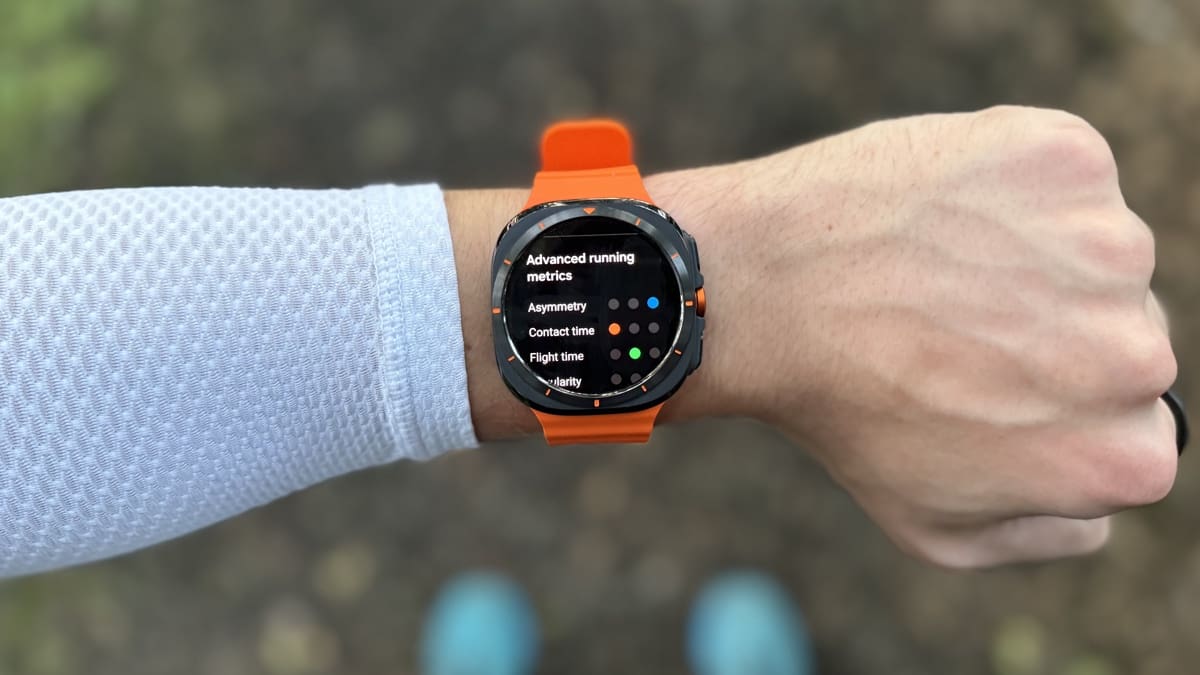
Workout tracking covers a solid range of activities, and the multi-sport mode works well for triathletes. However, the depth of training analytics – recovery metrics, training load, race predictions, structured workout execution – is noticeably thinner than what Garmin and COROS offer. Samsung provides the basics competently but lacks the sophistication that serious athletes expect from a $650 watch positioned against the Fenix 8.
Battery Life
2 to 3 days. That is the real-world battery life with the always-on display enabled, regular notifications, a few short phone calls, and a daily 30-60 minute GPS workout. Disable the AOD and lighten the notification load and you can stretch closer to 3.5 days. Power saving mode theoretically extends to 100 hours, but it strips so many features that it is really only useful as an emergency reserve.
For a Wear OS smartwatch, this is genuinely impressive. The Exynos W1000's efficiency gains over previous Samsung chips are real and tangible. Compared to the Pixel Watch 3 or older Galaxy Watch models, the Ultra's battery life is in a different league.
But context matters. The Garmin Fenix 8 AMOLED lineup lasts 10 to 29 days in smartwatch mode depending on case size – the comparable 47mm model manages up to 16 days – and 28 to 84 hours in continuous GPS mode (up to 47 hours for the 47mm). The Apple Watch Ultra 3 manages up to 42 hours (72 in low power mode). Samsung beats Apple slightly on battery endurance but gets absolutely demolished by Garmin. If you are planning multi-day backcountry trips, the Galaxy Watch Ultra will need a charger. The Fenix 8 will not.
Charging speed is acceptable – roughly 90 minutes to two hours from empty to full – but it would be nice to see faster charging given how much more frequently this watch needs the charger compared to dedicated sports watches.
Battery drain can be inconsistent – identical usage patterns produced anywhere from 35 to 55 hours on a charge during our testing period. Software updates have improved consistency since launch, but this variability is worth noting.
Who It's For
Buy the Galaxy Watch Ultra if you: - Use a Samsung phone and want the deepest possible integration between watch and phone - Need a single watch for smart features (notifications, calls, apps, payments) and weekend fitness - Value GPS accuracy and build quality but do not need weeks of battery life - Want the best Wear OS experience available, period
Skip the Galaxy Watch Ultra if you: - Train seriously for endurance events and need deep training analytics (get a Garmin Fenix 8 or COROS Vertix 2S) - Have small wrists (under 155 mm circumference) - Use a non-Samsung Android phone and want the full feature set - Need multi-day battery life without charging (get a Garmin) - Primarily cycle and need reliable optical heart rate data
The Verdict
Score: 81/100 – The Samsung Galaxy Watch Ultra earns a solid Recommended rating as the best Wear OS watch available, with genuinely excellent GPS accuracy and premium build quality, but its battery life and training depth cannot justify the $650 asking price against purpose-built competitors from Garmin.
For those deciding between Samsung's own lineup, we also reviewed the Galaxy Watch 8 Classic, which offers a more traditional design at a lower price. And if you are comparing rugged options across ecosystems, our best outdoor watches guide and best smartwatches for Android roundup can help narrow the field.
| Category | Weight | Score | Weighted |
|---|---|---|---|
| Core Function (GPS, fitness, smart features) | 30% | 83 | 24.9 |
| Build Quality (materials, durability, water resistance) | 15% | 92 | 13.8 |
| User Experience (software, comfort, daily use) | 20% | 80 | 16.0 |
| Value ($650 vs. alternatives) | 20% | 72 | 14.4 |
| Battery Life | 15% | 78 | 11.7 |
| Total | 100% | 80.8 → 81 |