

Samsung dropped the rotating bezel from the Galaxy Watch 5, brought it back for the Galaxy Watch 6 Classic, then axed it again for the Galaxy Watch 7. Now the Galaxy Watch 8 Classic revives it – wrapped in stainless steel, loaded with Gemini AI, and carrying a $499.99 price tag that lands uncomfortably close to the Galaxy Watch Ultra's $649.99. The question isn't whether the Classic is a good smartwatch. It absolutely is. The question is whether that satisfying click of the bezel is worth $150 more than the nearly identical Galaxy Watch 8, and whether Samsung's classiest Wear OS watch justifies Ultra-level money without Ultra-level specs.
The answer is nuanced. The Galaxy Watch 8 Classic is the most enjoyable Android smartwatch to use in 2025, but it occupies an awkward middle ground that makes it a tougher recommendation than it should be.
Design & Build
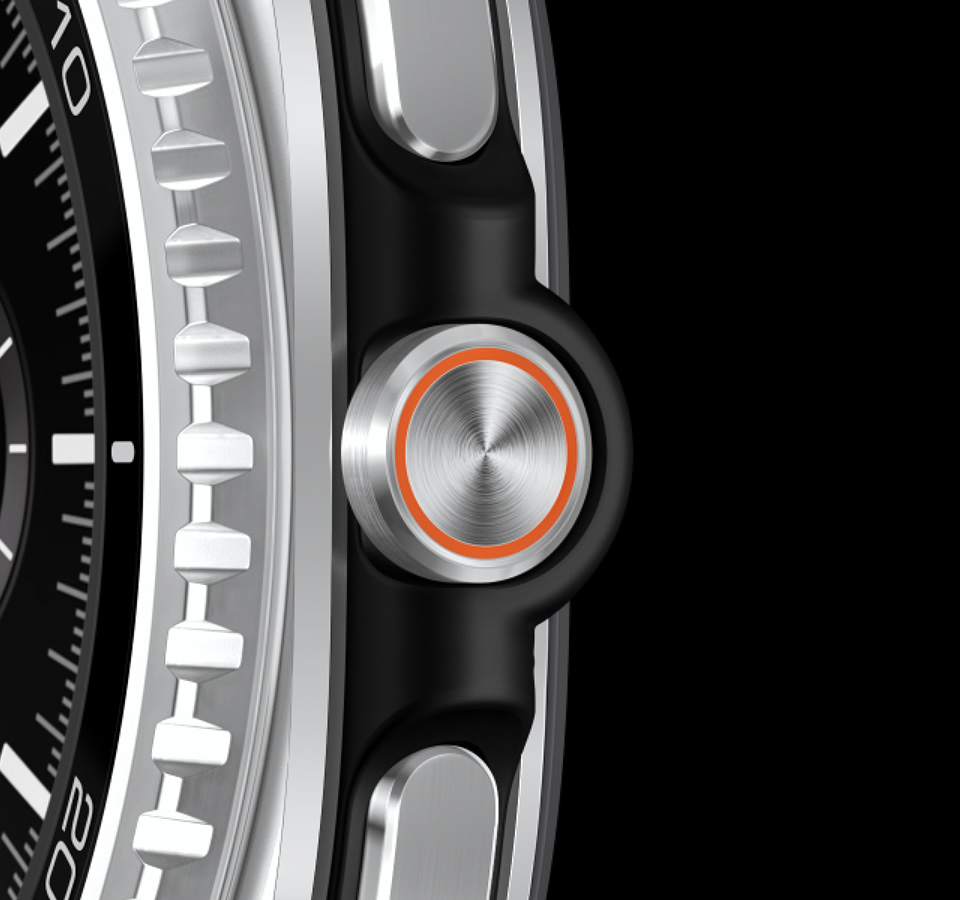
The Galaxy Watch 8 Classic takes the "cushion" squircle case that debuted on last year's Galaxy Watch Ultra and dresses it in stainless steel with a rotating bezel ring that makes the squared-off shape nearly invisible on the wrist. It is, by some margin, the most handsome watch in Samsung's 2025 lineup. The bezel ring clicks with authority – and there is a physicality to navigating Wear OS this way that no touchscreen swipe or digital crown can replicate.
At 46 x 46.4 x 10.6mm and 63.5 grams, this is a substantial piece of hardware. It wears large. There is no getting around it, and there is no smaller size option – Samsung chose a single 46mm configuration for the Classic this year, which is a genuine miss. Anyone with a wrist circumference under about 165mm will find this watch dominating their forearm rather than complementing it. The Galaxy Watch 6 Classic offered a 43mm option; its absence here is felt.
The case earns its premium materials credentials: sapphire crystal protects the display, and the watch meets both IP68 and 5ATM water resistance alongside MIL-STD-810H military durability certification. It will survive rain, swimming pools, and the occasional knock against a doorframe without complaint.
Samsung's new Dynamic Lug band system replaces standard 20mm quick-release pins with a proprietary click-in mechanism. The good news: band swaps take seconds and the angled lug design improves wrist contact for better heart rate readings. The bad news: every existing Samsung watch band you own is now a paperweight. Third-party options are growing but remain limited compared to the universal 20mm ecosystem.
Two colors are available: Black and White, both in stainless steel. A third Quick Button – borrowed from the Galaxy Watch Ultra – sits alongside the home and back buttons, offering programmable shortcuts to workouts, Samsung Health, or any app of your choice.
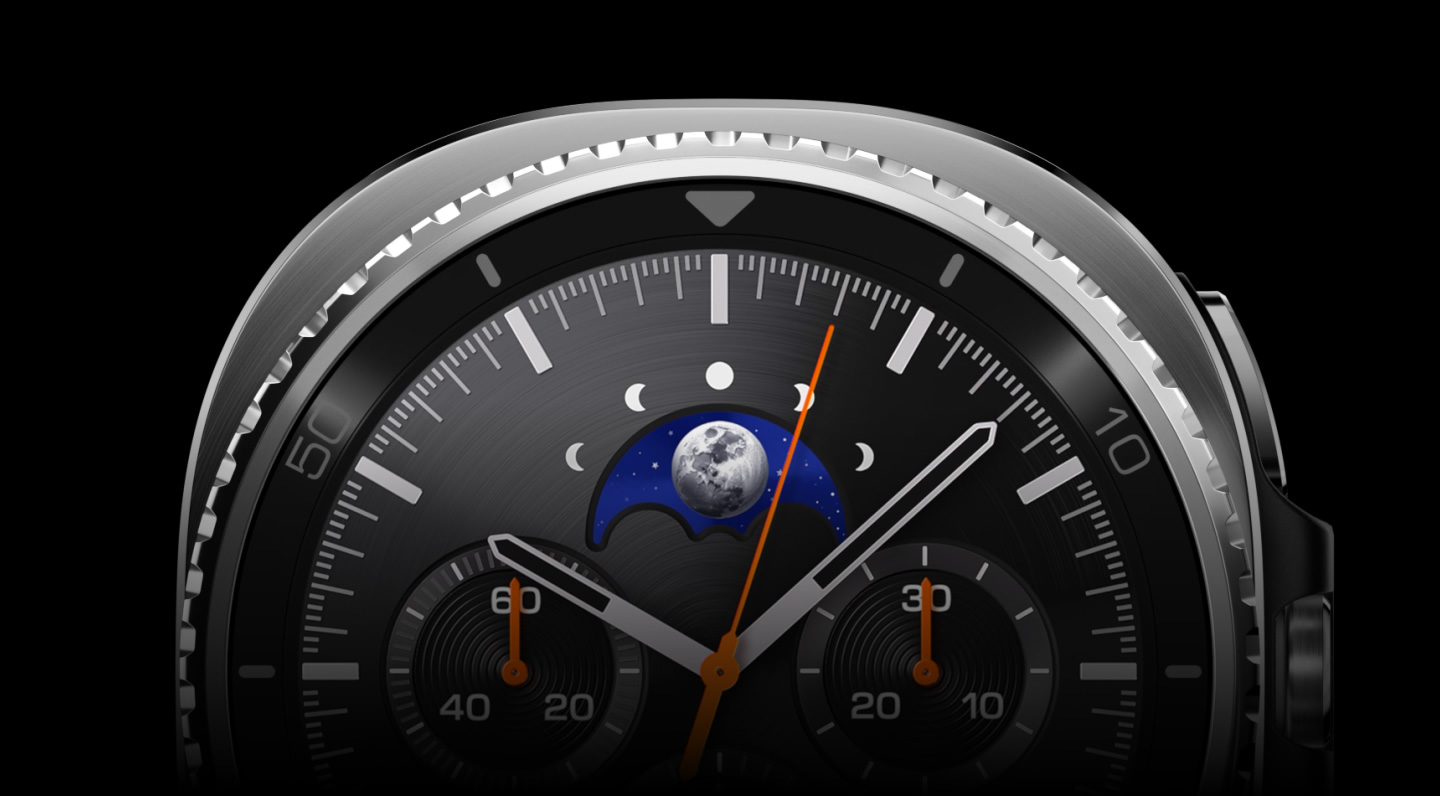
Display
The 1.34-inch Super AMOLED display runs at 438 x 438 pixels (~327 PPI) and peaks at a blistering 3,000 nits – a 50% jump from last year's Galaxy Watch 7 and enough to make the screen effortlessly readable in direct sunlight. Colors pop, blacks are inky, and the always-on display mode is clean and legible.
There is a catch. The 1.34-inch panel feels modest inside a 46mm case. The Galaxy Watch Ultra crams a 1.5-inch screen into a similar footprint, and the difference is noticeable when reading notifications or navigating tile-heavy layouts. You are paying $500 for a watch whose screen area-to-case ratio doesn't quite match the competition. It is perfectly usable – just not as immersive as you might expect from Samsung's flagship Classic.
The 60Hz refresh rate keeps animations smooth, and the always-on display reliably wakes with a wrist raise or tap.
Performance & Features
The Exynos W1000 – Samsung's 3nm smartwatch processor – powers the entire Galaxy Watch 8 family, and it is excellent. App launches are near-instant. Scrolling through tiles with the rotating bezel is fluid. Switching between workout tracking, notifications, and Gemini AI queries happens without stutter. Paired with 2GB of RAM and 64GB of storage (double the standard Watch 8's 32GB), there is room for offline Spotify playlists, maps, and plenty of apps.
Wear OS 6 with One UI 8 Watch is where Samsung truly distinguishes itself. The software experience is the best on any Wear OS device, full stop. Multi-Info Tiles let you stack two information-dense widgets on a single screen. The Now Bar surfaces contextual information – active timers, media playback, navigation steps – in a persistent strip below the watch face. The new vertical grid app launcher is cleaner than the honeycomb layout it replaces.
Google Gemini serves as the default voice assistant, and it is meaningfully more capable than Bixby ever was. Ask it to find a nearby coffee shop and text a friend to meet you, and it handles the compound request smoothly. On-wrist dictation is fast and accurate. That said, Gemini's watch capabilities remain a subset of what it can do on a phone – complex queries still get punted to your handset.
Samsung Health integration is deep and seamless. Workout auto-detection – which identifies walking, running, cycling, swimming, and elliptical sessions without manual input – is among the best in the business. The Running Coach feature generates personalized training plans after a 12-minute test run, building 3-5 week programs targeting 5K through marathon distances. Real-time pace and heart rate zone guidance during runs is useful, though the plans themselves are fairly generic compared to Garmin's training ecosystem.
Health & Fitness
The BioActive sensor remains Samsung's crown jewel, packing optical heart rate, electrical heart (ECG), bioelectrical impedance analysis (BIA), and SpO2 monitoring into a single module. The Galaxy Watch 8 Classic supports an impressive array of health metrics:
- Heart rate monitoring with continuous and on-demand tracking
- ECG (FDA-cleared) with enhanced detection of frequent ectopic beats
- Blood pressure monitoring (requires calibration with a traditional cuff every 28 days)
- Body composition analysis – body fat percentage, skeletal muscle mass, BMI, body water, and BMR
- SpO2 blood oxygen tracking (readings can be inconsistent, especially during movement)
- Sleep tracking with sleep stage analysis, snore detection, skin temperature monitoring, and FDA-authorized sleep apnea risk detection for moderate-to-severe obstructive sleep apnea
- Temperature monitoring via an infrared sensor
- Energy Score – a daily readiness metric synthesizing sleep quality, activity, and stress data
The FDA-authorized sleep apnea risk detection remains a standout – few competitors have cleared this regulatory bar, and it gives the Galaxy Watch 8 Classic a genuine edge in preventative health monitoring.
New for 2025, the Antioxidant Index measures skin carotenoid levels in five seconds using multi-wavelength spectroscopy. In theory, it provides insight into dietary antioxidant intake. In practice, it is a party trick at best – the sensor can be fooled by orange-colored food or even an orange marker on the skin. Treat it as a curiosity, not a clinical tool.
Vascular Load monitoring is more promising, tracking arterial stiffness trends over time. Combined with blood pressure and ECG data, Samsung is building toward a comprehensive cardiovascular monitoring picture – but individual readings require context and should not replace medical advice.
Workout tracking covers a wide range of exercises with automatic detection for the most common activities. GPS performance using dual-band satellite positioning (GPS, GLONASS, Galileo, BeiDou) is accurate and locks on quickly. The heart rate sensor holds up well during steady-state cardio, though it can lag during high-intensity interval work – a common optical sensor limitation.
Battery Life
Samsung rates the Galaxy Watch 8 Classic at 30 hours with always-on display and 40 hours without it. Real-world experience splits the difference. With always-on display active, a GPS workout logged daily, continuous heart rate monitoring, sleep tracking, and moderate notification volume, expect to reach for the charger roughly every 30-36 hours. Turning off always-on display and reducing notification frequency can stretch that closer to two days.
That is acceptable for a smartwatch in 2025, but it is not impressive. The OnePlus Watch 3 ($349) delivers genuine multi-day battery life from a 648mAh cell. The Galaxy Watch Ultra ($649.99) packs a 590mAh battery that Samsung rates for up to 60 hours of typical use. At $500, the Classic's 445mAh battery feels undersized for the price.
Charging is the Classic's weakest link. The 10W wireless charging takes approximately 90 minutes from empty to full. The Apple Watch Series 11 reaches 80% in about 30 minutes. The Pixel Watch 4 charges noticeably faster too. In a lineup where Samsung charges flagship prices, the charging speed feels like it belongs to a budget tier.
Who It's For / Who Should Skip
Buy the Galaxy Watch 8 Classic if: - You are a Samsung Galaxy phone owner who values the tightest possible ecosystem integration - The rotating bezel is a must-have – you tried digital alternatives and hated them - You want the most comprehensive health monitoring suite on any Android smartwatch (ECG, blood pressure, body composition, sleep apnea detection) - You want premium materials and a watch that looks dressy enough for business casual - You have larger wrists (170mm+) and prefer a substantial watch presence
Skip the Galaxy Watch 8 Classic if: - You have smaller wrists – 46mm is the only option, and it is big - You are budget-conscious – the standard Galaxy Watch 8 at $349.99 delivers 95% of the same features - Battery life is a priority – the OnePlus Watch 3 and Galaxy Watch Ultra both last significantly longer - You need outdoor durability – the Galaxy Watch Ultra offers 10ATM water resistance and an emergency siren for $150 more - You have a large collection of 20mm watch bands – the proprietary Dynamic Lug system makes them all incompatible
The Verdict
The Samsung Galaxy Watch 8 Classic is a genuinely excellent smartwatch hamstrung by a price that asks too much for what it uniquely offers. The rotating bezel is magnificent. One UI 8 Watch is the best software on any Wear OS device. The health monitoring suite is unmatched on Android. But $499.99 puts it in direct competition with watches that offer more – the Galaxy Watch Ultra's bigger screen, bigger battery, and greater durability for $150 more, or the OnePlus Watch 3's multi-day battery and rotating crown for $150 less.
The Classic's real competition is the standard Galaxy Watch 8 at $349.99. That watch shares the same processor, the same health sensors, the same software, and a slimmer design. The Classic's advantages – rotating bezel, 64GB storage, Quick Button, larger battery – are meaningful but not $150 meaningful for everyone. For help weighing up these options, check our best smartwatches for Android guide.
For those who prioritize the feel of using their watch above all else, the Galaxy Watch 8 Classic delivers something no other Wear OS device can match. That clicking bezel transforms mundane interactions into something tactile and satisfying. If that matters to you, the premium is justified. If it doesn't, the standard Watch 8 is the smarter buy.
Score: 83/100
| Category | Weight | Score |
|---|---|---|
| Core Function | 30% | 87 |
| Build Quality | 15% | 90 |
| User Experience | 20% | 91 |
| Value | 20% | 72 |
| Battery | 15% | 74 |
The bottom line: The Galaxy Watch 8 Classic is Samsung's most satisfying smartwatch to use, but its $500 price tag and single large size create a value gap that the magnificent rotating bezel can only partially bridge.