
The Smartwatch That Stopped Chasing the Charger
Every Wear OS watch makes the same trade-off. You get Google's polished software ecosystem, your favorite apps on your wrist, and smooth notifications – then you spend every evening tethered to a charging puck. The Samsung Galaxy Watch 7 lasts one to two days. The Pixel Watch 3 stretches to two days if you squint. The OnePlus Watch 3 lasts five.
That is not a typo, and it is not a marketing claim stretched beyond recognition. With the always-on display running, sleep tracking enabled every night, and a daily workout tracked with GPS, the OnePlus Watch 3 consistently delivers four to five full days of battery life. In a category where overnight charging is accepted as inevitable, OnePlus has built something that genuinely changes the daily experience of wearing a Wear OS watch. The question is whether battery life alone can carry a smartwatch to the top of the recommendation list – and the answer, as it turns out, is more nuanced than the battery gauge suggests. We scored it 85/100 – here is why.
Battery Life: The Headline That Delivers
This is where the OnePlus Watch 3 separates itself from every other Wear OS smartwatch on the market, and it is not close.
The 648mAh battery – significantly larger than the Galaxy Watch 7's 425mAh or the Pixel Watch 3's 420mAh (45mm) – powers through four to five full days of real-world use with the always-on display enabled, continuous heart rate monitoring active, sleep tracking running every night, and one GPS-tracked workout per day. Disable the AOD and lighter use patterns stretch that to the claimed 120 hours comfortably. Power saver mode, which drops to the RTOS co-processor for basic timekeeping and step counting, extends runtime to an impressive 16 days.
To put this in practical terms: on a Monday morning charge, the watch comfortably lasts through a full work week and into the weekend. A Friday departure for a camping trip does not require packing a charger. A long-haul flight with a full day of exploring on the other end is covered without anxiety. This is a fundamentally different ownership experience than any other Wear OS watch offers.
When you do need to charge, VOOC fast charging transforms the experience further. Ten minutes on the magnetic puck delivers roughly 24 hours of runtime. A full charge from empty takes about 40 minutes. The charging puck connects via USB-C and the magnetic alignment is precise – no fumbling to find the sweet spot.
For context: the Samsung Galaxy Watch 8 lasts one to two days. The Pixel Watch 3 (45mm) stretches to about two days. The Apple Watch Series 10 manages around 18 hours of standard use. The OnePlus Watch 3 triples or quadruples what its direct Wear OS competitors offer, using the same operating system and running the same apps. The dual-processor architecture is the engineering difference, and it works.
Design and Build: Premium Materials, Polarizing Size
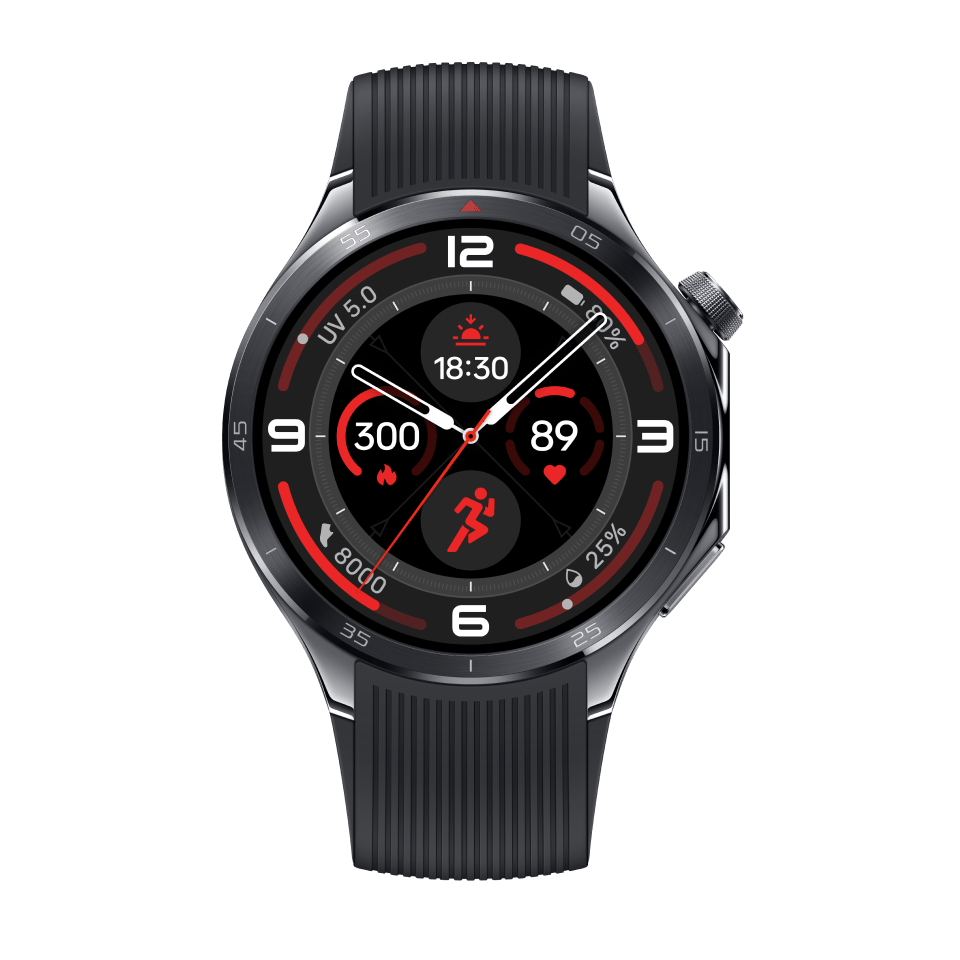
The OnePlus Watch 3 looks like a proper timepiece. The titanium bezel frames a 1.5-inch display with minute markings etched around the perimeter, giving it the presence of a dress watch rather than a gadget. Flip it over and the stainless steel case back houses a redesigned sensor array. A sapphire crystal covers the face, and the whole package carries MIL-STD-810H military-grade certification alongside IP68 and 5ATM water resistance. This watch can handle a lap pool, a rainstorm, or an accidental encounter with a doorframe without complaint.
The rotating crown at the two o'clock position is the most tactile improvement over the Watch 2. Each click delivers precise haptic feedback as you scroll through menus and notifications – satisfying in a way that makes the flat button on its predecessor feel like a missed opportunity. A secondary button below it can be customized for quick actions, and both sit flush enough to avoid accidental presses during workouts.
Here is the caveat that shapes every conversation about this watch: it is big. At 46.6 x 47.6 x 11.75mm and 49.7 grams without the strap (81 grams with it), the OnePlus Watch 3 commands wrist presence. On a 170mm wrist, it wears confidently. On anything smaller, it dominates. OnePlus has since released a 43mm variant that addresses this, but the original 46mm model remains the flagship, and its size will be a dealbreaker for a meaningful portion of potential buyers. The standard 22mm lug width does mean strap options are virtually unlimited, which helps dial in the fit.
The two colorways – Obsidian Titanium (black on black) and Emerald Titanium (silver with a green band) – both lean masculine. This is not a unisex design in the way that the Pixel Watch 3 or Apple Watch manage to be. OnePlus clearly designed for wrists that can carry a 47mm case, and the aesthetic choices reinforce that.
Performance and Software: Wear OS Done Right
Under the hood, the Snapdragon W5 Gen 1 processor paired with a BES2800 co-processor and 2GB of RAM keeps everything moving without hesitation. App launches are snappy, transitions between screens are fluid, and the watch never stuttered during weeks of testing – not when loading Google Maps, not when switching between a workout and an incoming notification, not when scrolling through a day's worth of health data.
The dual-architecture approach is the secret to the battery life. Wear OS 5 handles the heavy lifting – Google apps, notifications, third-party apps from the Play Store – while the BES2800 co-processor runs lighter tasks through OnePlus's proprietary RTOS. The handoff between the two is invisible. You never feel like you are using two different systems.
Wear OS 5 brings the full Google ecosystem. Google Assistant responds from a long-press on the crown. Google Wallet handles contactless payments through NFC. Google Maps provides turn-by-turn navigation. Calendar, Messages, and the entire Play Store library are available. If you have used a Pixel Watch, the software experience will feel immediately familiar, with OnePlus adding its own OHealth layer on top rather than replacing the foundation.
The OHealth companion app has matured significantly. It presents daily steps, calories, workout minutes, heart rate, sleep data, SpO2, and a mind-body score on a single scrollable dashboard. A 60-second health checkup aggregates heart rate, SpO2, skin temperature, and stress into a quick snapshot – genuinely useful for a morning vitals check before heading out the door. Data syncs with Google Health Connect and Strava, keeping everything accessible outside OnePlus's ecosystem.
The update situation deserves honest mention. OnePlus promises three years of Wear OS updates and security patches, which covers Wear OS 5 through 7 (through 2027). That is adequate but notably behind Samsung's four-year commitment with the Galaxy Watch 7. For a watch at this price point, two major OS updates after the out-of-box version is serviceable, not generous.
Display: Bright Enough to Forget It Is There
The 1.5-inch LTPO AMOLED panel punches at 466 x 466 pixels and peaks at 2,200 nits – brighter than the Pixel Watch 3 and competitive with the Galaxy Watch 7. In direct afternoon sunlight, the display remains completely legible without cupping a hand over the face or cranking brightness manually. The auto-brightness adjustment is fast and reliable, dimming smoothly in a dark bedroom and ramping up instantly when stepping outside.
Colors run vibrant, perhaps a touch oversaturated compared to the more neutral Pixel Watch 3, but the punchy palette works well for watch faces and workout screens where quick glancing matters more than color accuracy. The always-on display mode is well-implemented, offering a dimmed but readable version of most watch faces without the harsh brightness penalty some competitors impose.
DC dimming across the brightness range means no perceptible flicker at low levels – a detail that matters when you are reading your watch in a dark theater or checking the time at 3 a.m. The sapphire crystal protects it all without adding noticeable reflectivity. After weeks of daily wear, including gym sessions and outdoor runs, the display surface remained pristine.
Health and Fitness: The Generational Leap
The sensor hardware represents a massive upgrade from the Watch 2. The redesigned optical heart rate sensor, SpO2 monitor, skin temperature sensor, barometric altimeter, and multi-axis accelerometer/gyroscope suite deliver data that is substantially more reliable than its predecessor, which suffered from frequent tracking dropouts.
Heart rate tracking during steady-state runs aligned closely with a chest strap reference, with occasional deviations during high-intensity intervals – a pattern consistent with every optical wrist sensor on the market. The watch wears loosely enough for comfort while still maintaining sensor contact, a balance that competing watches with smaller sensor arrays sometimes struggle with.
Dual-band GPS (L1+L5) locks satellites quickly and tracks outdoor runs with minimal drift. Side-by-side with a Garmin Forerunner, total distance over a 10K differed by less than 100 meters – well within acceptable variance for a wrist-worn smartwatch. Urban canyon performance is solid, though dedicated running watches with superior antenna designs still edge it out in dense downtown corridors.
The 100+ workout modes cover standard categories comprehensively, with 11 professional tracking modes offering advanced metrics for running (cadence, stride length, vertical oscillation, ground contact time, running power), cycling, and swimming. VO2 max estimation, branded as "cardio fitness," tracks over time and provides a reasonable trend line, though absolute values run slightly optimistic compared to lab-grade testing.
Sleep tracking captures light, deep, and REM stages with reasonable accuracy, though occasional nights showed stage-distribution anomalies when compared against a dedicated sleep tracker. The data is useful for identifying patterns over weeks, less reliable for single-night diagnostics.
ECG monitoring is available in supported regions but notably absent in the United States due to FDA clearance requirements. The vascular health assessment, which measures arterial stiffness, is an interesting addition that few competitors offer, though its clinical utility for the average user remains limited. Fall detection rounds out the safety features, triggering through the OHealth app with an emergency call option.
Who It Is For
The OnePlus Watch 3 is built for Android users who want a full-featured smartwatch without the daily charging ritual. It suits people who value battery endurance alongside Google's app ecosystem – travelers, outdoor enthusiasts, and anyone who has simply grown tired of another nightly charging routine. At $349.99 with no subscription fees for health features (looking at you, Fitbit), the value proposition is strong for buyers who want premium materials and multi-day runtime. For a full rundown of top options, see our best smartwatches for Android guide.
Who Should Skip
If you have smaller wrists (under 160mm circumference), the 46mm case will overwhelm. Look at the 43mm variant instead, or consider the Pixel Watch 3 for a more compact option. If LTE independence matters – leaving your phone behind for a run and still getting calls – the OnePlus Watch 3 cannot help; it is Bluetooth and WiFi only. iPhone users are excluded entirely; there is no iOS compatibility. And if you need ECG monitoring in the United States, the regulatory gap makes this a non-starter for that specific use case.
Serious athletes who demand chest-strap-level heart rate precision and the most advanced training metrics should still look at Garmin or COROS. The OnePlus Watch 3 is a very capable fitness tracker, but it is a smartwatch first and a sports watch second. The Mobvoi TicWatch Pro 5 Enduro offers another dual-display alternative, while the Amazfit Balance 2 delivers strong fitness tracking at a lower price.
The Verdict
The OnePlus Watch 3 does not just improve on the Wear OS battery life problem – it eliminates it. Five days of real-world runtime with full smartwatch functionality is a genuine achievement, and the premium build with titanium, sapphire crystal, and MIL-STD-810H certification means the hardware matches the endurance. The rotating crown is excellent, the display is class-leading bright, and VOOC fast charging means even when you do need power, you are back on your wrist in minutes.
The compromises are real but contained. The 46mm size alienates smaller wrists. No LTE means your phone always needs to be nearby. The update commitment trails Samsung. And heart rate tracking, while vastly improved, does not quite match the Pixel Watch 3's precision during intense intervals.
None of that changes the fundamental equation: this is the Wear OS watch that finally lets you stop thinking about battery life. For the majority of Android smartwatch buyers, that trade-off lands decisively in OnePlus's favor. For a comprehensive look at all the top picks, check our best smartwatches roundup.
Score: 85/100
| Category | Weight | Score | Weighted |
|---|---|---|---|
| Core Function | 30% | 82 | 24.6 |
| Build Quality | 15% | 83 | 12.5 |
| User Experience | 20% | 82 | 16.4 |
| Value | 20% | 86 | 17.2 |
| Battery | 15% | 95 | 14.3 |
| Total | 100% | 85.0 |