
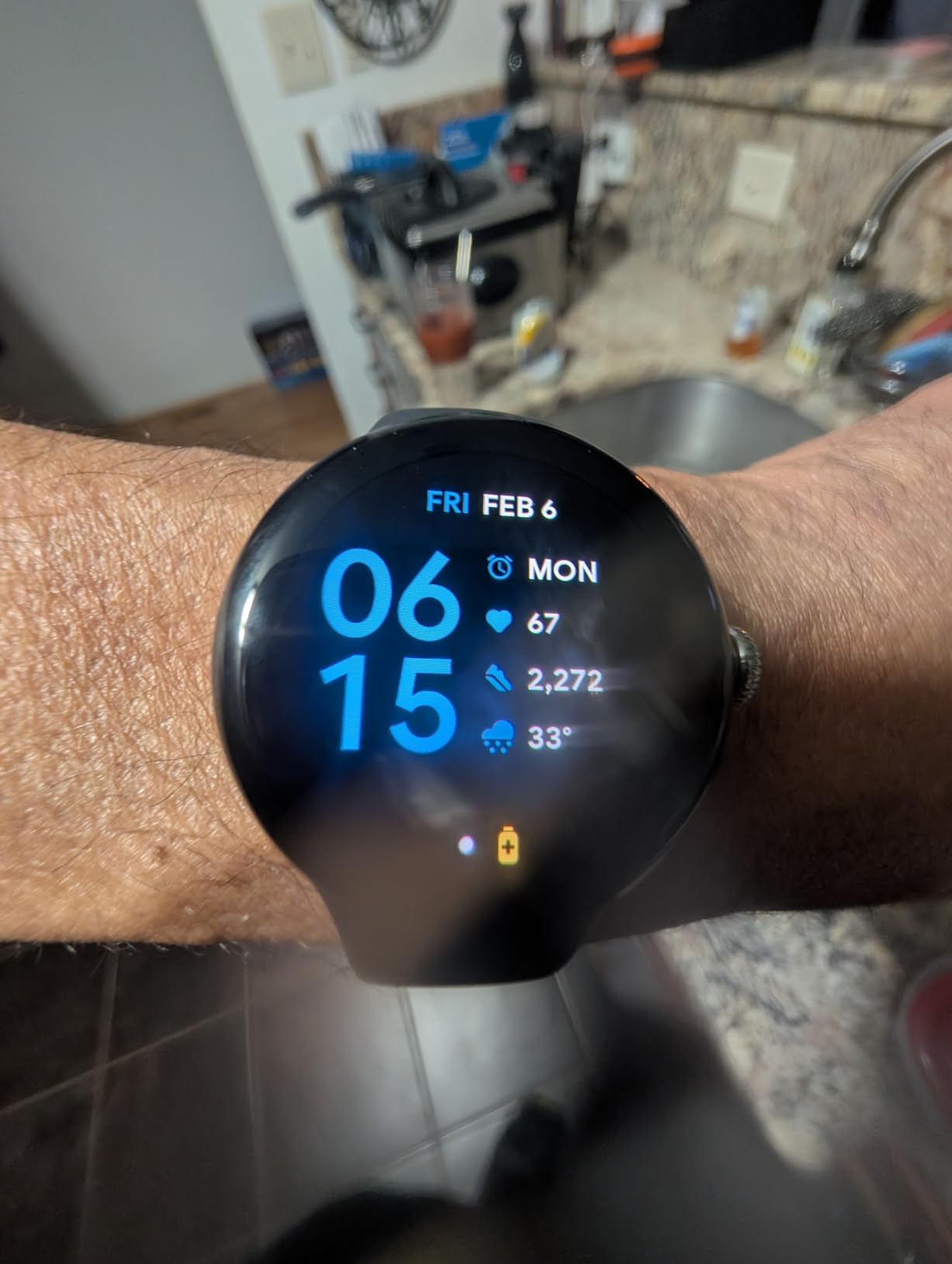
The Google Pixel Watch 2 is a study in contradictions. On the wrist, it delivers some of the most accurate health tracking available on any smartwatch – a multi-path heart rate sensor that rivals a chest strap, a continuous stress monitor that actually works, and skin temperature readings that add real depth to sleep analysis. For anyone who cares about what their body is doing, this watch rivals devices costing twice as much on pure sensor quality.
And yet, that weight class includes a 306 mAh battery that barely survives a full day. The Pixel Watch 2 dramatically improved on its deeply flawed predecessor in nearly every measurable way, but it kept the one habit that matters most in daily life: you will charge this watch every single night, without exception, and if you forget, you will wake up to a dead screen. Great sensors, bad habits. That is the Pixel Watch 2 in five words.
Design & Build
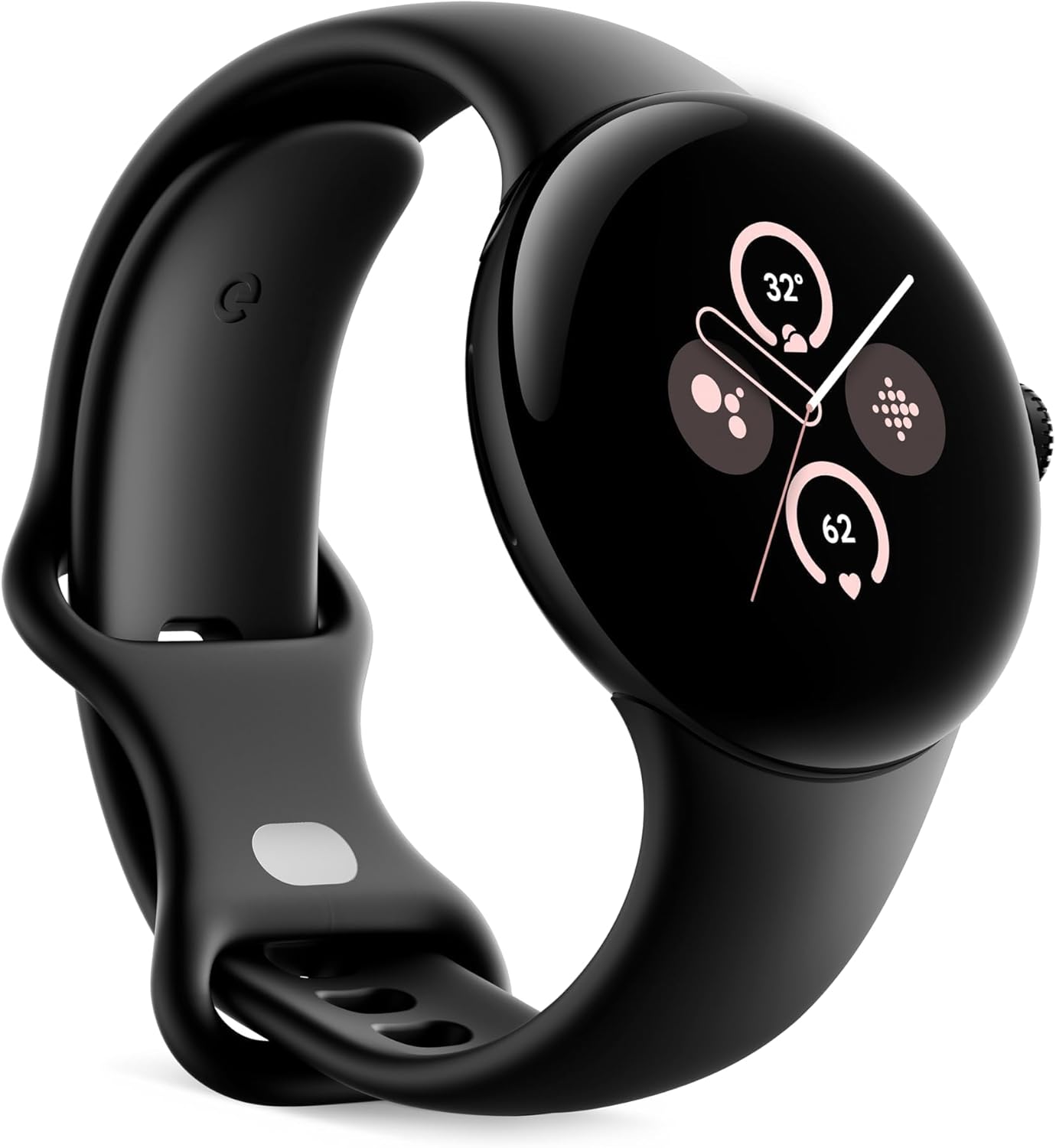
The Pixel Watch 2 inherits the dome-shaped silhouette that made the original such a distinctive piece of wrist jewelry. That curved, bezel-less look – Google calls it inspired by a water droplet – is still one of the most attractive designs in the smartwatch world. It looks like a polished pebble on your wrist, which is a genuine compliment in a market full of chunky rectangles and oversized sport watches.
Google switched from stainless steel to recycled aluminum for the case, shaving five grams and bringing the total weight down to 31 grams without the band. That difference is noticeable. The Pixel Watch 2 practically disappears during sleep tracking, which matters when you are wearing it around the clock to take advantage of all those sensors.
The tradeoff for that sleek dome shape is durability. The Corning Gorilla Glass 5 covering the display dates back to 2016, and it shows. Deep scratches are common within weeks of careful daily wear – no drops, no impacts, just the slow accumulation of micro-abrasions that come from living your life. Samsung uses Sapphire Crystal Glass on the Galaxy Watch 6. Even the base-model Apple Watch SE uses Ion-X strengthened glass, and higher-end Apple Watch models get sapphire crystal. Google chose Gorilla Glass 5 – a seven-year-old glass technology – and it is the Pixel Watch 2's most visible weakness.
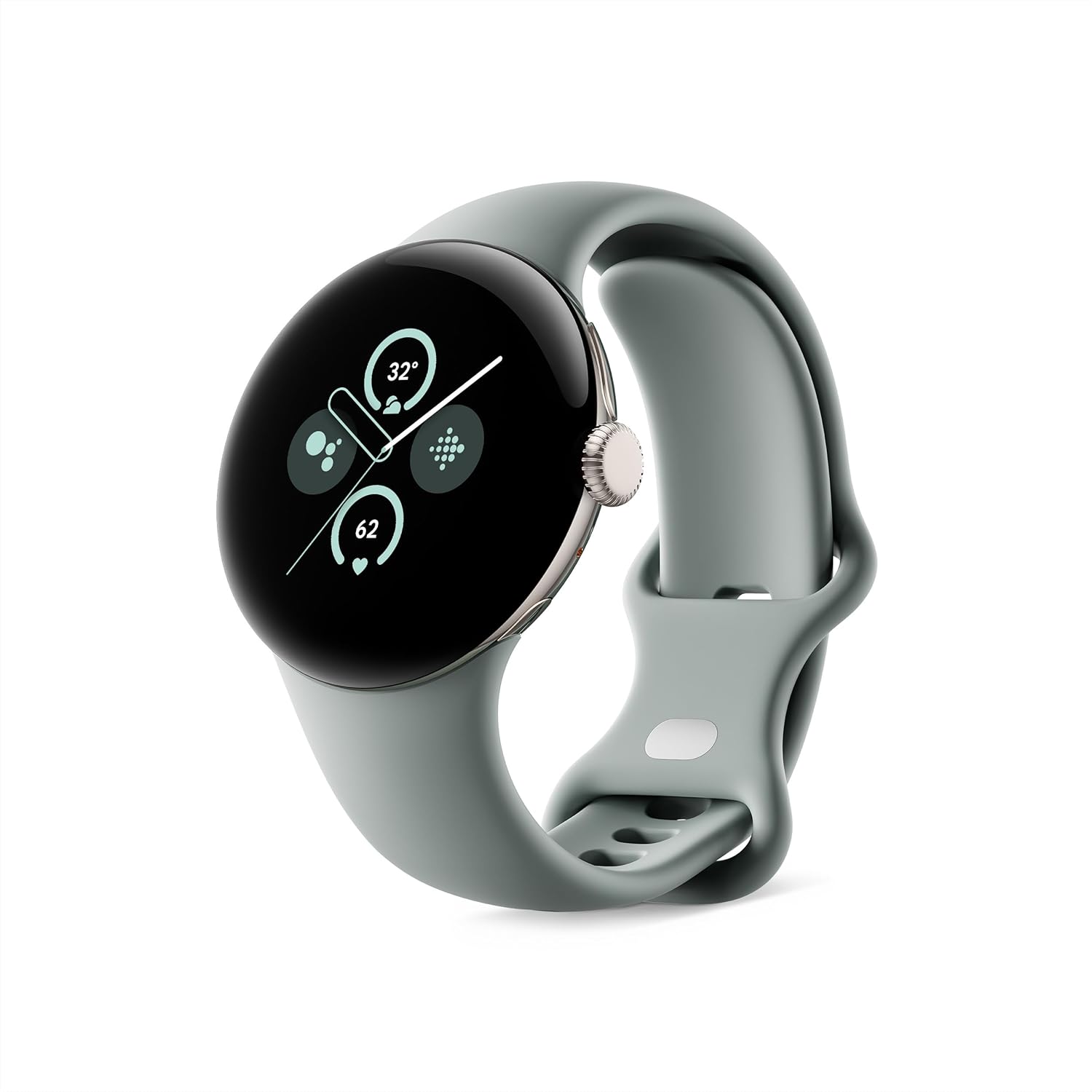
The watch ships in three case finishes: Polished Silver, Matte Black, and Champagne Gold, each paired with a default Active Band in Porcelain, Obsidian, or Hazel respectively. The Silver is also available with a Bay (blue-green) band as a separate SKU. Google's proprietary band system remains a limitation – third-party options exist but the selection is thin compared to Apple Watch's vast aftermarket.
At 41mm, the Pixel Watch 2 is still available in only one size. On smaller wrists, the proportions are excellent. On larger wrists, it looks like a piece of candy. Google would not introduce a larger option until the Pixel Watch 3, and the single-size approach cost them customers who wanted a bigger display and more battery capacity.
Display
The 1.2-inch AMOLED panel pushes 384 x 384 pixels at 320 ppi, and in most conditions, it looks gorgeous. Colors are vibrant, blacks are absolute, and the always-on display mode works well enough for casual time checks without waking the screen.
The peak brightness of 1,000 nits is adequate indoors and passable outdoors on overcast days, but it struggles in direct sunlight. The Samsung Galaxy Watch 6, by comparison, hits up to 2,000 nits – twice as bright. On a clear December afternoon, cupping a hand over the screen to read a notification is a real possibility.
The bezels remain chunky. Google's dome design curves the glass over the edges of the display, creating a visual illusion that partially hides them, but tilt the watch at certain angles and you can clearly see where the usable screen ends. It is a small watch with a small screen, and the bezels make it feel even smaller.
That said, the always-on display is a genuine improvement over the first generation. Thanks to the more efficient Snapdragon W5 processor, the AOD no longer acts as a battery parasite. Google claims 24-hour battery life with the AOD enabled this time, and that claim is essentially accurate, which was not the case with the original Pixel Watch.
Health & Fitness
This is where the Pixel Watch 2 earns its keep. Google gutted the sensor array from the original and rebuilt it with hardware that genuinely competes with the best in the industry.
The new multi-path heart rate sensor uses additional LEDs and photodiodes to achieve what Google claims is 40% better accuracy during vigorous activities like HIIT and rowing compared to the original. In practice, the improvement is dramatic. During high-intensity interval sessions, the heart rate readings tracked within a beat or two of a chest strap monitor after the first few minutes of warmup. Steady-state cardio – running, cycling, swimming – was even better, with the sensor locking in quickly and holding consistent readings throughout. The first two to three minutes of any workout can still wander as the sensor calibrates against skin moisture and movement, but once it settles, this is genuinely one of the most accurate optical heart rate sensors on any wrist-worn device.
The continuous electrodermal activity (cEDA) sensor is the Pixel Watch 2's most intriguing addition. It measures tiny electrical changes on your skin that correlate with your sympathetic nervous system response – essentially, your body's stress reaction. The watch combines cEDA data with heart rate variability to generate a "Body Response" metric in the Fitbit app, and with a few weeks of consistent wear data, the patterns become genuinely insightful. High stress readings correlate reliably with hectic days, and the watch occasionally flags elevated stress during seemingly calm periods, prompting useful self-reflection.
Skin temperature tracking runs passively during sleep, providing a nightly baseline that the Fitbit app uses to refine menstrual cycle predictions and flag potential illness. SpO2 monitoring works overnight as well, and the FDA-cleared ECG app can take a single-lead electrocardiogram to screen for atrial fibrillation.
Sleep tracking through Fitbit remains some of the best on any platform. The watch detects sleep stages – light, deep, and REM – with moderate accuracy, and the composite Sleep Score (out of 100) provides a quick daily snapshot that is easy to interpret. Sleeping skin temperature trends appear alongside the score, adding a layer of physiological context that most competitors lack.
Workout tracking covers 40-plus exercise types, including automatic detection for walking, running, cycling, elliptical, and rowing. GPS uses a multi-constellation system (GPS, GLONASS, Galileo, BDS) but lacks the dual-frequency capability found on high-end sport watches. In open environments – parks, suburban streets, trails – the GPS tracking is excellent and among the most accurate of any Fitbit-powered device. Urban environments with tall buildings expose the single-frequency limitation, with tracks occasionally cutting corners or drifting between buildings.
The one genuine frustration with fitness tracking is the limited customization. Workout data screens offer minimal layout options compared to Garmin, Apple, or even Samsung. You get one data page per activity with limited fields. For casual fitness users, this is fine. For anyone training with purpose, it feels restrictive.
Performance & Software
The Qualcomm Snapdragon W5 Gen 1 replaces the aging Samsung Exynos 9110 from the original Pixel Watch, and the improvement is immediately apparent. Paired with 2 GB of RAM and 32 GB of storage, the Pixel Watch 2 runs Wear OS 4 with a fluidity that the original never achieved. Apps load in a second or two, transitions are smooth, and the crown-and-touch navigation feels responsive rather than laggy.
Google's software integration is the Pixel Watch 2's other great strength. Google Maps on the wrist provides turn-by-turn navigation with haptic cues. Google Wallet handles contactless payments through NFC. Google Assistant responds quickly to voice commands and can set timers, reminders, and calendar events without pulling out your phone. If you live in the Google ecosystem, the Pixel Watch 2 feels like a natural extension of your Pixel phone.
The awkward split personality remains, though. Health data lives in the Fitbit app, not Google's own ecosystem. Workout summaries, sleep scores, stress readings, and body metrics all route through Fitbit, which means you are managing two distinct app experiences – Google for smartwatch features, Fitbit for health. Samsung and Apple both offer unified health platforms on their watches. Google's two-app approach feels disjointed by comparison.
The Wear OS app ecosystem has improved significantly but still trails watchOS and even Samsung's Galaxy Watch lineup in depth and polish. Most major apps are present – Spotify, YouTube Music, Strava, WhatsApp – but the long tail of niche apps remains thin. Google Play on the wrist works well enough for finding and installing apps, and 32 GB of storage provides ample room for offline music and map tiles.
Battery Life
Here is the uncomfortable truth: the Pixel Watch 2's 24-hour battery claim is both accurate and deeply inadequate.
With the always-on display enabled, continuous heart rate monitoring, sleep tracking, and typical notification volume, the watch reliably lasts about 24 hours. On lighter days with less screen interaction, it can stretch to 28 or even 30 hours. A GPS-tracked workout of an hour chews through roughly 10% of battery. A full day of use plus a morning run typically lands around 30-35% remaining by evening.
Those numbers represent a massive improvement over the original Pixel Watch, which struggled to last a full day with the always-on display enabled and could not run the AOD without dying well before bedtime. By that measure, the Pixel Watch 2 is a success.
By every other measure, it is the worst battery performer in its class. The Samsung Galaxy Watch 6 is rated for up to 40 hours on a charge with the always-on display off, and routinely lasts a full day and into the next morning in typical use. The Apple Watch Series 9 manages up to 36 hours in low-power mode, or 18 hours in normal use. Even the $300 Fitbit Sense 2 lasts six-plus days. The Pixel Watch 2's 306 mAh cell, constrained by that beautiful 41mm case, simply cannot compete.
Charging speed softens the blow. The magnetic USB-C charger takes approximately 75 minutes for a full charge and can deliver about 50% in 30 minutes. A quick top-up while you shower in the morning or get ready for bed gives you enough runway to get through the next stretch. But you will be doing this every single day, without fail. Miss a charge and the watch is dead by tomorrow afternoon.
For anyone who has used a multi-day wearable – a Garmin Venu 3, a Fitbit tracker, even a Galaxy Watch – the nightly charging ritual feels like stepping backward. It is the Pixel Watch 2's defining weakness and the single biggest reason to look elsewhere.
Who It's For / Who Should Skip
Buy the Pixel Watch 2 if:
- You own a Pixel phone and want the deepest possible integration between your watch and your phone. The seamless connection with Google apps, Assistant, and Fitbit health tracking is unmatched on Android.
- Health sensor accuracy is your top priority. The multi-path heart rate sensor, cEDA stress tracking, and skin temperature monitoring represent some of the best biometric hardware in the smartwatch category.
- You prefer a smaller, lighter watch. At 31 grams and 41mm, the Pixel Watch 2 is among the most comfortable smartwatches for all-day-and-night wear.
- You are transitioning from a Fitbit device and want to keep your health data history intact.
Skip the Pixel Watch 2 if:
- You use an iPhone. The Pixel Watch 2 does not work with iOS at all.
- Battery life matters to you. If charging every night is unacceptable, the Galaxy Watch 6 or any Garmin will serve you better.
- You want a larger display. The 1.2-inch screen is small by 2024 standards, and the single 41mm size is a dealbreaker for many wrists.
- You use a Samsung phone. The Galaxy Watch 7 lineup offers deeper integration with One UI, a better app ecosystem through Galaxy Store, and Samsung Health is a more unified platform than the Fitbit-Google split.
- You are on a tight budget. At $349 for the Wi-Fi model, the Pixel Watch 2 is more expensive than the Galaxy Watch 6 ($299) and does not offer enough value to justify the premium.
If you are considering newer alternatives, the Pixel Watch 3 addresses the size limitation with a 45mm option, and the Pixel Watch 4 brings significant upgrades across the board. For a broader comparison, see our guide to the best smartwatches for Android.
The Verdict
The Google Pixel Watch 2 is a genuinely good health-tracking smartwatch that cannot get out of its own way. The sensor suite is exceptional – the heart rate monitor rivals dedicated fitness devices, the stress tracking provides real insight, and the sleep analysis is among the best available. Wear OS 4 on the Snapdragon W5 finally delivers the smooth performance that the first generation promised but never achieved.
But that 24-hour battery life anchors the experience to a charger. The Gorilla Glass 5 scratches too easily. The 41mm case limits both display size and battery capacity. And the $349 price tag asks for a premium while delivering less raw battery endurance than watches costing $50 less.
Score: 73/100 – Great health sensors and smooth Wear OS performance undermined by daily charging requirements, fragile glass, and a premium price.
The Pixel Watch 2 is the right watch for a specific person: a Pixel phone owner who values health data accuracy above all else and is willing to charge nightly for the privilege. For everyone else, the compromises outweigh the considerable strengths.
| Category | Weight | Score |
|---|---|---|
| Core Function | 30% | 82/100 |
| Build Quality | 15% | 74/100 |
| User Experience | 20% | 76/100 |
| Value | 20% | 66/100 |
| Battery | 15% | 60/100 |
| Overall | 73/100 |