
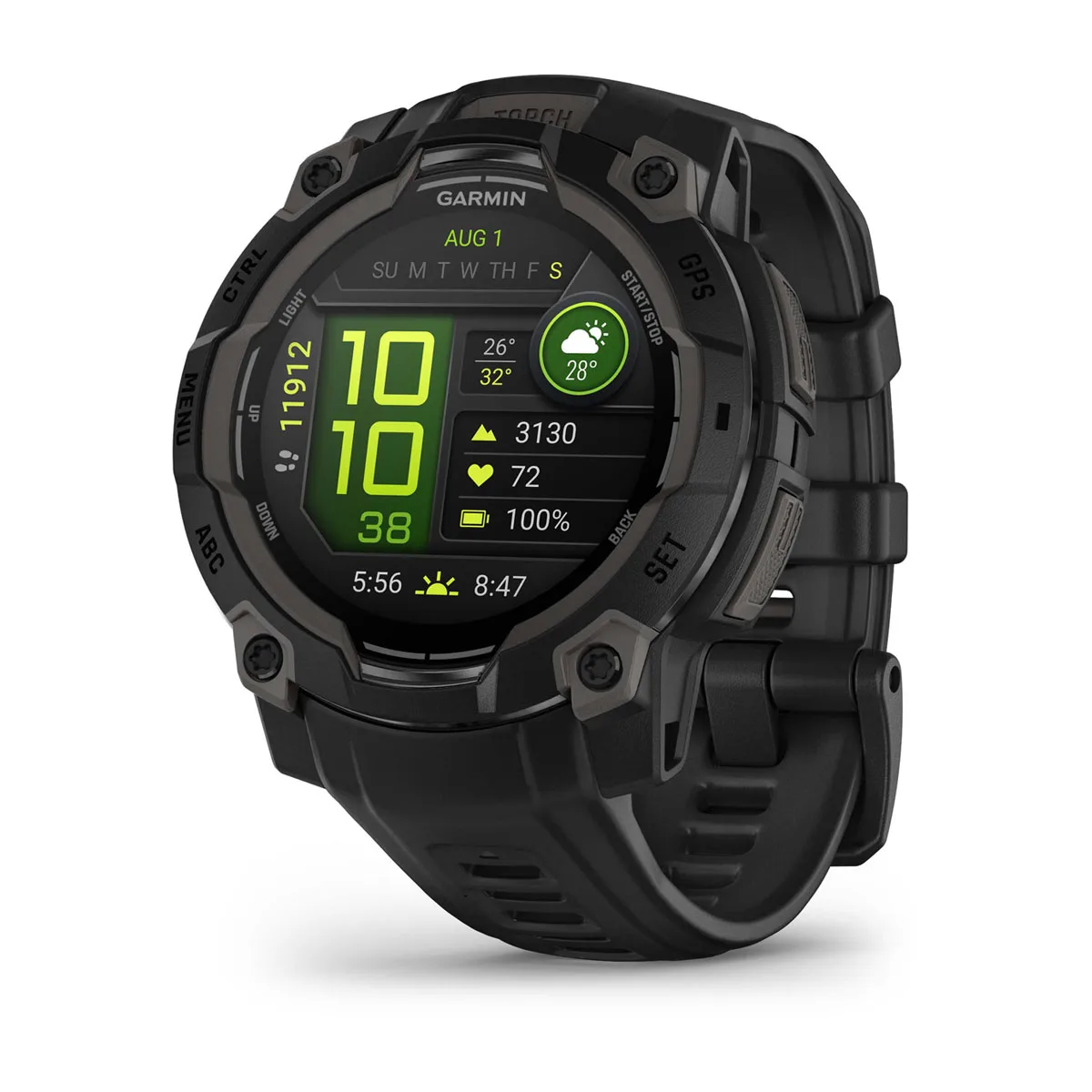
The Garmin Instinct 3 is a study in contradiction. It straps Garmin's best AMOLED display technology onto a watch that refuses to let you touch the screen. It charges from the sun but cannot store a single offline map for the trails you will navigate under that sun. It costs as much as competitors that offer meaningfully more features. And yet – worn through weeks of trail runs, gym sessions, and backcountry hiking – it is one of the most reliable, long-lasting, and genuinely tough adventure watches you can buy in 2026. The question is whether reliability and toughness are enough when the competition has moved on.
At 79/100, the Instinct 3 earns a cautious recommendation. It is an excellent tool for specific users, but a frustrating package of compromises for everyone else.
Design & Build
Pick up the Instinct 3 and you feel the intent immediately. The fiber-reinforced polymer case is dense without being heavy – 53 grams for the 45mm model, roughly the weight of a small egg. The metal-reinforced bezel catches light and takes knocks without complaint. Trail running through rocky terrain, gym work with barbells – the Instinct 3 handles daily punishment without visible damage beyond a superficial scuff on the band keeper.
The five-button control layout is classic Garmin. Every press is deliberate, every function accessible without looking. There is no touchscreen on any variant, and that is both the Instinct 3's identity and its limitation. Scrolling through data pages mid-workout is perfectly fine. Trying to zoom into a course map or type a response to a notification is where the button-only approach reveals its age.
Water resistance is rated at 10 ATM (100 meters), and the watch handles swimming, surfing, and shower steam without hesitation. The MIL-STD-810 certification for thermal and shock resistance is not marketing fluff – this watch is built to survive conditions that would crack lesser devices.
The built-in flashlight deserves mention. Variable intensity, red-light mode, and strobe make it genuinely useful for early-morning runs, campsite tasks, and emergency signaling. What started as a gimmick on Garmin's Fenix line has become a feature I reach for daily.
Display
This is where the Instinct 3 lineup splits into two fundamentally different watches.
The AMOLED variants (45mm and 50mm) are a revelation for the Instinct line. The 1.2-inch, 390x390 display on the 45mm delivers punchy colors, deep blacks, and sharp text that makes every data field readable at a glance. Coming from the Instinct 2's monochrome MIP panel, the upgrade is staggering. Graphs for heart rate zones, elevation profiles, and Body Battery actually become useful when rendered in full color.
The Solar variants retain the traditional MIP display – 0.9 inches on the 45mm, 1.1 inches on the 50mm, both at 176x176 resolution. These are functional, always-on, and perfectly readable in direct sunlight, but they feel like stepping back five years compared to the AMOLED. The tradeoff is battery life that borders on absurd (more on that below).
One frustration: the AMOLED model defaults to a gesture-activated wrist raise rather than always-on display. Enabling AOD cuts battery from 18 days to 7 days on the 45mm. That is a steep penalty, and it means the gorgeous screen spends most of its time dark.
Performance & Features
GPS performance is outstanding. Garmin's multi-band GNSS with SatIQ technology delivers consistently accurate tracks across forest canopy, urban canyons, and open mountain terrain. Compared side-by-side with a Fenix 8, track logs are nearly identical – the Instinct 3 benefits from the same satellite technology at roughly half the price.
SatIQ deserves credit here. It dynamically switches between single-band and multi-band based on signal conditions, which means excellent accuracy without unnecessarily hammering the battery. During a three-hour mountain bike ride through mixed canopy, GPS burn rate hovered at just 0.3% per hour with perfect track fidelity.
The activity profiles cover everything most outdoor athletes need: running, trail running, hiking, cycling, swimming, strength training, skiing, surfing, and more. Triathlon mode with auto-transition works smoothly. Training Load, Training Readiness, and Body Battery provide useful daily guidance for balancing effort and recovery.
But here is where the Instinct 3 stumbles – and stumbles hard.
No offline maps. At $449 for the AMOLED 45mm, you get breadcrumb navigation and basic course routing, but no topographic maps, no trail maps, nothing beyond a line on a blank screen. The Suunto Race at $399 includes full offline maps – $50 less for meaningfully more capability. The Coros Pace Pro at $349 offers offline maps and a touchscreen. For a watch marketed at outdoor adventurers, this omission is inexcusable in 2026.
No music storage. No speaker or microphone. These are features the Garmin Fenix 8 has. These are features competitors at the same price or lower have. Garmin has deliberately stripped them to protect its higher-priced lineup, and it shows.
Storage tells the story of Garmin's segmentation strategy. The Solar models get a paltry 128MB total, with roughly 90-100MB consumed by the system – barely room for Connect IQ apps, let alone music or maps. One post-launch firmware update could not install because the device had insufficient space. The AMOLED models fare better with approximately 4GB, but Garmin still does not enable music storage or offline maps on any Instinct 3 variant.
Health & Fitness
The Instinct 3 uses Garmin's Elevate Gen 4 optical heart rate sensor – not the newer Gen 5 found in the Fenix 8 and recent Forerunner models. It is a noticeable omission.
For steady-state activities – easy runs, hiking, zone 2 training – heart rate accuracy is solid, tracking within 3-5 BPM of a Polar H10 chest strap. Where it falters is during rapid intensity changes: interval sprints, HIIT sessions, and particularly outdoor cycling in cooler weather. There is a consistent 30-60 second lag when heart rate spikes, and the watch tends to underread peaks by 5-10 BPM during burst efforts.
For most recreational athletes, this is acceptable. For serious trainers chasing precise heart rate zones, pair a chest strap and move on.
Beyond heart rate, the health tracking suite is comprehensive and well-executed. Sleep tracking with sleep stages, HRV status, Body Battery, stress monitoring, Pulse Ox, Nap Detection, and Sleep Coach all work reliably. Garmin's algorithms remain best-in-class for translating raw sensor data into actionable daily guidance. Morning reports summarizing sleep quality, HRV trend, and training readiness are genuinely useful for planning the day's effort.
Battery Life
This is the Instinct 3's defining strength, and the reason many buyers will forgive its other shortcomings.
The 45mm AMOLED delivers up to 18 days in smartwatch mode with gesture-activated display, 32 hours of GPS-only tracking, and 23 hours with multi-band satellites. In real-world use with daily step tracking, notifications, and three GPS workouts per week, expect 12-14 days between charges. That is exceptional for an AMOLED watch.
The Solar variants are in a different league entirely. The 50mm Solar claims unlimited battery in smartwatch mode with adequate sun exposure (3 hours daily at 50,000 lux). In practice, that means hikers and outdoor workers in sunny climates may genuinely never need to charge the watch. GPS-only mode stretches to 60 hours without solar, 260 hours with it. During extended backpacking in clear conditions, the battery percentage can actually increase over the course of a full day of GPS tracking. That is remarkable.
For ultrarunners, thru-hikers, and multi-day expedition athletes, the Solar 50mm is difficult to beat. No other watch in this class – not even the Garmin Enduro 3 – offers comparable endurance at this price point.
Who It's For
The Garmin Instinct 3 is built for outdoor athletes who prioritize durability, battery life, and reliable GPS above all else. Trail runners who want a watch that survives falls and lasts weeks between charges. Hikers and backpackers – especially those considering the Solar variant for extended trips. Garmin ecosystem loyalists upgrading from the Instinct 2 who want a better display without jumping to Fenix pricing. If you're shopping for a rugged GPS watch, check our best outdoor watches guide for a full comparison.
Who Should Skip
Anyone who needs offline maps for backcountry navigation – the Suunto Race or Coros Nomad are better choices. Runners and cyclists who demand precise heart rate data without a chest strap – see our best running watches roundup for alternatives. Smartwatch users who want music, voice control, or a touchscreen. And anyone considering the 50mm AMOLED at $499 – at that price, a refurbished Fenix 8 offers vastly more capability, and the Coros Vertix 2S ($700), while pricier, delivers a full-featured adventure package.
The Verdict
Score: 79/100 – The Garmin Instinct 3 excels at ruggedness and battery life but charges a premium price while omitting features its competitors include by default.
The Instinct 3 is a strong watch with a clear identity problem. Garmin has built an impressively tough, reliable, and long-lasting adventure tool – then priced it against competitors that offer touchscreens, offline maps, and music storage. The AMOLED display is a welcome upgrade, and the Solar variant's battery endurance remains unmatched. But in 2026, toughness alone does not justify the asking price when the Suunto Race delivers more features for $50 less and the Coros Pace 3 undercuts it at $199. For budget-conscious buyers, our best budget smartwatches guide covers more affordable options.
Recommended for Garmin loyalists and solar-battery seekers. Everyone else should compare carefully before committing.