
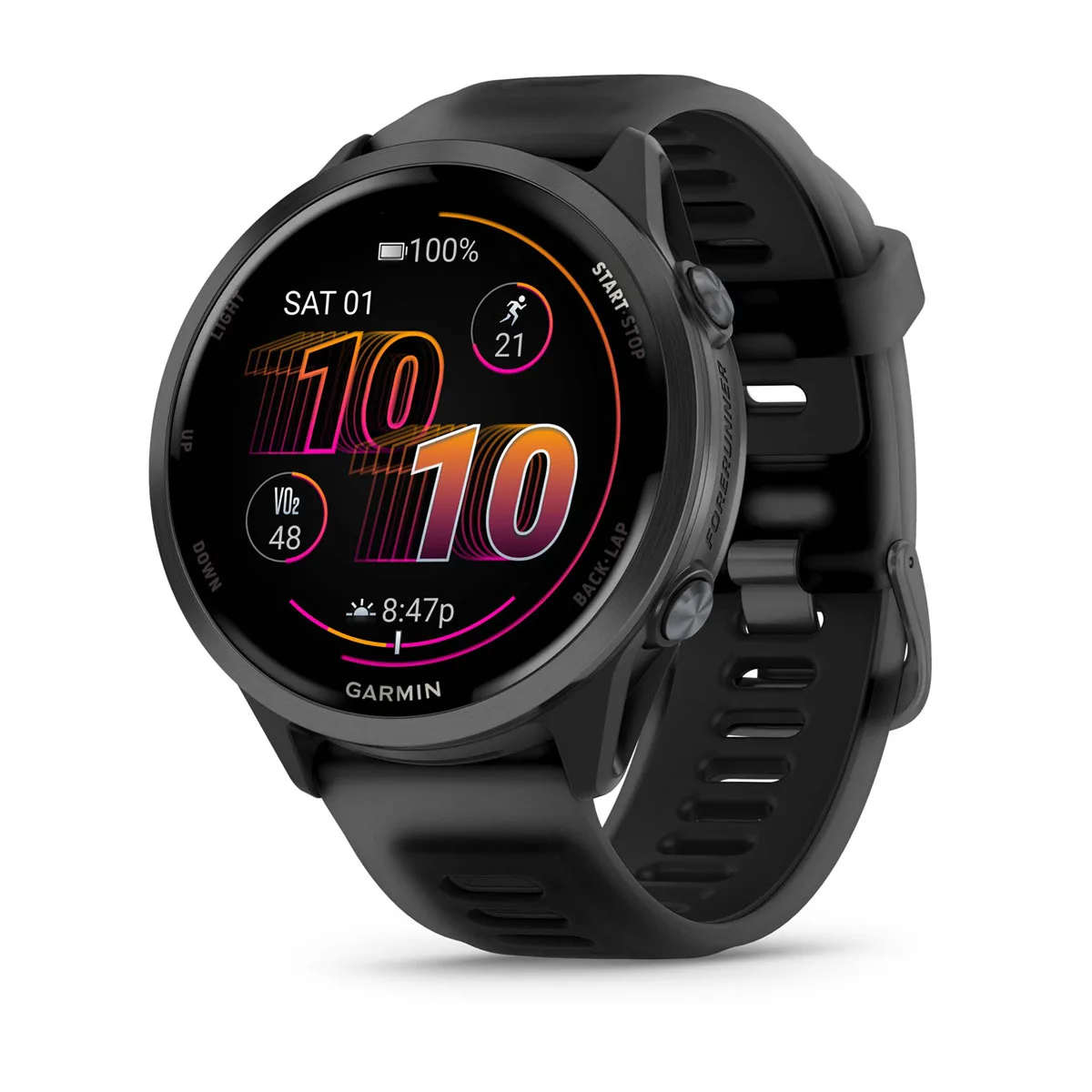
The Garmin Forerunner 570 is the best running watch you probably shouldn't buy at full price.
That sounds harsh for a device that genuinely excels at its core purpose – tracking your runs, swims, and rides with the kind of precision that has made Garmin the default choice for serious endurance athletes. The Forerunner 570 wraps that proven competence in a gorgeous new package: the brightest AMOLED display Garmin has ever made, a playful design overhaul with bold color options, and the latest Elevate Gen 5 heart rate sensor. On the wrist during a tempo run or an open-water swim, there is very little to fault. The problem is not what the 570 does. The problem is what it costs, and what it leaves out at that price.
At $549.99, the Forerunner 570 sits in the most uncomfortable spot in Garmin's lineup. It is $100 more than the Forerunner 265 it replaces, yet it still lacks offline maps, ECG readings, a dedicated LED flashlight, and sapphire glass – features you can find on competitors priced at or below the 570. Spend just $50 more and the Forerunner 965 gives you maps and a titanium bezel. Spend $250 less and the COROS PACE Pro gives you maps and 20 days of battery life. The Suunto Race 2 at $499 undercuts it with maps, sapphire glass, and superior battery. The 570 is caught in no man's land, and no amount of raspberry-mango color combos can change that math.
Design and Build
Garmin has loosened its collar with the Forerunner 570, and the result is the most visually striking Forerunner ever made. Gone is the utilitarian plastic-on-plastic aesthetic of the 265. In its place: an aluminum bezel, translucent silicone straps, and color combinations that range from understated (Slate Gray with black band) to genuinely bold (Amp Yellow with turquoise, Raspberry with mango). The 47mm model in Indigo with an imperial purple translucent band drew more compliments than any Garmin I have worn.
The case is fiber-reinforced polymer – sturdy but not premium in the way titanium feels – and the lens is Corning Gorilla Glass 3. That glass is perfectly adequate for daily wear and gym sessions, but at $550, the absence of sapphire crystal is notable. The Suunto Race 2 offers sapphire at $499. The Garmin Forerunner 965, at $599 MSRP and frequently discounted below $500, pairs Gorilla Glass 3 DX with a titanium bezel – the same glass family as the 570, but with a more premium frame. The 570's aluminum and Gorilla Glass sit in an uncomfortable middle ground: nicer than budget, but not premium enough to justify the premium price.
The watch comes in two sizes – 42mm at 42 grams and 47mm at 50 grams – both 12.9mm thick. Both are comfortable for all-day wear and sleep tracking, though the 47mm's wider 22mm quick-release band feels more secure during high-intensity efforts. Water resistance is rated at 5 ATM, sufficient for pool swimming and open water but falling short of the 10 ATM rating on the Suunto Race 2.
Display
This is where the Forerunner 570 genuinely earns its asking price, at least in isolation. The AMOLED panel is Garmin's brightest to date, and it transforms the outdoor experience. Running in direct afternoon sun with polarized sunglasses, the screen remains crisp and fully legible. The 47mm model's 1.4-inch display at 454 x 454 pixels is as large as screens get in Garmin's sport watch lineup, and the smaller 42mm version (1.2 inches, 390 x 390) is equally sharp for its size.
Colors are vivid and saturated, making the revamped Garmin interface feel more modern than ever. Data fields are easier to read mid-run, and the always-on display mode – while it devours battery – is genuinely useful during interval sessions when you need a constant glance at your pace. The touchscreen is responsive, complemented by five physical buttons for eyes-free operation during workouts.
If display quality were the sole criterion, the Forerunner 570 would be the best running watch on the market.
Performance and Features
The Forerunner 570 runs on Garmin's deep and mature training ecosystem, and this is where the watch truly delivers. Multi-band GNSS with SatIQ technology provides rock-solid positioning across urban canyons, dense tree cover, and mountain trails. During testing across road runs, trail sessions, and open-water swims, GPS tracks were consistently tight and accurate, with minimal drift even under heavy canopy.
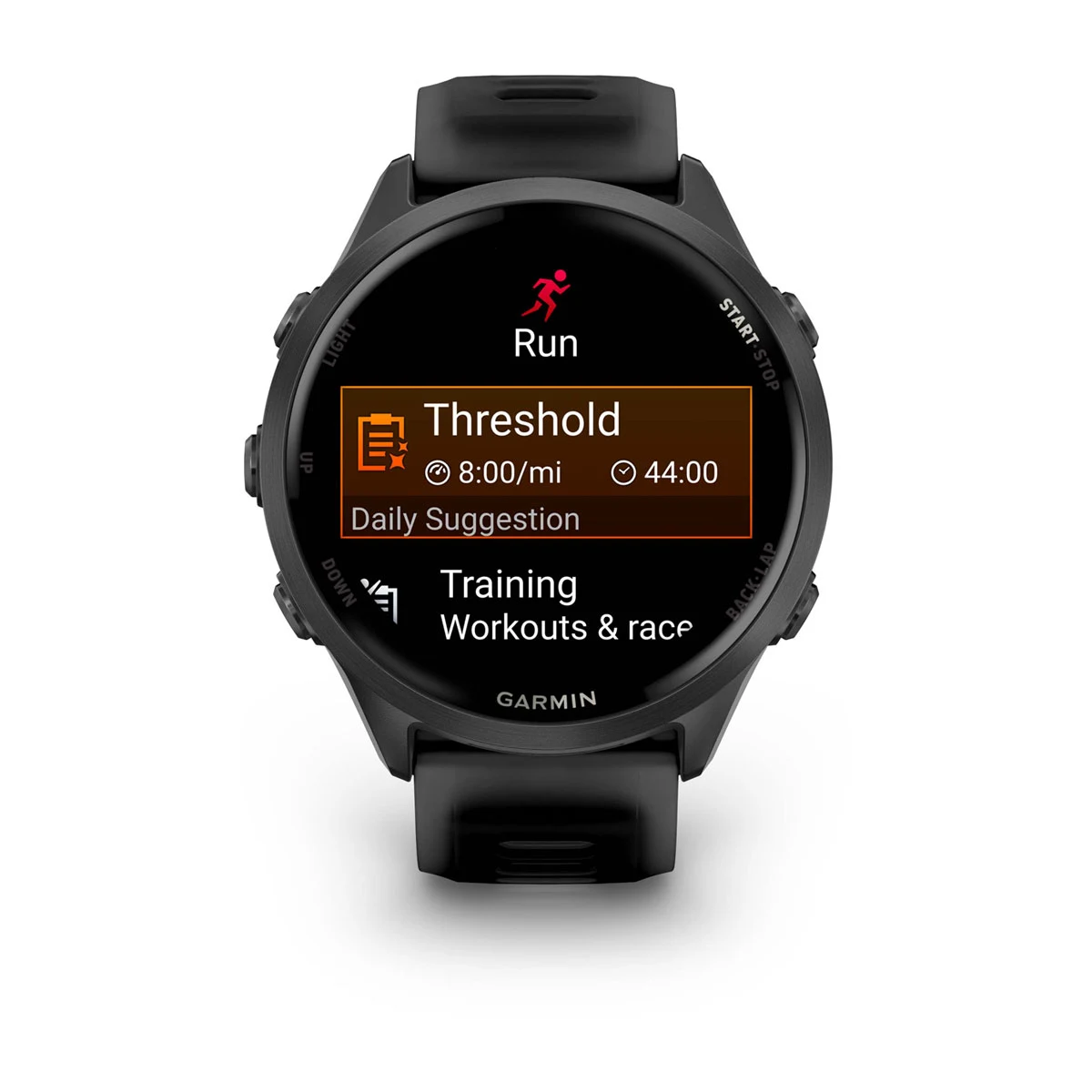
Training features are comprehensive: Training Readiness scores, Training Status, Training Load Ratio, VO2 Max estimation, wrist-based running power, PacePro for grade-adjusted pacing, and daily suggested workouts that adapt to your training load. Garmin Coach now extends beyond running to include cycling and strength training plans, and the new triathlon-specific structured workouts and Garmin Triathlon Coach plans make the 570 a legitimate multisport tool. There are over 50 activity profiles – including 23 not found on the Forerunner 265 – with newer additions like obstacle course racing, rucking, and cyclocross.
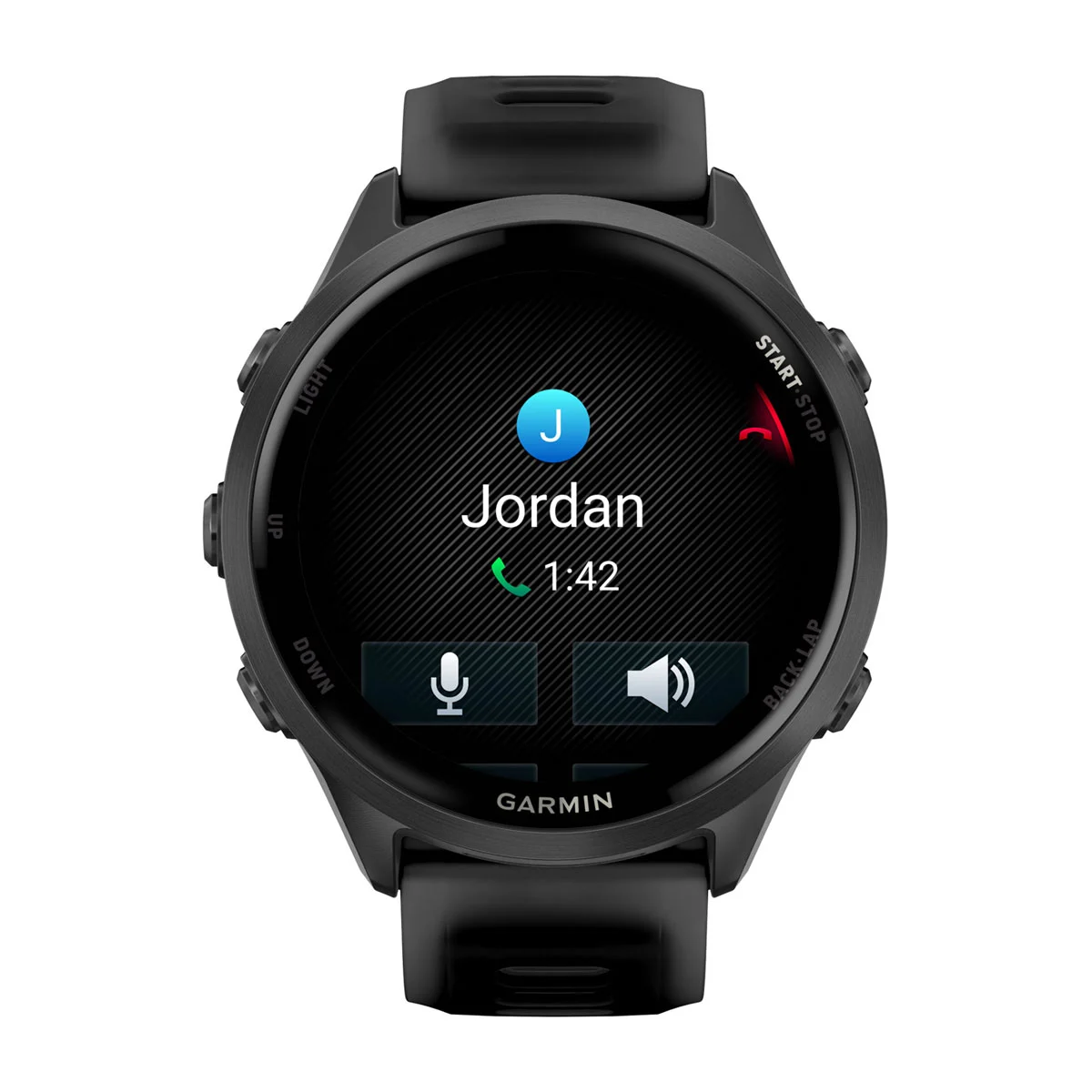
The built-in speaker and microphone are new additions for the Forerunner line, enabling Bluetooth phone calls from the wrist, voice commands for quick workout access, and smartphone voice assistant triggering. These are nice-to-have features rather than essential ones, but they do add daily convenience that the Forerunner 265 lacks entirely.
Music storage holds up to 500 songs on 8 GB of internal storage, with native support for Spotify Premium, Amazon Music, and Deezer. Garmin Pay via NFC handles contactless payments. Smart notifications, calendar access, and weather updates round out the smartwatch capabilities.
What the 570 conspicuously does not offer: offline maps (just basic breadcrumb navigation on a black screen), ECG readings (reserved for the Forerunner 970), and a dedicated LED flashlight (the 570 offers only a screen-based "flashlight" mode using the AMOLED panel). These omissions would be understandable at the Forerunner 265's $450 launch price. At $550, they sting.
Health and Fitness Tracking
The Elevate Gen 5 optical heart rate sensor is a genuine upgrade. It uses green, red, and infrared LEDs to deliver improved accuracy across a wider range of skin tones and wrist placements. During zone-based interval work and steady-state runs, wrist-based heart rate readings tracked closely with a chest strap reference, with only occasional lag during rapid intensity changes – a limitation inherent to all optical sensors.
Resting heart rate, heart rate variability, and sleep tracking are all improved, feeding into Garmin's Body Battery energy monitoring and morning/evening wellness reports. The new Evening Report is a thoughtful addition, providing a pre-sleep summary of your day's stress, activity, and recovery status. Sleep staging (light, deep, REM) is reliable, and the sleep coach offers actionable bedtime recommendations based on your recent patterns.
Pulse oximetry (SpO2) runs on demand or continuously overnight, and the new skin temperature sensor tracks overnight variations – useful for illness detection and menstrual cycle tracking, though Garmin's implementation requires wearing the watch to bed, which some users find uncomfortable given the 47mm model's thickness.
One notable gap: despite the Gen 5 sensor's ECG-capable hardware, the Forerunner 570 lacks the metal contacts and bezel connection required for ECG readings. That functionality is reserved for the Forerunner 970. For users who want wrist-based ECG on a Garmin, the Venu 4 offers it at $349 – $200 less than the 570.
Battery Life
Battery performance is competent but represents a step backward from the Forerunner 265, and that regression is hard to ignore at a higher price point.
Garmin claims up to 11 days in smartwatch mode for the 47mm (10 days for the 42mm), up to 18 hours in GPS-only mode, up to 14 hours in multi-band GNSS, and up to 16 hours in SatIQ auto-select mode. With music streaming, GPS modes drop to 8-9 hours.
In real-world use with notifications active, occasional SpO2 checks, and the always-on display enabled, the 47mm model lasted roughly 4-5 days between charges. With always-on display disabled and gesture-based wake instead, that stretched to about 7-8 days – solid, but noticeably short of the Forerunner 265's 13-day claim in smartwatch mode. The brighter, larger AMOLED panel is the culprit, and it is a trade-off that makes sense on paper but feels like a downgrade in daily life.
For context, the COROS PACE Pro claims up to 20 days in smartwatch mode, and the Suunto Race 2 manages up to 18 days. The Forerunner 965, despite its older display, claims up to 23 days. Battery life is not the 570's weakness in absolute terms – 18 hours of GPS is enough for most ultramarathon stages – but relative to its price class, it does not lead.
Who It's For and Who Should Skip
Buy the Forerunner 570 if: - You find it discounted below $450, where the value equation shifts dramatically - You want the brightest, most beautiful display on a Garmin sport watch - You value the speaker and microphone for hands-free calls during daily wear - You are a runner or triathlete who wants deep training metrics without stepping up to the Forerunner 970's $750 price
Skip the Forerunner 570 if: - You need offline maps for trail running or hiking – the COROS PACE Pro ($299), Suunto Race 2 ($499), or Garmin Forerunner 965 ($599, often discounted below $500) all deliver maps at or near this price - You want sapphire glass – the Suunto Race 2 ($499) offers sapphire and offline maps for $50 less - You already own a Forerunner 265 – the upgrades are real but incremental, and the 265 remains a superb watch at its now-discounted ~$350 street price - Battery life is a top priority – the 265, 965, COROS PACE Pro, and Suunto Race 2 all outlast the 570
The Verdict
The Garmin Forerunner 570 is a genuinely excellent running and multisport watch trapped inside a pricing strategy that undermines its appeal. The AMOLED display is the best in class. The GPS and heart rate accuracy are outstanding. The training ecosystem remains the deepest and most polished available. Garmin's new design direction is a welcome breath of fresh air for a lineup that has historically prioritized function over form.
But $549.99 is a lot of money for a watch that omits offline maps, ECG, and a dedicated flashlight – features that competitors are offering at or below this price. The Suunto Race 2 packs sapphire glass, maps, and superior battery life for $50 less. The Forerunner 570 occupies an awkward middle ground: too expensive to be the obvious mid-range pick, yet too feature-limited to justify its proximity to the flagship tier. Garmin's own lineup is the 570's worst enemy. The Forerunner 265 delivers 90% of this experience for $200 less, and the Forerunner 965 adds maps and a titanium bezel for just $50 more. If you're weighing all the options, check our guide to the best smartwatches for running for a full comparison.
If you catch it on sale below $450, buy it without hesitation. At full price, the math simply does not add up.
Score: 80/100
| Category | Weight | Score | Weighted |
|---|---|---|---|
| Core Function | 30% | 88 | 26.4 |
| Build Quality | 15% | 78 | 11.7 |
| User Experience | 20% | 84 | 16.8 |
| Value | 20% | 68 | 13.6 |
| Battery Life | 15% | 76 | 11.4 |
| Total | 100% | 80.0 |