

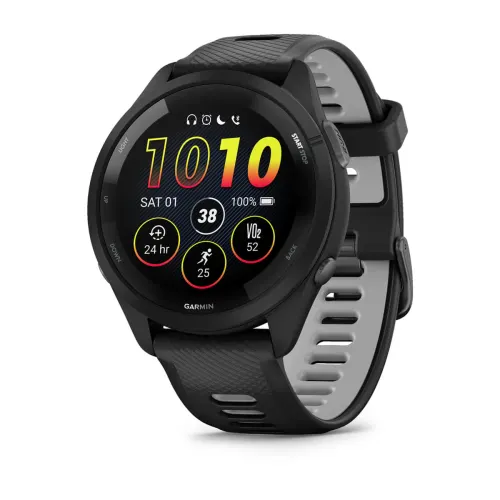
Before the Forerunner 265 arrived in March 2023, Garmin runners faced an ugly choice: buy a bright, colorful AMOLED display and accept mediocre battery life, or strap on a washed-out memory-in-pixel screen and enjoy two weeks between charges. The Forerunner 265 shattered that compromise. It delivered a vibrant 1.3-inch AMOLED touchscreen alongside up to 13 days of smartwatch battery life and 20 hours of continuous GPS tracking – numbers that made the entire running watch industry recalibrate what was possible. Glance down mid-stride and heart rate zones blaze in unmistakable color; wake up and a Morning Report paints your sleep, recovery, and training plan in gradients that make data feel intuitive rather than clinical.
Nearly three years later, with a successor already on shelves and a market flooded with AMOLED alternatives, the Forerunner 265 hasn't just aged gracefully. It has cemented itself as the most important running watch of its generation, and at current street prices around $300, it represents possibly the best value in serious GPS training technology today. Its optical heart rate sensor still struggles with sharp interval changes – a limitation shared by every wrist-worn sensor – but for the steady-state training that constitutes most runners' mileage, it delivers.
Design and Build
The Forerunner 265 is a watch that disappears on your wrist in the best possible way. At 47 grams with a 12.9mm thickness, it sits low and light enough to sleep in comfortably – a genuine requirement given how much of Garmin's training intelligence depends on overnight data. The fiber-reinforced polymer case won't win any jewelry awards, but it absorbs trail bumps and doorframe collisions without complaint. Two years into heavy rotation, the material shows virtually no wear.
Garmin offers two sizes: the standard 46mm case with a 1.3-inch display, and the 42mm Forerunner 265S that shrinks to 1.1 inches and drops to just 39 grams. Both share the same feature set, the same sensors, the same software – the only tradeoffs are screen real estate and wrist comfort.
The five-button layout carries over from Garmin's traditional design language, but the addition of a responsive touchscreen transforms daily interaction. Scrolling through Training Readiness data or pinching through Garmin Connect IQ watch faces feels fluid and natural. In the rain or with gloves on mid-winter, the physical buttons remain fully functional – a dual-input philosophy that touchscreen-only watches simply cannot match.
Corning Gorilla Glass 3 protects the display. It is not sapphire crystal, and it will pick up hairline scratches over months of hard use. A screen protector is a worthwhile $8 investment if you regularly brush against rock walls or gym equipment. The 5 ATM water resistance (50 meters) handles pool laps, open-water swims, and rainy trail runs without hesitation.
Color options add a welcome personality to the lineup – Aqua/Black and Whitestone/Tidal Blue stand out from the usual monochrome running watch palette, though the classic Black/Powder Gray remains the bestseller.
Display
This is the section that matters most, because the display is the reason the Forerunner 265 exists as a distinct product rather than a minor spec bump over the Forerunner 255.
The 1.3-inch AMOLED panel running at 416 x 416 pixels is, simply put, one of the most beautiful screens ever fitted to a running watch. Colors pop with a richness that makes heart rate zone graphs genuinely useful at a mid-stride glance – the difference between zone 3 orange and zone 4 red is instantly readable in a way that no MIP display can replicate. Deep blacks merge seamlessly with the bezel, giving the watch face an edge-to-edge illusion that makes it look far more premium than its polymer construction suggests.
Outdoor visibility under direct sunlight was the historical weakness of AMOLED sport watches, and it remains a slight compromise here. The Forerunner 265's peak brightness handles most conditions well, but under the harshest midday sun, a transflective MIP display is easier to read. In practice, a quick raise-to-wake gesture solves the issue in under a second, and the richness of the data presentation more than compensates for the rare moment of glare.
The always-on display mode keeps a simplified watch face visible at all times, though it cuts battery life to approximately five days. Most runners will find the default raise-to-wake behavior perfectly adequate and far more battery-friendly.
What the AMOLED display ultimately changed was not just aesthetics. It changed the relationship between runner and data. Morning Reports with colorful sleep stage breakdowns, Training Readiness scores rendered in intuitive green-yellow-red gradients, animated workout guides that show exactly which muscles to target – all of these features existed in some form on previous Garmin watches, but the AMOLED screen made them feel alive rather than academic.
Performance and Features
The Forerunner 265 runs on Garmin's mature software ecosystem, and two years of firmware updates have only sharpened its capabilities.
GPS accuracy is exceptional. The watch supports multi-band (dual-frequency) GNSS with Garmin's SatIQ technology, which intelligently switches between standard and all-systems satellite modes based on signal quality. In open terrain, GPS tracks are razor-straight. In dense urban canyons and thick forest canopy – environments that historically tormented running watches – multi-band mode produces impressively clean traces with minimal drift. The tradeoff is battery: multi-band GPS drops endurance from up to 20 hours to up to 14 hours, but SatIQ's automatic switching means you rarely need to force it on manually.
Garmin Connect remains the deepest training platform available, and the Forerunner 265 feeds it exceptionally well. Every run produces a detailed breakdown of pace, cadence, stride length, vertical oscillation, and ground contact time – all measured from the wrist without any external sensor. This wrist-based running dynamics capability debuted on the 265 and eliminated the need for the HRM-Pro chest strap or Running Dynamics Pod for casual form analysis. The data won't replace a biomechanics lab, but it is remarkably consistent for identifying asymmetries and tracking form changes over training cycles.
Training Readiness is the headline software feature and arguably the most useful metric Garmin has ever created. Each morning, the watch synthesizes your HRV status, sleep quality, recovery time, acute training load, and stress levels into a single readiness score. A green number means push hard. Yellow means proceed with caution. Red means rest. After months of calibration, the algorithm becomes uncannily accurate at predicting which days feel strong and which feel hollow – and it has prevented more than a few ill-advised tempo runs on depleted legs.
Additional training intelligence includes VO2 Max estimation (consistently within 1-2 ml/kg/min of lab-tested values for experienced runners), Training Status that categorizes your recent load as productive, maintaining, or overreaching, and race time predictions for 5K through marathon distances. The race predictor skews slightly optimistic for longer distances but serves as a useful benchmark gauge.
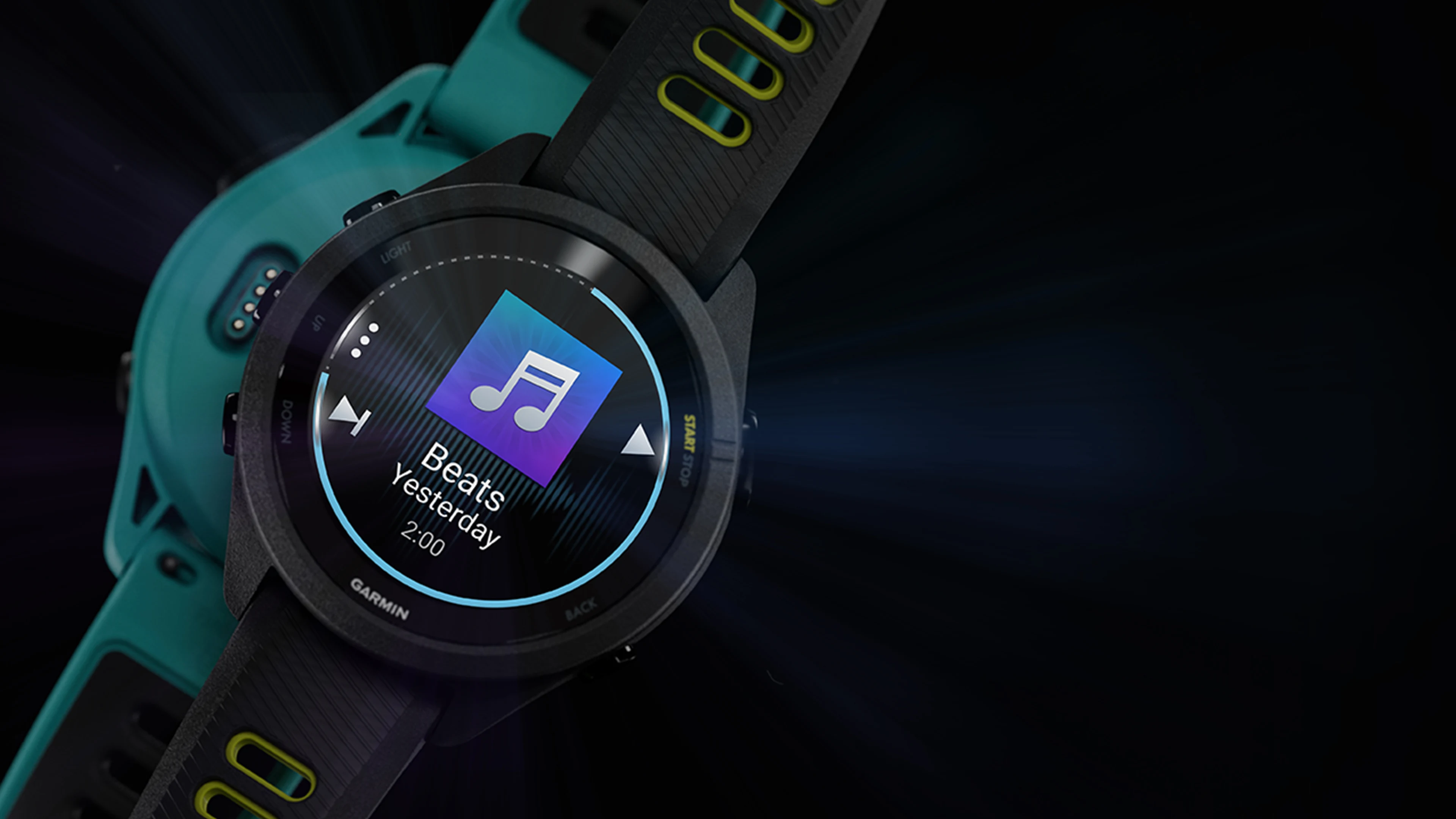
Music storage fills the 8GB of internal memory with offline playlists from Spotify, Amazon Music, or Deezer. Paired with Bluetooth headphones, it enables phone-free runs with a full soundtrack. Audio streaming drains battery faster – GPS with music drops to roughly 6 to 7 hours depending on satellite mode – but for most training runs under 90 minutes, it is a non-issue.
Smart notifications, Garmin Pay via NFC, and Connect IQ app and watch face customization round out the feature set. This is not an Apple Watch or Galaxy Watch in terms of smartwatch breadth, and it makes no effort to be one. There is no LTE connectivity, no voice assistant, no app store rivaling WearOS. What it offers instead is a focused, distraction-free training tool that also tells the time and shows your text messages.
Health and Fitness Tracking
The Forerunner 265 uses Garmin's Elevate V4 optical heart rate sensor, a multi-LED array that reads heart rate and blood oxygen (SpO2) levels from the wrist. For steady-state running – easy runs, tempo efforts, long runs at consistent intensity – the optical sensor tracks within 3-5 BPM of a chest strap in most conditions. That is genuinely impressive for a wrist-worn sensor and sufficient for zone-based training.
Where the Elevate V4 stumbles is the same place every optical wrist sensor stumbles: rapid intensity changes. Hard interval sessions with sharp accelerations and recoveries can produce momentary cadence-lock artifacts, where the sensor briefly confuses arm swing cadence with heart rate. A tight fit two finger-widths above the wrist bone minimizes this, but serious interval athletes should still pair a chest strap like the Polar H10 or Garmin HRM-Pro for session-critical data.
24/7 heart rate monitoring feeds into stress tracking, Body Battery energy scoring, and all-day respiration rate. The overnight data is particularly valuable: the watch tracks HRV (heart rate variability) during sleep and uses it to calculate a seven-day HRV status that provides an early warning system for overtraining, illness, or accumulated fatigue.
Sleep tracking scores each night on duration, deep sleep percentage, REM time, and restlessness. It is not polysomnography-grade, and it occasionally miscounts brief wake periods, but the trend data across weeks is genuinely actionable. The Morning Report that greets you with a consolidated sleep score, HRV status, weather, and training plan for the day is one of those features that becomes indispensable quickly.
The 30+ sport profiles extend well beyond running. Pool swimming tracks laps, stroke type, and SWOLF efficiency with reliable accuracy. Cycling power data integrates seamlessly with ANT+ and Bluetooth power meters. Triathlon and multisport modes handle automatic transitions. Strength training counts reps (with mixed accuracy – always verify the count) and identifies exercises. Hiking, skiing, yoga, HIIT, and even breathwork profiles round out a comprehensive activity portfolio.
Battery Life
This is where the Forerunner 265 made its most consequential argument. When it launched, the running watch market assumed that AMOLED displays demanded a charger every two or three days. The Forerunner 265 disagreed.
Official battery claims: - Smartwatch mode: up to 13 days - GPS mode (GPS only): up to 20 hours - GPS mode (all systems + multi-band): up to 14 hours - GPS mode with music: up to 6-7 hours (varies by satellite mode) - Always-on display: approximately 5 days
In real-world testing with a daily one-hour GPS run, intermittent music streaming, all-day heart rate monitoring, sleep tracking, and smart notifications, the watch consistently delivers 4 to 5 days between charges with the always-on display enabled. Disable AOD and rely on raise-to-wake, and that stretches to 7 to 9 days depending on GPS usage intensity.
Those numbers may sound modest compared to the Forerunner 255's legendary 14-day smartwatch battery, but they obliterate the competition in the AMOLED running watch segment. The Apple Watch Ultra 2 manages up to 36 hours. The Samsung Galaxy Watch Ultra manages up to 60 hours of typical use. The COROS PACE Pro, a direct competitor at $299, lasts longer on paper but lacks Garmin's depth of training intelligence. No AMOLED running watch on the market matches the Forerunner 265's combination of display quality and endurance.
The proprietary Garmin charging cable (not wireless, not Qi) fully replenishes the battery in roughly two hours. It is not the fastest charging in the segment, but the infrequency of charging sessions makes it a minor inconvenience.
Who It's For
Buy the Forerunner 265 if you are: - A runner who wants serious training metrics without the complexity of the Forerunner 965 - Upgrading from an older Garmin (Forerunner 245, 245 Music, or earlier) and want a generational leap in display, sensors, and software - A triathlete or multisport athlete who needs reliable swim/bike/run tracking without paying for offline maps you will never use - Someone who values battery life but refuses to sacrifice display quality - A data-driven athlete who wants Training Readiness, HRV tracking, and wrist-based running dynamics without wearing a chest strap for every run
Skip the Forerunner 265 if you: - Need offline maps and turn-by-turn trail navigation (the Forerunner 965 or Fenix 8 serve that need) - Prioritize smartwatch features like LTE calling, voice assistants, or a deep third-party app ecosystem (the Apple Watch or Galaxy Watch family fits better) - Want ECG or advanced cardiac monitoring (Garmin reserves that for the Venu 3 and newer models) - Are satisfied with the Forerunner 255 and primarily care about battery longevity over display quality – the 255 still works beautifully and lasts longer per charge - Are on a tight budget and the Forerunner 165 at $249.99 MSRP (or $299.99 for the Music edition) covers your needs
The Verdict
The Garmin Forerunner 265 is the watch that proved AMOLED and endurance could coexist, and nearly three years later, nothing has fully eclipsed that achievement. Its training intelligence is deep and genuinely useful. Its GPS accuracy is among the best available. Its battery life, while shorter than MIP predecessors, remains class-leading for an AMOLED sport watch. And at current street prices around $300 – a significant discount from the $449.99 MSRP – it represents extraordinary value for a watch that Garmin still actively supports with firmware updates.
The optical heart rate sensor has its limits during high-intensity intervals, and the lack of offline maps constrains its utility for backcountry exploration. These are real limitations, not nitpicks. But for the overwhelming majority of runners who train on roads, tracks, and well-marked trails, the Forerunner 265 delivers everything that matters and does so with a screen that makes every data point a pleasure to read. For a broader look at the category, check our best running watches guide.
Score: 88/100
| Category | Score | Weight | Weighted |
|---|---|---|---|
| Core Function (GPS, training metrics, sport tracking) | 92 | 30% | 27.6 |
| Build Quality (materials, durability, water resistance) | 83 | 15% | 12.5 |
| User Experience (display, UI, software ecosystem) | 91 | 20% | 18.2 |
| Value (price-to-performance, feature density) | 90 | 20% | 18.0 |
| Battery Life (real-world endurance, charging speed) | 79 | 15% | 11.9 |
| Total | 100% | 88.2 |
The bottom line: Even with the Forerunner 570 on shelves, the 265 remains the smarter buy for most runners. It delivers elite GPS accuracy, deep training intelligence, and a gorgeous AMOLED display with battery life that lasts nearly a week of real training – all for roughly $150 less than its successor.