
The Budget Running Watch That Started a Price War
When Garmin dropped the Forerunner 165 in February 2024, it detonated a quiet bomb in the running watch market. Here was a $249.99 GPS watch with the same gorgeous AMOLED display technology that had been locked behind the $449+ Forerunner 265 just months earlier, paired with the kind of training tools that would have cost you $500 a generation ago. Two years later, the ripple effects are still being felt: COROS slashed the PACE 3 to $199, Amazfit pushed harder on sub-$200 AMOLED options, and the entire definition of what a "budget" running watch should deliver was permanently rewritten. And the watch that started it all? Still the one to beat at its price.
After wearing this watch through hundreds of miles across road runs, trail sessions, and a handful of races, the Forerunner 165 remains one of the most compelling values in the running watch market – even in early 2026, when the competition has had two full years to respond. The question is no longer whether the FR165 is good enough. It is whether you actually need anything more.
Design and Build
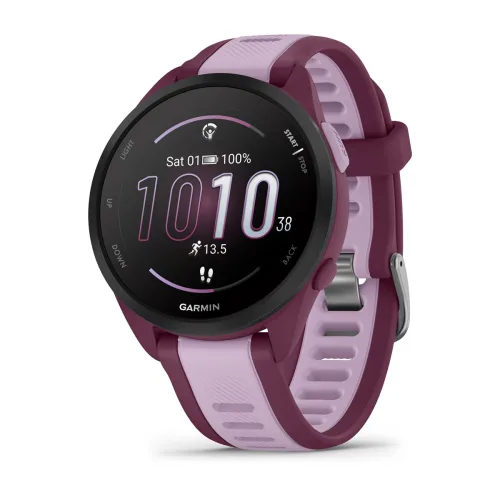
The Forerunner 165 is a watch that disappears on the wrist, and I mean that as the highest compliment. At 39 grams with its silicone strap, the fiber-reinforced polymer case sits at 43 x 43 x 11.6mm – compact enough that it does not look out of place under a dress shirt, light enough that you forget about it mid-run. The 20mm quick-release silicone band is soft and breathable, with none of the skin irritation issues that plague cheaper alternatives.
The case is plastic, and it looks like plastic. Garmin made no attempt to disguise this with faux-metal finishes or decorative flourishes. The five buttons – three on the left, two on the right – have a satisfying click, and the touchscreen is responsive even with sweaty fingers. The chemically strengthened glass over the display is a step down from the Corning Gorilla Glass 3 on the pricier Forerunner 265, but after two years of daily wear – including accidental doorframe encounters and a few tumbles on rocky trails – my unit shows only the faintest hairline scratches visible under direct light. A screen protector is wise insurance, but not strictly mandatory.
Water resistance is rated at 5 ATM (50 meters), and the watch handles pool swimming without complaint. I have tracked open water swims and worn it through countless post-run showers without a single moisture issue.
Display
This is where the Forerunner 165 still punches above its weight class. The 1.2-inch AMOLED panel runs at 390 x 390 pixels, and it is genuinely stunning. Colors are saturated without being garish, blacks are true black, and the contrast makes data fields pop during mid-run glances. In bright sunlight, the display remains perfectly legible – a concern I had coming from Garmin's older MIP (memory-in-pixel) displays, which were sunlight champions.
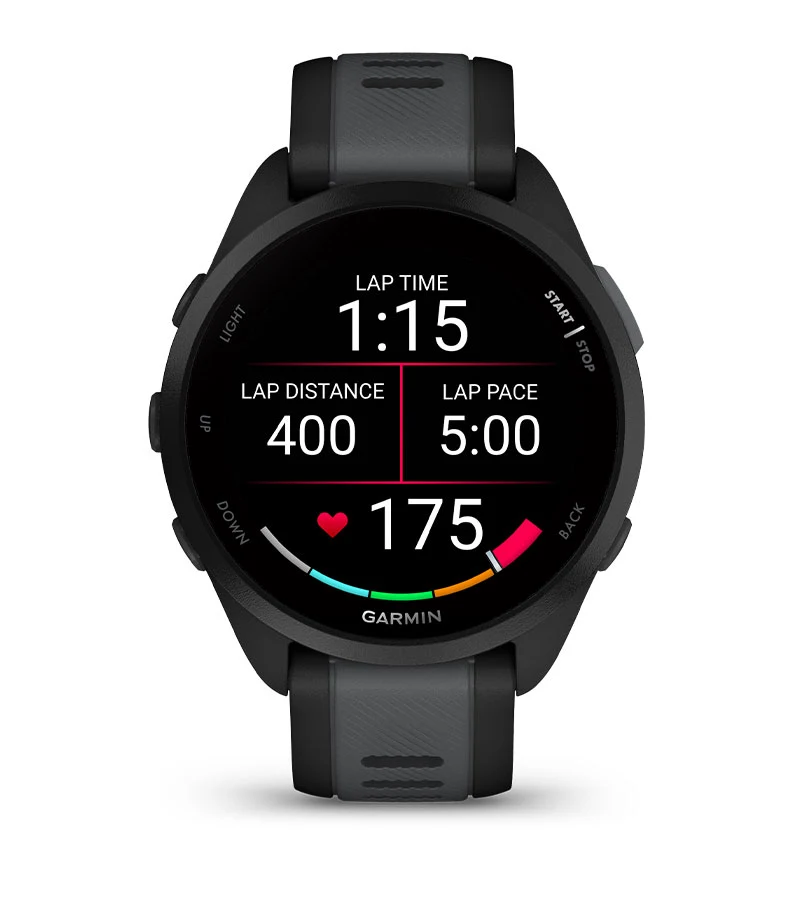
The touchscreen responds quickly and accurately, complementing the physical buttons – particularly the start/stop and back/lap controls on the right side. Navigation feels natural: swipe through widgets on the touchscreen, use buttons during workouts when your fingers are too wet or gloved.
The always-on display mode is available but comes with a meaningful battery trade-off, dropping smartwatch endurance from roughly 11 days to about 4 days. I ran with AOD on for about a month before switching it off; the raise-to-wake gesture is fast enough that the compromise did not feel worth it for my usage. Your mileage may vary, especially if you like checking pace without the wrist-flick.
Performance and Features
The Forerunner 165 supports multi-GNSS tracking – GPS, GLONASS, and Galileo – though notably not the dual-frequency (multi-band) GPS found on the Forerunner 265 and Forerunner 955. On paper, this sounds like a significant compromise. In practice, it barely matters. Across dozens of tracked runs through urban canyons, tree-lined trails, and open roads, the GPS accuracy has been remarkably consistent. Typical deviation on a known 5K loop is 0.02-0.05 miles, which matches – and occasionally beats – what I see from watches costing twice as much.
The satellite lock time is my one recurring frustration. On cold starts, particularly in areas with tall buildings, the FR165 can take 30 seconds to a minute to acquire a signal. Occasionally it stretches to several minutes. Starting your activity from the same location repeatedly helps, as the watch caches satellite positions, but impatient runners will want to hit the GPS button while lacing up rather than waiting at the trailhead.
Sport profiles number over 25, covering the essentials: road running, trail running, track running, treadmill, cycling (indoor and outdoor), pool and open water swimming, hiking, walking, strength training, yoga, HIIT, pickleball, tennis, and more. The conspicuous absences are triathlon/multisport mode (reserved for the FR 255 and above), skiing/snowboarding, and cycling power meter support. If you need any of those, this is not your watch.
Running-specific features are deep. The FR165 calculates cadence, stride length, ground contact time, and vertical oscillation directly from the wrist accelerometer – no external pod required. You get VO2 max estimates, race time predictions, recovery time advisories, and Garmin's PacePro pacing strategy tool. The Garmin Coach adaptive training plans are excellent for runners working toward 5K, 10K, or half marathon goals, delivering structured workouts straight to the watch face.
What you do not get – and this is the primary software distinction from the FR265 – is Training Readiness, Training Load, and Training Status. These are the features that tell you whether your training load is productive, maintaining, or overreaching. For intermediate to advanced runners who live by those metrics, this omission stings. For the majority of runners who want solid GPS tracking, daily suggested workouts, and helpful health metrics, it will never be missed.
The Music variant ($299.99 MSRP) adds 4GB of onboard storage for Spotify, Amazon Music, Deezer, and YouTube Music playlists. Bluetooth headphone pairing is reliable. If you run without your phone, this is worth the $50 premium. If your phone is always in your pocket or armband, save the money.
Connect IQ support opens up a world of custom watch faces, data fields, and apps – though the selection for the FR165 is somewhat more limited than for flagship models. Garmin Pay contactless payments work smoothly for post-run coffee stops.
Health and Fitness Tracking
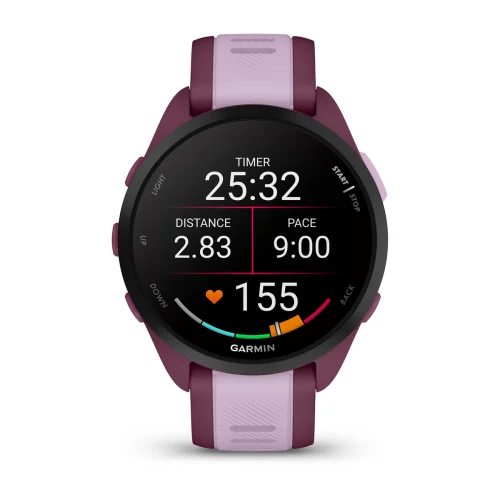
The Elevate v4 optical heart rate sensor on the Forerunner 165 is the same hardware found in the Forerunner 265 and Garmin Vivoactive 5, and the accuracy reflects it. During steady-state runs, the wrist readings track closely with a chest strap – typically within 1-3 BPM. During high-intensity intervals with rapid heart rate changes, the wrist sensor occasionally lags by a few beats, which is standard behavior for optical sensors across all brands. For interval training where every beat matters, pair a chest strap via Bluetooth or ANT+.
Sleep tracking delivers a nightly sleep score with breakdowns for light, deep, and REM stages. The data is directionally useful – it correctly identifies my worst nights and best nights – but the precision of awake-time detection is inconsistent. Nights with brief wake-ups to check on kids tend to get logged as uninterrupted sleep. This is not unique to the FR165; it is a limitation of wrist-based accelerometer sleep tracking across the industry.
Body Battery, Garmin's energy-level metric that synthesizes heart rate variability, sleep quality, stress, and activity data, has become one of my most-checked features. It is not scientifically rigorous, but it is remarkably good at telling me whether I should push a tempo run or dial it back to an easy jog. The Morning Report that greets you each day with sleep score, recovery status, weather, and training suggestions is a genuinely useful feature that trickled down from the FR955.
Stress tracking, blood oxygen (SpO2) monitoring, women's health tracking, and all-day respiration rate round out the health suite. The Forerunner 165 is not a medical device, but as a holistic daily health companion, it delivers far more than its price suggests.
Battery Life
Garmin claims up to 11 days in smartwatch mode and up to 19 hours in GPS-only mode. Those numbers hold up. With daily activity tracking, constant heart rate monitoring, phone notifications, and 3-4 GPS-tracked runs per week (averaging 45-60 minutes each), I consistently hit 8-10 days between charges. That is outstanding for an AMOLED watch at this price.
In GPS mode, the All Systems satellite configuration (GPS + GLONASS + Galileo) drops battery life to about 17 hours, which is still more than enough for ultra-distance events up to 50K for most runners. The UltraTrac mode stretches to up to 25 hours by reducing GPS polling frequency – acceptable for long hikes, less ideal for precise run tracking.
The Music model delivers up to 7 hours of GPS with music streaming to Bluetooth headphones (about 6.5 hours in All Systems mode), which comfortably covers a marathon and then some.
Charging uses Garmin's proprietary cable, and a full charge from empty takes about an hour. A quick 10-minute charge provides enough juice for a GPS-tracked run, which is a lifesaver when you forget to top off the night before race day.
Who It's For
Buy the Forerunner 165 if you are: - A beginner to intermediate runner who wants accurate GPS, a gorgeous display, and the Garmin ecosystem without paying $400+ - A daily runner who values reliable health metrics, Body Battery, and adaptive training plans - Someone upgrading from a basic fitness tracker or an older Garmin (FR45, FR55, FR245) who wants AMOLED and modern features - A runner who primarily does road running, trail running, and cross-training, and does not need triathlon mode
Skip the Forerunner 165 if you are: - A triathlete or multisport athlete who needs brick workouts and auto-transition – look at the FR255 or COROS PACE Pro - An advanced runner who relies on Training Load, Training Status, and Training Readiness to periodize training – the FR265 is worth the upgrade - A cyclist who needs power meter support – this watch does not have it - Someone who wants offline maps and navigation – that starts at the FR965
The Verdict
WearableBeat Score: 84/100
| Category | Weight | Score | Weighted |
|---|---|---|---|
| Core Function | 30% | 82 | 24.6 |
| Build Quality | 15% | 78 | 11.7 |
| User Experience | 20% | 85 | 17.0 |
| Value | 20% | 92 | 18.4 |
| Battery Life | 15% | 82 | 12.3 |
| Total | 100% | 84.0 |
The Garmin Forerunner 165 is the watch that proved you do not need to spend $400 to get a serious running tool. Two years after launch, it remains the default recommendation for any runner who wants the Garmin ecosystem, an AMOLED display, and accurate GPS tracking without the premium tax. The MSRP of $249.99 ($299.99 for Music) was already aggressive; at a frequent sale price of around $200, it is an outright steal. For more options at this price point, see our best budget smartwatches guide and our best running watches roundup.
What it sacrifices – Training Load analytics, multi-band GPS, triathlon mode, Gorilla Glass – are features that matter deeply to a subset of runners and barely register for the vast majority. The FR165 understood its audience from day one: runners who want their watch to track accurately, look great, last more than a week, and get out of the way. On all four counts, it delivers. The price war it started was not an accident. It was a statement that the era of overpriced entry-level running watches was over – and two years later, the competition is still catching up.