
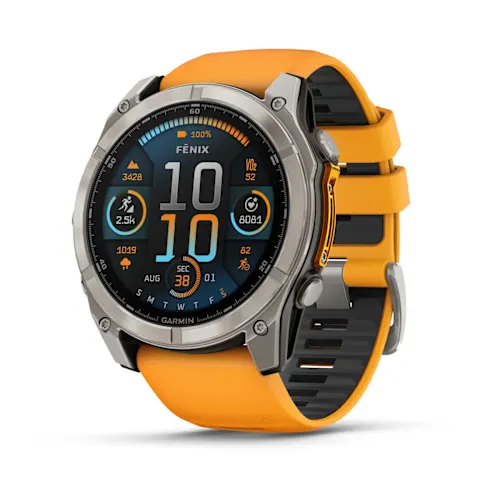
The Garmin Fenix 8 is the most capable multisport watch ever made – and at $999.99, the most expensive Fenix ever made. If you are upgrading from a Fenix 5, Fenix 6, or any non-Garmin multisport watch, this is the one to buy. But if you already own a Fenix 7 Pro or Epix Pro, the upgrade is steep for what amounts to a dive computer, a speaker, and a flashlight.
Starting at $999.99 for the 47mm AMOLED model and climbing to $1,099.99 for the 51mm stainless steel and $1,199.99 for the 51mm sapphire titanium, the Fenix 8 demands a premium that previous Fenix generations never dared to ask. The GPS is best-in-class, the AMOLED display is gorgeous, the build is indestructible, and the training ecosystem remains unmatched. Our score: 84/100 (Recommended) – excellence held back only by a Value score of 68 that reflects the hard truth: the Fenix 7 Pro at ~$599-$699 offers 90% of the experience at 60% of the cost.
Design & Build
The Fenix 8 is the product of Garmin finally merging the Fenix and Epix lines into a single family. You can now get AMOLED or solar MIP displays across the board, in 43mm, 47mm, or 51mm case sizes. The 47mm AMOLED is available in both stainless steel ($999.99) and sapphire titanium ($1,099.99), and the titanium model is worth every penny of that $100 uplift. At roughly 73 grams with the silicone band (versus 81 grams for steel), the weight difference is noticeable during long runs and overnight wear.
The most interesting design change is invisible until you press the buttons. Garmin replaced traditional mechanical pushers with leakproof inductive buttons. They still feel like physical buttons – there is a satisfying click – but the sealed design enables the 40-meter dive rating (certified to EN13319). The five-button layout remains unchanged, and the touchscreen works alongside buttons for navigation. A built-in LED flashlight sits above the 12 o'clock position, bright enough to find your way back to a trailhead after dark.
Build quality is Garmin at its absolute best. The fiber-reinforced polymer case shrugs off trail impacts, the sapphire crystal lens on the higher-end models resists scratching (go sapphire if you are doing anything outdoors – the standard Gorilla Glass scratches faster than you would expect at this price), and the whole package meets MIL-STD-810 standards for thermal, shock, and water resistance.
Display
The 1.4-inch AMOLED panel on the 47mm model runs at 454 x 454 pixels with up to 1,000 nits of peak brightness. In direct sunlight, it remains legible. In low light, the colors pop off the wrist in a way that the old MIP screens never could. Topographic maps are rendered in vivid detail, and the AMOLED contrast ratio makes data fields easy to read mid-effort without squinting.
Always-on display mode is available but cuts battery life roughly in half (from 16 days to about 7 days in smartwatch mode on the 47mm). The raise-to-wake gesture responds quickly and reliably. The display auto-brightness is generally good, though there is a known quirk where it dims aggressively in certain low-light conditions – a minor firmware annoyance that Garmin has been iterating on.
If battery life matters more than display vibrancy, the solar MIP versions offer dramatically longer endurance (up to 28 days with solar on the 47mm), but the AMOLED is the better daily experience for most people.
Performance & Features
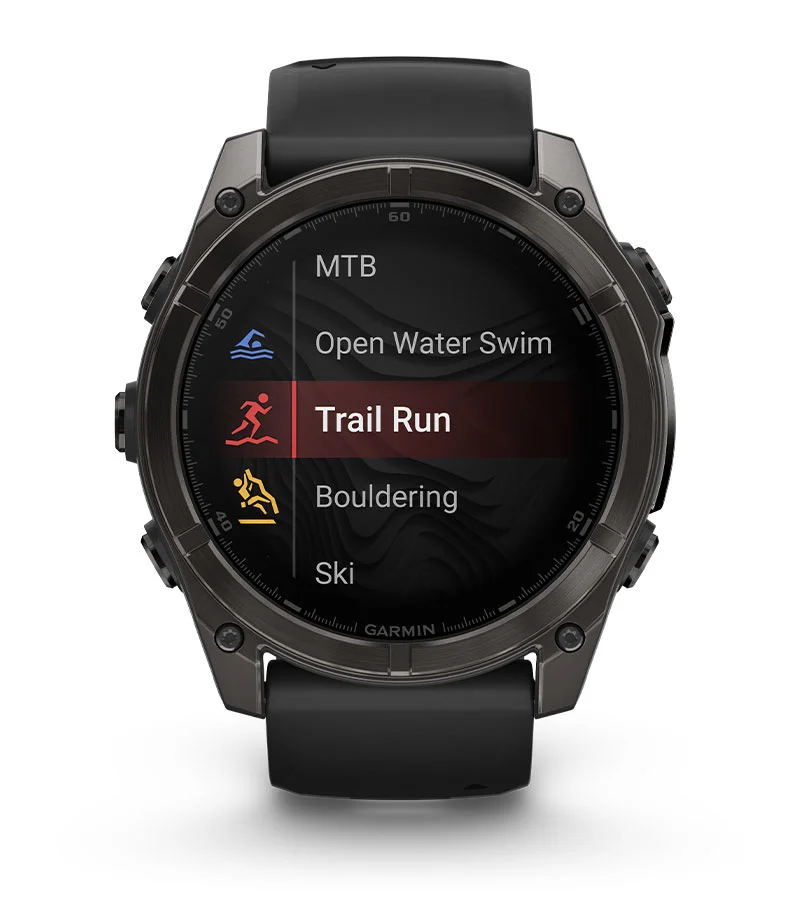
GPS accuracy is where the Fenix 8 truly earns its flagship status. The multi-band GNSS chipset with SatIQ technology delivers the most precise positioning available on any wrist-based device. Urban canyons, dense forest canopy, steep mountain valleys – the track logs are consistently tight and accurate. SatIQ intelligently toggles between GPS modes to balance accuracy and battery life, and in practice, it works remarkably well. Open-water swim tracking shows meaningful improvement thanks to the new position enhancement feature.
On the smartwatch side, the Fenix 8 introduces a built-in speaker and microphone. Phone calls work on your wrist (with your phone nearby via Bluetooth), voice notes are handy for mid-trail observations, and offline voice commands help start activities or set timers hands-free. Call quality is serviceable but unremarkable – fine for quick conversations, not a replacement for your phone. These are useful additions, but the speaker and microphone alone do not justify a $300 price increase over the Fenix 7 Pro for most athletes.
Garmin Pay works via NFC for contactless payments. Music storage holds up to 2,000 songs locally via 32GB of onboard storage, with offline support for Spotify, Deezer, and Amazon Music. Full topographic maps come preloaded with dynamic round-trip routing, though this feature can occasionally generate questionable route suggestions.
The 40-meter dive functionality is a genuine differentiator. The Fenix 8 functions as a certified recreational dive computer with depth gauge, water temperature, and dive logging. If you split your time between trail running and scuba diving, this eliminates the need for a dedicated dive watch – a compelling value proposition that partially offsets the price premium.
Health & Fitness
The Elevate V5 optical heart rate sensor delivers strong accuracy across a range of activities. During steady-state running and cycling, wrist-based readings track closely with a chest strap. High-intensity intervals show occasional lag – a common limitation of optical sensors – but recovery readings snap back quickly. The sensor is identical to the one in the Fenix 7 Pro and Epix Pro – do not expect a generational leap in HR accuracy.
SpO2 monitoring runs continuously or on-demand. HRV status tracking feeds into Garmin's morning report, providing a rolling baseline of autonomic stress levels. The ECG feature (available in supported markets) adds medical-grade heart rhythm assessment. Sleep tracking captures deep, light, and REM stages with a sleep score – though early firmware versions had accuracy issues that have since been largely resolved.
Training features remain Garmin's crown jewel. Training Readiness, Training Load, Training Effect, and Recovery Time all work in concert to prevent overtraining and guide periodization. Personalized strength coaching with animated on-screen demonstrations is a thoughtful addition for gym sessions. Race predictors for 5K through marathon distances use training data and physiological metrics to generate surprisingly accurate finish estimates. No other watch on the market offers this depth of training intelligence out of the box.
Battery Life
Garmin's battery claims for the 47mm AMOLED model:
- Smartwatch mode: up to 16 days (gesture) / 7 days (always-on)
- GPS only: up to 47 hours
- All Satellite + Multi-band: up to 35 hours
- GPS with music: up to 10 hours
- Expedition GPS: up to 17 days
In real-world use with daily GPS activities of 45-90 minutes, regular notifications, and gesture-based display activation, expect 6 to 8 days between charges. That is short of the 16-day headline figure (which assumes no GPS at all) but substantially better than any Apple Watch or Samsung Galaxy Watch. For a watch with an AMOLED display this bright and a sensor suite this comprehensive, the power management is impressive.
The 51mm AMOLED model nearly doubles the battery figures (up to 29 days smartwatch, 84 hours GPS), making it the better choice for multi-day backpacking trips. The solar MIP models push endurance into absurd territory – up to 48 days with solar on the 51mm – but sacrifice the AMOLED display experience.
Who It's For / Who Should Skip
Buy the Fenix 8 if you: - Are upgrading from a Fenix 5, Fenix 6, or a non-Garmin multisport watch - Want one watch for running, hiking, swimming, and recreational diving - Need offline topographic maps with turn-by-turn navigation - Value GPS accuracy above all else - Can justify spending $1,000+ on a watch
Skip the Fenix 8 if you: - Already own a Fenix 7 Pro or Epix Pro (the upgrade is incremental) - Prioritize battery life above everything (get the Enduro 3 at $899) - Want the best smartwatch experience (the Apple Watch Ultra 3 at $799 is more polished) - Need a premium multisport watch on a budget (the COROS NOMAD at $699 undercuts it by $300) - Do not dive, do not take calls on your wrist, and do not need a flashlight
The Verdict
Score: 84/100 – The Garmin Fenix 8 is the best multisport GPS watch you can buy, full stop. It sets the standard for GPS accuracy, training intelligence, and outdoor navigation. The AMOLED display is beautiful, the build quality is tank-like, and the dive functionality adds genuine versatility that no competitor matches at this level. The Value score of 68 – the lowest in our rubric – is what keeps this watch from the Excellent tier.
But "best" and "best value" are not the same thing. The $200-$300 price increase over the Fenix 7 Pro generation buys a dive computer, a speaker, inductive buttons, and a flashlight. If those features do not excite you, the Fenix 7 Pro at ~$599-$699 offers 90% of the experience at 60% of the cost. The Enduro 3 at $899 trades the AMOLED screen for vastly superior battery life. And the COROS VERTIX 2S at $699 provides a compelling, if less polished, alternative. For athletes who want LTE and satellite messaging on the wrist, the Fenix 8 Pro builds on this platform with built-in connectivity. And if you are still deciding between flagship outdoor watches, our best outdoor watches guide and best running watches roundup can help narrow the field.
| Category | Weight | Score | Weighted |
|---|---|---|---|
| Core Function (GPS/fitness) | 30% | 93 | 27.9 |
| Build Quality | 15% | 95 | 14.3 |
| User Experience | 20% | 82 | 16.4 |
| Value | 20% | 68 | 13.6 |
| Battery Life | 15% | 80 | 12.0 |
| Total | 100% | 84.2 |