
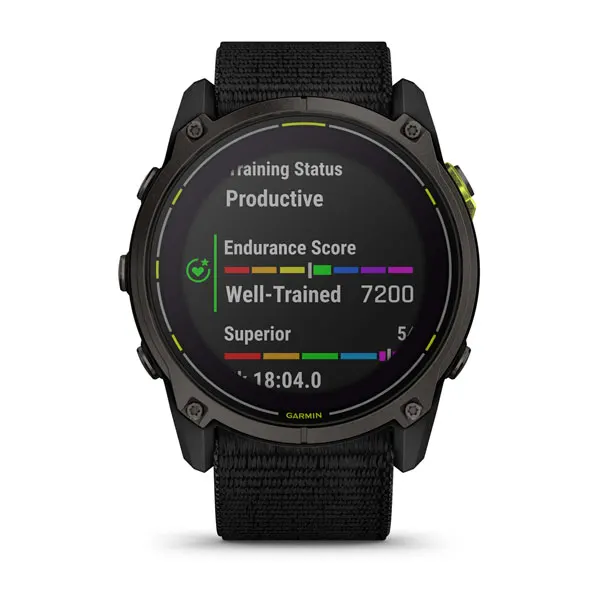
The Garmin Fenix 8 is a phenomenal watch. It is also, for many outdoor athletes, a phenomenal waste of money. The Enduro 3 takes virtually everything the Fenix 8 offers – the same Elevate Gen 5 heart rate sensor, the same TopoActive maps, the same training metrics and recovery tools – strips away the speaker, the microphone, and the dive rating, then delivers it in a package that weighs 34% less, lasts twice as long on a charge, and costs $300 less than the Fenix 8 Solar. If you spend your weekends on trails instead of Zoom calls, the Enduro 3 is the smarter buy. It might be the smartest watch Garmin has ever made.
The Enduro 3 represents a rare moment where Garmin actually listened. The Enduro 2 launched at $1,099.99 and felt like a niche play for ultra-distance masochists. The Enduro 3 drops to $899.99, adds every major Fenix 8 software feature, and improves solar efficiency by 120%. Garmin essentially said: here is the Fenix 8 for people who care about performance, not phone calls from their wrist.
Design & Build
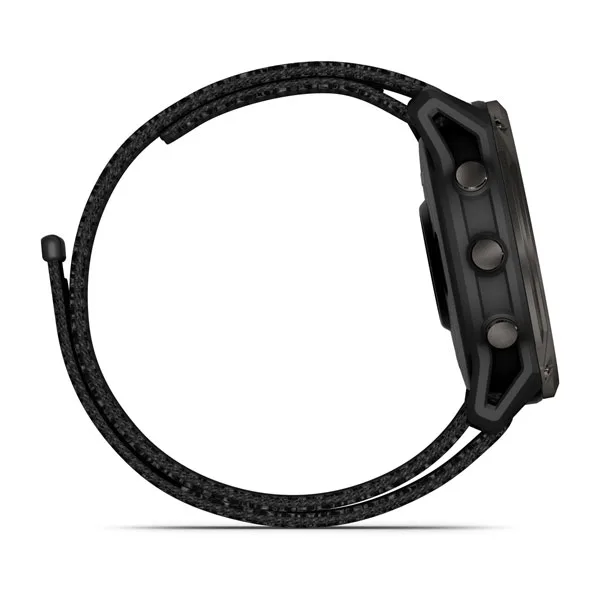
The first thing you notice strapping on the Enduro 3 is how impossibly light it is. At 63 grams with the included UltraFit nylon band (57 grams for the case alone), this is a 51 mm watch that wears like something two sizes smaller. For context, the Fenix 8 in the same 51 mm size tips the scales at roughly 95 grams. The COROS VERTIX 2S – often considered the Enduro's closest competitor – comes in at 70 grams. Neither comes close to the Enduro 3's featherweight feel on the wrist.
The case is fiber-reinforced polymer with a Carbon Gray DLC titanium bezel and a sapphire crystal lens. The sapphire is essentially indestructible in normal use – mountain biking crashes, rock scrambles, brushing against granite walls – nothing leaves a mark. The titanium bezel picks up the occasional superficial scratch but holds up admirably against serious abuse.
The 26 mm UltraFit nylon band is a love-it-or-tolerate-it affair. It is light, breathable, and dries faster than silicone. It also absorbs sweat during long efforts and can develop a certain funk if you do not rinse it regularly. For multi-day adventures, it is the right choice. For gym sessions, you might want to swap in a silicone option.
At 15.7 mm thick, the Enduro 3 sits a millimeter taller than the Fenix 8 AMOLED (14.7 mm) and just 0.3 mm taller than the Fenix 8 Solar (15.4 mm). Under a jacket sleeve, this is noticeable. On bare skin during a run, it is not. The watch only comes in one size and one color – 51 mm in Carbon Gray. Smaller-wristed athletes are out of luck, and that is a genuine limitation – it was significant enough to factor into our final score deduction. If your wrist circumference is under 150 mm, this watch will look and feel oversized.
Display
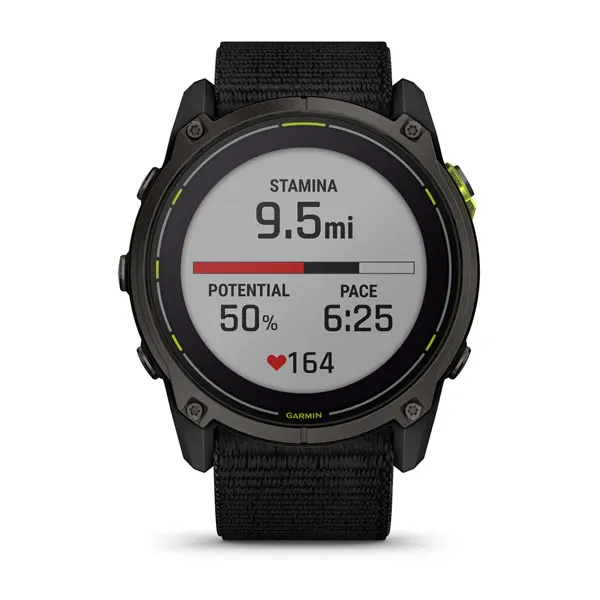
The Enduro 3 uses a 1.4-inch transflective memory-in-pixel (MIP) display running at 280 x 280 pixels. This is the same resolution and technology as the Fenix 8 Solar, and it is not AMOLED. That distinction matters.
In direct sunlight – which is where an endurance watch spends most of its working life – the MIP display is outstanding. Data fields are crisp, contrast is high, and there is zero washout. Garmin removed the transparent solar panel that sat across the Enduro 2's display surface, and the improvement in clarity is immediately visible. The screen simply looks cleaner and sharper than its predecessor.
Where the MIP panel falters is in low light. Under dense forest canopy or at dawn and dusk, readability drops significantly without activating the backlight. The Fenix 8 AMOLED's vibrant 454 x 454 display makes the Enduro 3's screen look like a calculator in comparison. But that AMOLED brightness comes at a devastating battery cost – the Fenix 8 AMOLED lasts 29 days in smartwatch mode versus the Enduro 3's 90 days with solar. That is a three-to-one battery advantage in exchange for a screen that looks a bit dim at 5 AM.
For ultrarunners and adventure athletes who spend the bulk of their time outdoors in daylight, the MIP tradeoff is worth it. For urban runners who train before sunrise, the AMOLED Fenix might be more practical.
Performance & Features
Under the hood, the Enduro 3 runs identical software to the Fenix 8. Every training feature, every data metric, every navigation tool. The only functional differences are the absence of voice control (no speaker/mic) and dive features (no depth sensor). Everything else is here.
GPS accuracy is excellent. The multi-band GNSS system supports GPS, GLONASS, Galileo, BeiDou, and QZSS through Garmin's SatIQ technology, which dynamically selects satellite constellations based on your environment. In testing across trail runs, mountain hikes, and urban routes, distance tracking matched within 0.05 to 0.2 miles of a Fenix 8 over marathon-length efforts. The watch also features a post-activity automatic track enhancement that cleans up minor GPS wobble – a subtle but welcome addition.
Navigation is where the Enduro 3 truly flexes. Preloaded worldwide TopoActive maps live on the 32 GB of internal storage, alongside space for offline music from Spotify, Deezer, or Amazon Music. The NextFork map guide calls out upcoming trail intersections, ClimbPro breaks down ascents in real time with gradient and distance-remaining data, and dynamic round-trip routing generates loop routes on the fly based on a target distance and direction. For backcountry navigation, the breadcrumb trail tracking is genuinely useful – following your track out of an unfamiliar canyon or wash can save hours of wandering.
The UI has been reorganized into a three-lane activity structure for settings, data pages, and music controls, with consolidated navigation elements in a single "Saved" bin. The UI is not simple – Garmin's software never has been – but it is more logical than previous generations.
PacePro pacing strategies, trail run VO2 max, grade-adjusted pace, strength training plans designed for endurance athletes, and a built-in LED flashlight with variable intensity, red mode, and strobe round out the feature set. The flashlight alone is worth mentioning – it is bright enough to navigate a dark trailhead and the red mode preserves night vision during pre-dawn starts.
Health & Fitness Sensors
The Elevate Gen 5 optical heart rate sensor is Garmin's best to date. It tracks heart rate continuously, supports FDA-cleared ECG for detecting atrial fibrillation, monitors blood oxygen (SpO2), and measures wrist temperature overnight. HRV status, stress monitoring, Body Battery energy tracking, and advanced sleep analysis all feed into Garmin's health ecosystem.
Heart rate accuracy during steady-state running and hiking is strong – readings consistently track within a few beats of a chest strap. Where the optical sensor still struggles is during high-intensity intervals and rapid heart rate changes. Hill repeats, track intervals, and high-variability efforts produce the occasional spike or overshoot. For racing and serious interval work, a chest strap remains the better choice.
The sleep tracking works well for consistent sleepers but falls apart for anyone with interrupted patterns – parents of young children, shift workers, or anyone who wakes frequently. The watch sometimes fails to recognize fragmented sleep sessions as sleep at all. This is a known Garmin-wide issue, not specific to the Enduro 3, but it remains frustrating.
Altitude and heat acclimation tracking feed into training readiness calculations, and the barometric altimeter provides reliable elevation data for mountain activities. The combined sensor suite is as comprehensive as anything on the market.
Battery Life
This is the reason the Enduro 3 exists, and the numbers are staggering.
| Mode | Without Solar | With Solar* |
|---|---|---|
| Smartwatch | 36 days | 90 days |
| GPS Only | 120 hours | 320 hours |
| All Satellites | 80 hours | 144 hours |
| All Sat + Multi-band | 60 hours | 90 hours |
| All Sat + Music | 22 hours | – |
| Max Battery GPS | 210 hours | Unlimited |
| Expedition GPS | 77 days | Unlimited |
*Solar figures assume 3 hours/day at 50,000 lux (direct outdoor sunlight)
Put simply: 320 hours of GPS tracking with solar means over 13 days of continuous GPS recording without touching a charger. Even without any solar input, up to 120 hours of GPS-only tracking means up to five solid days of non-stop recording. For a 100-mile ultramarathon, a multi-day thru-hike, or a bikepacking trip, this is the kind of endurance that eliminates battery anxiety entirely.
Garmin achieved this through a completely redesigned Power Sapphire solar charging system that harvests 120% more energy than the Enduro 2. The key innovation was removing the transparent solar panel from the display surface and concentrating solar collection into a dedicated ring around the bezel. This simultaneously improved display clarity and boosted charging efficiency.
Real-world numbers tell a more nuanced story. During extended testing with daily GPS activities, the watch delivered roughly 20-22 days of mixed use including 8-10 hours of GPS-tracked activities. A marathon-distance run with full GPS drained about 5% of the battery. A 20-mile trail run consumed approximately 4%. An hour of indoor climbing registered zero measurable drain. These are extraordinary numbers.
The solar claims do require genuinely sunny conditions. If you live in the Pacific Northwest or run primarily in dense forest, the solar benefit will be modest. If you are an Arizona trail runner or a thru-hiker spending 8+ hours in open sunlight, the solar charging becomes transformative.
Compared to the competition: the Fenix 8 Solar tops out at up to 149 hours GPS with solar (95 hours without) and up to 48 days smartwatch with solar (30 days without). The Fenix 8 AMOLED manages just up to 84 hours GPS and 29 days. The COROS VERTIX 2S delivers up to 118 hours GPS and up to 36 days smartwatch, with no solar option. The Enduro 3 is not incrementally better – it is in a different category.
Who It's For / Who Should Skip
Buy the Enduro 3 if you are: - An ultrarunner who needs multi-day GPS without a charger - A thru-hiker or backpacker who spends days or weeks in the backcountry - A trail runner who values navigation, maps, and battery over screen brightness - An adventure athlete (bikepacking, ski touring, mountaineering) who needs a reliable GPS partner - A Fenix 8 buyer who realized you never use the speaker or dive features
Skip the Enduro 3 if you are: - Someone with a wrist circumference under 150 mm – the 51 mm case is the only option - An urban runner who trains primarily in low light and wants a vibrant, bright display - A diver or water sports athlete who needs a depth sensor and 40 m dive rating - Someone who takes phone calls on their watch or relies on voice assistants - A casual fitness user – this is a serious tool for serious athletes, and the complexity reflects that
If you are shopping for trail-ready GPS watches more broadly, our best outdoor watches guide covers the full category, and runners may also want to consult our best running watches roundup.
The Verdict
Score: 88/100 – The Garmin Enduro 3 is the best value in Garmin's lineup and the definitive endurance watch for athletes who prioritize battery life, lightweight design, and outdoor capability over display vibrancy and smart features.
| Category | Weight | Score | Weighted |
|---|---|---|---|
| Core Function (GPS, training, navigation) | 30% | 92 | 27.6 |
| Build Quality | 15% | 90 | 13.5 |
| User Experience | 20% | 80 | 16.0 |
| Value | 20% | 92 | 18.4 |
| Battery | 15% | 96 | 14.4 |
| Total | 100% | 89.9 - 2 = 88 |
Adjusted down 2 points for single-size limitation and MIP low-light readability, which meaningfully impact a broad user base.
At $899.99, the Enduro 3 gives you 95% of the Fenix 8's capability at 75% of its price and 66% of its weight. The missing 5% – a speaker, a microphone, a dive sensor, and AMOLED brightness – are features that most trail and endurance athletes will never miss. The battery life is not just better than the Fenix 8; it is better than everything else on the market, including tough competitors like the Suunto Vertical 2 and the Garmin Instinct 3. Period.
The Garmin Enduro 3 is the watch the Fenix 8 should have been – lighter, longer-lasting, and $300 cheaper, with every feature an endurance athlete actually needs.