

The Watch That Rewrites the Rules
The Coros Nomad does something that seemed impossible a year ago: it delivers full offline color topographic maps, dual-frequency GPS, and a genuinely innovative voice-tagging system for $349 – fifty dollars less than the Garmin Instinct 3, which ships without any maps at all. That is not a typo. Coros has built the outdoor watch that out-Garmins Garmin, and it has done so at a price point that makes the established players look complacent.
After weeks on wrists across mountain trails, urban runs, and lakeside fishing sessions, the verdict is clear: the Nomad is the best value in outdoor GPS watches right now. It is not flawless – the training load tracking has quirks and there is no built-in flashlight – but for hikers, trail runners, anglers, and weekend adventurers who want serious navigation tools without a four-figure price tag, nothing else comes close.
Design and Build: Rugged Without the Bulk
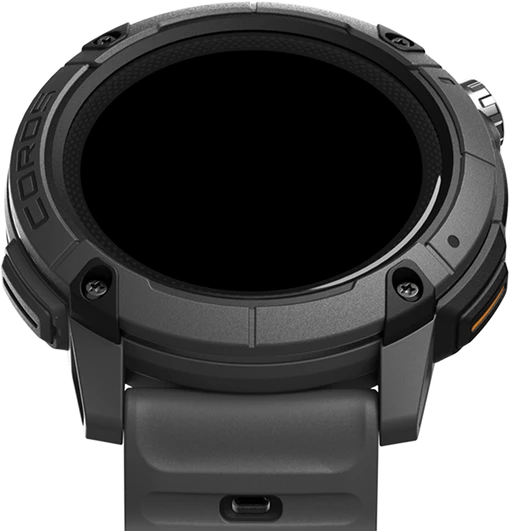
The Nomad wears its outdoor ambitions on its sleeve – literally. The dual-layer bezel combines a fiber-reinforced polymer shell with an aluminum alloy subframe, creating a watch that absorbs impacts without adding unnecessary heft. At 61 grams with the silicone band (or a featherweight 49 grams with the nylon option), it is lighter than most competitors in this class despite its 47.8mm case diameter.
The 16.4mm thickness is the one dimension that announces itself on the wrist. Under a long-sleeve base layer, the Nomad occasionally catches on cuffs. But for a watch packing a barometric altimeter, dual microphones, and 32GB of onboard storage, the package is impressively compact.
Water resistance sits at 5 ATM (50 meters), adequate for swimming and rain exposure but half the 10 ATM rating on the Garmin Instinct 3. Deep-water divers will look elsewhere; everyone else will be fine.
Three colorways – Green, Brown, and Dark Grey – lean into the gorpcore aesthetic that has overtaken outdoor gear. The matte military green, in particular, looks like it was designed around a campfire rather than a conference room. Hardened mineral glass protects the display. It is not sapphire, but the crystal is built to handle trail abuse – rock scrambles, brush-whacking, pack-on/pack-off cycles – without scratching. For a sub-$400 watch, the durability is more than acceptable.
Display: MIP Done Right
The 1.3-inch Memory-in-Pixel screen will not win beauty contests against the AMOLED panels on the Garmin Fenix 8 or the Coros Pace Pro. What it will do is remain perfectly legible in blinding midday sun, pouring rain, and every condition between. MIP technology means no wrist-flick delay, no battery-sapping always-on compromise, and no squinting under a trail canopy.
The 260 x 260 pixel resolution is modest on paper but effective in practice. Coros has cleverly designed the interface so that data field labels shrink into icons after two seconds, maximizing the space for the numbers that actually matter mid-effort. Map rendering is exceptionally fast – the processor pushes map tiles around with zero perceptible lag, which is best-in-class for MIP displays.
The backlight is adequate for nighttime navigation, though the absence of a built-in LED flashlight (a feature the Instinct 3 includes) is a notable omission for a watch aimed at backcountry users. If late-night tent organization matters to you, bring a headlamp.
Performance and Features: Where the Nomad Earns Its Name
GPS and Navigation
The dual-frequency GNSS engine (GPS, GLONASS, Galileo, BeiDou, QZSS with L1+L5 support) is the heart of the Nomad, and it delivers. Tracks recorded across Alpine switchbacks, dense urban canyons, and forested single-track consistently align with known trails and roads. Altitude data from the barometric altimeter holds steady through weather changes, and initial satellite lock is fast – typically under 15 seconds in open sky.
But the real headline is the mapping. Full offline topographic maps with street names, trail markings, points of interest, and terrain shading – all rendered in color on a MIP screen, stored on 32GB of flash memory. The Garmin Instinct 3, its most direct competitor, offers breadcrumb navigation and nothing more. The Fenix 8 has equivalent maps but costs $999. The Suunto Vertical 2 has maps but starts at $499. At $349, the Nomad is the cheapest full-mapping outdoor watch from a major GPS brand.
Route syncing from Strava and Komoot works reliably, though it requires manual uploads – Garmin automatically syncs favorited routes, which is a convenience the Nomad lacks. On-trail navigation provides clear turn indicators and audible/vibration alerts when straying off course, but there is no climb preview feature equivalent to Garmin ClimbPro, and no automatic rerouting. When you go off-route, the watch points a compass arrow back toward the trail rather than calculating a new path. For most hikers, this is sufficient. For mountaineers in complex terrain, it is a limitation worth noting.
Voice Pins and Adventure Journal
The dual-microphone voice note system is the Nomad feature that sounds gimmicky on paper and proves genuinely useful on the trail. Press the Action button, speak a geo-tagged note – "water source here," "cairn marking the left fork," "spotted elk at treeline" – and the watch records, timestamps, and GPS-tags it. Back on the phone, the Coros app auto-transcribes and summarizes the notes into a trip journal.
The noise reduction from the dual-mic setup handles wind surprisingly well, though heavy gusts still garble transcriptions. The main limitation: voice pins require an active GPS session, so casual daily-life journaling is off the table. There is also no on-watch speaker for playback, which means reviewing notes requires the phone app.
Fishing
Seven dedicated fishing profiles – Shore Fishing, Shore Fly Fishing, Boat Fishing, Boat Fly Fishing, Inshore, Offshore, and Kayak Fishing – transform the Nomad into a proper angling companion. Real-time barometric pressure, tide tables, moon phase data, ambient temperature, and catch logging with species and location tracking are all baked in. Each catch can be logged with location, time, and environmental conditions for pattern analysis over a season.
No other watch at this price takes fishing this seriously. The Garmin Instinct 3 offers a basic fishing widget; the Nomad offers an ecosystem.
Music
On-watch MP3 playback via Bluetooth headphones is a welcome addition for long trail days. The 32GB storage handles maps and a substantial music library simultaneously. The caveat: Coros does not support streaming services like Spotify or Amazon Music, so you are limited to side-loaded MP3 files. For offline-first adventurers, this is fine. For anyone accustomed to playlist syncing from streaming platforms, it is a friction point.
Health and Fitness Tracking
The optical heart rate sensor represents the best hardware Coros has shipped to date, though it still trails the leaders. Steady-state efforts – long hikes, zone 2 runs, cycling – produce data that tracks within 2-3 BPM of a chest strap. Interval work and rapid effort transitions reveal occasional lag and overshoot, a common limitation of wrist-based optical sensors but one that Garmin and Apple have largely tamed.
SpO2 monitoring, HRV tracking, sleep staging, stress tracking, and temperature sensing round out the health suite. The data is comprehensive and generally reliable for trend analysis, though the VO2 Max estimates tend to be conservative – race predictions consistently undershoot actual performance by a meaningful margin.
Training load tracking has a puzzling implementation: the rolling calculation resets every Monday rather than maintaining a true 7-day window. Coros has acknowledged this and indicated a fix is coming, but as of early 2026, the behavior persists. For athletes who rely on training load to manage intensity, this is a genuine shortcoming.
Battery Life: Set It and Forget It
Battery performance is one of the Nomad watch's strongest cards. The 22-day daily-use rating holds up in practice – mixed use with notifications, daily HR monitoring, and occasional GPS activities easily stretches past two weeks. GPS mode at 50 hours (all systems) and 34 hours (dual frequency) means multi-day backcountry trips without a charger are entirely feasible.
Real-world testing confirms the numbers: an 18-day stretch of mixed hiking and trail running left 18% in the tank. Two-hour GPS hikes consume roughly 4% battery. For context, the Garmin Instinct 3 Solar offers superior longevity only with consistent solar exposure; in cloudy or forested conditions, the two watches perform similarly.
The absence of solar charging is the one battery-related weakness. The Instinct 3 Solar can theoretically run indefinitely in smartwatch mode with enough sunlight. For most users in most conditions, the Nomad 22-day rating renders this advantage academic, but through-hikers on months-long treks may find the difference meaningful.

Who Should Buy the Coros Nomad
Buy it if you are: a hiker, trail runner, or angler who wants full offline maps and solid GPS in a lightweight, durable package without spending $600+. Weekend warriors, fishing enthusiasts, and anyone frustrated by the Garmin Instinct's lack of mapping will find the Nomad compelling. The voice pin system is a genuine differentiator for trip documentation.
Skip it if you need: sapphire crystal durability for extreme environments, a built-in flashlight, solar charging for extended expeditions, advanced training load analytics, or a polished smartwatch experience with NFC payments and app stores. The Garmin Fenix 8 or Suunto Vertical 2 serve those needs better – at significantly higher prices. Endurance athletes focused on structured training may also want to consider the Coros Vertix 2S or check our best running watches guide. For rugged alternatives with different strengths, the Garmin Enduro 3 and Amazfit T-Rex 3 are worth a look.
The Verdict
Score: 86/100 – The Coros Nomad delivers the features that matter most to outdoor adventurers at a price that makes the competition look overpriced.
| Category | Weight | Score | Weighted |
|---|---|---|---|
| Core Function (GPS, maps, navigation, sports) | 30% | 86 | 25.8 |
| Build Quality (materials, durability, comfort) | 15% | 80 | 12.0 |
| User Experience (display, UI, connectivity) | 20% | 82 | 16.4 |
| Value (price vs. features vs. competition) | 20% | 94 | 18.8 |
| Battery Life (all modes, real-world) | 15% | 88 | 13.2 |
| Overall | 100% | 86.2 |
At $349, the Nomad does not just compete with the Garmin Instinct 3 – it embarrasses it on mapping and matches it nearly everywhere else. The missing flashlight, sapphire glass, and training load quirks keep it from the 90+ tier, but for pure outdoor adventure value, no watch on the market touches it.