
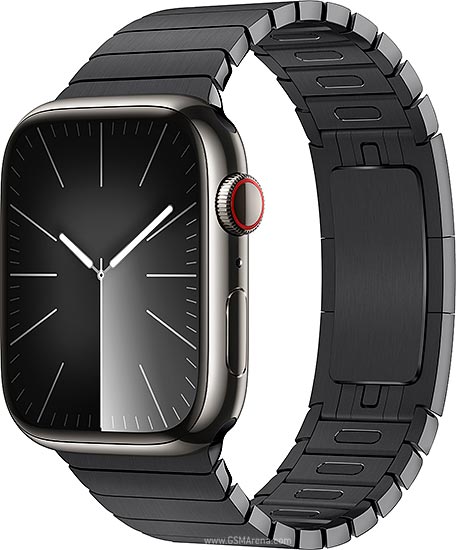
The Apple Watch Series 9 is the smartwatch everything else gets measured against. That was true when it launched in September 2023, and it remains true now – even as a discontinued model you can only find through third-party retailers. The S9 chip is genuinely snappy, the Double Tap gesture changes how you interact with your wrist, and the 2,000-nit display is readable in direct sunlight without squinting. For iPhone owners who want the most polished smartwatch experience money can buy, this is still it.
But the Series 9 arrives with baggage. The blood oxygen sensor – one of its headline health features – was stripped from US models for over a year thanks to a bitter patent dispute with Masimo. Apple eventually restored SpO2 readings via a software workaround in August 2025, but the implementation now processes data on your paired iPhone rather than the watch itself, and results live in the Health app rather than on your wrist. It works, but it is not the seamless experience Apple originally promised. That asterisk, combined with the fact that the Series 10 and Series 11 have since arrived, means you need to buy this watch with your eyes wide open.
Design and Build
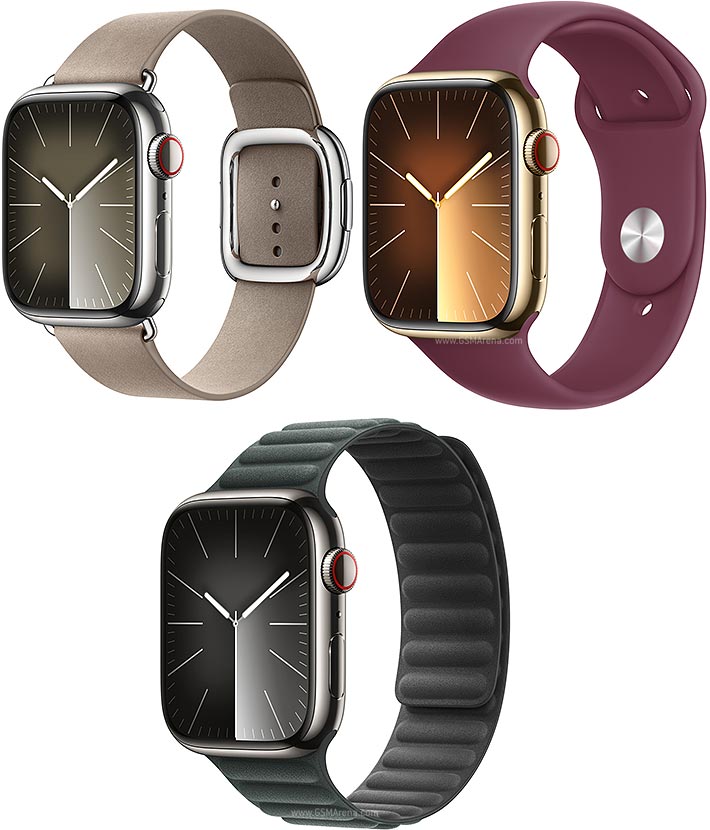
The Series 9 looks identical to the Series 8, the Series 7, and honestly, most Apple Watches since the Series 4 redesign. The rounded-square case with its curved edges and Digital Crown sits comfortably on the wrist in either 41mm or 45mm sizes. Apple offers aluminum cases in Midnight, Starlight, Silver, (PRODUCT)RED, and a genuinely attractive Pink that became the breakout color of the lineup. Stainless steel models come in Silver, Gold, and Graphite for those who want sapphire crystal glass instead of Ion-X.
The aluminum 45mm model weighs just 38.7 grams (GPS) – light enough to sleep in without noticing. Stainless steel bumps that to 51.5 grams, which adds a satisfying heft without becoming burdensome. Build quality is exactly what you expect from Apple: tight tolerances, no creaking, and IP6X dust resistance paired with WR50 water resistance for swimming. This thing handles pool laps, rain-soaked runs, and sweaty gym sessions without breaking a sweat.
The proprietary band system remains a double-edged sword. Apple's bands are beautifully engineered – the redesigned Sport Loop with 82 percent recycled yarn is genuinely comfortable – but you are locked into Apple's ecosystem (or third-party knockoffs) rather than using standard 20mm lugs like most of the Android competition.
Display
This is where the Series 9 made its most immediately noticeable improvement. The always-on Retina LTPO OLED panel pushes up to 2,000 nits of peak brightness – double the Series 8's 1,000 nits. Outside on a bright afternoon, the difference is stark. Glancing down mid-run to check pace or heart rate no longer requires cupping a hand over the screen or tilting at odd angles.
The display can also dim to just 1 nit for theater mode or nighttime use, which is a thoughtful touch for sleep tracking. At 326 pixels per inch, text is crisp and colors are vivid. The always-on functionality works well, dropping to a dimmed state that still shows the time and complications without hammering the battery too aggressively.
Both sizes remain the same as the Series 8 – there is no screen size increase here. That would come with the Series 10, which bumped up to 42mm and 46mm cases with larger displays. But the 41mm and 45mm screens on the Series 9 remain perfectly adequate for notifications, workout data, and quick interactions.
Performance and Features
The S9 SiP is the heart of what makes the Series 9 feel like a genuine step forward rather than another incremental tick. Built with 5.6 billion transistors – 60 percent more than the S8 – it packs a 30 percent faster GPU and a four-core Neural Engine that is twice as fast for machine learning tasks. In daily use, this translates to snappier app launches, smoother scrolling through the Smart Stack, and noticeably faster Siri responses.
Double Tap
This is the headline feature, and it earns that billing. Tapping your index finger and thumb together twice triggers a context-sensitive primary action: answer a call, snooze an alarm, scroll through your Smart Stack, play or pause music, dismiss a notification. The Neural Engine processes data from the accelerometer, gyroscope, and optical heart sensor to detect the unique signature of those tiny wrist movements and blood flow changes.
It sounds gimmicky on paper. In practice, it is the kind of feature you cannot imagine living without once you have used it for a week. Carrying grocery bags, holding a dog leash, gripping a steering wheel – any time your other hand is occupied, Double Tap eliminates the awkward reach-across to tap the screen. Reliability is excellent; false triggers are rare, and the gesture registers consistently whether your arm is at your side or raised.
On-Device Siri
The S9's Neural Engine enables on-device Siri processing for common requests. This means voice commands get transcribed and understood locally on the watch rather than being routed to the cloud. The practical benefit is speed – Siri responds noticeably faster, and it works even when you have no cellular or Wi-Fi connection. Dictation accuracy improved noticeably over the Series 8.
Siri also gained access to Health data on the Series 9, so you can ask "How much did I sleep last night?" or "What was my resting heart rate this week?" and get answers without your health data ever leaving the device. This is a meaningful privacy improvement.
Ultra Wideband 2
The second-generation UWB chip enables Precision Finding for your iPhone – but only if you also own an iPhone 15 or later. When paired with a compatible phone, you get directional guidance and approximate distance to locate your device. It is a nice quality-of-life feature, but the iPhone 15 requirement limits its usefulness for many buyers.
Storage doubled to 64GB, which is generous for a watch and means plenty of room for offline music, podcasts, and apps.
Health and Fitness
The Apple Watch Series 9 packs the same comprehensive sensor array as its predecessor: a third-generation optical heart sensor for continuous heart rate monitoring, an electrical heart sensor for ECG readings, and a temperature sensor for cycle tracking and retrospective ovulation estimates. Crash Detection can identify severe car crashes, and fall detection triggers emergency SOS capabilities.
Heart rate tracking remains among the best in the wearable industry. Resting heart rate, walking heart rate, heart rate recovery, and high/low heart rate notifications all work reliably. The ECG app can identify signs of atrial fibrillation, and the irregular rhythm notification feature provides passive monitoring between manual checks. For users who prioritize these capabilities, our best health monitoring watches guide offers a broader comparison.
Workout tracking covers the essentials well. GPS accuracy is solid in open environments – comparable to mid-range dedicated sports watches – though urban canyon performance with tall buildings can produce some outliers. watchOS supports structured workouts through third-party apps like TrainingPeaks and TrainerRoad via the workout API, and cycling power meter connectivity adds value for serious cyclists.
The Blood Oxygen Situation
This requires its own section because it has been a saga. The Series 9 launched with SpO2 monitoring, but Apple was forced to disable it on newly sold US models starting January 18, 2024, following an ITC exclusion order stemming from Masimo's patent infringement claims. Previously purchased units retained the feature, but for well over a year, new American buyers got a watch with a blood oxygen sensor that did absolutely nothing.
In August 2025, Apple restored the feature via iOS 18.6.1 and watchOS 11.6.1, using a technical workaround that processes sensor data on the paired iPhone rather than the watch itself. Results appear in the Health app's Respiratory section rather than as an on-wrist complication or spot-check. It works, but "better than nothing" is a low bar for a feature Apple originally marketed as a flagship health capability. You cannot glance at your wrist and see your current SpO2 level the way you can on a Samsung Galaxy Watch or a Garmin.
The patents in question do not expire until August 2028, so this workaround architecture is likely here to stay.
Battery Life
Apple rates the Series 9 at up to 18 hours of normal use, extending to 36 hours in Low Power Mode. In practice, those numbers are accurate but unremarkable. A typical day with always-on display active, a 45-minute workout with GPS, regular notifications, and occasional Siri queries leaves the watch at around 40-50 percent by bedtime. That is enough to get through a full day and track sleep if you top up in the morning during your routine, but it means daily charging is non-negotiable.
Heavy use – extended GPS tracking, lots of music streaming, frequent app interactions – can drain the battery faster. One intensive day at a music festival with constant GPS navigation and music streaming drains from full to under 20 percent in about ten hours.
Fast charging helps soften the blow. The Series 9 reaches 80 percent in about 45 minutes, so a quick charge while you shower and get ready in the morning is usually enough to start the day fully topped up. But compared to the Samsung Galaxy Watch 6's 30-40 hours (depending on always-on display settings), or the Apple Watch Ultra 2's 36-hour standard runtime, the Series 9 is firmly in the one-day-watch camp.
This is the Apple Watch's most persistent weakness, and the Series 9 did nothing to address it.
The Verdict
The Apple Watch Series 9 is a supremely polished smartwatch that excels at nearly everything it attempts. The S9 chip delivers meaningful performance gains, Double Tap is a legitimately great feature that improves daily usability, and the 2,000-nit display is a tangible upgrade anyone can appreciate. Health and fitness tracking is comprehensive, watchOS is the most refined smartwatch platform available, and build quality is impeccable.
The caveats are real, though. Battery life remains a one-day affair. The blood oxygen feature was gutted for US users and only partially restored through an inferior workaround. The design has not meaningfully changed in years. And critically, Apple discontinued the Series 9 when the Series 10 launched in September 2024 – you can no longer buy it new from Apple. The Series 10 brought a thinner, lighter design with larger displays, faster charging, water temperature sensing, and a depth gauge. The newer Series 11 regularly drops to $299 during sales, down from its $399 MSRP.
If you find a Series 9 at a significant discount from a third-party retailer – and they were regularly available for $299-$329 before stock dried up – it remains an excellent value. You get 90 percent of the current Apple Watch experience for substantially less money. But if you are buying at or near the original $399 MSRP, the math gets harder to justify when the Series 10 and SE offer better value propositions.
Score Breakdown
- Core Function (30%): Exceptional smartwatch performance with watchOS, notifications, apps, and connectivity. Double Tap is a genuine innovation. (28/30)
- Build Quality (15%): Premium materials, IP6X dust and WR50 water resistance, sapphire crystal on steel models. Unchanged design, but it is still excellent. (13/15)
- User Experience (20%): watchOS remains the gold standard for smartwatch software. On-device Siri is faster and more private. Seamless iPhone integration. (18/20)
- Value (20%): At original MSRP, tough to recommend over newer models. At discount pricing ($299-$329), outstanding. Blood oxygen saga hurts perceived value. (13/20)
- Battery (15%): 18 hours is adequate but firmly below the competition. Fast charging helps but does not solve the daily-charge reality. (9/15)
Score: 81/100 – A superb smartwatch held back by unchanged battery life, the blood oxygen debacle, and its discontinued status that makes the value proposition complicated.
Who It's For
- iPhone owners upgrading from Series 6 or older who find one at a discount. The jump in display, chip performance, and health features is substantial.
- First-time Apple Watch buyers who want a premium smartwatch without paying full price for the Series 10 or 11.
- Anyone who values Double Tap for accessibility or convenience during hands-occupied activities.
Who Should Skip
- Series 8 owners. The upgrade is marginal. Wait for a bigger generational leap.
- Android users. The Apple Watch does not work with Android phones. Period.
- Battery life prioritizers. If daily charging is a dealbreaker, look at the Samsung Galaxy Watch lineup or Garmin watches.
- Buyers who want hassle-free SpO2 monitoring. The blood oxygen workaround is functional but clunky compared to competitors.
- Anyone willing to pay MSRP. At $399, the Series 10 or a discounted Series 11 is almost always a better buy.