
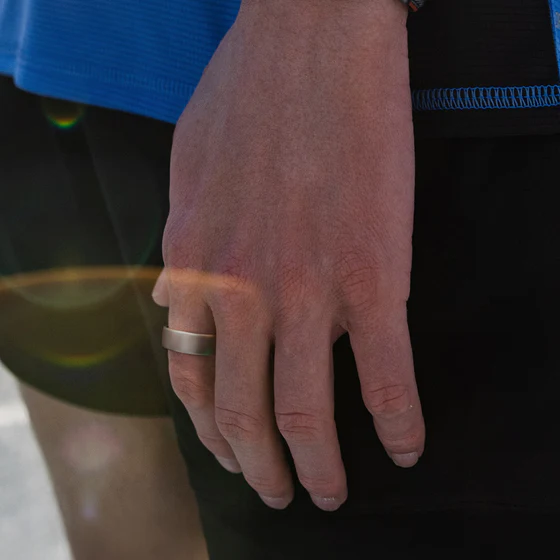
The Amazfit Helio Ring wants to be the smart ring for people who refuse to pay subscription fees. At $199.99 with lifetime free access to Zepp Aura and Zepp Fitness – perks that would cost roughly $100 per year otherwise – it is the cheapest smart ring to own over time, undercutting the Oura Ring 4, Samsung Galaxy Ring, and RingConn Gen 2 on total cost of ownership by a significant margin. Whether worn to bed, through workouts, or into the shower, the Helio Ring delivers genuinely useful sleep insights in a titanium package that feels like nothing on the finger.
But the compromises Zepp Health made to hit this price point are not subtle: 2.5-to-3-day real-world battery life, a charging dock that tests your patience, only three ring sizes, and workout tracking so limited it barely qualifies as a feature. The Helio Ring is a smart ring that knows exactly what it wants to be – a sleep and recovery tracker – and does not pretend to be anything more. Whether that works for you depends on a single question: do you need your ring to do anything beyond sleep tracking?
Design and Build
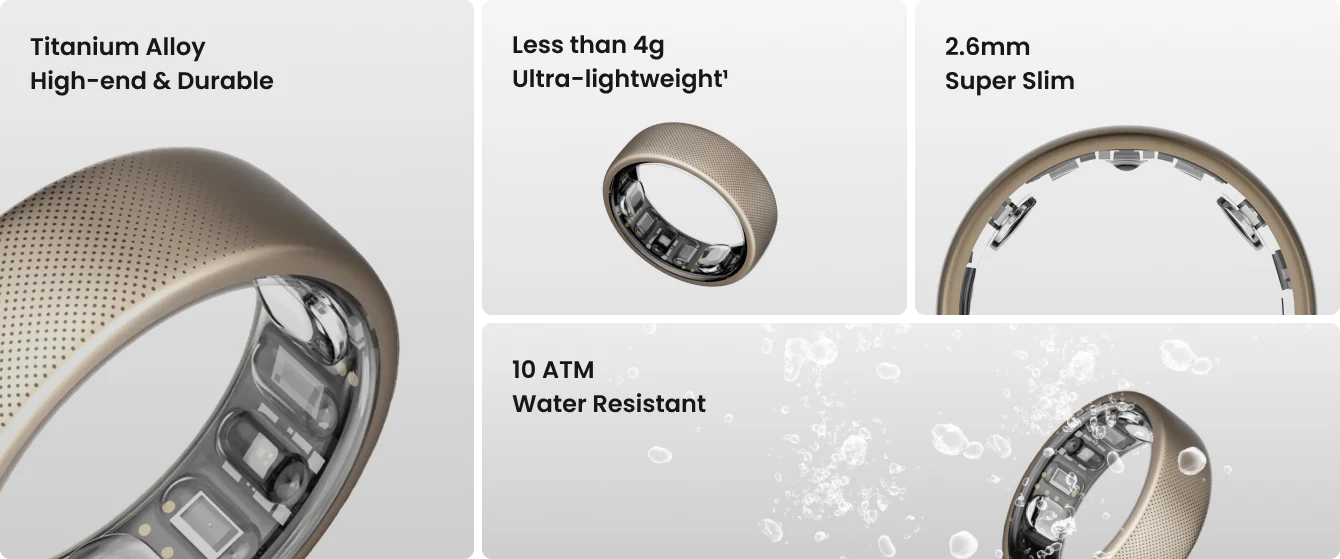
The Helio Ring is a handsome piece of hardware. The titanium alloy shell has a matte, lightly textured finish that catches light without screaming "tech gadget" the way some thicker competitors do. At 2.6mm thin and under 4 grams regardless of size, it practically disappears on the finger within an hour of first wearing it. I genuinely forgot it was there during sleep, which is exactly the point for a device whose primary job is overnight tracking.
Build quality is reassuring. After extended daily wear – cooking, lifting weights, washing dishes, bumping it against doorframes – the titanium shows zero scratches. The 10 ATM water resistance rating means showers, swimming pools, and rainy runs are all fair game. Pool sessions and rainy runs are no cause for concern.
The interior uses a synthetic resin that sits comfortably against skin, with the sensor bump on the underside being the only tactile reminder that this is more than jewelry. It is noticeable if you run your thumb across it, but it never created pressure points or irritation during sleep or exercise.
Here is where the compromises begin, though. The Helio Ring comes in exactly one color – a muted titanium grey – and only three sizes: US 8, 10, and 12. That is a remarkably narrow selection. Oura offers sizes 4 through 15 in six finishes. Samsung covers sizes 5 through 15. If you fall between the Helio's available sizes or prefer something smaller than an 8, you are simply out of luck. Amazfit sells a sizing kit, which is worth ordering before committing, but even that cannot solve the fundamental problem: the majority of women and many men with smaller hands will find nothing that fits.
The charging dock deserves its own paragraph of mild frustration. It is a small magnetic puck powered via USB-C, and getting the ring to seat properly on it requires more fiddling than it should. The sensor bumps on the ring must align with corresponding divots on the dock, and the magnets are not strong enough to snap everything into place reliably. Checking the app multiple times to confirm charging has actually started is a common frustration. It works, but it is nowhere near as effortless as dropping an Oura Ring onto its cradle.
Performance and Features
The Helio Ring connects to your phone via Bluetooth 5.0 BLE and funnels all data through the Zepp app, the same platform used by Amazfit's smartwatch lineup. Setup is quick: pair the ring, create a free Zepp account, and the app walks you through enabling the health features you want.
The Zepp app is genuinely well-designed. Health data is organized into clean cards for sleep, heart rate, stress, blood oxygen, and a daily Readiness Score. The interface is intuitive enough that anyone migrating from Apple Health or Google Fit will feel at home within minutes. Helio Ring owners get free lifetime access to Zepp Aura Premium, which adds AI-driven sleep coaching, customized wind-down audio playlists, and detailed weekly and monthly sleep trend reports. Zepp Fitness, also free, provides workout analysis and recovery metrics. This is not a stripped-down free tier – it is the full software suite, no asterisks.
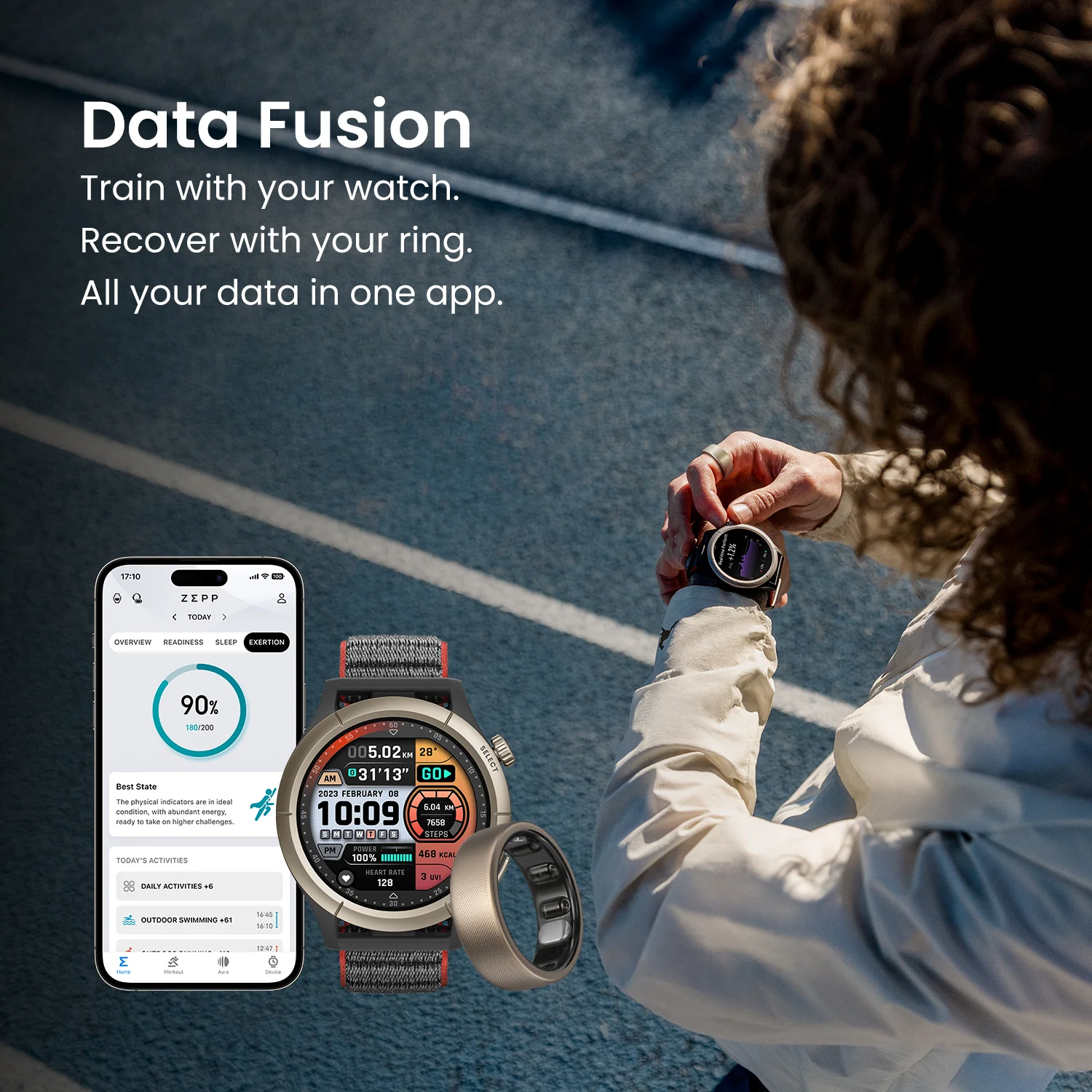
Data syncs to Apple Health, Google Fit, and Strava, which is a welcome touch. If you already use an Amazfit smartwatch like the Balance 2 or T-Rex Ultra, the ring's data merges seamlessly with watch data in the Zepp ecosystem, and Amazfit claims the combined sensor inputs yield more accurate composite readings. This companion-device philosophy is clearly how Zepp Health envisions the Helio Ring being used, and it works well in that context.
Where the Helio Ring falls flat is workout tracking. It supports exactly four sport modes – walking, running, cycling, and treadmill – and there is no automatic workout detection. You must open the Zepp app on your phone and manually start a session. The ring captures heart rate, estimated VO2 max, duration, and calories during exercise, but without onboard GPS, route tracking depends entirely on your phone. Cycling tracking, in particular, is essentially useless; the accelerometer misinterprets pedaling cadence as steps, inflating step counts dramatically. For anyone who considers exercise tracking a core requirement, this ring is a hard pass. Amazfit built the Helio Ring to track your recovery, not your reps.
What else is missing? Quite a lot:
- No NFC – contactless payments are off the table
- No smart notifications
- No alarm vibrations
- No gesture controls
This is a passive sensor that collects data while you live your life. That simplicity has its appeal, but it also means the ring does less than almost every competitor at or near its price.
Battery Life
Battery life is the Helio Ring's most significant weakness and the one area where the budget engineering is impossible to overlook. Amazfit claims up to four days per charge. In practice, with continuous heart rate monitoring, SpO2 tracking, and sleep detection all enabled – which is to say, using the ring as intended – I consistently got between two and a half and three days before hitting the low battery warning.
That is roughly half what the Oura Ring 4 delivers and a quarter to a third of what the RingConn Gen 2 manages. Even the Samsung Galaxy Ring, which is not exactly a battery champion, outlasts the Helio Ring by two or three days. For a device that is supposed to track your sleep, having to remember to charge it every other day creates an ironic problem: you will occasionally forget, and it will die overnight, producing a gap in the data that matters most.
The charging dock brings the ring from empty to full in about an hour and forty minutes, which is reasonable. But the finicky alignment issue I mentioned earlier means you cannot just toss it on the charger before bed and trust it. I developed a habit of confirming the charging indicator in the Zepp app every time, which is not a workflow anyone should have to maintain.
The battery situation improves modestly if you disable daytime SpO2 monitoring or reduce heart rate sampling frequency, but those trade-offs defeat the purpose of wearing a health tracker. The tiny battery capacities – 16.5 mAh for size 8, 18.5 mAh for size 10, 20.5 mAh for size 12 – simply cannot support always-on monitoring at the level competitors deliver with larger cells.
Health and Fitness Tracking
Sleep tracking is the Helio Ring's reason for existing, and it performs this job well. Wearing a slim ring to bed is inherently more comfortable than strapping on a watch, and the Helio Ring capitalizes on that advantage. It automatically detects when you fall asleep and tracks sleep duration, sleep stages (light, deep, REM), heart rate throughout the night, blood oxygen levels, and breathing quality. Morning results appear in the Zepp app with a sleep score out of 100 and a breakdown that makes it easy to identify patterns over time.
Sleep stage detection aligns closely with what I have come to expect from cross-referencing multiple wearables. The ring consistently identified deep sleep windows in the early part of the night and captured REM cycles accurately. It does have a tendency to slightly overestimate total sleep time – if I lay in bed reading for twenty minutes before actually falling asleep, the ring sometimes counted that as light sleep. It is a minor gripe, but it inflates sleep scores by a few points on good nights.
Heart rate monitoring runs continuously when enabled, sampling every five minutes during the day and more frequently during sleep and tracked workouts. Spot-checking against a chest strap showed readings that were consistently within one to two beats per minute during rest and light activity. During intense exercise, the accuracy held up surprisingly well for a ring-based PPG sensor, though the five-minute daytime sampling interval means you will miss brief heart rate spikes between readings.
Blood oxygen (SpO2) monitoring works but tends to read two to three percentage points higher than a medical pulse oximeter. This is consistent with most consumer wrist and finger wearables, and the trend data is still useful for spotting anomalies even if the absolute numbers run slightly optimistic.
The EDA (electrodermal activity) sensor combined with HRV data powers the ring's stress and emotional tracking feature, which charts your emotional state over days and weeks. It is an interesting data point, but I found the readiness score – a daily number reflecting whether your body is recovered enough for intense activity – far more actionable. On days after poor sleep or hard training, the readiness score dropped noticeably and aligned with how I actually felt. That said, during a bout of illness, the readiness score remained stubbornly stable when I expected it to crater, suggesting the algorithm may not be sensitive enough to acute physiological stress.
Body temperature tracking runs passively overnight and surfaces deviations from your baseline. It is useful for spotting early signs of illness or tracking menstrual cycle patterns, though Amazfit does not offer the kind of period prediction features that Oura and Samsung have built out.
Who It Is For / Who Should Skip
Buy the Amazfit Helio Ring if: - You want a dedicated sleep tracker that is more comfortable than any wristwatch - Subscription fees are a dealbreaker and you want the cheapest total cost of ownership in smart rings - You already own an Amazfit smartwatch and want a companion device for overnight wear - You want basic heart rate, HRV, and stress tracking without the complexity of a full fitness platform - Your ring size is 8, 10, or 12
Skip the Amazfit Helio Ring if: - Battery life shorter than five days is unacceptable to you - You need comprehensive workout tracking with auto-detection and GPS - Your ring size falls outside the 8/10/12 options - You want NFC payments, notifications, or any smart features beyond passive health monitoring - You are looking for a standalone fitness tracker that replaces a smartwatch
The Helio Ring makes the most sense as a nighttime companion to an Amazfit watch you wear during the day. Used that way, the limited workout tracking and short battery life matter less because the watch handles daytime duties. As a solo device for someone with no Amazfit ecosystem investment, the value proposition weakens considerably.
The Verdict
Score: 65/100
The Amazfit Helio Ring is a smart ring that gets the fundamentals of sleep tracking right and wraps them in a genuinely well-built titanium shell – all without ever asking for a subscription payment. At $199.99 with free lifetime access to Zepp Aura and Zepp Fitness, no other smart ring can match its total cost of ownership over two or three years of use. That is a meaningful advantage for budget-conscious buyers who recognize that $6 per month adds up.
But the corners Zepp Health cut to reach this price are significant. Battery life that barely clears two and a half days with full monitoring enabled is the worst in the smart ring category by a wide margin. Three ring sizes and one color option exclude a large portion of potential buyers before they even evaluate the features. The four-sport workout tracking is an afterthought. And the charging dock, while functional, is a small daily annoyance that better-engineered competitors have solved.
| Category | Weight | Score | Notes |
|---|---|---|---|
| Core Function | 30% | 62/100 | Strong sleep tracking, but minimal workout features and no auto-detect |
| Build Quality | 15% | 78/100 | Titanium alloy, 10ATM, scratch-resistant, but only 3 sizes and 1 color |
| User Experience | 20% | 60/100 | Zepp app is solid, but charging dock is frustrating and size exclusions limit appeal |
| Value | 20% | 80/100 | $199.99 with no subscription is the best deal in smart rings |
| Battery | 15% | 45/100 | 2.5-3 days real-world is worst in class; half of Oura, quarter to third of RingConn |
The Helio Ring is best understood not as an Oura Ring killer but as the best sleep-tracking ring you can buy for under $200. If that specific combination of priorities matches yours, it delivers. If you need more from your ring, the extra $100-200 for an Oura Ring 4 or Samsung Galaxy Ring buys meaningfully more capability (though Oura adds $70/year in subscription fees to the true cost). Buyers who want a wider range of sizes and advanced gesture controls may also want to explore the Ultrahuman Ring Air or Circular Ring 2.